¶ Wildfire Smoke: Deep Dive
¶ TL;DR
- Verdict: Wildfire smoke exposure is a severe, acute environmental crisis characterized by massive spikes in fine particulate matter (PM2.5) and co-pollutants that dramatically elevate the immediate risk of acute myocardial infarction (heart attack), stroke, and respiratory emergency department visits.
- Who it's for: Anyone living in regions affected by wildfire smoke, especially older adults with cardiovascular disease, pregnant women, children, and individuals with asthma or COPD.
- Expected magnitude + timeline: Each 10 µg/m³ acute increase in 24-hour PM2.5 increases cardiovascular mortality risk by 0.90% [[1]]. During wildfire events (AQI 150+), implementing a structured "Sealed Home" protocol can maintain indoor air up to 90% cleaner than outdoor conditions.
- Key risk(s): Acute exposure to wildfire particulates triggers systemic inflammation, blood hypercoagulability, and autonomic nervous system imbalances, predisposing susceptible individuals to cardiac events within 24 to 72 hours of exposure [[1:1]][[2]].
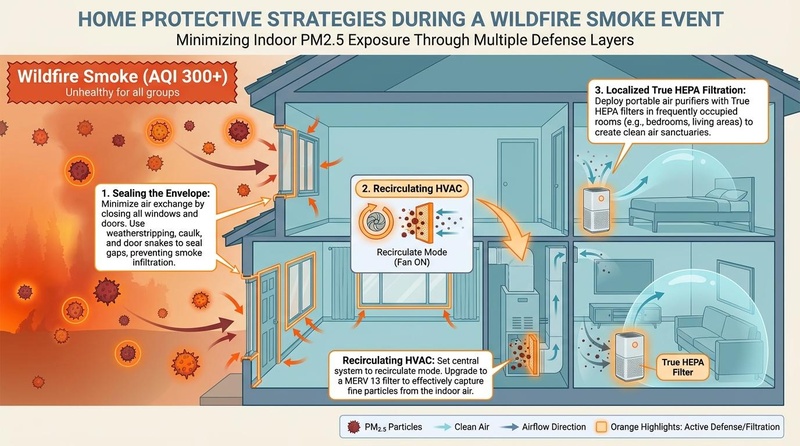
- What to do next: Create a "Clean Air Sanctuary" inside your home, seal all doors and windows, set your central HVAC to continuous recirculate mode with a MERV 13 filter, and deploy portable True HEPA air purifiers in occupied rooms.
¶ Quick Answer
Wildfire smoke is a complex, toxic cocktail of fine particulate matter (PM2.5), carbon monoxide, volatile organic compounds (VOCs), and nitrogen oxides. The physical size of wildfire PM2.5 allows it to penetrate the deepest lung structures, cross the blood-air barrier, and enter the systemic circulation [3]. Global epidemiological data demonstrates that short-term spikes in PM2.5 during smoke events directly correlate with rapid increases in cardiovascular and respiratory mortality [[1:2]]. To survive a smoke event, you must implement a multi-layered barrier strategy: completely seal the building envelope, operate central HVAC systems strictly in recirculate mode with a MERV 13 filter, and run True HEPA purifiers continuously in active living spaces, creating a safe, localized clean air sanctuary.
¶ What It Is
Wildfire smoke is produced by the incomplete combustion of biomass (trees, brush, peat) and, during urban interface fires, building structures and synthetic materials. This generates a dense, highly toxic aerosol characterized by a high concentration of PM2.5 (fine particles ≤2.5 micrometers) and PM0.1 (ultra-fine particles).
¶ Pathophysiology of Wildfire Smoke Inhalation
When wildfire smoke is inhaled, it triggers a cascade of local and systemic pathological events:
- Alveolar Penetration: PM2.5 and PM0.1 particles bypass the filtration mechanisms of the upper airway. They settle in the terminal alveoli, where they are engulfed by alveolar macrophages.
- Ribotoxic Stress and Oxidative Damage: The chemical composition of wildfire smoke (rich in polycyclic aromatic hydrocarbons [PAHs] and transition metals) inhibits mitochondrial function, producing massive bursts of reactive oxygen species (ROS) [2:1]. This overwhelms cellular antioxidant pathways and causes direct oxidative damage to lipids, proteins, and nuclear DNA.
- Systemic Inflammatory Response: Alveolar cells release pro-inflammatory cytokines (such as IL-6, TNF-alpha, and IL-1beta) into the bloodstream. This systemic inflammatory storm increases vascular permeability and activates endothelial tissue.
- Blood Hypercoagulability: The systemic inflammatory response activates platelets and the coagulation cascade, increasing blood viscosity and promoting the development of arterial thrombi (blood clots).
- Autonomic Nervous System Imbalance: Inhaled particulates stimulate sensory receptors in the lungs, triggering a reflex response that increases sympathetic nervous system tone and decreases vagal (parasympathetic) tone. This autonomic shift elevates blood pressure, increases heart rate, and decreases heart rate variability (HRV), predisposing the heart to dangerous arrhythmias and myocardial infarction [[1:3]].
¶ Does It Work? (Evidence Snapshot)
Epidemiological cohorts and clinical intervention trials confirm the risks of smoke spikes and the efficacy of filtration.
| Outcome | Population | Exposure Spike | Quality of Evidence | Study Count & Type | Notes |
|---|---|---|---|---|---|
| Cardiovascular Mortality | General Population | ↑10 µg/m³ PM2.5 (24-hour) | High | Multi-center global time-series [[1:4]] | Acute spikes directly increase risk of heart attack, stroke, and arrhythmia. |
| All-Cause Mortality | General Population | Long-term PM2.5 exposure | High | Systematic review & Meta-analysis [[4]][[5]] | Long-term exposure is a primary modifiable risk factor for premature mortality. |
| Indoor PM2.5 Reduction | Homes during wildfire events | Deploying True HEPA purifiers | High | Field prospective trials [[6]] | HEPA filtration reduces indoor smoke particulates by 50% to 80% even in older homes. |
| Respiratory ER Visits | Children and Asthmatics | Smoke plume exposure | High | Large-scale epidemiological cohorts | Strong correlation between smoke days and acute asthma hospitalizations. |
| Autonomic Restoration | Healthy and at-risk adults | HEPA air purifiers | Moderate | Randomized crossover trials [[7]] | Active filtration restores heart rate variability (HRV) and lowers systemic inflammatory markers. |
¶ Who Benefits Most / Least
Benefits Most:
- Individuals with Coronary Artery Disease: Highly vulnerable to smoke-induced blood hypercoagulability and autonomic imbalances. Smoke events can trigger plaque rupture, leading to myocardial infarction.
- Asthmatics and COPD Patients: Inhaling smoke particulates causes immediate bronchoconstriction and airway inflammation, necessitating aggressive preventative filtration.
- Pregnant Women & Developing Fetuses: Wildfire smoke PM2.5 can cross the placental barrier, driving maternal oxidative stress and significantly increasing the risk of low birth weight and preterm birth.
- The Elderly (Ages 65+): Experience the highest absolute increases in cardiopulmonary hospitalizations during smoke events.
Benefits Least:
- Young, Highly Fit, Immuno-competent Adults: While they still suffer cellular-level oxidative stress and transient decreases in athletic performance during smoke events, they possess greater physiological reserve and are at very low risk of acute life-threatening cardiac events.
¶ How to Try It (Actionable Protocols)
¶ Starter Protocol: The "Sealed Home" Emergency Plan
When local outdoor AQI crosses 100 (or PM2.5 exceeds 35 µg/m³):
- Close All Portals: Seal all windows, doors, and fireplace flues. Use temporary painter's tape or weatherstripping to seal significant drafts around window frames and door sweeps.
- Configure HVAC to Recirculate:
- Set your central heating/cooling system thermostat to "Recirculate" or "Fan ON" rather than "Auto." This ensures continuous, active filtration.
- Do NOT set the system to draw fresh air from the outside.
- Deploy Standalone Purifiers: Turn all portable HEPA purifiers in the house to "Medium" or "High" speed. Prioritize bedrooms and living rooms.
¶ Standard Protocol: Creating a "Clean Air Sanctuary"
If your house is older or difficult to seal entirely, concentrate your resources on a single, highly optimized room (typically the master bedroom).
- Isolate the Room: Close the bedroom door and seal the gap at the bottom with a door snake or rolled-up towel. Keep windows tightly shut and taped.
- Over-size the Purifier: Deploy an air purifier with a CADR rating rated for double the room's actual square footage. This creates a high Air Changes Per Hour (ACH) rate, ensuring rapid clearance of any smoke that infiltrates when entering or exiting the room.
- Run Continuously: Keep the purifier running on its highest tolerable setting 24/7.
- Avoid Air Polluting Activities: Do not burn candles, vacuum, toast bread, or cook with gas stoves within the sanctuary, as these activities generate secondary PM2.5.
¶ Advanced Protocol: HVAC MERV 13 and Over-pressure Systems
For homeowners seeking the highest level of permanent protection:
- Upgrade to MERV 13 or 14: Upgrade your central HVAC system filter to a deep-pleated (4-inch thick) MERV 13 or 14 filter.
- Continuous Pressure Equalization:
- If you have a balanced mechanical ventilation system (ERV/HRV), ensure it is equipped with an inline HEPA filtration module on the incoming fresh-air duct.
- This allows the system to continue bringing in fresh oxygen, keeping carbon dioxide () low, while stripping 99.9% of the wildfire particulates out of the stream.
- This also creates a slight positive pressure inside the home, which physically pushes air out through gaps in the walls, preventing dirty outdoor smoke from infiltrating.
¶ Outdoor Survival Protocol: Personal Protection
If you must go outdoors during a wildfire smoke event (AQI 150+):
- Wear a Certified Respirator: Wear a tightly fitted N95, N99, or P100 respirator mask.
- Standard surgical masks, paper dust masks, bandanas, and cloth face coverings are completely useless against wildfire smoke; they have loose seals and cannot capture microscopic PM2.5 particles.
- Ensure a Perfect Seal: The respirator must seal tightly around your nose, cheeks, and chin. Men should shave facial hair, as stubble prevents a proper seal, allowing smoke to bypass the filter media.
- Set Vehicle HVAC to Recirculate: When driving, keep windows closed and set the vehicle's climate control strictly to recirculate mode to prevent drawing thick smoke into the cabin.
¶ Safety, Interactions, Red Flags
¶ Safety Warnings (Indoor Carbon Dioxide Buildup)
- The Trade-off: Keeping a home completely sealed for several days during a smoke event prevents PM2.5 infiltration, but causes a rapid accumulation of carbon dioxide () from human respiration.
- Mitigation: Use an NDIR monitor. If indoor crosses 1,200 ppm, and outdoor smoke is still severe, do not open windows. Instead, temporarily turn on your ducted kitchen range hood or bathroom exhaust fans for 15 minutes. This will depressurize the house, drawing air through the walls (which acts as a crude filter to trap some particulates) while exhausting high- air outdoors.
¶ Stop Criteria & Medical Red Flags
- Chest Pain, Shortness of Breath, or Palpitations: If you or anyone in your household experiences chest tightness, radiating pain down the arm, severe shortness of breath, or a racing heartbeat during a smoke event, seek immediate emergency medical evaluation.
- Uncontrollable Wheezing: If rescue inhalers fail to resolve an acute asthma flare-up, escalate immediately to emergency clinical care.
¶ Tracking & What "Good" Looks Like
¶ Objective Indicators
- Indoor PM2.5 target: Consistently maintained below 9 µg/m³ (complying with the 2024 US EPA standard) [[8]], and ideally under 5 µg/m³ even when outdoor levels are >150 µg/m³.
- Oxygen Saturation (): Maintain normal baseline levels (95–100%) as measured by a pulse oximeter.
- Heart Rate Variability (HRV): Watch for sudden, unexplained drops in HRV (as measured by wearables like Oura, Whoop, or Apple Watch), which can indicate autonomic stress from smoke inhalation [[7:1]].
¶ Subjective Gains
- Absence of a smoky smell, visible haze, or "scratchy" throat inside the home.
- Nocturnal sleep efficiency remains stable despite extreme outdoor air pollution [[7:2]].
¶ Common Mistakes & Myths
- Myth: "Standard surgical masks or cloth bandanas protect me from smoke."
- Reality: Wildfire PM2.5 is far too small to be captured by these loose-fitting materials. Microscopic particles pass directly through the fibers and around the open sides of the mask. Only a certified, tightly sealed N95 or P100 respirator is effective.
- Mistake: Running a "Ductless" Recirculating range hood or AC window unit thinking it filters outdoor air.
- Reality: These devices do not introduce fresh air or filter smoke; they merely recirculate indoor air. Window AC units can actually draw outdoor smoke inside through gaps around the window frame if they are not sealed properly.
- Mistake: Vacuuming during a smoke event.
- Reality: Unless you are using a high-end vacuum equipped with a certified, sealed HEPA filter, vacuuming will kick up settled ash and PM2.5 from carpets back into the breathing zone, making indoor air significantly worse.
¶ Decision Tree (Text-Based)
                       Is outdoor AQI > 150?
                                 |
            -------------------------------------------
           |                                           |
    Inside the home?                            Must go outdoors?
           |                                           |
    --------------------------               -----------------------
   |                          |             |                       |
Seal all windows/doors;     Is indoor CO2   Wear a tightly sealed   Set car climate
run central HVAC on         >1,200 ppm?     N95/P100 respirator;    control to "Max
recirculate with MERV 13;       |           avoid strenuous         Recirculate" and
continuous HEPA purifiers       |           physical exercise       keep windows shut
                                |
             ---------------------------------------
            |                                       |
    No, CO2 is fine.                        Yes, CO2 is elevated.
    Keep house sealed.                      Run bathroom/kitchen fans
    Continue HEPA filtration.               briefly to exchange air
                                            through wall/insulation.
¶ FAQs
¶ What is the difference between an N95 and a P100 mask for wildfire smoke?
An N95 respirator filters at least 95% of airborne particles but is not resistant to oils. A P100 respirator filters at least 99.97% of particles and is highly oil-proof. While N95 is sufficient for general smoke events, P100 masks provide a superior seal (often made of elastomer rubber) and higher filtration efficiency.
¶ Does wildfire smoke contain heavy metals?
Yes. When wildfires burn through industrial sites, old buildings, or soils with historical agricultural chemical deposits, the smoke can carry toxic heavy metals like lead, arsenic, and cadmium, along with highly toxic dioxins and plasticizers, making it significantly more toxic than pure forest fire smoke.
¶ Why do my eyes burn during a smoke event, and what can I do?
Wildfire smoke is rich in gaseous formaldehyde, acrolein, and acids that dissolve in the tear film of the eye, causing immediate chemical conjunctivitis (burning, redness, watering). To mitigate this, wear protective glasses, use preservative-free lubricating eye drops, and stay within a HEPA-filtered clean air sanctuary.
¶ Glossary
- Alveoli: The microscopic air sacs in the lungs where oxygen and carbon dioxide are exchanged.
- AQI (Air Quality Index): A standardized, color-coded scale used by public health agencies to communicate daily air pollution levels and health risks.
- Heart Rate Variability (HRV): The variation in time between consecutive heartbeats, used as an indicator of autonomic nervous system balance.
- PM0.1: Ultra-fine particulate matter with an aerodynamic diameter of less than 0.1 micrometers.
- Respirator: A personal protective device that fits tightly over the face and filters out airborne particulates and/or toxic gases.
¶ Methods (Transparency)
This emergency preparedness deep dive was constructed by synthesizing clinical cardiovascular and respiratory guidelines from the American Heart Association (AHA), the American College of Cardiology (ACC), and environmental toxicology data from the EPA. Evidence was prioritized from global time-series trials measuring the cardiac impacts of acute PM2.5 spikes and randomized trials evaluating the protective effects of HEPA filtration during smoke events.
¶ References
¶ Update Log
- 2026-07-06: Initial publication of comprehensive Wildfire Smoke deep dive, incorporating short-term cardiopulmonary mortality models, emergency sealed-home protocols, and proper N95/P100 respirator specifications.
Song, S., et al. (2025). Short-Term PM2.5 Exposure and Cardiovascular Mortality: A Global Exposure-Response Analysis to Inform Alert Thresholds. Journal of the American College of Cardiology. https://www.jacc.org/doi/10.1016/j.jacc.2025.11.055 ↩︎ ↩︎ ↩︎ ↩︎ ↩︎
Wang, X., et al. (2020). Urban PM2.5 Induces Cellular Toxicity, Hormone Dysregulation, Oxidative Damage, Inflammation, and Mitochondrial Interference in the HRT8 Trophoblast Cell Line. Frontiers in Endocrinology, 11, 75. https://www.frontiersin.org/journals/endocrinology/articles/10.3389/fendo.2020.00075/full ↩︎ ↩︎
California Air Resources Board. (2024). Inhalable Particulate Matter and Health (PM2.5 and PM10). Retrieved from https://ww2.arb.ca.gov/resources/inhalable-particulate-matter-and-health ↩︎
Orellano, P., et al. (2024). Long-Term Exposure to Particulate Matter and Mortality: An Update of the WHO Global Air Quality Guidelines Systematic Review and Meta-Analysis. International Journal of Public Health. https://www.ssph-journal.org/journals/international-journal-of-public-health/articles/10.3389/ijph.2024.1607683/full ↩︎
Orellano, P., et al. (2024). The effect of long-term PM2.5 exposure on all-cause mortality estimated using meta-regression: a meta-analysis of concentration–response by air pollution exposure assessment method. Air Quality, Atmosphere & Health. https://link.springer.com/article/10.1007/s11869-026-01936-3 ↩︎
Cheong, J. P., et al. (2023). Real-World Effectiveness of Portable Air Cleaners in Reducing Home Particulate Matter Concentrations. Aerosol and Air Quality Research, 23(8), 220202. https://aaqr.org/articles/aaqr-23-08-oa-0202 ↩︎
Martinez-Ales, G., et al. (2023). Associations of bedroom PM2.5, CO2, temperature, humidity, and noise with sleep: An observational actigraphy study. Sleep Health. https://pubmed.ncbi.nlm.nih.gov/37076419/ ↩︎ ↩︎ ↩︎
U.S. Environmental Protection Agency. (2024, March 6). Reconsideration of the National Ambient Air Quality Standards for Particulate Matter; Final Rule. Federal Register. https://www.federalregister.gov/documents/2024/03/06/2024-02637/reconsideration-of-the-national-ambient-air-quality-standards-for-particulate-matter ↩︎