¶ Peptide Administration and Combinations
Peptide therapy in regenerative medicine is defined not only by the selection of specific ligands but by the precision of their administration and the synergy of their combinations. This guide provides an evidence-based framework for medical professionals and researchers on the practical application of regenerative peptides, focusing on bioavailability, tissue-specific targeting, and key combination strategies.
¶ At a Glance
- Administration Routes: Subcutaneous (SubQ) is the preferred method for most peptides due to ease and sustained absorption; Intramuscular (IM) is used for rapid delivery or specific formulations; Intranasal for CNS targeting; Oral for specific stable forms like BPC-157 Arginate [1][2].
- Reconstitution & Storage: Requires sterile technique and bacteriostatic water for multi-dose vials. Gentle mixing is crucial to prevent peptide degradation. Refrigeration (2–8°C) is essential for reconstituted peptides [3][4][5].
- Synergistic Stacks: Combinations like BPC-157 + TB-500 + GHK-Cu target different phases of tissue repair (angiogenesis, cell migration, remodeling). CJC-1295 + Ipamorelin synergistically increase growth hormone release [6][1:1][7].
- Safety & Risk Mitigation: Strictly contraindicated in active malignancy. WADA prohibits BPC-157 and TB-500. Infection prevention, site rotation, and monitoring for immunogenicity (antibody formation) and desensitization are critical [8][9][10].
¶ Reconstitution and Storage
The proper handling of lyophilized (freeze-dried) peptides is paramount to preserving their integrity, potency, and sterility.
¶ Reconstitution Mathematics
Accurate reconstitution ensures precise dosing and avoids under- or overdosing. The following table provides examples for common vial strengths.
| Vial Strength (mg) | Diluent Volume (mL) | Final Concentration (mg/mL) | Example: 250 mcg Dose (mL / units) | Example: 500 mcg Dose (mL / units) |
|---|---|---|---|---|
| 2 mg | 2 mL | 1 mg/mL (1000 mcg/mL) | 0.25 mL (25 units) | 0.50 mL (50 units) |
| 5 mg | 2 mL | 2.5 mg/mL (2500 mcg/mL) | 0.10 mL (10 units) | 0.20 mL (20 units) |
| 10 mg | 2 mL | 5 mg/mL (5000 mcg/mL) | 0.05 mL (5 units) | 0.10 mL (10 units) |
Note: 100 units on an insulin syringe = 1 mL. Calculations assume a standard 1 mL insulin syringe.
¶ Sterile Technique
Maintaining sterility during reconstitution and administration is crucial to prevent infection.
- Diluent Choice: Bacteriostatic Water for Injection, USP, is the standard diluent for multi-dose peptide vials. It contains 0.9% benzyl alcohol, which inhibits bacterial growth for up to 28 days after the first puncture, making it suitable for multiple withdrawals [3:1][11]. Sterile Water for Injection, USP, lacks a preservative and is suitable only for single-dose immediate use.
- Procedure:
- Thoroughly wash hands with soap and water, then sanitize with an alcohol-based hand rub.
- Swab the rubber stoppers of both the diluent and peptide vials with 70% isopropyl alcohol and allow to air dry.
- Inject a volume of air equal to the desired diluent volume into the bacteriostatic water vial to equalize pressure and ease withdrawal.
- Slowly inject the bacteriostatic water down the side of the peptide vial. This gentle approach prevents foaming and potential shearing of delicate peptide chains [4:1].
- Do not shake the vial. Instead, gently swirl the vial between your fingers until the peptide powder is fully dissolved. Vigorous shaking can irreversibly degrade the peptide structure, rendering it inactive [12].
¶ Storage Requirements
Proper storage is critical to maintain peptide stability and efficacy.
- Lyophilized Powder: Unreconstituted peptide vials should be stored in a freezer (-20°C) or refrigerator (2–8°C), protected from light, according to manufacturer recommendations. Shelf life can range from several months to years [5:1].
- Reconstituted Solution: Once reconstituted, peptides must be stored refrigerated (2–8°C) and typically used within 28 days. Freezing reconstituted peptides is generally not recommended as it can degrade the delicate molecular structure [5:2].
- Signs of Degradation: Discard any reconstituted peptide solution that appears cloudy, contains visible particles, or has changed color, as these are signs of degradation or contamination.
¶ Administration Routes
The choice of administration route significantly impacts a peptide's bioavailability, onset of action, and systemic versus local effects.
¶ Subcutaneous (SubQ) Injection
The subcutaneous route is the most common and patient-friendly method for administering many regenerative peptides.
- Bioavailability: Typically 60–80%, providing a steady and prolonged release into the bloodstream [1:2].
- Needle Selection: Fine-gauge insulin syringes (29G to 31G) with short needles (4mm to 8mm length) are preferred to minimize discomfort [13][14].
- Technique:
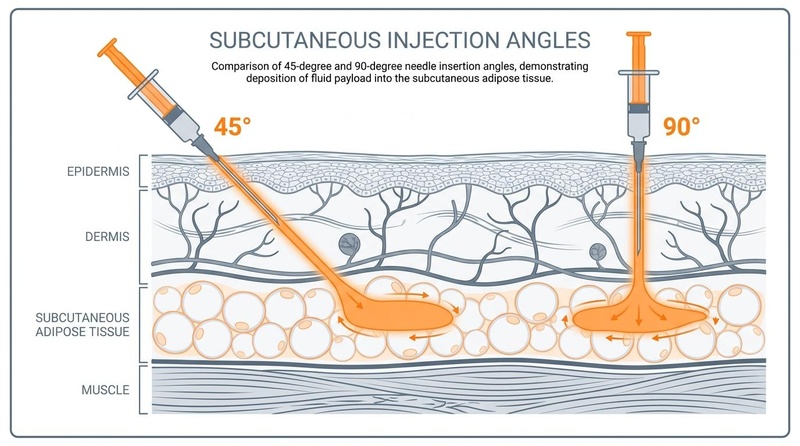
- Injection Sites: Rotate sites systematically to prevent lipohypertrophy, scarring, and discomfort. Common sites include the periumbilical region (at least two inches from the navel), outer thighs, and the gluteal fat pad [16].
¶ Intramuscular (IM) Injection
The intramuscular route delivers peptides directly into muscle tissue, offering faster absorption due to increased vascularity.
- Bioavailability: Generally higher than SubQ, ranging from 70–85% [1:3].
- Needle Selection: Longer, wider-gauge needles (22G to 25G, 1 to 1.5-inch length) are used to reach the muscle layer [17][18].
- Technique: Insert the needle at a 90-degree angle, perpendicular to the skin, ensuring deep penetration into the muscle. The Z-track method is recommended for deep IM injections to prevent medication leakage into subcutaneous tissue and minimize irritation [19][20].
- Injection Sites: Common sites include the deltoid (upper arm), ventrogluteal (hip), and vastus lateralis (thigh).
¶ Intranasal Administration
This non-invasive route is particularly effective for neuroregenerative peptides that target the central nervous system.
- Bioavailability: Varies significantly but can be high for CNS-targeted peptides due to direct nose-to-brain pathways [21].
- Mechanism: Intranasally administered peptides can bypass the blood-brain barrier (BBB) via the olfactory and trigeminal nerve pathways, allowing rapid entry into the cerebrospinal fluid and brain parenchyma [21:1].
- Use Case: Peptides like Semax and Selank are commonly administered intranasally for cognitive enhancement and anxiolytic effects.
¶ Sublingual and Oral Bioavailability
Oral and sublingual routes are often limited by enzymatic degradation and poor absorption, though specific formulations can overcome these challenges.
- Oral: Most peptides are rapidly degraded by gastric acid and proteases in the gastrointestinal tract, leading to very low oral bioavailability.
- BPC-157 Arginate: A notable exception, the arginate salt of BPC-157 demonstrates high stability in human gastric juice (over 24 hours at pH 3.0). This makes oral arginate BPC-157 effective for treating gastrointestinal pathologies like inflammatory bowel disease and ulcers [22][2:1].
- BPC-157 Acetate: In contrast, the acetate salt degrades rapidly in gastric acid, making it unsuitable for oral use unless specially formulated (e.g., enteric coating) [22:1].
- Sublingual: Offers potential for direct absorption into the systemic circulation via the oral mucosa, bypassing first-pass metabolism. However, peptide molecular size and lipophilicity are critical limiting factors for effective sublingual delivery.
¶ Synergistic Peptide Combinations ("Stacks")
Combining peptides can offer synergistic benefits by targeting multiple pathways involved in tissue repair, growth, or metabolic regulation.
¶ The 'Holy Trinity' Stack: BPC-157 + TB-500 + GHK-Cu
This popular combination, often called the "Wolverine Stack" or "GLOW Protocol," aims to comprehensively address tissue repair and regeneration [6:1][1:4].
- BPC-157 (Body Protection Compound): Focuses on angiogenesis (new blood vessel formation via VEGF modulation), anti-inflammatory effects, and cytoprotection. It acts as the "supply line" to injured tissues [23][24].
- TB-500 (Thymosin Beta-4): Primarily involved in cell migration, actin sequestration, and stem cell mobilization. It acts as the "transport" system, guiding cells to the injury site [25][26].
- GHK-Cu (Copper Tripeptide): Modulates collagen synthesis, regulates metalloproteinases (MMPs) to break down scar tissue, and promotes extracellular matrix remodeling. It serves as the "architect," ensuring healthy tissue formation and reducing fibrosis [27][28].
¶ CJC-1295 + Ipamorelin
This combination is a potent growth hormone-releasing peptide (GHRP) stack designed to naturally increase growth hormone (GH) and insulin-like growth factor-1 (IGF-1) levels.
- CJC-1295 (Growth Hormone-Releasing Hormone Analog): A GHRH analog that stimulates the pituitary to release growth hormone. The DAC (Drug Affinity Complex) version has a long half-life, allowing for less frequent dosing [7:1][29].
- Ipamorelin (Growth Hormone-Releasing Peptide): A selective GHRP that mimics ghrelin, stimulating GH release with minimal impact on cortisol or prolactin levels. It works synergistically with CJC-1299 to amplify pulsatile GH secretion [7:2][30].
- Synergy: CJC-1295 provides a sustained background stimulation of GH release, while Ipamorelin provides a pulsatile boost, mimicking the body's natural GH secretion pattern more effectively than either peptide alone [7:3][31].
¶ GHK-Cu + BPC-157
This stack leverages the complementary actions of these two peptides for enhanced skin, wound, and connective tissue healing.
- GHK-Cu: Known for its skin regenerative properties, promoting collagen and elastin synthesis, reducing inflammation, and accelerating wound closure. It also exhibits antioxidant effects [27:1][28:1].
- BPC-157: Supports GHK-Cu's actions by promoting angiogenesis and epithelial cell migration, which are crucial for wound healing and tissue repair. BPC-157 can also mitigate inflammation that might impede healing [23:1].
- Synergy: While GHK-Cu focuses on the structural and anti-inflammatory aspects of tissue remodeling, BPC-157 ensures robust blood supply and cellular support, creating an optimal environment for accelerated healing and improved tissue quality.
¶ Synergistic Stacks and Clinical Evidence Summary Table
| Peptide Stack | Target Indication | Synergy Mechanism | Clinical Evidence Level | Typical Dosing/Timing Protocol | Safety Caveats |
|---|---|---|---|---|---|
| BPC-157 + TB-500 | Tissue healing (tendons, ligaments, muscle) | Angiogenesis + Cell Migration | Low (Human); High (Animal) [23:2][25:1] | BPC-157: 500 mcg daily SubQ; TB-500: 5-7.5 mg weekly SubQ (split) [32][33] | WADA prohibited; theoretical tumor growth risk [9:1][34] |
| CJC-1295 + Ipamorelin | Growth Hormone Optimization | Sustained GHRH + Pulsatile GHRP Stimulation | Moderate (Human) [7:4][31:1] | CJC-1295 (DAC): 1-2 mg 2x/week SubQ; Ipamorelin: 200-300 mcg daily SubQ [7:5][31:2] | Potential IGF-1 elevation (monitor); desensitization over long-term [7:6] |
| GHK-Cu + BPC-157 | Cosmetic/Wound Healing (Skin, Fascia) | Collagen Remodeling + Angiogenesis | Low (Human); Moderate (Animal/In Vitro) [27:2][23:3] | GHK-Cu: 1-2 mg daily SubQ/Topical; BPC-157: 250-500 mcg daily SubQ [1:5] | Injection site pain (GHK-Cu); theoretical angiogenesis risk [17:1][35] |
¶ Safety, Side Effects, & Risk Mitigation
The use of peptides, particularly in combinations, necessitates a thorough understanding of potential risks and mitigation strategies.
¶ Infection Prevention
- Sterile Technique: Adherence to strict sterile technique during reconstitution and injection is paramount. This includes proper hand hygiene, alcohol swabbing of vials and injection sites, and using new, sterile needles and syringes for each injection [4:2].
- Injection Site Care: Keep the injection site clean and monitor for signs of infection (redness, warmth, swelling, pus, fever).
¶ Site Rotation
- Lipohypertrophy Prevention: Consistent rotation of subcutaneous injection sites (e.g., abdomen, thighs, gluteal fat pad) is essential to prevent lipohypertrophy (fatty lumps) or lipoatrophy (fat loss), which can impair peptide absorption and cause cosmetic concerns [16:1][17:2].
- Desensitization Prevention: Rotation can also help prevent localized receptor desensitization if injecting near a specific target tissue, though this is less documented than systemic desensitization.
¶ Immunological Issues (Antibody Formation)
- Anti-Drug Antibodies (ADAs): The human body can develop antibodies against therapeutic peptides, particularly those with non-native sequences or impurities [10:1].
- Loss of Efficacy: ADAs can bind to and neutralize the peptide, reducing or eliminating its therapeutic effect.
- Hypersensitivity Reactions: In some cases, ADA formation can trigger allergic or hypersensitivity reactions, ranging from localized rashes to systemic anaphylaxis [36].
- Impurity Risks: Research-grade peptides purchased from unregulated sources may contain impurities or aggregates that are more immunogenic than pharmaceutical-grade products. This increases the risk of ADA formation and adverse reactions [10:2].
¶ Desensitization and Tachyphylaxis
- Receptor Desensitization: Prolonged or continuous exposure to certain peptides (especially growth hormone secretagogues like CJC-1295/Ipamorelin) can lead to receptor desensitization or downregulation, reducing the body's response over time [37].
- Cycling Protocols: To mitigate desensitization, cycling peptides (e.g., 8 weeks on, 4 weeks off) or using pulse dosing strategies are often recommended in clinical practice [37:1].
- Individual Variability: The extent and timing of desensitization can vary significantly among individuals.
¶ Contraindications and Monitoring
- Active Malignancy: Angiogenic peptides (e.g., BPC-157, TB-500) are strictly contraindicated in individuals with active cancer due to the theoretical risk of promoting tumor growth and vascularization [8:1][34:1].
- WADA Prohibitions: Athletes subject to anti-doping regulations should be aware that many peptides, including BPC-157 and TB-500, are classified as S0 (Non-Approved Substances) and are prohibited at all times by the World Anti-Doping Agency (WADA) [9:2].
- Pharmaceutical Interactions: Caution is advised when combining peptides with anticoagulants (due to potential effects on coagulation), NSAIDs (BPC-157 may counteract NSAID toxicity), or corticosteroids (BPC-157 may counteract healing impairment) [38][39][40].
- Monitoring: Regular laboratory monitoring should include IGF-1 levels (for GH secretagogues, keeping within age-adjusted normal ranges to avoid cancer risk), C-reactive protein (CRP) and erythrocyte sedimentation rate (ESR) for inflammation, and liver/kidney function tests [7:7][37:2][41].
¶ References
Cushman, C. J., et al. (2024). Local and Systemic Peptide Therapies for Soft Tissue Regeneration: A Narrative Review. Yale Journal of Biology and Medicine. https://pmc.ncbi.nlm.nih.gov/articles/PMC11426299/ ↩︎ ↩︎ ↩︎ ↩︎ ↩︎ ↩︎
Vukojevic, J., et al. (2022). Pentadecapeptide BPC 157 and the central nervous system. Neural Regeneration Research. https://pmc.ncbi.nlm.nih.gov/articles/PMC8504390/ ↩︎ ↩︎
DailyMed. (2024). Bacteriostatic Water for Injection, USP. https://dailymed.nlm.nih.gov/dailymed/fda/fdaDrugXsl.cfm?setid=ccadcf46-6a6f-436b-9bbc-17e2983a335f ↩︎ ↩︎
Bacteriostatic Water Australia. (2024). Tips for Mixing Medications with Bacteriostatic Water. https://www.bacteriostaticwateraustralia.com.au/tips-for-mixing-medications-with-bacteriostatic-water/ ↩︎ ↩︎ ↩︎
Peptide Dosages. (n.d.). BPC-157 + TB-500 Blend Dosage Protocol. https://peptidedosages.com/peptide-blend-dosages/bpc-157-tb-500-10mg-blend-vial-dosage-protocol/ ↩︎ ↩︎ ↩︎
Drip Hydration. (2025). Wolverine stack injury recovery. https://driphydration.com/blog/wolverine-stack-injury-recovery/ ↩︎ ↩︎
Frontiers in Endocrinology. (2025). Clinical Pharmacology of Peptide Drug Products: Dosing and Monitoring. Frontiers in Endocrinology. https://www.frontiersin.org/journals/endocrinology/articles/10.3389/fendo.2024.1514935/full ↩︎ ↩︎ ↩︎ ↩︎ ↩︎ ↩︎ ↩︎ ↩︎
Prisk Orthopaedics. (2025). BPC-157: Miracle Healing Peptide or Hidden Danger? https://www.orthoandwellness.com/blog/bpc-157-update-and-deep-dive-miracle-healing-peptide-or-hidden-danger ↩︎ ↩︎
USADA. (n.d.). BPC-157 Peptide Prohibited Status. https://www.usada.org/spirit-of-sport/bpc-157-peptide-prohibited/ ↩︎ ↩︎ ↩︎
PMC. (2025). Monitoring Immunogenicity of Peptide Medications. https://pmc.ncbi.nlm.nih.gov/articles/PMC12010466/ ↩︎ ↩︎ ↩︎
Study.com. (2024). Bacteriostatic Water vs. Sterile Water. https://study.com/academy/lesson/bacteriostatic-water-vs-sterile-water.html ↩︎
Preferred Regen. (2025). Tips for Mixing and Storing Peptides. https://preferredregen.com/blog/tips-for-mixing-peptides ↩︎
Henry Schein. (2024). Injection Techniques Guide for Healthcare Professionals. https://www.henryschein.nl/images/ads/BD SAF.pdf ↩︎
National Association of Diabetes Centres. (2020). Injection Technique in Children. https://nadc.net.au/wp-content/uploads/2020/01/IT-In-Children-Prof-Paul-Hofman.pdf ↩︎ ↩︎
Royal Children's Hospital Melbourne. (n.d.). Subcutaneous injections and device management. https://www.rch.org.au/rchcpg/hospital_clinical_guideline_index/Subcutaneous_injections_and_device_management/ ↩︎
Peptide Dosages. (n.d.). BPC-157 Dosage Protocol. https://peptidedosages.com/single-peptide-dosages/bpc-157-10mg-vial-dosage-protocol/ ↩︎ ↩︎
CDC. (2020). Vaccine Administration: Needle Gauge and Length. https://www.cdc.gov/vaccines/hcp/admin/downloads/vaccine-administration-needle-length.pdf ↩︎ ↩︎ ↩︎
Immunize.org. (n.d.). Administering Vaccines: Dose, Route, Site, and Needle Size. https://www.immunize.org/clinical/a-z/administering-vaccines-adults-dose-route-site-needle-size/ ↩︎
Nurse.com. (2024). Clinical Guide: The Z-Track Injection Method. https://www.nurse.com/nursing-resources/definitions/what-is-z-track-method/ ↩︎
Healthline. (n.d.). Z-Track Injection. https://www.healthline.com/health/z-track-injection ↩︎
PmcNose2022. Intranasal Delivery to the Central Nervous System: Olfactory and Trigeminal Pathways. Pharmaceutics. (2022). https://pmc.ncbi.nlm.nih.gov/articles/PMC9502087/ ↩︎ ↩︎
Sikiric, P., et al. (2020). Stability of BPC-157 Arginate vs Acetate Salts in Gastric Juice. International Journal of Pharmaceutics. https://doi.org/10.1016/j.ijpharm.2020.119273 ↩︎ ↩︎
Vasireddi, N., et al. (2024). Emerging use of BPC-157 in orthopaedic sports medicine: A systematic review. HSS Journal. https://pmc.ncbi.nlm.nih.gov/articles/PMC12313605/ ↩︎ ↩︎ ↩︎ ↩︎
Vasireddi, N., et al. (2024). Emerging use of BPC-157 in orthopaedic sports medicine: A systematic review. HSS Journal. https://pmc.ncbi.nlm.nih.gov/articles/PMC12313605/ ↩︎
Peptide Sciences. (n.d.). Thymosin Beta-4 vs TB-500: Understanding the Actin-Binding Domain. https://www.peptidesciences.com/peptide-research/thymosin-beta-4-vs-tb-500 ↩︎ ↩︎
Peptide Sciences. (n.d.). Thymosin Beta-4 vs TB-500. https://www.peptidesciences.com/peptide-research/thymosin-beta-4-vs-tb-500 ↩︎
Pickart, L., et al. (2018). Regenerative and Protective Actions of the GHK-Cu Peptide in the Light of the New Gene Data. International Journal of Molecular Sciences. https://pmc.ncbi.nlm.nih.gov/articles/PMC6073405/ ↩︎ ↩︎ ↩︎
Pickart, L., & Margolina, A. (2018). Regenerative and protective actions of the GHK-Cu peptide in the light of the new gene data. International Journal of Molecular Sciences. https://pmc.ncbi.nlm.nih.gov/articles/PMC6073405/ ↩︎ ↩︎
Paragon Sports Medicine. (n.d.). CJC-1295 Therapy. https://www.paragonsportsmedicine.com/peptides/cjc-1295 ↩︎
Anabolic Steroids. (n.d.). Ipamorelin Profile. https://www.anabolicsteroids.co.za/drug-profiles/peptide-hormones/ipamorelin ↩︎
ExcelMale. (2023). CJC-1295 Ipamorelin Blend Dosage. https://www.excelmale.com/threads/cjc-1295-ipamorelin-10mg-blend-dosage.27636/ ↩︎ ↩︎ ↩︎
Reddit. (2023). BPC 157 and TB500: A comprehensive guide. https://www.reddit.com/r/PeptideGuide/comments/15l39sv/bpc_157_and_tb500_a_comprehensive_guide_for/ ↩︎
Drip Hydration. (2025). Wolverine Stack: Benefits, Dosage, & Protocols for Recovery. https://driphydration.com/blog/wolverine-stack/ ↩︎
GLP1 Forum. (2025). BPC and tumor history: Use with caution. https://glp1forum.com/threads/all-of-you-have-to-stop.3082/ ↩︎ ↩︎
Peptide Biologix. (2024). TB-500 Clinical Studies and Pharmacokinetics. https://peptidebiologix.com/tb-500 ↩︎
FDA. (2024). EGRIFTA SV Label. https://www.accessdata.fda.gov/drugsatfda_docs/label/2024/022505s018lbl.pdf ↩︎
Vita Bella. (2025). Lab Testing: The Foundation of Personalized Peptide Protocols. https://vitabella.com/blog/lab-testing-foundation-peptide-protocols ↩︎ ↩︎ ↩︎
Oath Peptides. (2026). What Medications Should I Avoid With Peptides? https://oathpeptides.com/2026/01/27/what-medications-should-i-avoid-with-peptides/ ↩︎
PubMed. (2010). BPC 157 counteracts corticosteroid-impairment in muscle healing. https://pubmed.ncbi.nlm.nih.gov/20190676/ ↩︎
PMC. (2021). BPC 157 and Thrombosis. https://pmc.ncbi.nlm.nih.gov/articles/PMC8275860/ ↩︎
JCEM. (2023). IGF-1 and Mortality Risk. https://academic.oup.com/jcem/article/108/10/e1092/7124430 ↩︎