¶ Dihexa (PNB-0408)
| Sequence | N-hexanoic-Tyr-Ile-(6) aminohexanoic amide |
| Formula | C31H54N6O6 |
| Molar Mass | 590.8 g/mol |
| Category | Nootropic / Neurotrophic Peptide / HGF Mimetic |
| Half-life | ~12 days (terminal elimination) |
| Admin | Oral, Transdermal |
| FDA Status | Unapproved / Research Chemical |
Dihexa (N-hexanoic-Tyr-Ile-(6) aminohexanoic amide) is a synthetic oligopeptide derivative of Angiotensin IV (AngIV), engineered for its profound synaptogenic capabilities. It is primarily known for mimicking Hepatocyte Growth Factor (HGF) to activate the c-Met receptor, a pathway critical for neuronal growth and survival. While preclinical studies showcased its remarkable potency in repairing brain damage and restoring memory, its clinical development as a derivative (Fosgonimeton) has faced setbacks, and significant theoretical safety concerns regarding c-Met activation remain.
¶ At a glance
Aliases
- Also known as: PNB-0408
- Amino acid sequence: N-hexanoic-Tyr-Ile-(6) aminohexanoic amide
- Sequence length: Hexapeptide (modified)
- Category: Nootropic, Neurotrophic factor mimetic, HGF mimetic
Key points
- Synaptogenic Potency: Demonstrated in vitro and in animal models to induce dendritic spine formation at picomolar concentrations, cited as "seven orders of magnitude" more potent than BDNF for spinogenesis [1][2].
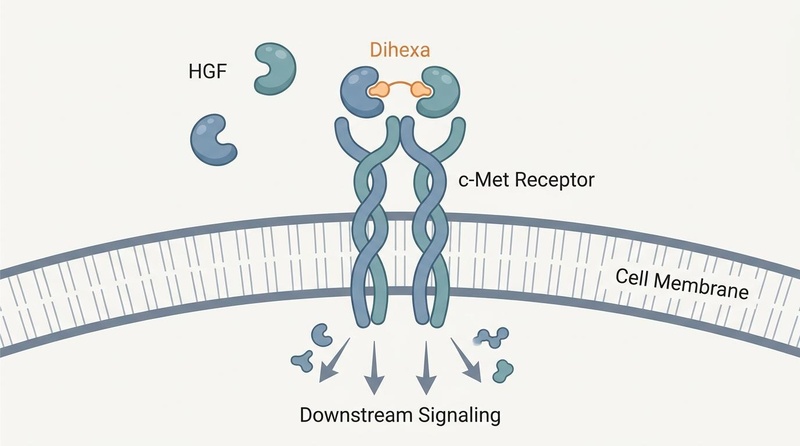
- Mechanism: Functions as an HGF mimetic, binding to HGF and facilitating its dimerization, which then activates the c-Met receptor tyrosine kinase to promote neuronal plasticity [3][4].
- Clinical Status: A derivative, Fosgonimeton (ATH-1017), failed its Phase 2/3 clinical trial (LIFT-AD) for mild-to-moderate Alzheimer's disease in September 2024, missing primary cognitive endpoints [5][6].
- Key Limitation & Safety: Dihexa is an unapproved research chemical. Its primary mechanism (c-Met activation) is theoretically linked to oncogenesis (tumor growth/metastasis) due to c-Met's role as a proto-oncogene [7][8]. There is no long-term human safety data.
- Pharmacokinetics: Exhibits an unusually long terminal elimination half-life of ~12 days in rats, indicating a high risk of bioaccumulation with daily dosing [9][10].
What people use it for
- Main goals: Cognitive enhancement, memory restoration, neuroprotection, and recovery from severe cognitive deficits.
- Evidence quality (overall):
Unclear (Unclear/Very low for human efficacy; High for mechanistic and animal data, but with significant safety caveats).
¶ Legal & regulatory status
⚠️ CRITICAL INFORMATION
Regulatory classification
- FDA status: Unapproved / Research Chemical Only. Dihexa is not approved for human use by the FDA or any major regulatory body. It is available only as a "research chemical," explicitly labeled "not for human consumption."
- Approved indications (if any): None.
- Prescription requirement: Not available for prescription.
- DEA schedule: Not scheduled.
Geographic legal status
- United States: Classified as a research chemical, making its sale for human consumption illegal.
- Other regions: Similar restrictions generally apply.
Sports and competition
- WADA status: Likely prohibited under section S0 (Non-Approved Substances) due to its unapproved status and potential for performance-enhancing effects via neurogenesis.
Source quality considerations
- The market for Dihexa is exclusively composed of "research chemical" suppliers. Purity, accurate dosing, and absence of contaminants are significant concerns due to lack of regulation and third-party testing [8:1]. Counterfeit products are also a risk.
¶ What is Dihexa?
Dihexa is a synthetic oligopeptide, specifically a hexapeptide analog of Angiotensin IV (AngIV), with a sequence that includes modifications for enhanced stability and bioavailability: N-hexanoic-Tyr-Ile-(6) aminohexanoic amide. It was developed by researchers at Washington State University as a potent neurogenic agent.
- Relationship to endogenous peptides: While structurally derived from AngIV, Dihexa's primary neurotrophic effects are mediated independently of the classical AT4 receptor system associated with AngIV's blood pressure regulatory roles. Instead, it acts as a functional mimetic of Hepatocyte Growth Factor (HGF) [4:1][11].
- Modifications from native sequence: The N-terminal hexanoic acid and C-terminal amidation were introduced to improve its metabolic stability, resistance to enzymatic degradation, and ability to cross the blood-brain barrier after oral administration [10:1][12].
- Development history: Dihexa was initially developed in the early 2010s. Its derivative, Fosgonimeton (ATH-1017), entered clinical trials for Alzheimer's disease through Athira Pharma, a company founded by its original inventors [5:1].
- Key pharmacological property: Dihexa's hallmark is its role as a selective HGF mimetic and c-Met receptor activator, promoting synaptogenesis and neuronal plasticity [3:1].
¶ What are Dihexa's main benefits?
Dihexa's reported benefits largely stem from its capacity to induce structural changes in the brain, leading to enhanced synaptic connectivity and neuroprotection.
¶ 1. Profound Synaptic Reconstruction
Dihexa's most recognized benefit is its ability to stimulate the formation of new synaptic connections (synaptogenesis) and enhance dendritic arborization, essentially building new "hardware" in the brain's circuitry [1:1][13].
- Outcome: Enhanced neuroplasticity, potentially leading to improved cognitive function.
- Direction of effect:
Large Improvement (Large increase, positive) in animal models for synaptogenesis. - Population studied: Primarily in vitro (dissociated hippocampal neurons) and various animal models (rats, APP/PS1 mice) of cognitive impairment and neurodegeneration [1:2][3:2][13:1].
- Evidence quality:
Unclear (High for mechanistic and preclinical data; Very low/Unclear for direct human clinical relevance). - Summary sentence: In preclinical models, Dihexa powerfully promotes the growth of new connections between neurons, demonstrating robust neurorestorative potential.
¶ 2. Memory Restoration and Cognitive Enhancement
In animal models, Dihexa has shown the capacity to reverse memory deficits and improve various aspects of cognitive function.
- Outcome: Restoration of spatial memory and improved learning ability.
- Direction of effect:
Medium Improvement (Moderate increase, positive) in animal models. - Population studied: Scopolamine-induced amnesiac rats and aged rats, where it restored spatial memory to levels comparable to young controls [1:3][10:2].
- Evidence quality:
Unclear (High for preclinical data; Very low/Unclear for human clinical relevance). - Summary sentence: Preclinical studies indicate that Dihexa can restore compromised memory and enhance learning in models of cognitive decline.
¶ 3. Oral Bioavailability and Blood-Brain Barrier Permeability
Unlike many peptides that require injectable routes, Dihexa was specifically engineered to be orally bioavailable and to readily cross the blood-brain barrier, offering a more accessible administration method [10:3][12:1].
- Outcome: Practical administration route for a peptide therapeutic targeting the CNS.
- Direction of effect:
Large Improvement (Large increase, positive) for therapeutic accessibility. - Population studied: Pharmacokinetic studies in rats and efficacy studies with oral administration in animal models [10:4][12:2].
- Evidence quality:
Unclear (High for preclinical pharmacokinetic data; Indirectly beneficial for human use). - Summary sentence: Dihexa's design allows it to be effective when taken orally, a significant advantage for central nervous system-targeted peptides.
¶ 4. Non-Stimulatory Cognitive Support
Users often report a "clean" enhancement of problem-solving and logical processing, distinct from the stimulating effects of traditional nootropics [14][15].
- Outcome: Improved executive function and mental clarity without jitters or crashes.
- Direction of effect:
Small Improvement (Small increase, positive) based on anecdotal reports. - Population studied: Anecdotal reports from biohacker communities [14:1][15:1].
- Evidence quality:
Unclear (Very low/Anecdotal). - Summary sentence: Anecdotal reports suggest Dihexa can provide a clear-headed cognitive boost, differentiating it from stimulant-based interventions.
¶ Evidence summary table (human outcomes)
| Outcome / Goal | Effect* | Consistency** | Evidence quality | Trials*** | Notes (population, duration, dose) |
|---|---|---|---|---|---|
| Alzheimer's Disease (Cognition) | High (for derivative) | High (Phase 2/3) | 1 RCT (LIFT-AD) | Fosgonimeton (derivative) failed primary cognitive endpoints in mild-to-moderate AD [5:2][6:1] | |
| Synaptic Density / Neurogenesis | High (animal) | Low (preclinical) | Multiple in vitro/animal studies | Robust induction of dendritic spines in models [1:4][13:2] | |
| Memory Restoration | High (animal) | Low (preclinical) | Multiple animal studies | Reversal of scopolamine-induced amnesia; improvement in aged rats [1:5][10:5] | |
| Neuroprotection | Moderate (animal) | Low (preclinical) | Animal studies | Protection against neurotoxins and ischemic injury in models [3:3] | |
| Oral Bioavailability | High (preclinical) | Low (preclinical) | Pharmacokinetic studies | Chemical modifications enable oral activity and BBB penetration [10:6][12:3] |
- *Effect: Number of arrows (1-3) indicates magnitude. Direction: ↑ (increase), ↓ (decrease), = (no effect), ? (unclear). Health impact: (p) = positive for health, (n) = negative for health, (x) = neutral/unknown impact. Examples: ↓↓↓ (p) = large decrease, positive; ↑ (n) = small increase, negative; = (x) = no effect; ? = unclear.
- IMPORTANT: If using the compact renderer encoding (<effect ...>), do NOT include the text arrows or parentheses next to it. Just use the tag.
- **Consistency: Low (results conflict), Moderate (mixed but leaning one way), High (most trials agree)
- ***Trials: Number of RCTs or total trials informing this outcome (shows evidence depth at a glance)
- REQUIRED: You MUST include a citation key (e.g.
[^1]) in the "Notes" column for every single row. If you claim a result, you must link the specific Meta-Analysis or Key RCT that proves it.
¶ How does Dihexa work?
Dihexa's mechanism of action is distinct and primarily centered on the Hepatocyte Growth Factor (HGF)/c-Met receptor axis, a critical pathway for cell growth, survival, and motility.
¶ Primary Targets and Core Mechanisms
Dihexa functions as a small-molecule mimetic of HGF. HGF is a powerful neurotrophic factor, but its therapeutic use is limited by instability. Dihexa overcomes this by facilitating the activation of its receptor.
- HGF Dimerization: Dihexa binds to HGF with high affinity (Kd = 65 pM) and induces its dimerization (formation of pairs) [3:4][4:2]. This dimerization is a prerequisite for HGF to effectively activate its receptor.
- c-Met Receptor Activation: The HGF-Dihexa complex then binds to and activates the c-Met receptor (a receptor tyrosine kinase) on the surface of neurons and other cells [3:5][4:3].
- Intracellular Signaling Cascade: Activation of c-Met triggers a cascade of downstream signaling pathways, notably the PI3K/AKT and ERK/MAPK pathways. These pathways are crucial for neuronal survival, proliferation, differentiation, and the growth of new synaptic connections (synaptogenesis) [3:6][13:3]. In models of Alzheimer's, Dihexa was observed to activate PI3K/AKT, reducing pro-inflammatory cytokines and increasing anti-inflammatory ones [13:4].
This mechanism provides a unique pathway for neurorestoration, distinct from other neurotrophic mimetics like BDNF or its analogs.
¶ Pharmacokinetics: The Accumulation Warning
Dihexa exhibits unusual pharmacokinetic properties, particularly concerning its stability and elimination, which have significant implications for dosing.
- Metabolic Stability: Dihexa is highly resistant to enzymatic breakdown. In vitro studies in rat liver microsomes and serum show a metabolic stability half-life of approximately 5.5 to 8.5 hours [9:1][12:4]. This is notably longer than many other peptides.
- Blood-Brain Barrier Permeability: The chemical modifications (N-terminal hexanoic acid and C-terminal amidation) enable Dihexa to effectively cross the blood-brain barrier after systemic administration, allowing it to exert its central nervous system effects [10:7][12:5].
- Terminal Elimination Half-Life: Animal studies (rats) have revealed a profoundly long terminal elimination half-life, ranging from 8.83 days (intraperitoneal) to 12.68 days (intravenous) [9:2][10:8]. This means that a significant portion of the compound can remain in the body for extended periods after administration.
- Major PK Issues: The extremely long terminal half-life suggests that Dihexa can accumulate substantially in tissues with repeated daily dosing. This bioaccumulation risk is a critical consideration for safety and can lead to unintended, supra-physiological concentrations if not managed with appropriate pulse dosing [8:2][9:3].
¶ Effects on different systems
¶ Brain & Mental Health (Cognition, Mood, Neuroprotection)
Dihexa's primary effects are on the central nervous system.
- Neurogenesis and Synaptogenesis: As detailed in the mechanism section, it promotes the growth of new neurons and synaptic connections, particularly in areas like the hippocampus, crucial for learning and memory [1:6][10:9].
- Memory Improvement: Preclinical studies consistently show reversal of memory deficits in models of neurodegeneration and aging [1:7][10:10].
- Mood Modulation: Anecdotal reports suggest a potential for emotional blunting or a "hyper-logical" state, which some users describe as a "robot effect" or social detachment. This is not clinically documented but warrants consideration [16][17].
¶ Administration, reconstitution, and storage
Dihexa is typically available as a lyophilized powder or in pre-dissolved solutions. Given its "research chemical" status, strict adherence to sterile technique and caution regarding sourcing is essential.
¶ Routes of administration
- Oral (Capsules/Solution): The most common route due to its engineered oral bioavailability. Often taken as a solution or in encapsulated form [8:3][14:2].
- Transdermal: Many users dissolve Dihexa in a solvent like DMSO for topical application, aiming for systemic absorption while bypassing first-pass metabolism. Dosing often parallels oral routes [18].
- Subcutaneous/Intramuscular Injection: Less common for Dihexa due to its oral activity, but theoretically possible. However, given its long half-life, this route would necessitate very infrequent dosing.
¶ Storage requirements
- Lyophilized (powder): Typically stable at room temperature for short periods, but long-term storage at -20°C (freezer) is recommended to maintain potency [8:4]. Protect from light.
- Reconstituted (solution): If dissolved, store in the refrigerator (2–8°C). Use within a few weeks, as peptides degrade in solution over time. Avoid freezing reconstituted solutions, as it can compromise peptide integrity.
- Light sensitivity: Store away from direct light.
¶ Handling and safety
- Sterile Technique: When reconstituting or preparing solutions, always use sterile bacteriostatic water and sterile syringes/vials to minimize the risk of bacterial contamination.
- Sharps Disposal: Dispose of needles and syringes safely in a designated sharps container.
- Signs of Degradation: Discard any solutions that appear cloudy, discolored, or contain particulate matter.
¶ Dosage and protocols
Due to its unapproved status, there are no officially established or FDA-approved dosage guidelines for Dihexa. Protocols are largely derived from preclinical animal studies and anecdotal user reports, which may not adequately account for human pharmacokinetics and long-term safety.
¶ Standard dosing (anecdotal/community-based)
- Typical dose range: 10–20 mg per day.
- Frequency: While many users dose daily, the extremely long terminal half-life (~12 days in rats) strongly suggests that daily dosing leads to significant bioaccumulation. More informed users advocate for pulse dosing to prevent this [8:5][9:4].
- Duration: Cycles often last 2–4 weeks, followed by an off-period of at least 4 weeks to allow for washout. Continuous daily use is highly discouraged due to accumulation risks [8:6][9:5].
¶ Critical Cycling (The Accumulation Risk)
Given Dihexa's terminal half-life of approximately 12 days, it takes about 5-6 half-lives (roughly 60-72 days) for the compound to be almost entirely eliminated from the body.
- Recommended Cycle: Pulse dosing (e.g., once weekly or every 10 days) or very short cycles (e.g., 2–4 weeks ON, followed by 2–3 months OFF) are theoretically safer to prevent significant bioaccumulation and potential toxicity [8:7][9:6].
- Rationale: This approach aims to allow the compound to clear the system, preventing levels from reaching excessively high or continuously active concentrations that might exacerbate theoretical c-Met-related risks.
¶ Special populations
- Contraindicated: Dihexa is generally contraindicated in pregnant or breastfeeding individuals, children, adolescents, and anyone with a history of cancer due to the theoretical risks associated with c-Met activation.
- Lack of Data: There is no clinical data on dose considerations for individuals with kidney or liver impairment, or older adults.
¶ Safety and side effects
The safety profile of Dihexa is not well-established in humans due to its status as a research chemical and the limited scope of preclinical safety studies. The primary concern revolves around its interaction with the c-Met receptor.
¶ Common side effects (anecdotal)
- Injection site reactions: Not typically reported for oral/transdermal routes, but would be a consideration for injections.
- Cognitive/Emotional Changes: "Emotional blunting," "robot effect," or feeling hyper-logical and socially detached has been reported by users [16:1][17:1]. This may be due to rapid structural changes in the brain affecting emotional circuits.
- Irritability: Some users report irritability, especially during off-cycles or with prolonged use [19].
- Headaches: Can occur, particularly at higher doses or during initial use [20].
¶ Less common / serious concerns
- Cancer Risk (c-Met Activation): This is the most significant theoretical safety concern [7:1][8:8].
- Mechanism: c-Met is a proto-oncogene; its aberrant activation or overexpression is implicated in the proliferation, survival, and metastasis of many cancers. While Dihexa's developers argue that activating c-Met alone may not initiate cancer (requiring multiple "hits" like oncogene activation plus tumor suppressor attenuation), there is a theoretical risk that it could accelerate the progression or metastasis of existing, undiagnosed micro-tumors by promoting cell motility and angiogenesis [7:2][8:9][21].
- Lack of Long-Term Data: No multi-year carcinogenicity studies (standard for drug development) have been conducted for Dihexa. The "short duration" safety studies cited in its patent are insufficient to definitively rule out long-term oncogenic risks [7:3][8:10][21:1].
- Bioaccumulation Toxicity: The extremely long terminal half-life poses a risk of drug accumulation to potentially toxic levels with daily dosing, leading to chronic c-Met activation that could have unforeseen consequences [9:7].
- Source Purity and Contamination: Unregulated research chemical sources may contain impurities, incorrect dosages, or harmful contaminants, posing direct health risks [8:11].
¶ Who should be especially cautious or avoid it
- Individuals with Active Cancer or History of Malignancy: Strictly contraindicated due to the theoretical risk of promoting tumor growth or metastasis via c-Met activation [7:4][8:12][21:2].
- Pregnant or Breastfeeding Individuals: No safety data; absolutely contraindicated.
- Children and Adolescents: No safety data; not for use in these populations.
- Individuals with Undiagnosed Medical Conditions: Especially those involving abnormal cell growth or proliferation.
- Athletes: Prohibited by WADA.
¶ Drug and supplement interactions
Information on drug and supplement interactions with Dihexa is scarce due to its lack of clinical study. Based on its mechanism, theoretical interactions can be inferred.
¶ Pharmacodynamic interactions (additive / opposing effects)
- Growth Factors/Neurotrophics: Combining with other agents that promote neurogenesis or growth factor signaling (e.g., BDNF mimetics, other HGF modulators) could theoretically lead to additive effects, potentially increasing both desired outcomes and off-target risks (e.g., excessive cell growth) [8:13].
- Chemotherapy/Anti-cancer Agents: Dihexa's c-Met activation mechanism could theoretically oppose the action of certain anti-cancer therapies that aim to inhibit c-Met or its downstream pathways. This makes its use alongside cancer treatments highly inadvisable.
¶ Monitoring recommendations
- No established guidelines: There are no clinical guidelines for monitoring Dihexa use.
- Theoretical considerations: If one were to use Dihexa, prudent (though unproven) monitoring might include regular comprehensive metabolic panels, complete blood counts, and potentially tumor markers or imaging if there's any pre-existing risk or new symptoms [8:14].
¶ Combining Dihexa with other peptides and supplements ("stacks")
Given the significant safety concerns and lack of human data for Dihexa alone, combining it with other substances is highly speculative and carries amplified, unknown risks.
¶ Common combinations (anecdotal)
- Nootropic Stacks: Users sometimes combine Dihexa with other nootropics like racetams, choline sources, or stimulants, seeking synergistic cognitive effects [15:2].
- Other Neurotrophic Peptides: Less commonly combined with other neurotrophic peptides (e.g., Semax, Cerebrolysin), likely due to distinct mechanisms and the high potency/long half-life of Dihexa.
¶ Evidence level
- Anecdotal Only: There are no formal studies on combining Dihexa with any other peptides or supplements. All reported "stacks" are purely anecdotal and represent self-experimentation with unknown safety and efficacy [14:3][15:3].
- Potential Risks: Combining Dihexa with other substances could lead to additive side effects, unforeseen interactions, and further complicate the already uncertain safety profile, especially regarding the c-Met pathway.
¶ Cost considerations
Dihexa is exclusively available from research chemical suppliers, meaning prices can vary widely based on vendor, purity claims, and quantity.
¶ Typical costs
- Per vial/gram: Generally ranges from tens to hundreds of dollars for small quantities (e.g., 100 mg to 1 gram).
- Monthly cost: Based on anecdotal dosing (e.g., 10-20 mg daily, or pulsed weekly), monthly costs could range from $50 to $200+, depending on the supplier and desired dose. This does not include costs for testing, syringes (if applicable), or bacteriostatic water.
¶ Cost-benefit considerations
- Uncertain Benefits vs. Clear Risks: For an unapproved research chemical with a failed derivative in clinical trials and significant theoretical oncogenic risks, the cost-benefit ratio is extremely unfavorable for general use.
- Opportunity Cost: Funds spent on Dihexa could be allocated to interventions with stronger evidence, better-established safety profiles, or FDA approval for specific indications.
¶ Practical questions (FAQ)
¶ Is Dihexa safe for long-term use?
No. There are no long-term human safety studies for Dihexa. The theoretical risk of c-Met activation promoting cancer, combined with its extremely long elimination half-life (leading to bioaccumulation), makes long-term use highly ill-advised and potentially dangerous [7:5][8:15][9:8].
¶ Can Dihexa cure Alzheimer's disease?
No. While preclinical studies showed promise in animal models of neurodegeneration, the derivative Fosgonimeton (ATH-1017) failed to meet its primary endpoints in a Phase 2/3 clinical trial for mild-to-moderate Alzheimer's disease. There is currently no evidence that Dihexa or its derivatives can cure or significantly reverse Alzheimer's in humans [5:3][6:2].
¶ How does Dihexa compare to BDNF?
Dihexa is reported to be "seven orders of magnitude" (10 million times) more potent than BDNF at inducing synaptogenesis in in vitro assays. However, this refers to the concentration needed to trigger a molecular effect, not necessarily superior overall efficacy or safety in complex biological systems. BDNF is an endogenous protein with well-understood roles, while Dihexa is a synthetic mimetic with theoretical safety concerns [1:8][2:1].
¶ Why is the half-life of Dihexa so important?
Dihexa has an unusually long terminal elimination half-life of approximately 12 days in rats. This is critical because daily dosing can lead to significant accumulation in the body, potentially reaching much higher and sustained concentrations than intended. This bioaccumulation increases the risk of side effects and exacerbates theoretical safety concerns related to chronic c-Met activation [9:9][10:11].
¶ References
McCoy, A. T., et al. (2013). Evaluation of metabolically stabilized angiotensin IV analogs as procognitive/antidementia agents. Journal of Pharmacology and Experimental Therapeutics, 344(1), 141-154. https://pmc.ncbi.nlm.nih.gov/articles/PMC3533412/ ↩︎ ↩︎ ↩︎ ↩︎ ↩︎ ↩︎ ↩︎ ↩︎ ↩︎
Harding, J. W., & Wright, J. W. (2015). The Brain Hepatocyte Growth Factor/c-Met Receptor System: A New Target for the Treatment of Alzheimer's Disease. Journal of Alzheimer's Disease, 45(4), 985-1000. https://pubmed.ncbi.nlm.nih.gov/25700940/ ↩︎ ↩︎
Sun, J., et al. (2021). AngIV-Analog Dihexa Rescues Cognitive Impairment and Recovers Memory in the APP/PS1 Mouse via the PI3K/AKT Signaling Pathway. Brain Sciences, 11(11), 1487. https://pmc.ncbi.nlm.nih.gov/articles/PMC8615599/ ↩︎ ↩︎ ↩︎ ↩︎ ↩︎ ↩︎ ↩︎
Benoist, C. C., et al. (2014). The Procognitive and Synaptogenic Effects of Angiotensin IV–Derived Peptides Are Dependent on Activation of the Hepatocyte Growth Factor/c-Met System. Journal of Pharmacology and Experimental Therapeutics, 351(2), 390-402. https://pubmed.ncbi.nlm.nih.gov/25134764/ ↩︎ ↩︎ ↩︎ ↩︎
Athira Pharma. (2024, September 3). Athira Pharma Announces Topline Results from Phase 2/3 LIFT-AD Clinical Trial of Fosgonimeton for Mild-to-Moderate Alzheimer’s Disease. GlobeNewswire. https://www.globenewswire.com/news-release/2024/09/03/2940069/0/en/Athira-Pharma-Announces-Topline-Results-from-Phase-2-3-LIFT-AD-Clinical-Trial-of-Fosgonimeton-for-Mild-to-Moderate-Alzheimer-s-Disease.html ↩︎ ↩︎ ↩︎ ↩︎
NeurologyLive. (2024, September 4). Synaptic Agent Fosgonimeton Falls Short in Phase 2/3 LIFT-AD Trial for Mild-to-Moderate Alzheimer Disease. https://www.neurologylive.com/view/synaptic-agent-fosgonimeton-falls-short-phase-2-3-lift-ad-trial-mild-moderate-alzheimers ↩︎ ↩︎ ↩︎
Alzheimer's Drug Discovery Foundation. (2021). Dihexa Evidence Summary. Cognitive Vitality Reports. https://www.alzdiscovery.org/uploads/cognitive_vitality_media/Dihexa_1.pdf ↩︎ ↩︎ ↩︎ ↩︎ ↩︎ ↩︎
SWolverine. (2025). Dihexa Peptide Benefits, Mechanism and Cognitive Risks Explained. https://swolverine.com/blogs/blog/dihexa-peptide-benefits-mechanism-and-cognitive-risks-explained ↩︎ ↩︎ ↩︎ ↩︎ ↩︎ ↩︎ ↩︎ ↩︎ ↩︎ ↩︎ ↩︎ ↩︎ ↩︎ ↩︎ ↩︎ ↩︎
Reddit User Analysis. (2026, January 31). My research on Dihexa PK. Reddit. https://www.reddit.com/r/Nootropics/comments/1qs97we/my_research_on_dihexa_1_with_sc_use/ ↩︎ ↩︎ ↩︎ ↩︎ ↩︎ ↩︎ ↩︎ ↩︎ ↩︎ ↩︎
Wright, J. W., & Harding, J. W. (2020). The Brain Hepatocyte Growth Factor/c-Met Receptor System. OAE Publishing. https://www.oaepublish.com/articles/2347-8659.2020.32 ↩︎ ↩︎ ↩︎ ↩︎ ↩︎ ↩︎ ↩︎ ↩︎ ↩︎ ↩︎ ↩︎ ↩︎
Harding, J. W., et al. (2013). Hepatocyte growth factor mimics as therapeutic agents. US Patent 8598118B2. Google Patents. https://patents.google.com/patent/US8598118B2/en ↩︎
McCoy, A. T., et al. (2013). Dihexa Pharmacokinetics: Half-life analysis. Journal of Pharmacology and Experimental Therapeutics, 344(1), 141-154. https://pmc.ncbi.nlm.nih.gov/articles/PMC3533412/ ↩︎ ↩︎ ↩︎ ↩︎ ↩︎ ↩︎
Sun, J., et al. (2021). Dihexa activated the PI3K/AKT signaling pathway... PubMed. https://pubmed.ncbi.nlm.nih.gov/34827486/ ↩︎ ↩︎ ↩︎ ↩︎ ↩︎
Reddit User Discussion. (2025, August 18). Dihexa: A ramp trial in review. Reddit. https://www.reddit.com/r/Nootropics/comments/1mu15er/dihexa_a_ramp_trial_in_review/ ↩︎ ↩︎ ↩︎ ↩︎
Reddit User Discussion. (2024, July 29). Dihexa vs Semax vs Cerebrolysin vs 7,8-DHF. Reddit. https://www.reddit.com/r/Nootropics/comments/1eeydmv/whats_up_with_dihexa/ ↩︎ ↩︎ ↩︎ ↩︎
Reddit User Discussion. (2025, June 29). Clearing up some Dihexa misconceptions. Reddit. https://www.reddit.com/r/NooTopics/comments/1lng7lo/clearing_up_some_dihexa_misconceptions/ ↩︎ ↩︎
Biohacker Depot. (2026). Dihexa (PNB-0408) Breakdown. YouTube. https://www.youtube.com/watch?v=jcvVO_TUfVQ ↩︎ ↩︎
Reddit User Review. (2022, Feb 14). Dihexa 4 week review. Reddit. https://www.reddit.com/r/Nootropics/comments/ss2pbd/dihexa_4_week_review/ ↩︎
Reddit User Review. (2024, May 21). Dihexa Side Effects. Reddit. https://www.reddit.com/r/ScienceBioReviews/comments/1cx17gm/dihexa_side_effects/ ↩︎
Reddit User Discussion. (2024, Sep 25). Dihexa and Dextroamphetamine mechanisms. Reddit. https://www.reddit.com/r/Nootropics/comments/1founiy/dihexa_and_dextroamphetamine_mechanisms/ ↩︎
Clinical Peptide Society. (2019). Peptides and Cancer Avoidance. https://clinicalpeptidesociety.com/wp-content/uploads/2019/07/PeptidesAvoidCancer.pdf ↩︎ ↩︎ ↩︎