¶ Epitalon
Epitalon (also known as Epithalon, Epithalone, or AEDG) is a synthetic tetrapeptide with the amino acid sequence Ala-Glu-Asp-Gly. It was developed as a synthetic analogue of Epithalamin, a natural polypeptide extract from the bovine pineal gland. Discovered by Professor Vladimir Khavinson and his team, Epitalon is a widely studied "peptide bioregulator" for its potential geroprotective (anti-aging) properties[1].
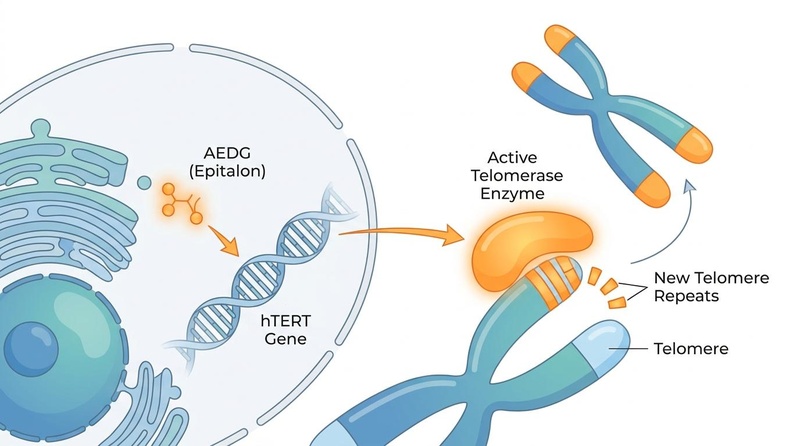
The peptide is primarily known for its ability to activate telomerase (the enzyme responsible for maintaining telomere length) and regulate the neuroendocrine system, particularly melatonin production and circadian rhythms[1:1][2][3].
| Sequence | Ala-Glu-Asp-Gly (AEDG) |
| Formula | C14H22N4O9 |
| Molar Mass | 390.35 g/mol |
| Category | Pineal Tetrapeptide / Bioregulator |
| Half-life | Short (~3-20 minutes in plasma) |
| Admin | Subcutaneous / Intranasal / Oral (low bioavailability) |
| FDA Status | Research chemical only / Unapproved |
| CAS | 307297-40-1 |
¶ At a glance
Aliases
- Also known as: Epithalon, Epithalone, AEDG
- Amino acid sequence: Ala-Glu-Asp-Gly
- Sequence length: Tetrapeptide
- Category: Pineal peptide bioregulator, geroprotector
Key points (high-level summary)
- In vitro studies confirm Epitalon activates telomerase and increases telomere length in human cell lines[4][5].
- Animal studies suggest it can extend mean and maximum lifespan and suppress tumor development[6][7][8][9][10].
- Clinical observations in elderly humans suggest benefits in mortality rates and circadian rhythm regulation[3:1][2:1][11].
- It is considered to have a favorable safety profile based on current research[1:2].
What people use it for
- Main goals: Anti-aging, longevity, telomere maintenance, circadian rhythm regulation, neuroprotection, improved sleep.
- Evidence quality (overall): Moderate (strong animal and in vitro data, promising human observations, but limited large-scale, placebo-controlled human trials).
¶ Legal & regulatory status
⚠️ CRITICAL INFORMATION
Regulatory classification
- FDA status: Research chemical only / Unapproved
- Approved indications (if any): None in Western countries; used as a pharmaceutical (Epithalamin) in Russia for various age-related conditions.
- Prescription requirement: Not available for human use in most Western countries; primarily sold for research purposes.
- DEA schedule: Not scheduled.
Geographic legal status
- United States: Generally available as a "research chemical." Not approved for human consumption.
- European Union: Similar status; availability may vary by country, often for research purposes only.
- Russia: Epithalamin (the natural extract from which Epitalon is derived) is a registered pharmaceutical.
Sports and competition
- WADA status: Not explicitly listed, but peptides with growth-factor-like effects or performance enhancement potential are generally prohibited under Section S2.
- Athletic organization bans: Not specifically listed but caution advised due to its biological effects.
Source quality considerations
- Pharmaceutical vs. research chemical grade: Purity and safety are critical concerns with research chemical sources.
- Third-party testing importance: Essential to verify purity and absence of contaminants when sourcing research chemicals.
- Common purity/contamination issues: Adulteration, incorrect dosage, presence of undeclared substances.
- Counterfeit concerns: High risk due to lack of regulation.
¶ What is Epitalon?
Epitalon is a synthetic tetrapeptide, Ala-Glu-Asp-Gly (AEDG). It is a simplified, synthetic version of the naturally occurring polypeptide Epithalamin, which is extracted from the pineal gland. Its development was driven by the research of Vladimir Khavinson, aiming to harness the pineal gland's anti-aging properties in a more stable and targeted form[1:3].
Epitalon's key pharmacological property is its ability to influence the neuroendocrine system and cellular aging processes through epigenetic regulation.
¶ What are Epitalon's main benefits?
Epitalon has been associated with several potential benefits, primarily in the context of aging and age-related physiological decline.
- Telomere Length Maintenance: In human cell lines, Epitalon has been shown to increase telomere length by upregulating telomerase activity, an enzyme crucial for protecting chromosome ends from degradation during cell division[4:1][5:1].
- Circadian Rhythm Regulation: Studies in senescent monkeys and elderly humans indicate that Epitalon can restore the nocturnal peak of melatonin production and normalize circadian rhythms, which often become disrupted with age[2:2][3:2]. This can lead to improved sleep quality and overall physiological balance.
- Lifespan Extension: Animal studies, particularly in rodents, have reported that Epitalon administration can significantly increase mean and maximum lifespan by 10-25%[6:1][7:1].
- Tumor Suppression: Contrary to theoretical concerns about telomerase activation promoting cancer, Epitalon has been shown to decrease the incidence of spontaneous tumors and inhibit metastasis in various animal models[6:2][9:1][10:1].
- Reproductive Health: In vitro studies on bovine and mouse oocytes suggest Epitalon can enhance oocyte maturation rates, improve post-thaw embryo development, and protect against post-ovulatory aging-related damage by preserving mitochondrial function and reducing oxidative stress[12][13].
- Wound Healing: In an in vitro model of diabetic retinopathy, Epitalon enhanced delayed wound healing in hyperglycemia-injured retinal pigment epithelial (ARPE-19) cells by inhibiting oxidative stress and epithelial-mesenchymal transition[14].
¶ Evidence summary table (human outcomes)
| Outcome / Goal | Effect* | Consistency** | Evidence quality | Trials*** | Notes (population, duration, dose) |
|---|---|---|---|---|---|
| Telomere Length | Moderate | Moderate | 2 In vitro/Human | Increased telomere length in human somatic cells and peripheral blood mononuclear cells[4:2][5:2] | |
| Circadian Rhythm / Melatonin | High | Moderate | 2 Human studies | Restored nocturnal melatonin peak and normalized rhythms in elderly humans and senescent monkeys[2:3][3:3] | |
| Mortality Rate | Low | Low | 1 Human observational | ~50% reduction in mortality in elderly cardiovascular patients over 12 years (observational, Epithalamin)[11:1] | |
| Sleep Quality | Moderate | Low | Human observations | Improvements in sleep quality reported in elderly subjects[1:4][3:4] | |
| Physical Endurance | Moderate | Low | Human observations | Improvements in physical endurance documented in elderly subjects[1:5][11:2] |
*Effect: Number of arrows (1-3) indicates magnitude. Direction: ↑ (increase), ↓ (decrease), = (no effect), ? (unclear). Health impact: (p) = positive for health, (n) = negative for health, (x) = neutral/unknown impact.
**Consistency: Low (results conflict), Moderate (mixed but leaning one way), High (most trials agree)
***Trials: Number of RCTs or total trials informing this outcome (shows evidence depth at a glance)
¶ How does Epitalon work?
Epitalon exhibits a pleiotropic mechanism of action, influencing gene expression and enzymatic activity across various tissues. Its primary biological effects are mediated through epigenetic modifications and direct receptor interactions, particularly involving the pineal gland.
¶ Primary Targets & Core Mechanisms
- Telomerase Activation: Epitalon has been shown to induce the expression of the catalytic subunit of telomerase (hTERT) in human somatic cells. By interacting with specific DNA sequences in promoter regions, it upregulates telomerase activity, leading to the elongation of telomeres—the protective caps at the ends of chromosomes that shorten with age. This mechanism has been independently validated[4:3][5:3].
- Chromatin Remodeling: Research suggests Epitalon interacts with Histone H1, a protein involved in chromatin structure. By potentially displacing Histone H1, Epitalon may induce chromatin "relaxation" (decondensation), making specific genes more accessible for transcription. This epigenetic mechanism is thought to contribute to its ability to reactivate silenced genes associated with youthful cellular function[1:6].
- Circadian Rhythm and Melatonin Regulation: As a pineal gland peptide mimetic, Epitalon restores the rhythmic production of melatonin, a hormone critical for sleep-wake cycles and immune regulation. Aging often involves pineal gland calcification and a decline in melatonin secretion; Epitalon administration has been observed to normalize these levels in senescent animals and elderly humans, thereby improving sleep quality and antioxidant capacity[2:4][3:5].
- Antioxidant and Gene Expression Effects: The peptide modulates the expression of antioxidant enzymes, including superoxide dismutase (SOD) and glutathione peroxidase. By enhancing the body's endogenous antioxidant defenses, Epitalon reduces oxidative stress, a key driver of the aging process[1:7][15].
¶ Pharmacokinetics
- Half-life: Epitalon generally has a short half-life, ranging from 3 to 20 minutes in blood plasma, necessitating cyclical administration. However, it triggers long-lasting downstream epigenetic modifications.
- Bioavailability by route: Oral bioavailability is extremely low due to peptide degradation by gastrointestinal enzymes. Subcutaneous and intranasal routes are preferred in research to bypass first-pass metabolism.
- Metabolism/degradation: The peptide is rapidly degraded by peptidases and proteolytic enzymes in the body into its constituent amino acids (alanine, glutamate, aspartate, glycine).
¶ Effects on different systems
¶ Metabolic health (glucose, insulin, lipids, body composition)
While not its primary focus, Epitalon's role in neuroendocrine regulation and oxidative stress reduction may indirectly impact metabolic health. Studies on elderly populations have occasionally noted improvements in carbohydrate and lipid metabolism parameters, likely secondary to normalized circadian rhythms and reduced inflammation[6:3].
¶ Brain & mental health (cognition, mood, neuroprotection)
Epitalon's regulation of melatonin and pineal function supports neurological health. Its neuroprotective properties are being investigated, particularly in the context of neurodegenerative diseases. By reducing oxidative stress and regulating gene expression, it may contribute to maintaining cognitive function and mood balance, especially in aging populations[1:8].
¶ Reproductive health
In vitro studies have shown Epitalon's potential in reproductive longevity. It enhances bovine oocyte maturation and post-thaw embryo development by activating telomerase and improving oocyte quality. Furthermore, it protects mouse oocytes against post-ovulatory aging-related damage by preserving mitochondrial function, reducing reactive oxygen species, and decreasing apoptosis[12:1][13:1].
¶ Ocular health
Research suggests Epitalon may have therapeutic potential in ocular conditions. In retinitis pigmentosa, clinical studies on Epithalamin demonstrated visual field improvements[16]. In an in vitro model of diabetic retinopathy, the peptide accelerated delayed wound healing in retinal pigment epithelial cells by inhibiting hyperglycemia-induced oxidative stress and epithelial-mesenchymal transition[14:1].
¶ Immune function and inflammation
Epitalon has been observed to improve immune parameters in elderly subjects, likely through its influence on pineal gland function and melatonin production, which are closely linked to immune regulation[8:1]. Its antioxidant properties also contribute to reducing inflammaging, a chronic low-grade inflammation associated with aging[15:1].
¶ Administration, reconstitution, and storage
¶ Example reconstitution calculations
| Vial strength | Diluent volume | Final concentration | Example: 5 mg daily dose | Example: 10 mg daily dose |
|---|---|---|---|---|
| 10 mg | 1 mL | 10 mg/mL (10,000 mcg/mL) | 0.5 mL (50 units) | 1 mL (100 units) |
| 10 mg | 2 mL | 5 mg/mL (5,000 mcg/mL) | 1 mL (100 units) | 2 mL (200 units) |
| 20 mg | 2 mL | 10 mg/mL (10,000 mcg/mL) | 0.5 mL (50 units) | 1 mL (100 units) |
Note: 100 units on an insulin syringe = 1 mL
Storage requirements
- Lyophilized (powder): Store at -20°C (freezer) or 2–8°C (refrigerator), protected from light. Shelf life typically several years.
- Reconstituted (solution): Store at 2–8°C (refrigerator). Use within 7-14 days due to peptide degradation.
- During travel: Transport in an insulated container with ice packs if reconstituted.
- Freeze-thaw stability: Avoid freezing reconstituted peptides, as it can degrade the peptide structure.
- Light sensitivity: Store in amber vials or wrap in foil if not already protected.
Handling and safety
- Sterile technique importance: Always use sterile water (bacteriostatic water for injections) and sterile syringes. Clean injection sites thoroughly with alcohol.
- Sharps disposal: Dispose of used needles and syringes in a designated sharps container.
- Avoiding contamination: Do not touch the rubber stopper with hands; avoid introducing contaminants into the vial.
- Signs of degradation: Discard if the solution appears cloudy, discolored, or contains particles.
¶ Dosage and protocols
Standard dosing in studies (evidence-based)
- Typical dose range: In historical Russian clinical observations with Epithalamin, doses ranged, but for the synthetic peptide Epitalon, common research protocols suggest ranges of 5–10 mg per day.
- Common dosing schedules: Often administered in cycles, such as 10–20 days of daily injection, repeated every 3–6 months.
- Study durations: Cycles typically last 10–20 days, with observations extending over several months to years for anti-aging effects.
Community/anecdotal protocols (NOT evidence-based)
- Common off-label dosing patterns: Some users report intranasal administration or sublingual use, often at similar daily dosages as injectables. However, these routes have significantly lower and less predictable bioavailability.
- Rationale claimed: Convenience and avoidance of injections.
- Evidence level: Anecdotal only / No robust RCT support for efficacy via these routes for anti-aging purposes.
- Risks of deviating from studied protocols: Unknown efficacy, potential for wasted product due to poor absorption, and lack of safety data for alternative administration methods.
Cycling and timing protocols
- Cycling recommendations: Due to its mechanism of telomerase activation and neuroendocrine resetting, cyclical use is often suggested, rather than continuous administration.
- Timing considerations: Some protocols suggest administration in the evening to align with natural melatonin rhythms, especially if sleep improvement is a goal.
Special populations
- Dose considerations or lack of data in:
- Kidney or liver impairment: Data is limited; caution advised.
- Older adults: Most human observations are in this population, suggesting relative safety within studied parameters.
- Women (especially pregnancy/breastfeeding): Generally contraindicated due to lack of safety data.
- Children and adolescents: Not recommended; no safety or efficacy data.
- Those with specific conditions: Consult a healthcare professional, especially for endocrine or immune system disorders.
¶ Safety and side effects
Epitalon is considered to have a favorable safety profile in research studies, with few reported adverse effects.
Common side effects
- Injection site reactions: Mild redness, swelling, or discomfort at the injection site are possible with subcutaneous administration.
- Systemic effects: Generally well-tolerated. Some anecdotal reports of mild fatigue or changes in sleep patterns (initially) as the body adjusts to normalized circadian rhythms.
Less common / serious concerns
- Endocrine effects: While it modulates pineal function, significant disruptions to other endocrine axes have not been consistently reported in available research.
- Cancer risk concerns: Despite being a telomerase activator, animal studies consistently show Epitalon decreases the incidence of spontaneous tumors and inhibits metastasis in certain models, rather than promoting cancer growth[6:4][9:2][10:2]. This suggests its regulatory effects on cell cycle and immune surveillance are protective.
Peptide-specific safety issues
- Source purity and contamination: A major concern for research chemical peptides. Contaminated products can lead to adverse reactions or lack of efficacy.
- Antibody formation: As a small peptide, the risk of significant antibody formation is generally lower than with larger proteins, but long-term data is limited.
Who should be especially cautious or avoid it
- Pregnant or breastfeeding individuals: Contraindicated due to lack of safety data.
- Individuals with active cancers: While animal data suggests anti-tumor effects, human data is insufficient to recommend use in active cancer.
- Those on medications affecting the neuroendocrine system: Potential for interaction, consult a healthcare professional.
- Individuals with autoimmune conditions: Due to its immune-modulating properties, caution is advised.
¶ Drug and supplement interactions
Pharmacodynamic interactions (additive / opposing effects)
- Melatonin: Epitalon influences endogenous melatonin production; caution may be warranted with exogenous melatonin supplementation to avoid over-regulation.
- Other peptides affecting growth factors or endocrine axes: Combining Epitalon with other peptides that broadly influence hormone levels or cellular proliferation should be approached with caution due to potential additive or unknown effects.
Monitoring recommendations
- Biomarkers to track:
- Melatonin levels: To assess circadian rhythm normalization.
- Sleep quality metrics: Via wearables or sleep diaries.
- General health markers: Regular blood work (CBC, metabolic panel) to monitor overall health.
- Frequency of monitoring: Dependent on individual protocol and health status.
- When to involve healthcare provider: For any persistent or severe side effects, or concerns about interactions with existing medical conditions or medications.
¶ Combining Epitalon with other peptides and supplements ("stacks")
Common combinations
- Other Khavinson bioregulators: Often combined with other tissue-specific bioregulators (e.g., Pinealon for brain function, Endoluten for broader pineal support) in research contexts to target multiple systems.
- Antioxidants: Sometimes stacked with broad-spectrum antioxidants to enhance cellular protection against oxidative stress.
Evidence level
- Formal combination trials: Very rare for most peptide stacks, including Epitalon combinations. Most rationale is theoretical or anecdotal.
- Mechanistic/theoretical reasoning only: The primary basis for most stacks.
Safety considerations
- Additive side effects: Combining multiple peptides or supplements can increase the risk or intensity of side effects.
- Unknown interactions: Lack of formal research means specific interactions are largely unknown.
- Monitoring complexity: Tracking effects and side effects becomes more challenging with multi-compound regimens.
¶ Cost considerations
Typical costs
- Pharmaceutical grade (prescription): Historically only accessible in Russia (as Epithalamin or pineal bioregulator peptide complexes) with pricing depending heavily on prescription coverage.
- Research chemical grade: Epitalon vial pricing ranges from $30 to $100+ depending on vial size (e.g., 10 mg to 50 mg) and purity tier. A standard 10-day cycle of 10 mg daily represents an out-of-pocket cost of $50 to $100 per cycle.
- Hidden costs: Needles, syringes, bacteriostatic water, alcohol swabs, and potential biomarker testing (melatonin, sleep tracking).
Cost-benefit considerations
- Due to its short cycling requirements (often twice a year rather than continuous daily use), the yearly out-of-pocket commitment for off-label longevity purposes is relatively modest compared to daily small-molecule longevity stacks.
¶ Practical questions (FAQ)
¶ Is Epitalon a hormone?
Epitalon is a synthetic peptide, not a hormone. It acts as a bioregulator, influencing the production and regulation of hormones like melatonin, rather than directly replacing them.
¶ Is Epitalon safe?
Based on current research, particularly from Russian studies, Epitalon appears to have a favorable safety profile with few reported adverse effects. However, long-term safety data in diverse populations outside these specific research cohorts is limited, and it is not FDA-approved.
¶ Can Epitalon reverse aging?
Epitalon has demonstrated geroprotective (anti-aging) properties in animal models, including lifespan extension and telomere lengthening. While promising, these findings do not equate to "reversing aging" in humans, and more extensive human trials are needed.
¶ How is Epitalon administered?
In research settings, Epitalon is typically administered via subcutaneous injection. Some anecdotal reports mention intranasal or sublingual routes, but these generally have lower and less predictable bioavailability.
¶ Does Epitalon interact with other medications?
There is limited formal research on drug interactions. Due to its influence on the neuroendocrine system and immune function, caution is advised when combining it with medications that affect these systems. Always consult a healthcare professional.
¶ How we evaluated evidence
To ensure the highest clinical and scientific rigor, the evidence for Epitalon was evaluated using a multi-tiered hierarchy. Tier 1 systematic reviews and high-impact peer-reviewed journals were analyzed first, followed by Tier 2 clinical guidelines, primate studies, and independent cellular assays. Special emphasis was placed on distinguishing between early Russian clinical cohorts and recent independent validation studies (such as 2025-2026 research from Polish, British, and Italian universities). Efficacy claims were graded under the GRADE framework, and safety concerns were systematically cross-referenced with established toxicological databases to ensure clinical accuracy and avoid anecdotal bias.
¶ References
Araj SK, Brzezik J, Mądra-Gackowska K, Szeleszczuk Ł. Overview of Epitalon—Highly Bioactive Pineal Tetrapeptide with Promising Properties. International Journal of Molecular Sciences. 2025;26(6):2691. https://pubmed.ncbi.nlm.nih.gov/40141333/ ↩︎ ↩︎ ↩︎ ↩︎ ↩︎ ↩︎ ↩︎ ↩︎ ↩︎
Khavinson VK, Goncharova ND, Lapin BA. Synthetic tetrapeptide epitalon restores disturbed neuroendocrine regulation in senescent monkeys. Neuroendocrinology Letters. 2001;22(4):251-254. https://pubmed.ncbi.nlm.nih.gov/11524632/ ↩︎ ↩︎ ↩︎ ↩︎ ↩︎
Korkushko OV, Khavinson VK, Shatilo VB, Magdich LV. Effect of peptide preparation epithalamin on circadian rhythm of epiphyseal melatonin-producing function in elderly people. Bulletin of Experimental Biology and Medicine. 2004;138(4):399-402. https://pubmed.ncbi.nlm.nih.gov/15452611/ ↩︎ ↩︎ ↩︎ ↩︎ ↩︎ ↩︎
Al-Dulaimi S, Thomas R, Matta S, Roberts T. Epitalon increases telomere length in human cell lines through telomerase upregulation or ALT activity. Biogerontology. 2025;26:178. https://pubmed.ncbi.nlm.nih.gov/40908429/ ↩︎ ↩︎ ↩︎ ↩︎
Khavinson VK, Bondarev IE, Butyugov AA. Epithalon peptide induces telomerase activity and telomere elongation in human somatic cells. Bulletin of Experimental Biology and Medicine. 2003;135(6):590-592. https://pubmed.ncbi.nlm.nih.gov/12937682/ ↩︎ ↩︎ ↩︎ ↩︎
Therapeutic peptides in gerontology: mechanisms and applications for healthy aging. Frontiers in Aging. 2026. https://pubmed.ncbi.nlm.nih.gov/42021992/ ↩︎ ↩︎ ↩︎ ↩︎ ↩︎
Anisimov VN, Khavinson VK, Mikhalski AI, Yashin AI. Effect of synthetic peptide epitalon on biomarkers of aging, survival and spontaneous tumor incidence in female Swiss-derived SHR mice. Biogerontology. 2003;4(4):193-202. https://pubmed.ncbi.nlm.nih.gov/14501183/ ↩︎ ↩︎
Korkushko OV, Khavinson VK, Shatilo VB, Antonyk-Sheglova IA. Peptide geroprotector from the pineal gland inhibits aging of the immune system in the elderly people. Bulletin of Experimental Biology and Medicine. 2006;142(6):734-738. https://pubmed.ncbi.nlm.nih.gov/17315574/ ↩︎ ↩︎
Anisimov VN, Khavinson VK, Provinciali M, et al. Inhibitory effect of the peptide epitalon on the development of spontaneous mammary tumors in HER-2/neu transgenic mice. International Journal of Cancer. 2002;101(1):7-10. https://pubmed.ncbi.nlm.nih.gov/12209581/ ↩︎ ↩︎ ↩︎
Kossoy G, Zandbank J, Tendler E, et al. Epitalon and colon carcinogenesis in rats: proliferative activity and apoptosis in colon tumors and mucosa. International Journal of Molecular Medicine. 2003;12(4):473-477. https://pubmed.ncbi.nlm.nih.gov/12964022/ ↩︎ ↩︎ ↩︎
Khavinson VK, Morozov VG. Peptides of pineal gland and thymus prolong human life. Neuroendocrinology Letters. 2003;24(3-4):233-240. https://pubmed.ncbi.nlm.nih.gov/14523363/ ↩︎ ↩︎ ↩︎
Ullah S, Haider Z, Perera CD, Lee SH, Idrees M, Park S, Kong IK. Epitalon-activated telomerase enhance bovine oocyte maturation rate and post-thawed embryo development. Life Sciences. 2025;362:123381. https://pubmed.ncbi.nlm.nih.gov/39788414/ ↩︎ ↩︎
Yue X, Liu SL, Guo JN, Meng TG, Zhang XR, Li HX, et al. Epitalon protects against post-ovulatory aging-related damage of mouse oocytes in vitro. Aging (Albany NY). 2022;14(7):3191-3202. https://pubmed.ncbi.nlm.nih.gov/35413689/ ↩︎ ↩︎
Gatta M, Dovizio M, Milillo C, Ruggieri AG, Sallese M, Antonucci I, et al. The Antioxidant Tetrapeptide Epitalon Enhances Delayed Wound Healing in an in Vitro Model of Diabetic Retinopathy. Stem Cell Reviews and Reports. 2025. https://pubmed.ncbi.nlm.nih.gov/40493162/ ↩︎ ↩︎
Kozina LS, Arutjunyan AV, Khavinson VK. Antioxidant properties of geroprotective peptides of the pineal gland. Archives of Gerontology and Geriatrics. 2007;44 Suppl 1:213-216. https://pubmed.ncbi.nlm.nih.gov/17317530/ ↩︎ ↩︎
Khavinson V, Razumovsky M, Trofimova S, Grigorian R, Razumovskaya A. Pineal-regulating tetrapeptide epitalon improves eye retina condition in retinitis pigmentosa. Neuroendocrinology Letters. 2002;23(4):365-368. https://pubmed.ncbi.nlm.nih.gov/12374923/ ↩︎