¶ FGL
FGL (also known as FGLL or the Fibroblast Growth Loop peptide) is a synthetic peptide mimetic derived from the Neural Cell Adhesion Molecule (NCAM). It is designed to bind directly to and activate the Fibroblast Growth Factor Receptor (FGFR), a critical signaling hub for neuronal growth, survival, and synaptic plasticity. While it successfully passed Phase I human safety trials demonstrating excellent tolerability, its clinical development has since stalled, leaving it as a prominent "orphan" compound in nootropic research.
| Sequence | Glu-Val-Tyr-Val-Val-Ala-Glu-Asn-Gln-Gln-Gly-Lys-Ser-Lys-Ala |
| Short Seq | EVYVVAENQQGKSKA |
| Category | NCAM Mimetic / Nootropic |
| Origin | Synthetic (NCAM FN3 Module) |
| Admin | Intranasal, Subcutaneous |
| FDA Status | Unapproved / Research Chemical |
¶ At a glance
Aliases
- Also known as: FGLL, Fibroblast Growth Loop
- Amino acid sequence: Glu-Val-Tyr-Val-Val-Ala-Glu-Asn-Gln-Gln-Gly-Lys-Ser-Lys-Ala
- Sequence length: 15 amino acids (pentadecapeptide)
- Category: NCAM mimetic, Nootropic, Neurotrophic Factor Mimetic
Key points
- Primary Benefit: Enhances synaptic plasticity and memory formation by mimicking the natural "growth" signal of NCAM [1].
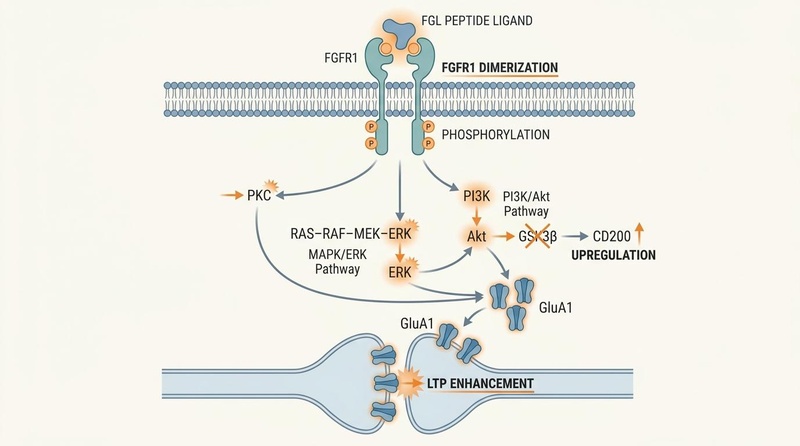
- Mechanism: Directly activates the FGFR1 receptor, triggering downstream pathways (PKC, ERK, PI3K/Akt) that strengthen synapses (LTP) and inhibit GSK3β [1:1][2].
- Status: Experimental. It passed a Phase I human safety trial in 2007 but has not been approved for any medical use [3][4].
- Safety: Appeared safe in limited human testing (up to 200 mg intranasal), but long-term human efficacy and safety data are non-existent [3:1].
What people use it for
- Main goals: Cognitive enhancement, memory restoration, neuroprotection, and antidepressant/anxiolytic effects.
- Evidence quality (overall):
Unclear (Unclear/Very low for human efficacy; High for mechanistic and animal data, but with significant safety caveats).
¶ Legal & regulatory status
⚠️ CRITICAL INFORMATION
Regulatory classification
- FDA Status: Unapproved / Research Chemical Only. FGL is an investigational compound that has not received FDA approval for any indication. It is legally classified as a research chemical [4:1].
- Approved indications (if any): None.
- Prescription requirement: Not available by prescription. It can only be sourced from research chemical suppliers for laboratory use.
- DEA Schedule: Not scheduled. It is not a controlled substance in the US.
Sports and competition
- WADA Status: Not explicitly listed, but could fall under the "Catch-all" category of non-approved substances (S0) or peptide hormones/growth factors (S2) depending on interpretation. Athletes should exercise extreme caution.
Source quality considerations
- Research Grade Only: Since there is no pharmaceutical product, all FGL on the market is "research grade." This implies no regulatory oversight on purity, sterility, or heavy metal content.
- Purity Risks: Third-party testing is essential to ensure the peptide sequence is correct and free from synthesis byproducts.
¶ What is FGL?
FGL is a 15-amino acid synthetic peptide mimetic derived from the second fibronectin type III (FN3) module of the human Neural Cell Adhesion Molecule (NCAM). It specifically mimics the "FG loop" region of NCAM, which is the binding site that interacts with the Fibroblast Growth Factor Receptor (FGFR) [5].
¶ The "Velcro" of the Brain
To understand FGL, you must understand NCAM. NCAM is a protein expressed on the surface of neurons that plays a crucial role in cell-cell adhesion and synaptic stability. When NCAM interacts with other NCAM molecules or with receptors like FGFR, it signals neurons to strengthen connections and promote plasticity [5:1].
¶ Development History
FGL was championed by Enkam Pharmaceuticals A/S (Denmark) in the early 2000s, with initial development aimed at treating neurodegenerative conditions like Alzheimer’s disease and memory loss [4:2].
- Phase I Success: In 2007, a study published in Clinical Pharmacokinetics showed that intranasal FGL (FGLL) was safe and well-tolerated in healthy men [3:2].
- Stalled Progress: Despite this success, Enkam Pharmaceuticals ceased operations around 2012–2016, and no Phase II efficacy trials were published. The peptide remains a tool in academic neuroscience but has not advanced commercially [4:3].
¶ What are FGL's main benefits?
Note: The following benefits are primarily based on robust preclinical (animal) models. Human efficacy has not been established for these indications, beyond initial safety data.
¶ 1. Memory and Cognitive Enhancement
The most well-documented effect of FGL is its ability to facilitate Long-Term Potentiation (LTP)—the cellular process that underlies memory formation—and improve various cognitive functions [1:2][6].
- Outcome: Enhanced spatial, social, and recognition memory, and improved learning speed.
- Direction of effect:
Medium Improvement (Moderate increase, positive) in animal models. - Population studied: Healthy rodents, aged rodents, and models of stress-induced cognitive impairment [1:3][7][6:1][8].
- Evidence quality:
Unclear (High for preclinical data; Very low/Unclear for human clinical relevance). - Summary sentence: FGL consistently enhances memory formation and learning in animal models by promoting synaptic strengthening.
¶ 2. Neuroprotection (Alzheimer's and Stroke)
FGL appears to protect neurons from various forms of stress and toxicity, showing promise in models of neurodegenerative diseases and acute brain injury [2:1][9].
- Outcome: Prevention of neuronal death, reduction of amyloid-beta toxicity, reduced infarct volume after stroke, and mobilization of neural stem cells.
- Direction of effect:
Medium Improvement (Moderate increase, positive) in animal models. - Population studied: Rodent models of Alzheimer's disease (amyloid-beta injection) and ischemic stroke (MCAO) [2:2][9:1].
- Evidence quality:
Unclear (High for preclinical data; Very low/Unclear for human clinical relevance). - Summary sentence: Preclinical studies indicate FGL can protect brain cells from damage associated with Alzheimer's disease and stroke, potentially aiding recovery.
¶ 3. Antidepressant and Anxiolytic Effects
There is preclinical evidence suggesting that FGL possesses rapid-acting antidepressant and anxiolytic (anxiety-reducing) properties [8:1].
- Outcome: Reversal of depression-like behaviors and reduction in anxiety.
- Direction of effect:
Small Improvement (Small increase, positive) in animal models. - Population studied: NCAM-deficient mice and rats subjected to chronic stress [8:2].
- Evidence quality:
Unclear (Moderate for preclinical data; Very low/Unclear for human clinical relevance). - Summary sentence: FGL has shown antidepressant and anxiolytic effects in animal models, likely through its influence on neurotrophic signaling and synaptic connectivity.
¶ Evidence summary table (human outcomes)
| Outcome / Goal | Effect* | Consistency** | Evidence quality | Trials*** | Notes (population, duration, dose) |
|---|---|---|---|---|---|
| Safety & Tolerability | High | High | 1 Phase I RCT | Safe up to 200mg intranasal (single dose) in healthy men [3:3] | |
| Memory Enhancement | N/A | Very low | 0 RCTs | Robust preclinical data, no human efficacy data [1:4][7:1] | |
| Synaptic Plasticity (LTP) | N/A | Very low | 0 RCTs | Mechanistically proven in vitro/in vivo, no human data [1:5][6:2] | |
| Neuroprotection (AD/Stroke) | N/A | Very low | 0 RCTs | Preclinical effects in rodent models, no human data [2:3][9:2] | |
| Depression/Anxiety | N/A | Very low | 0 RCTs | Preclinical effects in rodent models, no human data [8:3] |
¶ How does FGL work?
FGL is a "precision tool" for the Fibroblast Growth Factor Receptor 1 (FGFR1). Its mechanism of action involves a targeted activation of FGFR1 and downstream signaling pathways crucial for neuronal health and plasticity [1:6][5:2].
¶ Primary Targets and Core Mechanisms
- Receptor Binding: FGL binds to a specific regulatory site on the Fibroblast Growth Factor Receptor 1 (FGFR1), mimicking the natural interaction with NCAM [5:3][10].
- Dimerization & Activation: This binding induces FGFR1 receptor dimerization and autophosphorylation, which is essential for initiating intracellular signaling [1:7].
- Signaling Cascades: Activation of FGFR1 triggers several key pathways [1:8][2:4]:
- PKC (Protein Kinase C): Critical for the trafficking of AMPA receptors to the synapse.
- MAPK/ERK: Drives gene expression for neuronal growth, differentiation, and synaptic plasticity.
- PI3K/Akt: Promotes neuronal survival (anti-apoptotic effects).
- Synaptic Strengthening (LTP): The ultimate result is the enhanced delivery of AMPA receptors (specifically GluA1 subunits) to the postsynaptic membrane. This increases synaptic strength and responsiveness, forming the physical basis of Long-Term Potentiation (LTP), which is crucial for memory formation [1:9].
¶ Inhibition of GSK3β
FGL also leads to the phosphorylation (inactivation) of Glycogen Synthase Kinase 3 beta (GSK3β) [2:5].
- Why this matters: Overactive GSK3β is implicated in Alzheimer's disease by promoting tau hyperphosphorylation and neuronal death. By inhibiting GSK3β, FGL contributes to neuroprotection against amyloid-beta toxicity [2:6].
¶ Anti-Inflammatory Modulation (CD200)
Recent research suggests FGL interacts with glial cells (the brain's immune cells) to exert anti-inflammatory effects. It upregulates CD200, a glycoprotein that maintains microglia in a quiescent, non-inflammatory state. This is vital for preventing chronic neuroinflammation, which contributes to aging and neurodegeneration [9:3].
¶ Pharmacokinetics
- Half-life: Short in plasma (hours) [3:4]. However, its biological effects on synapses can last for days due to persistent downstream signaling changes [6:3].
- Bioavailability:
¶ Effects on different systems
¶ Brain & Mental Health (Cognition, Mood, Neuroprotection)
- Cognition: The primary target of FGL. It enhances both the acquisition (learning) and retention (memory) of new information by promoting synaptic plasticity [1:10][7:2][6:4].
- Mood: Modulation of the NCAM-FGFR pathway appears to have antidepressant and anxiolytic effects, potentially by correcting deficits in neurogenesis or synaptic connectivity associated with mood disorders [8:6].
- Neuroprotection: Protects neurons against damage from amyloid-beta toxicity (Alzheimer's models) and ischemic injury (stroke models) by inhibiting GSK3β and mobilizing neural stem cells [2:7][9:4].
¶ Immune Function & Inflammation
- Microglia Modulation: FGL upregulates CD200, a key immunomodulatory molecule that keeps microglia (brain immune cells) in a non-inflammatory state. This action helps to mitigate neuroinflammation, a driver of neurodegenerative processes [9:5].
¶ Administration, reconstitution, and storage
The following protocols are compiled from preclinical studies and clinical trial literature for professional and research reference.
¶ Routes of Administration
- Intranasal (Preferred for Nootropic Use)
- Why: Bypasses the blood-brain barrier and delivers the peptide directly to the brain via the olfactory nerves. This matches the route used in the successful human Phase I trial [3:6].
- Device: Typically administered via a nasal spray bottle.
- Subcutaneous Injection
- Why: A standard route in animal studies for neuroprotection and systemic delivery [9:6].
- Site: Abdominal fat or thigh.
¶ Storage requirements
- Lyophilized (powder): Store at -20°C (freezer) for long-term stability. Protect from light.
- Reconstituted (solution): Store at 2–8°C (refrigerator). Use within 2–3 weeks, as peptides degrade in solution over time. Avoid freezing reconstituted solutions.
- Handling: FGL is a fragile peptide. Avoid shaking reconstituted solutions vigorously.
¶ Handling and safety
- Sterile Technique: Always use sterile bacteriostatic water for reconstitution and sterile syringes/vials to minimize contamination risk.
- Sharps Disposal: Dispose of needles and syringes safely in a designated sharps container.
- Signs of Degradation: Discard any solutions that appear cloudy, discolored, or contain particulate matter.
¶ Dosage and protocols
Due to its unapproved status, there are no officially established or FDA-approved dosage guidelines for FGL. Protocols are derived primarily from preclinical animal studies and the single human Phase I trial.
¶ Standard dosing in studies (evidence-based)
- Human Trial Dosage: The Phase I study tested single intranasal doses of 25 mg, 100 mg, and 200 mg [3:7].
- All doses were tolerated, demonstrating safety.
- Rodent Studies (Neuroprotection/Memory):
¶ Human Equivalent Dose (HED) Estimation
Note: These are theoretical conversions based on standard allometric scaling factors (Rat Km = 6, Human Km = 37) for professional research analysis.
- For a rat dose of 10 mg/kg (s.c.):
- Human equivalent dose (for a 70 kg human): Approximately 113 mg (Subcutaneous).
- Intranasal Dosing: The Phase I trial used up to 200 mg intranasally, which aligns with the high bioavailability requirements of peptide delivery for CNS effects [3:8].
¶ Cycling and timing protocols
- Research Context: In animal studies, FGL has been administered in various regimes, from single acute doses for memory enhancement to chronic administration over several weeks for neuroprotection.
- Lack of Human Data: There are no human data or guidelines for optimal cycling, duration, or timing.
¶ Special populations
- Contraindicated: Due to the lack of safety data, FGL is generally contraindicated in pregnant or breastfeeding individuals, children, and adolescents.
- Caution: Individuals with a history of epilepsy should exercise extreme caution due to theoretical concerns about lowering the seizure threshold, although animal studies showed it did not worsen seizures in kindled mice [3:9].
¶ Safety and side effects
The safety profile of FGL in humans is based on a single Phase I clinical trial in healthy men, which showed excellent short-term tolerability. However, long-term human safety and potential side effects with chronic use are unknown [3:10].
¶ Common side effects (human Phase I data)
- Nasal irritation: Mild and transient burning sensation or runny nose immediately after intranasal administration (likely due to the spray formulation) [3:11].
- Systemic: No changes in heart rate, blood pressure, ECG, or liver/kidney toxicity markers were observed in the Phase I trial [3:12].
¶ Theoretical Risks (Preclinical)
- Seizure Threshold: While FGL enhances synaptic excitation and plasticity, one animal study in a kindling model (epilepsy) raised a theoretical concern about potentially lowering the seizure threshold. However, it did not worsen seizures in fully kindled animals [3:13].
- Cancer: Since it activates FGFR (a growth factor receptor), there is a theoretical concern about promoting tumor growth. However, NCAM mimetics are generally considered distinct from broad-spectrum growth factors like HGH, and no oncogenic effects have been reported in preclinical studies.
¶ Who should be especially cautious or avoid it
- Pregnant or Breastfeeding Individuals: No safety data; absolutely contraindicated.
- Children and Adolescents: No safety data; not for use in these populations.
- Individuals with Epilepsy or Seizure Disorders: Theoretical caution due to potential effects on excitability.
- Athletes: Potentially prohibited by WADA under broad categories for unapproved substances.
¶ Drug and supplement interactions
There is no formal research on drug or supplement interactions with FGL due to its investigational status. Theoretical interactions can be inferred based on its mechanism of action.
¶ Pharmacodynamic interactions (additive / opposing effects)
- Nootropics/Cognitive Enhancers: Combining FGL with other substances that affect synaptic plasticity, neurogenesis, or neurotransmitter systems could theoretically lead to additive or synergistic effects.
- Antidepressants/Anxiolytics: Given its preclinical antidepressant and anxiolytic properties, combining FGL with prescription medications for these conditions could lead to unpredictable effects and should be avoided.
¶ Monitoring recommendations
- No established guidelines: There are no clinical guidelines for monitoring FGL use.
- Theoretical considerations: If one were to use FGL, prudent (though unproven) monitoring might include regular cognitive assessments, and neurological evaluations.
¶ Cost and Availability
- Availability: Very low. FGL is not commonly stocked by standard peptide vendors and often requires custom synthesis from specialized research chemical laboratories.
- Cost: High. Because the effective dose used in human trials is in the milligram range (e.g., 50-200 mg) rather than the microgram range typical for many potent peptides, a single effective dose can be significantly more expensive than other nootropics like Semax or Noopept.
¶ References
Knafo, S., Venero, C., Sánchez-Puelles, C., Pereda-Peréz, I., Franco, A., et al. (2012). Facilitation of AMPA Receptor Synaptic Delivery as a Molecular Mechanism for Cognitive Enhancement. PLoS Biology, 10(2): e1001262. https://journals.plos.org/plosbiology/article?id=10.1371/journal.pbio.1001262 ↩︎ ↩︎ ↩︎ ↩︎ ↩︎ ↩︎ ↩︎ ↩︎ ↩︎ ↩︎ ↩︎ ↩︎
Klementiev, B., et al. (2007). A synthetic peptide termed FGL derived from the neural cell adhesion molecule (NCAM) was able to prevent or, if already manifest, strongly reduce all investigated signs of Abeta25-35-induced neuropathology and cognitive impairment. Neuroscience. https://pubmed.ncbi.nlm.nih.gov/17223274/ ↩︎ ↩︎ ↩︎ ↩︎ ↩︎ ↩︎ ↩︎ ↩︎
Anand, R., Seiberling, M., Kamtchoua, T., & Pokorny, R. (2007). Tolerability, safety and pharmacokinetics of the FGLL peptide, a novel mimetic of neural cell adhesion molecule, following intranasal administration in healthy volunteers. Clinical Pharmacokinetics, 46(4), 351–358. https://pubmed.ncbi.nlm.nih.gov/17375985/ ↩︎ ↩︎ ↩︎ ↩︎ ↩︎ ↩︎ ↩︎ ↩︎ ↩︎ ↩︎ ↩︎ ↩︎ ↩︎ ↩︎
BioCentury. (n.d.). Company Profile: Enkam Pharmaceuticals A/S. https://profiles.biocentury.com/companies/enkam_pharmaceuticals_as ↩︎ ↩︎ ↩︎ ↩︎
Berezin, V., & Bock, E. (2010). Peptide Mimetics of the Neural Cell Adhesion Molecule. International Journal of Molecular Sciences. https://pmc.ncbi.nlm.nih.gov/articles/PMC2904917/ ↩︎ ↩︎ ↩︎ ↩︎
Secher, T., et al. (2006). The neural cell adhesion molecule-derived peptide FGL facilitates long-term plasticity in the dentate gyrus in vivo. Journal of Neurochemistry. https://pubmed.ncbi.nlm.nih.gov/16805770/ ↩︎ ↩︎ ↩︎ ↩︎ ↩︎
Popov, V. I., et al. (2008). A cell adhesion molecule mimetic, FGL peptide, induces alterations in synapse and dendritic spine structure in the dentate gyrus of aged rats: A three-dimensional ultrastructural study. European Journal of Neuroscience. https://onlinelibrary.wiley.com/doi/10.1111/j.1460-9568.2008.06042.x ↩︎ ↩︎ ↩︎
Turner, C. A., et al. (2019). Neural cell adhesion molecule peptide mimetics modulate emotionality: pharmacokinetic and behavioral studies in rats and non-human primates. Neuropsychopharmacology. https://pmc.ncbi.nlm.nih.gov/articles/PMC6300554/ ↩︎ ↩︎ ↩︎ ↩︎ ↩︎ ↩︎ ↩︎
Klein, R., et al. (2016). The Neural Cell Adhesion Molecule-Derived Peptide FGL Mobilizes Endogenous Neural Stem Cells, Promotes Remyelination and Modulates Neuroinflammation after Focal Ischemia. Journal of Neuroimmune Pharmacology. https://pubmed.ncbi.nlm.nih.gov/27352075/ ↩︎ ↩︎ ↩︎ ↩︎ ↩︎ ↩︎ ↩︎ ↩︎
Neiiendam, J. L., et al. (2004). An NCAM-derived FGF-receptor agonist, the FGL-peptide, induces neurite outgrowth and neuronal survival in primary rat neurons. Journal of Neurochemistry. https://pubmed.ncbi.nlm.nih.gov/15569260/ ↩︎