¶ GHK-Cu
| Sequence | Gly-His-Lys-Cu |
| Formula | C₁₄H₂₄CuN₆O₄ |
| Molar Mass | 340.86 g/mol |
| Category | Copper Tripeptide |
| Half-life | Short (minutes to hours) |
| Admin | Topical, Subcutaneous (experimental) |
| FDA Status | Cosmetic (Category 1); Injectable (Category 2 - Prohibited for compounding) |
| CAS | 49557-75-7 |
GHK-Cu (Glycyl-L-histidyl-L-lysine copper) is a naturally occurring tripeptide-copper complex that serves as a potent signaling molecule for tissue regeneration and anti-aging. Originally discovered in human plasma, GHK-Cu has the unique ability to modulate the expression of over 4,000 human genes—effectively "resetting" cellular transcriptomes toward a younger, healthier state [1][2].
¶ At a Glance
Aliases
- Also known as: Copper Peptide, Glycyl-L-histidyl-L-lysine copper(II)
- Amino acid sequence: Gly-His-Lys-Cu
- Sequence length: Tripeptide
- Category: Copper-binding peptide, Gene modulator, Regenerative factor
Key points (high-level summary)
- A human plasma tripeptide with high affinity for copper (II), acting as a gene modulator.
- Reverses age-associated transcriptomic changes, stimulates collagen/elastin, and enhances DNA repair.
- Significantly improves skin elasticity and thickness, reduces photodamage, and promotes hair growth.
- Topical applications have a high safety profile; injectable forms face stricter regulatory scrutiny.
What people use it for
- Main goals: Skin regeneration, anti-aging, hair growth, wound healing, systemic cellular rejuvenation.
- Evidence quality (overall): Moderate (for topical skin/hair benefits); Low (for systemic anti-aging claims).
¶ Legal & Regulatory Status
⚠️ CRITICAL INFORMATION
Regulatory classification
- FDA status: Widely approved for topical cosmetic use ("Copper Tripeptide-1" INCI name); not FDA-approved as a systemic drug.
- Approved indications (if any): None as a pharmaceutical drug; recognized as a cosmetic ingredient.
- Prescription requirement: Not prescription-only for topical use; injectable forms are not available via legitimate compounding pharmacies due to regulatory restrictions.
- FDA 503A Bulks List: Category 1 for non-injectable routes; Category 2 (Significant Safety Risks) for injectable routes, effectively prohibiting its compounding for injection by 503A pharmacies [3][4].
Geographic legal status
- United States: Topical use is generally permissible. Injectable use is restricted.
- European Union: Typically regulated as a cosmetic ingredient for topical use.
Source quality considerations
- The market includes both high-purity cosmetic-grade GHK-Cu and research-grade chemicals, which may have varying purity. Third-party testing is recommended to ensure purity and absence of contaminants.
¶ What is GHK-Cu?
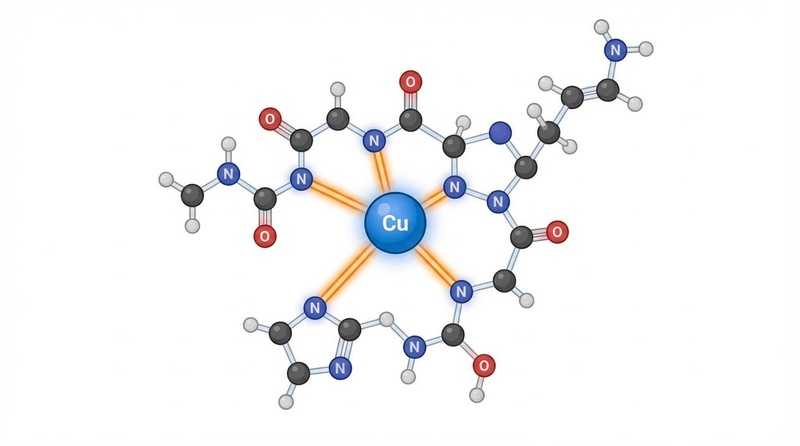
GHK (Glycyl-L-histidyl-L-lysine) is a tripeptide with a high-affinity binding site for copper (II) ions (Cu2+). In its active form, GHK-Cu, the copper ion is coordinated by the nitrogen atoms of the peptide backbone and the imidazole group of the histidine residue [1:1][5]. This complex is exceptionally stable, allowing it to transport copper to cells without releasing toxic free copper ions.
Natural occurrence and discovery
GHK was first isolated in 1973 by Dr. Loren Pickart while investigating why young blood plasma stimulated the protein synthesis of aged liver cells better than old plasma [2:1]. He identified GHK as the factor responsible for "rejuvenating" the tissue. It is naturally present in human plasma, saliva, and urine.
Age-related decline
In healthy young adults (age 20), GHK levels in the plasma are approximately 200 ng/mL. By age 60, these levels decline by more than 60%, dropping to roughly 80 ng/mL [6]. This decline is hypothesized to contribute to the reduced wound healing and regenerative capacity observed in elderly populations.
¶ Main Benefits
GHK-Cu is increasingly viewed as an "epigenetic modulator" rather than a simple growth factor. It is the "gold standard" for regenerative skincare, often outperforming traditional actives in head-to-head trials. Beyond the skin, GHK-Cu exhibits significant systemic potential through its gene-modulating effects.
For each major health domain (e.g., body composition, glycemic control, tissue repair, cognitive function):
- Skin Regeneration & Photodamage Reversal: Clinical trials show that GHK-Cu significantly improves skin elasticity, thickness, and clarity, reducing lines and wrinkles [7][8].
- Wound Healing & Scar Reduction: GHK-Cu accelerates wound closure and promotes "scar-free" healing by modulating extracellular matrix (ECM) remodeling [9].
- Hair Follicle Regeneration: It stimulates dermal papilla cell proliferation, increases VEGF for improved blood supply, and can promote hair growth comparable to minoxidil [10][11].
- Cognitive Protection & Neuroprotection: Preliminary data suggests GHK-Cu modulates genes relevant to nervous system function, upregulating anti-pain and anti-anxiety pathways, and protecting neurons from oxidative stress [12][13].
- Anti-Aging & DNA Repair: GHK-Cu upregulates 47 DNA repair genes (including BRCA1) and antioxidant systems, while suppressing pro-inflammatory cytokines, suggesting a broad systemic anti-aging role [14][15].
¶ Evidence Summary Table (Human Outcomes)
| Outcome / Goal | Effect* | Consistency** | Evidence quality | Trials*** | Notes (population, duration, dose) |
|---|---|---|---|---|---|
| Skin Elasticity & Thickness | High | Moderate | 2 RCTs | In women with photodamage (12 weeks, topical cream) [7:1][8:1] | |
| Collagen Production | High | Moderate | 2 RCTs | 70% response rate in treated women, outperforming Vitamin C [7:2][16] | |
| Wrinkle Reduction | High | Moderate | 2 RCTs | Significant reduction in lines and wrinkles vs. placebo [8:2] | |
| Hair Growth / Follicle Size | Moderate | Low | 1 In vitro, 1 Preclinical | Comparable to minoxidil in some models, improved delivery via microemulsion [10:1][11:1] | |
| DNA Repair Gene Expression | High | Low | 1 Transcriptomic | Upregulation of BRCA1, OGG1 in human cells [14:1] |
¶ How does GHK-Cu work?
GHK-Cu acts as a "signal peptide" and a "carrier peptide." It signals cells to perform specific functions, and it carries copper ions, essential cofactors for numerous enzymatic reactions.
Primary targets: GHK-Cu modulates approximately 31.2% (4,192) of human genes by 50% or more [1:2].
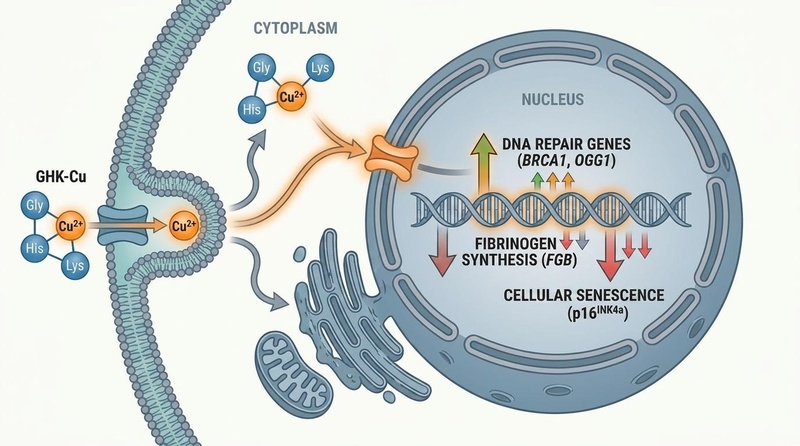
- Upregulation: Promotes genes for tissue repair, DNA repair, and antioxidant defense.
- Downregulation: Suppresses genes associated with chronic inflammation and cancer progression.
Core mechanisms:
- DNA Repair Mechanisms: GHK-Cu upregulates 47 genes involved in DNA repair and downregulates only 5 [14:2]. It stimulates the expression of BRCA1 (a key tumor suppressor) and the base excision repair enzyme OGG1 (8-oxoguanine DNA glycosylase), which protects against oxidative DNA damage. It also influences the MUTYH pathway, further reducing the risk of mutations.
- p16INK4a Suppression: GHK-Cu functions as a senomorphic by suppressing p16INK4a expression and restoring youthful markers like p63 and integrins in basal keratinocytes, effectively "rejuvenating" cellular senescence cell populations [6:1].
- Fibrinogen and Inflammation: GHK-Cu is a powerful inhibitor of fibrinogen synthesis, specifically suppressing the fibrinogen beta chain (FGB) gene by nearly 500% [1:3]. Lowering fibrinogen is associated with reduced cardiovascular risk and better wound healing. It also modulates the TGF-β pathway, regulating collagen remodeling and preventing excessive fibrosis.
- Collagen Remodeling Pathway: GHK-Cu stimulates the breakdown of large, stiff collagen aggregates and replaces them with youthful, organized Type I and Type III collagen fibers [1:4][16:1].
- Mitochondrial Protection: Modern 2026 studies demonstrate that GHK-Cu delays senescence and extends life in model organisms via the activation of DAF-16/SKN-1 and coordinated regulation of mitochondrial bioenergetics [17].
Pharmacokinetics:
- Half-life: The half-life of GHK-Cu in human plasma is relatively short, often reported in minutes to a few hours, suggesting rapid clearance when administered systemically [2:2]. Topical application provides localized effects with minimal systemic absorption.
- Bioavailability by route: Oral bioavailability is very poor due to peptidase degradation. Subcutaneous and topical administration are the primary routes of delivery.
- Metabolism/degradation: GHK-Cu is readily metabolized by peptidases in the body.
- Major PK issues: Rapid degradation for systemic use necessitates frequent administration or advanced delivery systems (e.g., liposomes, ionic liquids, or sponge spicules) for sustained effects [11:2][16:2].
¶ Age and Sex-Specific Differences in Baseline Levels and Skin
¶ Age-Related Depletion
Human plasma levels of GHK undergo a severe, progressive decline across the lifespan. In healthy young adults (age 20), physiological circulating GHK is approximately 200 ng/mL [6:2]. By age 60, plasma concentration drops by more than 60% to approximately 80 ng/mL. This significant age-associated depletion correlates with the body's reduced baseline healing efficiency, loss of skin elasticity, and compromised microvascular support. Consequently, older adults (ages 60+) often realize the most dramatic therapeutic benefit from exogenous GHK-Cu replacement, as it restores local signaling tissue variables toward a younger transcriptomic profile [14:3][15:1].
¶ Biological Sex Variations
- Epidermal Barrier and Thickness: Men consistently have a thicker epidermis and stratum corneum (approximately 20% thicker than women) due to baseline androgen exposure [18]. Consequently, topical GHK-Cu penetration is slightly lower in male skin. To achieve comparable deep dermal collagen stimulation, male topical formulations may require higher GHK-Cu percentages (up to 2%) or integration with mechanical penetration enhancers like microneedling [11:3].
- Aesthetic Presentation: Women experience accelerated skin thickness reduction and collagen loss during perimenopause and menopause due to estrogen suppression. Topical GHK-Cu serves as an ideal hormone-independent support to boost Type I and IV collagen synthesis without systemic side effects [18:1].
¶ Effects on Different Systems
Skin, hair, and appearance
GHK-Cu is well-established for its profound effects on skin health and appearance. It promotes collagen and elastin production, reduces photodamage, improves skin elasticity and thickness, and reduces wrinkles [16:3]. Its anti-inflammatory properties make it beneficial for conditions like rosacea and acne [1:5]. For hair, it stimulates follicle enlargement, improves blood supply, and can promote hair growth, making it a promising agent for androgenetic alopecia [10:2][11:4].
Brain & mental health (cognition, mood, neuroprotection)
Preliminary research suggests GHK-Cu has neuroprotective qualities. It upregulates genes associated with anti-pain and anti-anxiety pathways and protects neurons from oxidative stress and beta-amyloid toxicity. It promotes nerve outgrowth and regeneration by increasing neurotrophic factors like NGF [12:1]. In vivo studies from 2026 show GHK-Cu treatment in middle-aged models rescues cognitive/behavioral deficits and influences age-associated hippocampal gene expression programs [13:1].
Immune function and inflammation
GHK-Cu modulates immune responses by suppressing pro-inflammatory cytokines such as TNF-α and IL-6, and inhibiting NF-κB activation. This reduces chronic inflammation, which is a hallmark of aging. It also attracts macrophages to injury sites, aiding in debris clearance and initiating tissue repair [1:6][6:3].
¶ Administration, Reconstitution, and Storage
Administration
- Topical: Creams, serums, lotions are the most common and safest methods. Applied once or twice daily.
- Subcutaneous Injection: Used in some experimental or research settings. NOTE: FDA has placed injectable GHK-Cu into Category 2, effectively prohibiting compounding for injection by 503A pharmacies.
Reconstitution (for injectable forms, if used in research context)
- Diluent: Bacteriostatic water (BW) is typically used for reconstitution.
- Stability: Reconstituted solutions are less stable than lyophilized powder and should be refrigerated.
Example reconstitution calculations (for informational purposes only, not a recommendation for use):
| Vial strength | Diluent volume | Final concentration | Example: 1 mg dose | Example: 2 mg dose |
|---|---|---|---|---|
| 5 mg | 1 mL | 5 mg/mL (5000 mcg/mL) | 0.2 mL (20 units) | 0.4 mL (40 units) |
| 10 mg | 2 mL | 5 mg/mL (5000 mcg/mL) | 0.2 mL (20 units) | 0.4 mL (40 units) |
Note: 100 units on an insulin syringe = 1 mL
Storage requirements
- Lyophilized (powder): Store at 2-8°C (refrigerated) or -20°C (freezer) for long-term stability. Protect from light.
- Reconstituted (solution): Store at 2-8°C (refrigerated) and use within 2-4 weeks. Avoid freezing reconstituted peptides.
- Light sensitivity: Store in amber vials or protect from direct light exposure.
Handling and safety
- Sterile technique: For any injectable preparation, strict sterile technique is paramount to prevent infection.
- Signs of degradation: Discoloration (loss of blue color, turning green), cloudiness, or particulate matter in reconstituted solution may indicate degradation.
¶ Dosage and Protocols
Clinical Protocol (Topical)
Standard topical protocols involve once or twice daily application of 0.5% to 2% GHK-Cu creams or serums. For sensitive skin, starting with 0.1%–0.5% concentrations is recommended before moving to higher concentrations.
Standard dosing in studies (evidence-based - topical)
- Typical concentration range: 0.5% to 2% for daily facial use in skin regeneration studies [7:3][8:3].
- Scalp/Hair: Up to 5% for hair growth applications [10:3].
- Study durations: Clinical trials for skin benefits typically range from 8 to 12 weeks.
Community/anecdotal protocols (NOT evidence-based - injectable, for informational purposes only due to regulatory status)
- Typical dose range: Anecdotal reports for subcutaneous use often range from 1-2 mg per day, or 2-4 mg three times a week.
- Rationale claimed: Users aim for systemic anti-aging and healing effects not achievable with topical application.
- Evidence level: Anecdotal only; no robust human RCT support for these systemic protocols.
- Risks of deviating from studied protocols: Unknown safety profile for parenteral administration, lack of efficacy data, increased potential for side effects (e.g., injection site reactions), and significant regulatory risks.
Cycling and timing protocols
- Topical: Generally used continuously for sustained benefits.
- Injectable (anecdotal): Some users cycle GHK-Cu for 4-8 weeks on, followed by an off period, though no scientific basis supports this for GHK-Cu specifically.
Special populations
- Pregnancy/Breastfeeding: Use with caution or avoid due to lack of safety data.
- Kidney or liver impairment: Data is limited; caution is advised for systemic use.
¶ Safety and Side Effects
Common side effects
- Topical: Generally well-tolerated. Occasional temporary blue tint to the skin if not fully absorbed or properly formulated. Mild irritation is rare due to its anti-inflammatory nature.
- Injection site reactions (for subcutaneous use): Pain, redness, swelling, or bruising at the injection site (common with any injection).
Less common / serious concerns
- Copper Toxicity: Extremely rare with topical use as GHK-Cu is a stable complex and tightly bound. Systemic copper levels are generally unaffected by topical application. Concerns about copper toxicity are primarily relevant to very high-dose systemic copper supplementation, not typically GHK-Cu.
- Immunological: Though rare, theoretical risks of antibody formation with long-term injectable peptide use exist.
- Regulatory Risk: The FDA's Category 2 classification for injectable GHK-Cu highlights concerns about potential immunogenicity and impurities for parenteral routes [4:1].
Who should be especially cautious or avoid it
- Pregnant or breastfeeding individuals: Due to limited safety data.
- Individuals with underlying medical conditions: Especially those affecting copper metabolism (e.g., Wilson's disease), should consult a healthcare provider before any use.
- Individuals seeking injectable forms: Should be aware of the significant regulatory restrictions and safety concerns articulated by the FDA.
¶ Drug and Supplement Interactions
GHK-Cu is generally considered safe for topical use with most skincare ingredients, but specific incompatibilities exist due to its copper content and pH sensitivity.
Pharmacodynamic interactions (additive / opposing effects)
- Additives: May enhance effects of other ingredients that support skin health (e.g., Hyaluronic Acid, Niacinamide, Glycerin).
Incompatibilities
- Vitamin C (L-Ascorbic Acid): Avoid mixing with L-Ascorbic Acid in the same application step due to pH incompatibility (L-Ascorbic Acid is highly acidic, which can dissociate GHK-Cu) and potential for copper to oxidize Vitamin C, rendering both less effective.
- Strong Chelators (e.g., EDTA): Strong chelating agents can strip the copper ion from the GHK peptide, making it ineffective.
- AHAs/BHAs: While not a direct incompatibility for the peptide itself, the low pH of these acids can disrupt the GHK-Cu complex and should be used at different times or in separate products.
Monitoring recommendations
- For topical use, observe for any unusual skin reactions.
- For any systemic (non-topical) use, a healthcare provider should monitor copper levels and overall health markers, given the experimental nature and regulatory status.
¶ Combining GHK-Cu with other peptides and supplements ("stacks")
Common combinations
- Synergy with Hyaluronic Acid (HA): HA acts as an ideal delivery vehicle and immediate hydrator, while GHK-Cu provides the long-term structural repair. Combining Low Molecular Weight HA with GHK-Cu enhances penetration into deeper dermal layers [19].
- Topical Anti-Aging Blends: Often found in formulations with other peptides like Matrixyl (for collagen synthesis) and Argireline (for muscle relaxation), and antioxidants.
Evidence level
- Most "stacks" involving GHK-Cu are based on theoretical synergy or anecdotal reports, particularly for injectable forms. Formal combination trials are rare.
- The synergy with HA is supported by mechanistic and some preclinical data [19:1].
Safety considerations
- When combining multiple actives, especially for systemic use, the risk of additive side effects or unknown interactions increases significantly. Always introduce new ingredients one at a time to identify potential adverse reactions.
¶ Cost Considerations
Typical costs
- Topical formulations: GHK-Cu serums and creams vary widely in price, from approximately $30 to $150+ per ounce, depending on concentration, brand, and additional ingredients.
- Research chemical grade (powder): Raw GHK-Cu powder can be purchased for research purposes, with costs varying based on purity and quantity (e.g., $20-$50 for 100 mg). This is not intended for human use and carries purity risks.
Cost-benefit considerations
- For topical anti-aging and skin health, GHK-Cu offers a well-evidenced benefit, with a cost comparable to other high-end cosmeceuticals.
- For systemic or injectable use, the high cost, coupled with regulatory prohibitions and limited human safety data, means the cost-benefit ratio is highly unfavorable and carries significant risks.
¶ Practical Questions (FAQ)
Is GHK-Cu safe for sensitive skin?
Yes, GHK-Cu is generally considered safe for sensitive skin due to its anti-inflammatory properties. It is often used to calm irritation and redness.
Can GHK-Cu be used with Vitamin C?
It is generally not recommended to mix GHK-Cu directly with L-Ascorbic Acid (pure Vitamin C) in the same application due to pH incompatibility and potential oxidation. It is better to use them at different times of the day (e.g., GHK-Cu in the morning, Vitamin C at night).
How long does it take to see results from GHK-Cu?
For topical skin benefits, visible improvements in skin texture, elasticity, and fine lines can often be observed within 8-12 weeks of consistent use. Hair growth benefits may take longer, typically 3-6 months.
What is the difference between topical and injectable GHK-Cu?
Topical GHK-Cu is for localized skin and hair benefits and is widely accepted as a cosmetic ingredient. Injectable GHK-Cu aims for systemic effects, but its compounding for injection is effectively prohibited by the FDA due to safety concerns and lack of sufficient data.
¶ How we evaluated evidence
The information in this article is based on a comprehensive review of peer-reviewed scientific literature, including systematic reviews, human clinical trials, in vitro studies, and preclinical research. We prioritize evidence from human trials and meta-analyses, particularly for clinical outcomes. Mechanistic data from cellular and animal studies is included to explain the "how" but is clearly distinguished from human efficacy data. Regulatory information is sourced from official bodies like the FDA.
¶ References
Pickart L, Margolina A. Regenerative and Protective Actions of the GHK-Cu Peptide in the Light of the New Gene Data. Int J Mol Sci. 2018;19(7):1987. https://pmc.ncbi.nlm.nih.gov/articles/PMC6073405/ ↩︎ ↩︎ ↩︎ ↩︎ ↩︎ ↩︎ ↩︎
Pickart L. The human tri-peptide GHK and tissue remodeling. J Biomater Sci Polym Ed. 2008;19(8):969-88. https://pubmed.ncbi.nlm.nih.gov/18644119/ ↩︎ ↩︎ ↩︎
FDA. Bulk Drug Substances Used in Compounding Under Section 503A. 2024. https://www.fda.gov/drugs/human-drug-compounding/bulk-drug-substances-used-compounding-under-section-503a-fdc-act ↩︎
FDA. Safety Risks Associated with Certain Bulk Drug Substances (Category 2). 2024. https://www.fda.gov/drugs/human-drug-compounding/certain-bulk-drug-substances-use-compounding-may-present-significant-safety-risks ↩︎ ↩︎
Lau SJ, Sarkar B. The interaction of copper(II) and glycyl-L-histidyl-L-lysine, a growth-modulating tripeptide from plasma. Biochem J. 1981;199(3):649-56. https://pmc.ncbi.nlm.nih.gov/articles/PMC1163405/ ↩︎
Pickart L, Vasquez-Soltero JM, Margolina A. GHK-Cu may prevent oxidative stress in skin by regulating copper and modifying expression of numerous antioxidant genes. Cosmetics. 2015;2(3):236-247. https://www.mdpi.com/2079-9284/2/3/236 ↩︎ ↩︎ ↩︎ ↩︎
Abdulghani AA, et al. Effects of topical creams containing vitamin C, a copper-binding peptide cream or vitamin E on formation of collagen. Dermatol Surg. 1998;24(4):401-9. https://pubmed.ncbi.nlm.nih.gov/9568453/ ↩︎ ↩︎ ↩︎ ↩︎
Badenhorst T, et al. Effects of GHK-Cu on MMP and TIMP Expression, Collagen and Elastin Production, and Facial Wrinkle Parameters. J Aging Sci. 2016;4(3):157. https://www.ncbi.nlm.nih.gov/pmc/articles/PMC5401309/ ↩︎ ↩︎ ↩︎ ↩︎
Canapp SO Jr, et al. The effect of topical tripeptide-copper complex on healing of ischemic open wounds. Vet Surg. 2003;32(6):515-23. https://pubmed.ncbi.nlm.nih.gov/14648531/ ↩︎
Pyo HK, et al. The effect of tripeptide-copper complex on human hair growth in vitro. Arch Pharm Res. 2007;30(7):834-9. https://pubmed.ncbi.nlm.nih.gov/17702220/ ↩︎ ↩︎ ↩︎ ↩︎
Gelfuso GM, et al. A novel ionic liquid-based microemulsion system to improve the skin delivery of GHK-Cu peptide for alopecia treatment. Int J Pharm. 2023;647:123490. https://pubmed.ncbi.nlm.nih.gov/38026438/ ↩︎ ↩︎ ↩︎ ↩︎ ↩︎
Pickart L, et al. The Effect of the Human Peptide GHK on Gene Expression Relevant to Nervous System Function. Brain Sci. 2017;7(2):20. https://pmc.ncbi.nlm.nih.gov/articles/PMC5332963/ ↩︎ ↩︎
Mazzola J, Rosenfeld M, Tucker M. Middle-aged mice treated with GHK-Cu peptide administered intraperitoneally or intranasally show behavioral rescue but divergent hippocampal aging programs. Research Square. 2026. https://pubmed.ncbi.nlm.nih.gov/42245779/ ↩︎ ↩︎
Pickart L, Vasquez-Soltero JM, Margolina A. GHK and DNA: Resetting the Human Genome to Health. Biomed Res Int. 2014;2014:151435. https://pmc.ncbi.nlm.nih.gov/articles/PMC4180391/ ↩︎ ↩︎ ↩︎ ↩︎
Mavrych V, Shypilova I, Bolgova O. Therapeutic peptides in gerontology: mechanisms and applications for healthy aging. Frontiers in Aging. 2026. https://pubmed.ncbi.nlm.nih.gov/42021992/ ↩︎ ↩︎
Hong WK, Huang PP, Duncan D. Redox-Responsive GHK-Conjugated Sponge Spicules for Sustained Dermal Delivery and Enhanced Collagen Synthesis. Micromachines. 2026. https://pubmed.ncbi.nlm.nih.gov/42354780/ ↩︎ ↩︎ ↩︎ ↩︎
Wen H, Zhao K, Luo X. The GHK-Cu delays aging in Caenorhabditis elegans via coordinated regulation of mitochondrial function and activation of DAF-16/SKN-1 pathways. Biogerontology. 2026. https://pubmed.ncbi.nlm.nih.gov/42084774/ ↩︎
Renke G, Chinellato L. Therapeutic Peptides in Aesthetic, Metabolic and Endocrine Conditions: Effects, Safety, Clinical Applications, and Future Perspectives. International Journal of Molecular Sciences. 2026. https://pubmed.ncbi.nlm.nih.gov/42123471/ ↩︎ ↩︎
Jiang L, et al. Synergy of GHK-Cu and hyaluronic acid on collagen IV upregulation. J Cosmet Dermatol. 2023. https://onlinelibrary.wiley.com/doi/full/10.1111/jocd.15763 ↩︎ ↩︎