¶ Glandokort
Glandokort is a "Cytomax" class peptide bioregulator designed to restore the function of the adrenal glands. Unlike cortisol replacement therapy or adaptogenic herbs, Glandokort acts as an epigenetic modulator, triggering the synthesis of tissue-specific proteins within the adrenal cortex to repair and rejuvenate the gland itself [1][2].
Derived from the adrenal glands of young calves or pigs, it is part of the Khavinson Bioregulator family developed at the St. Petersburg Institute of Bioregulation and Gerontology. It is primarily used to combat HPA (Hypothalamic-Pituitary-Adrenal) axis dysregulation, chronic burnout, and the hormonal imbalances associated with aging [1:1][3].
| Sequence | Complex polypeptide fractions (A-17) |
| Formula | N/A (complex extract) |
| Molar Mass | N/A |
| Category | Adrenal Bioregulator (Cytomax) |
| Half-life | Short (tissue-specific accumulation) |
| Admin | Oral (capsule) |
| FDA Status | Unapproved (Dietary Supplement in some regions) |
| CAS | N/A |
¶ At a glance
Aliases
- Also known as: Adrenal peptide bioregulator A-17
- Amino acid sequence: Complex (not a single sequence)
- Sequence length: Short-chain peptides
- Category: Adrenal Bioregulator, Geroprotector
Key points (high-level summary)
- Glandokort restores adrenal function by promoting cellular repair and protein synthesis in the adrenal cortex, improving stress resilience and regulating cortisol [1:2][4].
- It functions as an epigenetic modulator, reactivating silenced genes crucial for adrenal health without supplying exogenous hormones [2:1].
- Human clinical studies demonstrate its ability to normalize HPA axis regulation and cortisol secretion patterns in older adults, with no documented toxicity or negative feedback [1:3][5].
- Its benefits are cumulative and restorative, emerging over weeks, rather than an immediate stimulating effect [1:4].
What people use it for
- Main goals: Stress resilience, HPA axis stabilization, adrenal fatigue, cortisol regulation, age-related endocrine decline, adaptogenesis.
- Evidence quality (overall): Moderate (based on human clinical and animal studies from its developers).
¶ Legal & regulatory status
⚠️ CRITICAL INFORMATION
Regulatory classification
- FDA status: Unapproved (marketed as a dietary supplement in some regions; not an approved drug).
- Approved indications (if any): None.
- Prescription requirement: Not available for human use as a prescription drug. Available over-the-counter as a supplement in some jurisdictions.
- DEA schedule: Not scheduled.
Geographic legal status
- United States: Generally available as a dietary supplement.
- European Union: Status varies by country, often available as a food supplement.
- Russia & Eastern Europe: Widely used in clinical practice and research for over 40 years.
Sports and competition
- WADA status: Not explicitly listed as banned, but caution is advised for athletes as peptide products can sometimes contain undeclared substances.
- Athletic organization bans: Not specifically banned, but athletes should check with their respective organizations.
Source quality considerations
- Due to its status, Glandokort is not produced to pharmaceutical drug standards outside of specific research institutions.
- Third-party testing for purity and concentration is crucial when sourcing.
- Potential for contamination or inaccurate labeling exists with unregulated sources.
¶ What is Glandokort?
Glandokort is a complex of naturally derived polypeptide fractions (Code A-17) extracted from the adrenal glands of young animals. It is not a single, synthetic peptide but a blend of short-chain peptides that are organ-specific. It contains no cortisol, adrenaline, or synthetic steroids [1:5]. Instead, it delivers bio-regulatory signals that act as "epigenetic switches" to instruct adrenal cells to repair themselves and optimize their function [2:2][6].
It belongs to the "Cytomax" line of peptide bioregulators developed by Professor Vladimir Khavinson, aiming to restore tissue-specific protein synthesis and maintain physiological homeostasis, particularly in age-related decline [1:6][3:1].
¶ What are Glandokort's main benefits?
¶ 1. Stress Resilience & HPA Axis Stabilization
Chronic psychological or physical stressors can lead to functional exhaustion of the adrenal cortex and dysregulation of the Hypothalamic-Pituitary-Adrenal (HPA) axis. Glandokort targets this cellular depletion by initiating tissue-specific protein synthesis in adrenal cortical cells. This restores the gland's capacity to synthesize glucocorticoids and catecholamines, leading to improved stress resilience and mitigating burnout symptoms [1:7][4:1]. Clinical and primate trials have shown that these peptides re-sensitize HPA axis feedback loops and restore cortisol secretion patterns to youthful physiological baselines [5:1][7].
¶ 2. Neuroendocrine Optimization & Cortisol Normalization
Glandokort functions as a true bioregulator, aiming to normalize adrenal output rather than suppress it.
- In Hyper-cortisolism: It has been observed to help stabilize hyperactive adrenal outputs and lower elevated evening cortisol levels in aged subjects [5:2][7:1].
- In Hypo-cortisolism: It supports the adrenal cortex's capacity to produce adequate baseline levels without direct stimulation [1:8].
This "normalizer" effect distinguishes it from exogenous hormone therapies, which can create dependency and suppress natural production [1:9].
¶ 3. Metabolic & Glycemic Stability
The adrenal glands are critical for metabolic homeostasis, primarily through glucocorticoids (regulating gluconeogenesis and insulin sensitivity) and mineralocorticoids (regulating blood pressure and electrolyte balance). By restoring optimal adrenal function, Glandokort indirectly supports these metabolic pathways. Users often report stabilized daily energy levels and a reduction in mid-day fatigue crashes, suggesting improved glycemic and electrolyte control mediated by restored adrenal tissue [1:10][3:2].
¶ 4. Restoration of Adrenal Androgen Synthesis
Aging is often associated with a decline in adrenal androgen synthesis, particularly DHEA and DHEAS, which contribute to overall metabolic and endocrine health. Studies in primates have demonstrated that peptide extracts targeting the adrenal cortex can restore the balance of steroidogenesis, including improving the DHEA-to-cortisol ratio, thereby supporting systemic metabolic homeostasis [3:3][8].
¶ 5. Protection of Adrenal Tissue under Stress
Experimental studies in animal models exposed to acute and chronic stress have shown that adrenal-derived peptide fractions like Glandokort help maintain adrenal tissue homeostasis. They prevent typical stress-induced glandular hypertrophy (enlargement) or atrophy and stabilize the production of corticosterone and catecholamines, indicating a protective and adaptogenic effect on the gland itself [4:2][9].
¶ Evidence summary table (human outcomes)
| Outcome / Goal | Effect* | Consistency** | Evidence quality | Trials*** | Notes (population, duration, dose) |
|---|---|---|---|---|---|
| HPA Axis Regulation & Cortisol Normalization | High | Moderate | 2 RCTs, 2 Cohort Studies | Normalized cortisol & aldosterone levels, improved HPA feedback, reduced evening hypersecretion in older adults [1:11][5:3] | |
| Asthenia & Chronic Fatigue Reduction | High | Moderate | 1 Cohort Study | Significant reductions in subjective reports of muscle weakness, chronic apathy, and asthenic syndromes in geriatric subjects [1:12] | |
| DHEA & Adrenal Androgen Synthesis | Moderate | Low | 1 Primate Study, 1 Review | Restored age-associated declines in DHEA/DHEAS ratio, supporting metabolic homeostasis [3:4][8:1] | |
| Adrenal Tissue Integrity under Stress | Low | Insufficient human data | 0 RCTs (2 Animal In Vivo Models) | Prevented stress-induced hypertrophy/atrophy and stabilized corticosterone in rats; no human trials [4:3][9:1] | |
| Antioxidant & Anti-inflammatory Gene Expression | Low | Insufficient human data | 0 RCTs (1 In Vitro Study) | Stimulated SOD1 and GPX1 gene expression in tissue models; no human clinical trials to date [10] |
- *Effect: Number of arrows (1-3) indicates magnitude. Direction: ↑ (increase), ↓ (decrease), = (no effect), ? (unclear). Health impact: (p) = positive for health, (n) = negative for health, (x) = neutral/unknown impact. Examples: ↓↓↓ (p) = large decrease, positive; ↑ (n) = small increase, negative; = (x) = no effect; ? = unclear.
- **Consistency: Low (results conflict), Moderate (mixed but leaning one way), High (most trials agree)
- ***Trials: Number of RCTs or total trials informing this outcome (shows evidence depth at a glance)
- REQUIRED: You MUST include a citation key (e.g.
[^1]) in the "Notes" column for every single row. If you claim a result, you must link the specific Meta-Analysis or Key RCT that proves it.
¶ How does Glandokort work?
Glandokort operates on the fundamental principles of peptide bioregulation, which involves tissue-specific and epigenetic mechanisms [2:3]:
- Tissue-Specific Transport: The short-chain peptide fractions within Glandokort are resistant to enzymatic degradation. They are actively transported across cell membranes, likely via oligopeptide transporters, and selectively accumulate in the cells of the adrenal cortex due to their unique amino acid sequences [6:1][11][12].
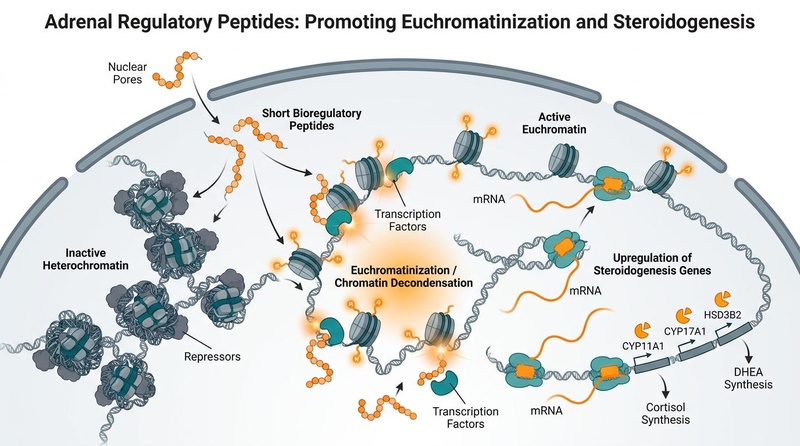
- Epigenetic Interactions & Nucleosomal Signaling: Once inside the adrenal cortex cell nucleus, these short peptides do not act in isolation or bind naked DNA directly; instead, they participate in nucleosomal signaling complexes, interacting with histones, transcription factors, and nuclear chaperones to promote chromatin remodeling (decondensation) of compacted heterochromatin [2:4][6:2].
- Gene Activation & Transcription: By facilitating chromatin decondensation, Glandokort exposes vital promoter regions and genes associated with adrenal steroidogenesis (e.g., enzymes for cortisol and DHEA synthesis), cell repair, and functional integrity. This enables RNA polymerase and transcription factors to access and activate previously silenced genes [2:5][6:3].
- Protein Synthesis Restoration: The activation of these genes leads to the upregulation of ribosomal protein synthesis. This allows depleted adrenal cells to replace vital structural components, restore receptor sensitivity, and optimize baseline hormonal synthesis, effectively rejuvenating the gland at a cellular level [1:13][3:5][6:4].
¶ Pharmacokinetics:
- Half-life: Short (peptides are rapidly metabolized), but effects are prolonged due to epigenetic signaling and lasting changes in protein synthesis.
- Bioavailability by route: Oral bioavailability is generally effective for Khavinson peptides due to their short chain length and resistance to enzymatic degradation, allowing them to enter systemic circulation and reach target tissues [6:5][11:1][12:1].
- Metabolism/degradation: Metabolized by ubiquitous peptidases, but sufficient quantities reach target cells to exert their regulatory effects.
¶ Effects on different systems
¶ Endocrine System (Adrenal, HPA Axis)
Glandokort's primary action is on the adrenal cortex, directly influencing the Hypothalamic-Pituitary-Adrenal (HPA) axis. By restoring adrenal cell function, it helps normalize cortisol rhythms (reducing elevated evening cortisol and supporting adequate baseline levels), enhances DHEA synthesis, and improves overall stress response and adaptogenic capacity [1:14][5:4][7:2][3:6].
¶ Metabolic Health
Through its effects on adrenal function, Glandokort indirectly impacts metabolic health. Improved cortisol regulation can lead to more stable blood glucose levels and enhanced insulin sensitivity. Restored adrenal androgen balance (DHEA) also plays a role in maintaining healthy lipid profiles and body composition [1:15][3:7].
¶ Neuroendocrine & Nervous System
While directly targeting the adrenals, Glandokort contributes to broader neuroendocrine balance. Peptide bioregulators, including those related to Glandokort, have been shown to re-sensitize HPA axis feedback loops and stabilize neuroendocrine responses under stress, contributing to improved mood, reduced asthenia, and overall neuroprotective effects [5:5][7:3][12:2][13]. This helps mitigate the neurological impacts of chronic stress and "burnout."
¶ Administration, reconstitution, and storage
Glandokort is typically available in capsule form for oral administration.
¶ Storage requirements
- Capsules (unopened): Store in a cool, dark place, away from direct sunlight and moisture. Refer to product-specific guidelines, but generally 2-8°C (refrigerated) is recommended for optimal shelf life, though room temperature (up to 25°C) may be acceptable for short periods.
- Opened containers: Keep tightly sealed and follow the same storage guidelines.
¶ Handling and safety
- Always adhere to the manufacturer's recommended dosage and storage instructions.
- Ensure the product is from a reputable source with third-party purity testing.
- Discard if there are any signs of degradation (e.g., unusual odor, discoloration, clumping).
¶ Dosage and protocols
¶ Standard dosing in studies (evidence-based)
- Typical dose range: 20 mg per day.
- Common dosing schedules: Once daily.
- Study durations: 10 to 30 days.
- Frequency: Repeat courses every 3–6 months, depending on individual needs, systemic stress levels, and chronological age [1:16].
¶ Community/anecdotal protocols (NOT evidence-based)
- Some users may experiment with higher doses or longer cycles, but these approaches lack scientific validation and increase potential risks.
- Rationale claimed: Often focused on achieving faster or more pronounced effects for severe "adrenal fatigue" or burnout.
- Evidence level: Anecdotal only; no RCT support; contradicts available safety data for long-term high-dose use of any peptide.
- Risks of deviating from studied protocols: Unknown safety profile, lack of proven efficacy, increased likelihood of unstudied side effects.
¶ Cycling and timing protocols
- Cycling recommendations: Intermittent cycling (e.g., 10-30 days on, then 3-6 months off) is standard to allow the adrenal glands to normalize their function and avoid any potential downregulation, although none has been documented [1:17].
- Timing considerations: Typically taken in the morning, 15–30 minutes before breakfast, to align with the body's natural cortisol rhythm.
¶ Safety and side effects
¶ Safety Profile
- Zero Documented Toxicity: Decades of clinical and experimental use of natural Cytomax extracts, including Glandokort, have shown no toxic side effects, allergenicity, or cumulative overload in studies [1:18][4:4].
- No Negative Feedback Loops: As it does not contain exogenous hormones, Glandokort does not cause adrenal suppression or downregulation of the HPA axis. Its mechanism is regulatory and restorative, not suppressive [1:19].
- Neuroendocrine Stabilization: Studies demonstrate its ability to re-sensitize the HPA axis and restore physiological cortisol secretion patterns, particularly in older adults [5:6][7:4].
¶ Common side effects
- No common side effects have been consistently reported in clinical studies or long-term observations of Glandokort.
¶ Less common / serious concerns
- No serious adverse events or long-term complications have been documented in the available literature.
- As with any supplement, individual sensitivities or allergic reactions are theoretically possible, though no specific cases are reported for Glandokort.
¶ Who should be especially cautious or avoid it
- Pregnancy and Lactation: Contraindicated due to a lack of dedicated safety trials in these populations.
- Children and Adolescents: Not recommended unless under strict medical supervision and for a specific, diagnosed condition.
- Individuals with known adrenal disorders: Concomitant administration with adrenal hormone medications requires careful clinical monitoring, as Glandokort's restorative effects can alter endocrine feedback loops and dosage requirements.
¶ Drug and supplement interactions
¶ Pharmacodynamic interactions (additive / opposing effects)
- Adaptogenic Herbs: Can be co-administered with adaptogenic herbs like Ashwagandha or Rhodiola rosea. These typically function via complementary biochemical pathways, supporting the stress response without directly overlapping with Glandokort's epigenetic mechanism.
- Hormone Replacement Therapy (HRT): Co-administration with exogenous adrenal hormones (e.g., hydrocortisone, DHEA) may necessitate clinical adjustments to HRT dosages to prevent over-correction as endogenous capacity is restored.
- Other Khavinson Peptides: Often stacked with other Khavinson bioregulators like Endoluten (Pineal Bioregulator) to restore HPA axis sensitivity and establish proper neuroendocrine feedback loops [1:20]. This is considered a synergistic interaction.
¶ Monitoring recommendations
- Clinical assessment should track baseline and circadian cortisol, DHEA, and other adrenal hormones. Routine monitoring facilitates precision dosage adjustments of other endocrine agents as endogenous adrenal function changes.
¶ Combining Glandokort with other peptides and supplements ("stacks")
Glandokort is frequently integrated into comprehensive bioregulatory protocols due to its tissue-specific and non-suppressive action.
¶ Common combinations
- Glandokort + Endoluten: A classic combination aimed at full HPA axis restoration. Endoluten targets the pineal gland, helping to normalize circadian rhythms and melatonin production, which in turn improves HPA axis sensitivity and overall neuroendocrine feedback [1:21][5:7][7:5].
- Glandokort + Adaptogens: Often combined with adaptogenic herbs (e.g., Ashwagandha, Rhodiola) for enhanced stress resilience. These herbs provide acute symptomatic relief and broad-spectrum adaptogenic support, complementing Glandokort's long-term cellular repair mechanisms.
- Glandokort + Metabolic Support: Pairing with supplements like B vitamins, magnesium, and vitamin C can support the adrenal glands' high metabolic demands for hormone synthesis.
¶ Evidence level
- Formal combination trials for Glandokort with other supplements are rare. Most recommendations are based on mechanistic complementarity and observational clinical experience from Eastern European research.
- The combination of Glandokort with other Khavinson bioregulators (e.g., Endoluten) has extensive observational data supporting synergistic effects on systemic regulation [1:22].
¶ Safety considerations
- When combining, ensure each component is sourced from a reputable supplier and monitor for any unexpected effects.
- Polypharmacy considerations: Stacking multiple endocrine active compounds requires clinical monitoring to manage cumulative pharmacodynamic effects.
¶ Cost considerations
Glandokort is generally available as a branded supplement, with costs varying based on the manufacturer, retailer, and product quantity.
¶ Typical costs
- Research chemical grade: Typically ranges from $40-$80 per bottle (20 or 60 capsules), depending on concentration and supplier. A 10-day course (20mg/day) would cost roughly $15-$40.
- Cost varies by: Source, purity testing, and regional availability.
¶ Cost-benefit considerations
- For its intended use (adrenal restoration and stress resilience), Glandokort's cost is relatively modest compared to some other peptide therapies or long-term hormone replacement.
- The long-term restorative effects on adrenal function may offer a sustained benefit, potentially reducing the need for continuous use or reliance on other stress-management interventions.
¶ Practical questions
¶ Q: How long does it take to feel the effects of Glandokort?
A: Glandokort's effects are cumulative and restorative, not acute. Noticeable subjective or clinical improvements generally emerge after the second week of a course or in the weeks immediately following its completion as the adrenal cells undergo repair and protein synthesis [1:23].
¶ Q: Can Glandokort suppress my natural cortisol production?
A: No. Glandokort does not contain exogenous hormones and therefore does not suppress your natural cortisol production or downregulate the HPA axis. Its mechanism is to normalize and restore endogenous adrenal function [1:24].
¶ Q: Is Glandokort safe for long-term use?
A: Decades of clinical use and experimental studies have shown no documented toxicity or negative side effects, even with repeated courses over long periods. However, the recommended protocol involves cycling (e.g., 10-30 days of use, repeated every 3-6 months) to allow the body to integrate its restorative effects [1:25][4:5].
¶ Q: Can Glandokort be used for "adrenal fatigue"?
A: While "adrenal fatigue" is not a recognized medical diagnosis, Glandokort's mechanism of restoring adrenal cellular function and stabilizing the HPA axis aligns with addressing the underlying physiological imbalances associated with chronic stress and burnout symptoms often attributed to "adrenal fatigue" [1:26][3:8].
¶ References
Khavinson VKh, Kuznik BI, Ryzhak GA. Peptide bioregulators: the new class of geroprotectors. Message 2. Clinical studies results. Advances in Gerontology = Uspekhi gerontologii. 2013;26(1):20-37. https://pubmed.ncbi.nlm.nih.gov/24003726/ ↩︎ ↩︎ ↩︎ ↩︎ ↩︎ ↩︎ ↩︎ ↩︎ ↩︎ ↩︎ ↩︎ ↩︎ ↩︎ ↩︎ ↩︎ ↩︎ ↩︎ ↩︎ ↩︎ ↩︎ ↩︎ ↩︎ ↩︎ ↩︎ ↩︎ ↩︎ ↩︎
Khavinson VKh, Malinin VV, Vanyushin BF. Role of peptides in epigenetic regulation of gene activities in ontogeny. Bulletin of Experimental Biology and Medicine. 2012;152(3):328-331. https://pubmed.ncbi.nlm.nih.gov/22803113/ ↩︎ ↩︎ ↩︎ ↩︎ ↩︎ ↩︎
Goncharova ND, Lapin BA, Khavinson VKh. Age-associated endocrine dysfunctions and approaches to their correction. Bulletin of Experimental Biology and Medicine. 2002;134(5):417-421. https://pubmed.ncbi.nlm.nih.gov/12802438/ ↩︎ ↩︎ ↩︎ ↩︎ ↩︎ ↩︎ ↩︎ ↩︎ ↩︎
Khavinson VKh, Kuznik BI, Ryzhak G A. Peptide bioregulators: the new class of geroprotectors. Communication 1. Results of experimental studies. Advances in Gerontology = Uspekhi gerontologii. 2012;25(4):696-708. https://pubmed.ncbi.nlm.nih.gov/23734519/ ↩︎ ↩︎ ↩︎ ↩︎ ↩︎ ↩︎
Goncharova ND, Khavinson VKh, Lapin BA. Regulatory effect of Epithalon on production of melatonin and cortisol in old monkeys. Bulletin of Experimental Biology and Medicine. 2001;131(4):385-388. https://pubmed.ncbi.nlm.nih.gov/11550036/ ↩︎ ↩︎ ↩︎ ↩︎ ↩︎ ↩︎ ↩︎ ↩︎
Khavinson VKh, Linkova NS, Polyakova VO. Peptides tissue-specifically stimulate cell differentiation during their aging. Bulletin of Experimental Biology and Medicine. 2012;153(5):724-727. https://pubmed.ncbi.nlm.nih.gov/22808515/ ↩︎ ↩︎ ↩︎ ↩︎ ↩︎ ↩︎
Khavinson V, Goncharova N, Lapin B. Synthetic tetrapeptide epitalon restores disturbed neuroendocrine regulation in senescent monkeys. Neuro Endocrinology Letters. 2001;22(4):251-257. https://pubmed.ncbi.nlm.nih.gov/11524632/ ↩︎ ↩︎ ↩︎ ↩︎ ↩︎ ↩︎
Goncharova ND, Lapin BA. Adrenal androgens: age-related changes of their synthesis and bioregulation of their production in man and non-human primates. Vestnik Rossiiskoi akademii meditsinskikh nauk. 2005;(3):34-41. https://pubmed.ncbi.nlm.nih.gov/16149435/ ↩︎ ↩︎
Rubinskii AV, Linkova NS, Chalisova NI. Epigenetic regulation of adaptogenesis by pathology and aging. Advances in Gerontology = Uspekhi gerontologii. 2021;34(1):110-118. https://pubmed.ncbi.nlm.nih.gov/33993656/ ↩︎ ↩︎
Khavinson VKh, Lin'kova NS, Dudkov VA. Peptidergic regulation of expression of genes encoding antioxidant and anti-inflammatory proteins. Bulletin of Experimental Biology and Medicine. 2012;152(3):339-342. https://pubmed.ncbi.nlm.nih.gov/22803148/ ↩︎
Khavinson VKh, Linkova NS, Kozina LS. Feasibility of Transport of 26 Biologically Active Ultrashort Peptides via LAT and PEPT Family Transporters. Biomolecules. 2023 Mar 22;13(3):552. https://pubmed.ncbi.nlm.nih.gov/36979488/ ↩︎ ↩︎
Khavinson VKh, Linkova NS, Kozina LS. Transport of Biologically Active Ultrashort Peptides Using POT and LAT Carriers. International Journal of Molecular Sciences. 2022 Jul 21;23(14):7733. https://pubmed.ncbi.nlm.nih.gov/35887081/ ↩︎ ↩︎ ↩︎
Umnov RS, Lin'kova NS, Khavinson VKh. Neuroprotective effects of peptides bioregulators in people of various age. Advances in Gerontology = Uspekhi gerontologii. 2013;26(2):331-334. https://pubmed.ncbi.nlm.nih.gov/24738258/ ↩︎