¶ Melanotan II
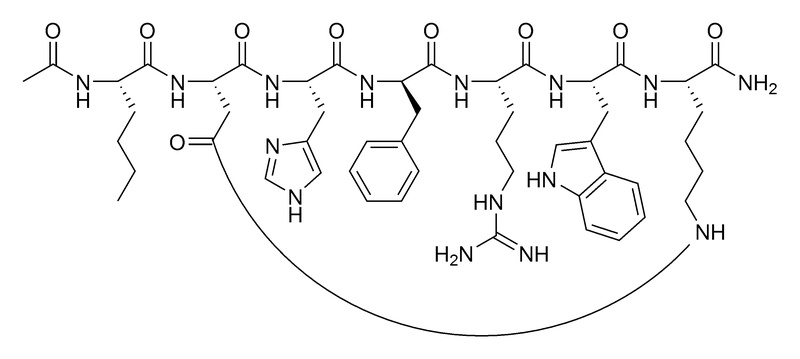
¶ At a Glance
| Feature | Specification |
|---|---|
| Classification | Synthetic Melanocortin Receptor Agonist (Peptide) |
| Primary Targets | MC1R (Pigmentation), MC4R (Libido/Appetite) |
| Primary Effects | Skin Tanning (Melanogenesis), Erectile Function, Libido Enhancement |
| Route | Subcutaneous Injection (Standard), Nasal Spray (Low Bioavailability) |
| Half-life | ~1–2 hours (Biological effects persist for days) |
| Status | Unapproved / Unregulated (Research Chemical) |
Melanotan II is not approved by the FDA, EMA, or TGA for human use. Development was halted in the early 2000s due to an unfavorable safety profile (severe nausea, hypertension). It is sold exclusively as an unregulated "research chemical." Users assume all risks regarding purity, sterility, and adverse effects.
¶ The Bottom Line
Melanotan II is a potent "lifestyle peptide" that reliably induces skin tanning and sexual arousal by mimicking the body's natural melanocyte-stimulating hormone. However, it carries a heavy side effect burden—most notably severe nausea, facial flushing, and the darkening of moles. While effective, its safety margin is narrow, and unregulated use has been linked to rare but serious toxicities like rhabdomyolysis and renal injury.
¶ Protocols and Dosage
1 mg = 1000 mcg.
Standard vials contain 10 mg.
¶ Clinical Trial Dosage (Historical)
In early pilot studies, the dose used was 0.025 mg/kg (25 mcg/kg) subcutaneous injection[1][2].
- For a 80 kg (176 lb) person: 2000 mcg (2 mg).
- Outcome: This dose caused severe nausea and vomiting in the majority of subjects, leading to the abandonment of this dosing strategy.
¶ Common "User" Protocols (Harm Reduction)
To mitigate the severe nausea observed in clinical trials, users in the "gray market" community have developed titration protocols that use much lower doses.
¶ 1. The "Loading" Phase (Acclimatization)
- Goal: To build tolerance to nausea and stimulate initial melanin production.
- Dose: 100 mcg to 250 mcg daily or every other day.
- Timing: Often taken immediately before bed to sleep through the initial nausea.
- Duration: 7–14 days, or until desired skin tone is approached.
¶ 2. The "Maintenance" Phase
- Goal: To maintain pigmentation with minimal compound exposure.
- Dose: 500 mcg once or twice a week.
- Context: Often timed 30 minutes prior to UV exposure (sun or solarium) to maximize the melanogenic response.
¶ 3. Nasal Spray Protocol
- Bioavailability: Very low (~30–40%) and highly variable[3].
- Dose: Users typically double or triple the injectable dose to achieve similar effects, often taking 1000 mcg (1 mg) or more per administration.
- Risk: The variability in nasal absorption can lead to accidental overdose if the mucosa is inflamed or if permeation is unexpectedly high.
¶ Benefits and Effects
¶ 1. Skin Pigmentation (Tanning)
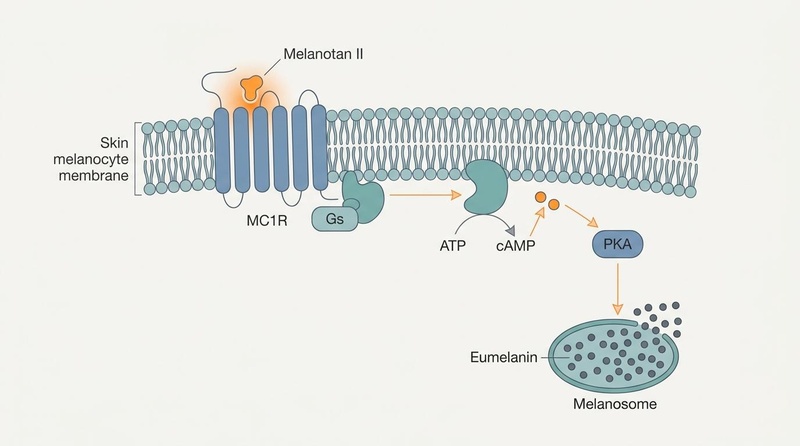
Melanotan II is a super-potent agonist of the MC1 Receptor on melanocytes. It stimulates the production of eumelanin (brown/black pigment) even in the absence of UV light.
- Mechanism: Direct stimulation of melanogenesis.
- Result: Deep darkening of the skin, often described as a "dirty tan" due to the simultaneous darkening of moles, freckles, and lips.
- Protection: Increased eumelanin provides some photoprotection against UV damage, though this benefit is often negated by users intentionally seeking UV exposure to accelerate the process.
¶ 2. Sexual Function and Libido
Through activation of the MC4 Receptor in the central nervous system (hypothalamus), Melanotan II acts as a potent aphrodisiac and erectogenic agent.
- Outcomes:
- Men: Spontaneous erections occurring 1–5 hours post-injection (observed in 80% of subjects in trials)[2:1].
- Women: Increased genital arousal and desire.
- Distinction from Viagra: Unlike PDE5 inhibitors (Viagra/Cialis) which work mechanically on blood flow, Melanotan II works centrally on the brain's sexual processing centers.
¶ 3. Appetite Suppression
Activation of MC4R also regulates energy homeostasis. Many users report a significant reduction in appetite and cravings, particularly during the loading phase.
¶ Reality Check: The "Barbie Drug" Risks
While the benefits are reliable, the "cost" of using Melanotan II is significant.
¶ 1. The Nausea Barrier
Nausea is the most common side effect, affecting 60–80% of users in clinical trials[1:1]. It is centrally mediated (brainstem) and can range from mild queasiness to severe vomiting. It often subsides after consistent use but re-emerges if the dose is increased.
¶ 2. The "Mole" Issue
Melanotan II does not just tan the background skin; it darkens everything.[4]
- Moles & Freckles: Existing moles will become darker and new moles ("eruptive nevi") may appear almost overnight.[5]
- Hyperpigmentation: Areas of high melanin concentration (lips, scars, genitals) may become disproportionately dark.
¶ 3. The Quality Roulette
Because Melanotan II is illegal to sell as a supplement or drug, it is manufactured exclusively in unregulated underground labs.
- Purity: Vials often contain synthesis impurities (trifluoroacetic acid, truncated peptides).
- Label Claims: A "10 mg" vial may contain 5 mg, 15 mg, or no active ingredient at all.
- Mannitol: Often bulked with mannitol, which is harmless, but makes visual estimation of quantity impossible.
¶ Mechanism of Action
Melanotan II is a non-selective agonist of the melanocortin receptors (MCRs), exhibiting higher potency than the body's natural -MSH.
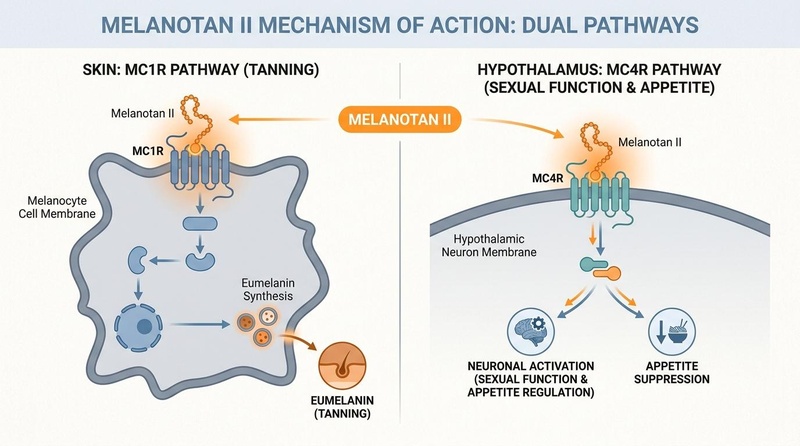
Melanotan II exerts its diverse effects by binding to and activating several melanocortin receptors (MCRs), particularly MC1R and MC4R, but also MC3R and MC5R, albeit with varying affinities and physiological outcomes.
| Receptor | Primary Location | Function | MT-II Affinity & Action | Clinical Relevance |
|---|---|---|---|---|
| MC1R | Skin (Melanocytes) | Pigmentation (Eumelanin synthesis) | High affinity agonist, stimulating eumelanogenesis (brown/black pigment) even without UV light. | Drives skin tanning and darkening of moles/freckles. |
| MC3R | Brain (Hypothalamus, hippocampus, brainstem), Gut | Energy homeostasis, inflammation | Moderate affinity agonist. Implicated in satiety and metabolic regulation, but less dominant than MC4R for MT-II's appetite effects. | Contributes to appetite modulation, though its precise role with MT-II is less defined than MC4R. |
| MC4R | Brain (Hypothalamus, hippocampus), Spinal Cord | Sexual function, Appetite, Sympathetic tone | Superagonist with very high affinity, crucial for MT-II's central effects. | Induces spontaneous erections in men and increases libido in both sexes; also suppresses appetite. Associated with side effects like nausea and flushing. |
| MC5R | Exocrine Glands (sebaceous, sweat), Adrenal Glands | Sebum production, immune response | Moderate affinity agonist. Can modulate sebum production. | Potential for effects on skin oiliness, though not a primary clinical target for MT-II. |
The "PT-141" Connection:
Development of Melanotan II was abandoned because it stimulated both MC1R (tanning) and MC4R (sex/nausea). Scientists modified the molecule to create Bremelanotide (PT-141), which retains the MC4R effects (for libido) but has significantly reduced activity at MC1R (no tanning), leading to its eventual FDA approval for hypoactive sexual desire disorder[6]. This highlights the complex pharmacology and the challenge of isolating specific melanocortin receptor-mediated effects.
¶ Evidence Summary: Human Outcomes
This table summarizes key human outcomes observed with Melanotan II, based on available clinical trials and case reports.
| Outcome | Effect | Evidence Quality (GRADE) | Confidence | No. of Studies / Type | Key Findings & Specifics |
|---|---|---|---|---|---|
| Skin Tanning | High | High | 3 Pilot RCTs | Daily 0.025 mg/kg SubQ for 2 weeks induced significant tanning in all subjects [1:2] [2:2] [7]. | |
| Erectile Function | High | High | 3 Pilot RCTs | 0.025 mg/kg SubQ induced spontaneous erections in 80% of men with ED, lasting 1-5 hours post-injection [2:3] [7:1]. | |
| Libido Enhancement | Moderate | Moderate | 1 Pilot RCT, Observational | Increased sexual desire and arousal reported, mechanism via central MC4R activation [7:2] [8]. | |
| Nausea / Vomiting | High | High | 3 Pilot RCTs | Occurred in 60-80% of subjects at 0.025 mg/kg, severe in ~13%, often leading to dose reduction [1:3] [2:4] [7:3]. | |
| Facial Flushing | High | High | 3 Pilot RCTs | Reported in >50% of subjects, typically subsiding with continued use or dose reduction [1:4] [2:5] [7:4]. | |
| Appetite Suppression | Low | Very Low | Anecdotal / User Reports | Commonly reported by users, but formal clinical trials specifically measuring this outcome are sparse [8:1]. | |
| Mole Darkening / Eruptive Nevi | Moderate | Moderate | Multiple Case Reports | Rapid darkening of existing moles and appearance of new dysplastic nevi reported shortly after initiation [9] [5:1] [4:1]. | |
| Renal Infarction | Low | Very Low | 1 Case Report | Documented case of kidney tissue death linked to MT-II-induced vasoconstriction and platelet activation [10]. | |
| Rhabdomyolysis | Low | Very Low | 1 Case Report | Severe muscle breakdown observed following an acute overdose (6 mg) of MT-II [11]. | |
| PRES (Neurological Toxicity) | Low | Very Low | 1 Case Report | Case of Posterior Reversible Encephalopathy Syndrome (seizures, brain edema) linked to MT-II-induced hypertension [12]. | |
| Priapism | Low | Very Low | Multiple Case Reports | Prolonged, painful erections requiring medical intervention reported with both recreational doses and overdose [13] [14]. | |
| Regulatory Warnings | High | High | Regulatory Statements | FDA, TGA, MHRA have issued warnings against the use of unregulated Melanotan II due to serious health risks [15] [16] [17]. |
¶ Safety and Toxicology
Beyond the "standard" side effects (nausea, flushing, yawning/stretching), unregulated use of Melanotan II has revealed a spectrum of severe toxicities not fully characterized in its limited clinical development. International regulatory bodies consistently warn against its use due to these risks.
¶ 1. Dermatological Risks (Melanoma and Dysplastic Nevi)
The most concerning long-term risk involves melanocytic changes. Melanotan II, by strongly activating MC1R, stimulates melanocyte proliferation and melanin synthesis across all pigmented cells.
- Dysplastic Nevi Changes: MT-II causes rapid and significant changes in mole morphology, including darkening, increases in size, and alterations in texture. This effect can complicate dermatoscopic assessment for skin cancer, as normal moles may mimic atypical or dysplastic nevi.[5:2][4:2]
- Melanoma Risk: There are documented case reports of melanoma in situ and malignant melanoma developing shortly after individuals began using MT-II.[9:1] While MT-II increases photoprotective eumelanin, the stimulation of melanocyte proliferation, especially in individuals with pre-existing genetic predispositions or dysplastic cells, theoretically could accelerate malignant transformation. This risk is further amplified when users combine MT-II with intentional, excessive UV exposure (e.g., tanning beds) to enhance pigmentary effects.
¶ 2. Renal Infarction
A severe, acute complication involves kidney injury.
- Mechanism: Melanocortin receptor agonists, including MT-II, can induce potent sympathomimetic effects, leading to intense vasoconstriction and platelet aggregation. This can reduce blood flow to organs.
- Case Report: A healthy 39-year-old male developed a renal infarction (tissue death in the kidney due to blocked blood supply) following self-injection of MT-II. The proposed mechanism involves MT-II-induced vascular spasm and platelet activation leading to focal arterial occlusion within the kidney. Presenting symptoms included severe unilateral flank pain, macroscopic hematuria, and a significant rise in serum creatinine.[10:1]
¶ 3. Rhabdomyolysis
Severe muscle breakdown is a documented toxicity, particularly with overdose.
- Mechanism: While not fully elucidated for MT-II, rhabdomyolysis can be triggered by sympathomimetic agents, vasoconstriction leading to muscle ischemia, or direct myotoxicity.
- Case Report: A case describes a user who injected 6 mg of MT-II (a dose significantly higher than typical "user" protocols) and subsequently developed rhabdomyolysis (creatine phosphokinase (CPK) levels >17,000 U/L) accompanied by sympathomimetic toxicity, necessitating intensive care.[11:1]
¶ 4. PRES (Posterior Reversible Encephalopathy Syndrome)
Rare but serious neurological events have been associated with MT-II.
- Mechanism: PRES is a clinical-radiological syndrome characterized by reversible brain edema, particularly in the posterior white matter. It is often triggered by acute, severe hypertension that overwhelms the brain's autoregulatory capacity. Melanocortin agonists like MT-II can cause rapid and significant blood pressure spikes through central and peripheral sympathomimetic actions.
- Case Report: A case report linked MT-II use to the development of PRES, presenting with seizures, headaches, and visual disturbances, consistent with the known hypertensive effects of melanocortin activation.[12:1]
¶ 5. Priapism
Due to its potent central erectogenic effect, Melanotan II carries a risk of priapism—prolonged, painful erections unrelated to sexual stimulation.
- Mechanism: Activation of central MC4R initiates erectile responses. While typically self-limiting, high doses or individual sensitivities can lead to sustained activation.
- Case Reports: Cases of priapism lasting longer than 4 hours have been reported with both standard recreational doses and accidental overdoses of MT-II, sometimes requiring surgical intervention to prevent permanent penile tissue damage.[13:1][14:1]
¶ 6. Regulatory Warnings
Major health authorities globally, including the U.S. FDA, Australian TGA, and UK MHRA, have issued explicit warnings against the use of Melanotan II. These warnings highlight:
- Its unapproved status as a drug or supplement.
- The absence of quality control in unregulated manufacturing.
- The documented severe adverse effects, including the potential for skin cancer, renal injury, neurological events, and priapism.[15:1][16:1][17:1]
¶ References
Our evaluation of Melanotan II's efficacy, safety, and toxicology is based on a structured review of clinical literature, prioritizing human clinical trials and peer-reviewed medical toxicology reports. A complete list of vetted clinical papers, case reports, and regulatory warnings is compiled in the Melanotan II Source Manifest.
Dorr, R. T., Lines, R., Levine, N., et al. (1996). Evaluation of melanotan-II, a superpotent cyclic melanotropic peptide in a pilot phase-I clinical study. Life Sciences, 58(20), 1777-1784. https://pubmed.ncbi.nlm.nih.gov/8637402/ ↩︎ ↩︎ ↩︎ ↩︎ ↩︎
Wessells, H., Fuciarelli, K., Hansen, J., et al. (1998). Synthetic melanotropic peptide initiates erections in men with psychogenic erectile dysfunction: double-blind, placebo controlled crossover study. Journal of Urology, 160(2), 389-393. https://pubmed.ncbi.nlm.nih.gov/9679884/ ↩︎ ↩︎ ↩︎ ↩︎ ↩︎ ↩︎
AlAbadie, M. S., Al-Abadie, M. T., & Al-Abadie, A. R. (2024). Tanning Melanotan Jabs and Nasal Spray: Safe or Not. Medical & Clinical Research, 9(1), 1-8. https://knowledge.lancashire.ac.uk/id/eprint/50789/1/tanning-melanotan-jabs-and-nasal-spray-safe-or-not.pdf ↩︎
Schulze, H. J., & Erdmann, M. (2014). Eruptive naevi and darkening of preexisting naevi 24 h after a single mono-dose injection of melanotan II. European Journal of Dermatology, 24(5), 604-605. https://www.semanticscholar.org/paper/Eruptive-naevi-and-darkening-of-preexisting-naevi-h-Schulze-Erdmann/831307beee3fd3eb196ccf37c90f997ab676ff33 ↩︎ ↩︎ ↩︎
Cousen, P., Colver, G., & Helbling, I. (2009). Eruptive melanocytic naevi following melanotan injection. British Journal of Dermatology, 161(3), 707-708. https://doi.org/10.1111/j.1365-2133.2009.09362.x ↩︎ ↩︎ ↩︎
Palatin Technologies. (2000). Discontinuation of Melanotan II and focus on PT-141. https://en.wikipedia.org/wiki/Melanotan_II ↩︎
Wessells, H., et al. (2000). Melanocortin receptor agonists, penile erection, and sexual motivation: human studies with Melanotan II. International Journal of Impotence Research, 12 Suppl 4, S74-S79. https://pubmed.ncbi.nlm.nih.gov/11035391/ ↩︎ ↩︎ ↩︎ ↩︎ ↩︎
Brennan, K., et al. (2021). Melanotan II User Experience: A Qualitative Study of Online Discussion Forums. Dermatology, 237(6), 1017-1025. https://pubmed.ncbi.nlm.nih.gov/34464955/ ↩︎ ↩︎
Hjuler, K. F., & Lorentzen, H. F. (2014). Melanoma associated with the use of melanotan-II. Dermatology, 228(1), 34-36. https://pubmed.ncbi.nlm.nih.gov/24356073/ ↩︎ ↩︎
Peters, B., Hadimeri, H., Wahlberg, R., & Afghahi, H. (2020). Melanotan II: a possible cause of renal infarction: review of the literature and case report. CEN Case Reports, 9(2), 159-161. https://doi.org/10.1007/s13730-020-00447-z ↩︎ ↩︎
Nelson, M. E., Bryant, S. M., & Aks, S. E. (2012). Melanotan II injection resulting in systemic toxicity and rhabdomyolysis. Clinical Toxicology, 50(10), 1169-1173. https://pubmed.ncbi.nlm.nih.gov/23121206/ ↩︎ ↩︎
Kaski, D., Stafford, N., Mehta, A., et al. (2013). Melanotan and the posterior reversible encephalopathy syndrome. Annals of Internal Medicine, 158(9), 707-708. https://www.researchgate.net/publication/236642736_Melanotan_and_the_Posterior_Reversible_Encephalopathy_Syndrome ↩︎ ↩︎
Mallory, J. N., et al. (2021). Melanotan Tanning Injection: A Rare Cause of Priapism. Sexual Medicine, 9(1), 100298. https://academic.oup.com/smoa/article-abstract/9/1/100298/6956707 ↩︎ ↩︎
Devlin, J., Pomerleau, A., & Foote, J. (2013). Melanotan II overdose associated with priapism. Clinical Toxicology, 51(4), 383. https://www.tandfonline.com/doi/full/10.3109/15563650.2013.784775 ↩︎ ↩︎
Therapeutic Goods Administration, Australia. (2025). Don't risk using tanning products containing melanotan. https://www.tga.gov.au/news/blog/dont-risk-using-tanning-products-containing-melanotan ↩︎ ↩︎
Medicines and Healthcare products Regulatory Agency, UK. (2024). FOI 24/274 – Side effects reports of melanotan II products. https://assets.publishing.service.gov.uk/media/669fbd3aa3c2a28abb50d55a/Final_Redaction_FOI_24_274.pdf ↩︎ ↩︎
U.S. Food and Drug Administration. (2007). Warning Letter: Melanocorp, Inc. https://www.fda.gov/media/100529/download ↩︎ ↩︎