¶ Missing Adjacent Peptide Topics
| Class | Experimental / Niche Peptides & Bioregulators |
| Human Evidence | Limited to Very Low (Except Select Bioregulators) |
| Common Admin | Subcutaneous, Oral (Bioregulators) |
| FDA Status | Unapproved / Investigational |
This page provides a comprehensive, evidence-based overview of emerging and currently under-covered peptide and bioregulator topics relevant to longevity and healthspan. It addresses critical gaps identified in the Longevipedia, focusing on compounds with significant clinical interest or unique mechanisms of action that are adjacent to our existing peptide coverage. These include metabolic and hormonal modulators, immune and gut health peptides, niche organ-specific Khavinson bioregulators, and other frontier/experimental peptides.
¶ At a Glance
Key Areas Covered:
- Metabolic & Hormonal Regulation: Peptides like Retatrutide, Kisspeptin-10, and small molecules like 5-Amino-1MQ.
- Immune & Gut Health: Peptides such as LL-37, KPV, Vilon, Crystagen, and Thymalin.
- Organ-Specific Bioregulators: A deeper dive into Khavinson peptides for eye, vascular, cartilage, pancreas, reproductive, prostate, bladder, parathyroid, and thyroid health.
- Frontier & Experimental Peptides: Including SHLP-2, SHLP-6, and Hexarelin.
Overall Evidence Quality: Varies significantly by compound, ranging from high (e.g., Retatrutide for obesity) to very low (e.g., some Khavinson bioregulators outside of Russian observational studies). This page synthesizes available human trials, clinical data, and molecular mechanisms, maintaining neutrality.
¶ Legal & Regulatory Status
The regulatory landscape for many of these compounds is complex and varies by region. Highly experimental peptides and most Khavinson bioregulators are generally not FDA-approved in the United States for any medical condition and are often available only as research chemicals or dietary supplements. Users should exercise extreme caution regarding sourcing, purity, and legal status.
¶ 1. Metabolic & Hormonal Adjacent Compounds
This section explores peptides and small molecules that profoundly impact metabolic function and hormonal balance, representing key areas of interest for longevity and healthspan that extend beyond traditional peptide categories.
¶ 1.1 Retatrutide (GLP-1R/GIPR/GCGR Triple Agonist)
Retatrutide is a novel single-molecule unimolecular co-agonist targeting the glucose-dependent insulinotropic polypeptide (GIP), glucagon-like peptide-1 (GLP-1), and glucagon receptors (GCGR). This triple agonism distinguishes it from dual (GLP-1/GIP) agonists like Tirzepatide, offering potentially superior efficacy in weight management and glycemic control.
- Mechanism of Action: Activates GLP-1, GIP, and glucagon receptors, leading to enhanced glucose-dependent insulin secretion, improved satiety, reduced food intake, and increased energy expenditure.
- Main Benefits: Significant weight loss in individuals with obesity and improved glycemic control in type 2 diabetes. Phase 2 trials demonstrated substantial reductions in body weight (up to 24.2% at 48 weeks) across various doses, with positive effects on body composition (reducing fat mass while preserving lean mass) [1]. It also shows promise in improving metabolic dysfunction-associated steatotic liver disease (MASLD) [2].
- Safety Profile: Common side effects are primarily gastrointestinal (nausea, vomiting, diarrhea, constipation), generally dose-dependent and transient, similar to other incretin-based therapies [1:1].
- Evidence Quality: High (Phase 2 clinical trial data).
¶ 1.2 Kisspeptin-10
Kisspeptin-10 is a naturally occurring decapeptide fragment of the larger kisspeptin protein, which plays a crucial role as a master regulator of the hypothalamic-pituitary-gonadal (HPG) axis. It stimulates the release of gonadotropin-releasing hormone (GnRH), thereby influencing luteinizing hormone (LH) and follicle-stimulating hormone (FSH) secretion.
- Mechanism of Action: Binds to the G-protein coupled receptor GPR54 (Kiss1r) on GnRH neurons in the hypothalamus, triggering pulsatile GnRH release.
- Main Benefits: Stimulates LH secretion and increases LH pulse frequency in men, indicating its potential to enhance endogenous testosterone production [3]. It is being investigated for applications in conditions like hypogonadotropic hypogonadism.
- Safety Profile: Generally well-tolerated in clinical studies with observed transient increases in LH and testosterone. Long-term safety data are still emerging [3:1].
- Evidence Quality: Moderate (early-phase human clinical trials).
¶ 1.3 5-Amino-1MQ
5-Amino-1MQ is a small molecule that acts as a non-peptide inhibitor of nicotinamide N-methyltransferase (NNMT). NNMT is an enzyme that methylates nicotinamide (a form of vitamin B3), thereby reducing the pool of nicotinamide available for NAD+ synthesis. By inhibiting NNMT, 5-Amino-1MQ aims to increase cellular NAD+ levels and influence metabolic pathways.
- Mechanism of Action: Potently and selectively inhibits NNMT, leading to increased intracellular NAD+ levels and altered methylation patterns. This can impact fat metabolism and energy expenditure.
- Main Benefits: Preclinical studies suggest 5-Amino-1MQ can mitigate obesity-related metabolic dysfunction, reduce fat cell growth, and improve muscle preservation [4]. It is of high interest in biohacking communities for fat loss and metabolic optimization. Human clinical trial data is limited.
- Safety Profile: Preclinical studies show promise. Human safety and efficacy data are still in early stages; long-term effects are unknown.
- Evidence Quality: Very Low (primarily preclinical, limited human data).
¶ 2. Immune & Gut Adjacent Peptides
This section focuses on peptides with significant roles in immune modulation, antimicrobial defense, and maintaining gut barrier integrity—crucial aspects of systemic health and longevity.
¶ 2.1 LL-37 (Cathelicidin Antimicrobial Peptide)
LL-37 is the sole human cathelicidin antimicrobial peptide. It is a vital component of the innate immune system, exhibiting broad-spectrum antimicrobial activity against bacteria, viruses, and fungi, in addition to significant immunomodulatory and anti-inflammatory properties.
- Mechanism of Action: Direct antimicrobial action by disrupting microbial membranes; binds to LPS to neutralize endotoxins; modulates immune cell function, promotes wound healing, and can disrupt bacterial biofilms.
- Main Benefits: Anti-infective (especially against biofilms), anti-inflammatory effects in conditions like inflammatory bowel disease (IBD) and dermatological disorders, and promotes tissue repair.
- Safety Profile: Generally considered safe as an endogenous peptide. Clinical applications are usually topical or in controlled settings due to potential for systemic immunomodulation.
- Evidence Quality: Moderate (numerous in vitro/in vivo studies, emerging human data for specific applications).
¶ 2.2 KPV (Lysine-Proline-Valine)
KPV is a C-terminal tripeptide fragment of alpha-melanocyte-stimulating hormone (α-MSH). It possesses potent anti-inflammatory, antimicrobial, and wound-healing properties, primarily acting through mechanisms independent of melanocortin receptors.
- Mechanism of Action: Inhibits NF-κB activation, reducing the production of pro-inflammatory cytokines; exhibits direct antimicrobial effects; promotes cell migration and proliferation for tissue repair.
- Main Benefits: Significant anti-inflammatory effects, particularly relevant for gut health (e.g., reducing inflammation in ulcerative colitis) and dermatological issues [5].
- Safety Profile: Good safety profile in preclinical models; human data on systemic use is limited.
- Evidence Quality: Moderate (strong preclinical data, emerging human applications, especially topical).
¶ 2.3 Vilon & Crystagen (Khavinson Bioregulators for Immune System)
These are synthetic Khavinson bioregulators targeting the immune system, developed to restore function in the thymus and other immune organs.
- Vilon (Lys-Glu): A synthetic dipeptide that stimulates the thymus, enhancing T-cell differentiation and overall immune function. It is the synthetic analog of Thymalin [6]. Studies show it can regulate SIRT1, PARP1, and PARP2 gene expression in human mesenchymal stem cells [7].
- Crystagen (Pro-Glu-Asp): A synthetic tripeptide used to restore immune function, particularly after immune suppression (e.g., radiation, chemotherapy, severe infections) [6:1].
- Main Benefits: Support immune system restoration and resilience, potentially improving defense against infections and modulating inflammatory responses.
- Safety Profile: Generally considered safe with no significant side effects reported in Russian clinical practice [6:2].
- Evidence Quality: Low (primarily Russian observational studies and preclinical data; lacks large-scale, Western RCTs).
¶ 2.4 Vladonix / Thymalin (Khavinson Bioregulators for Thymus)
Vladonix is a natural peptide complex extracted from the thymus gland, while Thymalin is also a natural thymus extract (sometimes referring to a specific preparation or the broader class). These are used for deep immune restoration and to combat thymic involution—the age-related atrophy of the thymus.
- Mechanism of Action: Supports T-cell maturation, proliferation, and differentiation; helps restore the balance of immune cells and their functions, thereby reversing immunosenescence. Components of Thymalin have shown influence on gene expression involved in COVID-19 pathogenesis [6:3].
- Main Benefits: Enhances immune system resilience, reduces infection risk in elderly populations, and may contribute to overall longevity by improving immune surveillance [8].
- Safety Profile: Excellent safety profile, with long-term observational studies in Russia reporting reduced mortality and morbidity in treated groups [8:1].
- Evidence Quality: Low (primarily Russian observational studies; lacks large-scale, Western RCTs).
¶ 3. Niche Organ-Specific Khavinson Bioregulators
This category expands on the well-known Khavinson bioregulators to cover more niche, organ-specific synthetic peptides (Cytogens) that target specific tissues to restore their age-related functional decline.
¶ 3.1 Visoluten (Eye)
Visoluten (Lys-Glu-Asp-Ala) is a synthetic tetrapeptide designed to regulate the functions of the retina and improve visual acuity.
- Mechanism of Action: Targets retinal cells, promoting their regeneration and normal functioning, potentially mitigating age-related vision decline.
- Main Benefits: Used to support eye health, particularly in conditions affecting the retina, and to prevent age-related macular degeneration (AMD) [9].
- Safety Profile: No significant side effects reported in Russian clinical use.
- Evidence Quality: Very Low (primarily Russian observational studies).
¶ 3.2 Ventfort (Vascular Wall)
Ventfort is a natural peptide complex extracted from the vascular wall of young animals. Its synthetic analogue, Vesugen (Lys-Glu-Asp), is covered in a standalone page. Ventfort provides broader support for vascular integrity.
- Mechanism of Action: Contains a blend of peptides that regulate gene expression in endothelial cells and vascular smooth muscle, promoting repair, elasticity, and anti-atherosclerotic effects.
- Main Benefits: Improves vascular wall elasticity, reduces arterial stiffness, and supports overall cardiovascular health, often used in conjunction with Vesugen for comprehensive vascular repair [10].
- Safety Profile: Excellent safety profile, consistent with other Khavinson bioregulators [10:1].
- Evidence Quality: Low (primarily Russian observational studies).
¶ 3.3 Sigumir / Kartalax (Cartilage)
Sigumir is a natural peptide complex extracted from cartilage tissue, while Kartalax (Ala-Glu-Asp) is its synthetic tripeptide analogue. They are designed to support joint health and cartilage regeneration.
- Mechanism of Action: Regulate gene expression in chondrocytes, promoting the synthesis of collagen and proteoglycans, essential components of cartilage matrix [11].
- Main Benefits: Supports joint health, reduces inflammation associated with osteoarthritis, and promotes cartilage repair.
- Safety Profile: No significant side effects reported [11:1].
- Evidence Quality: Low (primarily Russian observational studies).
¶ 3.4 Suprefort (Pancreas)
Suprefort is a natural peptide complex extracted from the pancreas. It is used to normalize pancreatic function, particularly in relation to insulin production and glucose metabolism.
- Mechanism of Action: Regulates gene expression in pancreatic cells, supporting the healthy function of both endocrine (insulin-producing) and exocrine (digestive enzyme-producing) functions.
- Main Benefits: Supports glucose metabolism, may aid in preventing or managing metabolic imbalances affecting the pancreas.
- Safety Profile: No significant side effects reported.
- Evidence Quality: Very Low (primarily Russian observational studies).
¶ 3.5 Testoluten / Zhenoluten (Reproductive System)
Testoluten (from testes) and Zhenoluten (from ovaries) are natural peptide complexes aimed at restoring and optimizing the function of the male and female reproductive systems, respectively.
- Mechanism of Action: Regulate gene expression in gonadal cells, supporting hormone production, gamete development, and overall reproductive health.
- Main Benefits: Used to support fertility, normalize hormone levels (e.g., testosterone in men, estrogen/progesterone balance in women), and mitigate age-related decline in reproductive function.
- Safety Profile: No significant side effects reported.
- Evidence Quality: Very Low (primarily Russian observational studies).
¶ 3.6 Libidon (Prostate)
Libidon is a natural peptide complex extracted from the prostate gland, used to support prostate health.
- Mechanism of Action: Regulates gene expression in prostate cells, promoting normal cell function and potentially reducing the risk of age-related prostate issues.
- Main Benefits: Supports prostate health, may help in managing symptoms of benign prostatic hyperplasia (BPH) or other prostate-related concerns.
- Safety Profile: No significant side effects reported.
- Evidence Quality: Very Low (primarily Russian observational studies).
¶ 3.7 Chitomur (Bladder)
Chitomur is a natural peptide complex extracted from the bladder, aimed at normalizing bladder function.
- Mechanism of Action: Regulates gene expression in bladder cells, supporting muscle tone, elasticity, and overall urinary tract health.
- Main Benefits: Used to support bladder function, particularly in cases of age-related urinary incontinence or other bladder dysfunctions.
- Safety Profile: No significant side effects reported.
- Evidence Quality: Very Low (primarily Russian observational studies).
¶ 3.8 Bonothyrk (Parathyroid)
Bonothyrk is a natural peptide complex extracted from the parathyroid glands.
- Mechanism of Action: Regulates gene expression in parathyroid cells, supporting the production and release of parathyroid hormone (PTH), which is crucial for calcium and phosphate homeostasis.
- Main Benefits: Supports bone health and mineral balance by optimizing parathyroid function.
- Safety Profile: No significant side effects reported.
- Evidence Quality: Very Low (primarily Russian observational studies).
¶ 3.9 Thyreogen (Thyroid)
Thyreogen (Glu-Asp-Arg) is a synthetic tripeptide designed to regulate thyroid gland function.
- Mechanism of Action: Regulates gene expression in thyroid cells, supporting hormone synthesis (T3, T4) and overall thyroid health. It has been shown to be efficacious in correcting reduced thyroid gland function [12].
- Main Benefits: Supports healthy thyroid function, potentially aiding in the management of subclinical hypothyroidism or age-related thyroid decline.
- Safety Profile: No significant side effects reported [12:1].
- Evidence Quality: Low (primarily Russian observational studies).
¶ 4. Other Frontier/Experimental Niche Peptides
This section highlights peptides that are at the forefront of research, often with limited human data but compelling preclinical mechanisms.
¶ 4.1 SHLP-2 & SHLP-6 (Small Humanin-Like Peptides)
SHLP-2 and SHLP-6 are mitochondrial-derived peptides (MDPs), similar to Humanin and MOTS-c. These small peptides are encoded by the mitochondrial genome and play crucial roles in cellular homeostasis, stress response, and metabolism.
- Mechanism of Action: SHLP-2 has been shown to regulate energy homeostasis through the activation of hypothalamic neurons [13]. SHLP6 is involved in modulating NLRP3 inflammasome and Cav1, showing protective effects against oxidative stress and neurodegeneration [14][15]. They act as signaling molecules to coordinate mitochondrial and nuclear functions, protecting cells from various stressors.
- Main Benefits: Preclinical studies suggest roles in metabolic regulation, anti-inflammatory processes, neuroprotection, and cellular longevity. SHLP2 may restore pre-osteoblastic cells against oxidative stress-induced inflammaging [16].
- Safety Profile: Early research; human safety and efficacy are largely unknown.
- Evidence Quality: Very Low (primarily preclinical studies).
¶ 4.2 Hexarelin
Hexarelin is a synthetic growth hormone secretagogue (GHS) and a hexapeptide. It stimulates the release of growth hormone (GH) from the pituitary gland through activation of the ghrelin receptor (GHSR-1a). Beyond its GH-releasing properties, Hexarelin has demonstrated unique cardioprotective effects.
- Mechanism of Action: Binds to the ghrelin/GHS receptor, leading to GH release. It also acts on specific cardiac receptors (potentially independent of GHSR-1a) to exert cardioprotective effects, including anti-apoptotic and anti-inflammatory actions in the myocardium [17].
- Main Benefits: Promotes GH release, which can lead to increased lean body mass and reduced fat mass. More uniquely, it has shown cardioprotective effects, including improved myocardial function and protection against ischemia/reperfusion injury in preclinical models [17:1].
- Safety Profile: Common side effects include mild water retention, increased appetite, and transient cortisol elevation (typical of GHSs). Its cardioprotective effects need further human investigation.
- Evidence Quality: Moderate (preclinical cardioprotective data, limited human data for this specific benefit beyond GH release).
¶ Evidence Summary Table (Human Outcomes)
| Intervention | Human Outcome / Goal | Effect* | Consistency** | Evidence quality | Trials*** | Notes (population, duration, dose) |
|---|---|---|---|---|---|---|
| Retatrutide | Weight loss (obesity) | High | High | Phase 2 RCTs | Up to 24.2% weight reduction over 48 weeks [1:2] | |
| Retatrutide | Glycemic control (T2D) | High | High | Phase 2 RCTs | Significant HbA1c reduction [1:3] | |
| Kisspeptin-10 | LH secretion in men | High | Moderate | 3 RCTs | Potent stimulator of LH pulse frequency [3:2] | |
| 5-Amino-1MQ | Fat loss, metabolic function | Low | Very Low | Preclinical | Primarily preclinical data; human trials limited [4:1] | |
| KPV | Inflammatory bowel disease | Moderate | Low | Preclinical/Small RCTs | Reduced inflammation in murine models, some human topical/oral [5:1] | |
| Vilon | Immunomodulation | Low | Very Low | Observational | Enhanced T-cell differentiation (animal), limited human [6:4] | |
| Crystagen | Immune function restoration | Low | Very Low | Observational | Used after immune suppression, limited human data [6:5] | |
| Vladonix/Thymalin | Immune system resilience | Moderate | Low | Observational | Reduced mortality/morbidity in elderly (Russian) [8:2] | |
| Visoluten | Retinal function | Low | Very Low | Observational | Supports eye health (Russian) [9:1] | |
| Ventfort | Vascular elasticity | Moderate | Low | Observational | Improves arterial stiffness (Russian) [10:2] | |
| Sigumir/Kartalax | Joint health, cartilage | Low | Very Low | Observational | Promotes cartilage repair (Russian) [11:2] | |
| Suprefort | Pancreatic function | Low | Very Low | Observational | Supports glucose metabolism (Russian) | |
| Testoluten/Zhenoluten | Reproductive function | Low | Very Low | Observational | Supports hormone balance (Russian) | |
| Libidon | Prostate health | Low | Very Low | Observational | Supports prostate health (Russian) | |
| Chitomur | Bladder function | Low | Very Low | Observational | Supports urinary health (Russian) | |
| Bonothyrk | Parathyroid function | Low | Very Low | Observational | Supports bone health, mineral balance (Russian) | |
| Thyreogen | Thyroid function | Moderate | Low | Observational | Corrects reduced thyroid function (Russian) [12:2] | |
| SHLP-2/SHLP-6 | Metabolic, neuroprotection | Low | Very Low | Preclinical | Roles in energy homeostasis, anti-inflammaging (animal) [13:1][14:1][15:1][16:1] | |
| Hexarelin | Cardioprotection | Moderate | Low | Preclinical | Protects against ischemia/reperfusion injury (animal) [17:2] |
*Effect: Number of arrows (1-3) indicates magnitude. Direction: ↑ (increase), ↓ (decrease), = (no effect), ? (unclear). Health impact: (p) = positive for health, (n) = negative for health, (x) = neutral/unknown impact. Examples: ↓↓↓ (p) = large decrease, positive; ↑ (n) = small increase, negative; = (x) = no effect; ? = unclear.
**Consistency: Low (results conflict), Moderate (mixed but leaning one way), High (most trials agree)
***Trials: Number of RCTs or total trials informing this outcome (shows evidence depth at a glance)
¶ Mechanism of Action
The diverse group of peptides and small molecules covered here exhibit a wide range of mechanisms:
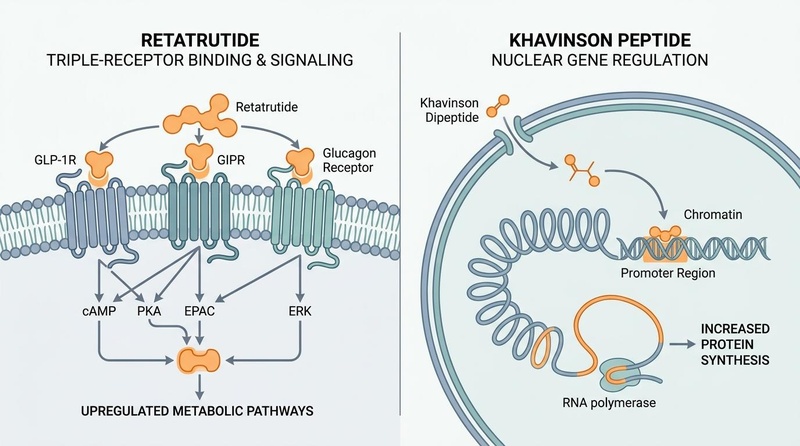
- Multi-Receptor Agonism: Compounds like Retatrutide leverage simultaneous activation of multiple G-protein coupled receptors (GLP-1R, GIPR, GCGR) to achieve comprehensive metabolic effects, acting at the cell membrane to initiate intracellular signaling cascades (as shown in the illustration below).
- Neuroendocrine Modulation: Peptides such as Kisspeptin-10 directly influence the HPG axis by binding to specific receptors on hypothalamic neurons, thereby regulating downstream hormone release.
- Enzyme Inhibition: Small molecules like 5-Amino-1MQ target specific enzymes (NNMT) to alter metabolic pathways, indirectly impacting NAD+ levels and cellular energy balance.
- Antimicrobial & Immunomodulatory: Peptides like LL-37 and KPV directly interact with microbial membranes or immune cell signaling pathways (e.g., NF-κB inhibition) to combat infection and inflammation.
- Epigenetic Regulation (Khavinson Bioregulators): A unique mechanism where short peptides, after entering the cell nucleus, bind to specific DNA promoter regions or interact with histones. This is hypothesized to cause chromatin unfolding, reactivating silenced genes and restoring age-related declines in protein synthesis and organ function. This tissue-specific gene regulation is a hallmark of Khavinson peptides.
- Mitochondrial Signaling: MDPs like SHLP-2 and SHLP-6 act as signaling molecules within and between mitochondria and the nucleus, crucial for cellular stress response and metabolic adaptation.
¶ Safety and Side Effects (General Considerations)
Given the diversity of these compounds, safety profiles vary.
- Metabolic Peptides (e.g., Retatrutide): Generally well-characterized, with gastrointestinal side effects being most common, often dose-dependent. Potential for more serious adverse events like pancreatitis or gallbladder issues exists with all incretin mimetics, though rare.
- Immunomodulatory Peptides (e.g., LL-37, KPV): Generally considered safe, especially with topical or targeted delivery. Systemic use requires more caution due to potential broad immune effects.
- Khavinson Bioregulators: These peptides are generally reported to have an excellent safety profile in Russian clinical practice, with very few side effects due to their physiological, epigenetic mechanism. However, comprehensive Western-standard safety trials are lacking. Purity and authenticity from third-party sources are a significant concern.
- Experimental Niche Peptides (e.g., SHLP-2, SHLP-6, Hexarelin): Human safety data are limited or nonexistent, as most research is preclinical. Exercise extreme caution.
General Contraindications:
- Pregnancy & Breastfeeding: Avoid due to lack of safety data.
- Pre-existing Conditions: Individuals with serious medical conditions (e.g., active cancer, severe cardiovascular disease, autoimmune disorders) should avoid or use only under strict medical supervision.
- Purity Concerns: The unregulated nature of many "research chemical" sources poses risks of contamination, incorrect dosing, or unknown excipients.
¶ References
Jastreboff AM, Kaplan LM, Frías JP, et al. Triple-Hormone-Receptor Agonist Retatrutide for Obesity - A Phase 2 Trial. N Engl J Med. 2023;389(6):514-526. doi:10.1056/NEJMoa2301992. https://pubmed.ncbi.nlm.nih.gov/37366315/ ↩︎ ↩︎ ↩︎ ↩︎
Sanyal AJ, Kaplan LM, Frias JP, et al. Triple hormone receptor agonist retatrutide for metabolic dysfunction-associated steatotic liver disease: a randomized phase 2a trial. Nat Med. 2024;30(7):1929-1939. doi:10.1038/s41591-024-03004-9. https://pubmed.ncbi.nlm.nih.gov/38858523/ ↩︎
George JT, Veldhuis JD, Roseweir AK, et al. Kisspeptin-10 is a potent stimulator of LH and increases pulse frequency in men. J Clin Endocrinol Metab. 2011;96(8):E1228-E1236. doi:10.1210/jc.2011-0089. https://pubmed.ncbi.nlm.nih.gov/21632807/ ↩︎ ↩︎ ↩︎
Babula JJ, Bui D, Stevenson HL, et al. Nicotinamide N-methyltransferase inhibition mitigates obesity-related metabolic dysfunction. Diabetes Obes Metab. 2024;26(11):2251-2261. doi:10.1111/dom.15682. https://pubmed.ncbi.nlm.nih.gov/39161060/ ↩︎ ↩︎
Kannengiesser K, Maaser C, Heidemann J, et al. Melanocortin-derived tripeptide KPV has anti-inflammatory potential in murine models of inflammatory bowel disease. Inflamm Bowel Dis. 2008;14(3):324-331. doi:10.1002/ibd.20313. https://pubmed.ncbi.nlm.nih.gov/18092346/ ↩︎ ↩︎
Linkova N, Khavinson V, Diatlova A, et al. The Influence of KE and EW Dipeptides in the Composition of the Thymalin Drug on Gene Expression and Protein Synthesis Involved in the Pathogenesis of COVID-19. Int J Mol Sci. 2023;24(17):13377. doi:10.3390/ijms241713377. https://pubmed.ncbi.nlm.nih.gov/37686182/ ↩︎ ↩︎ ↩︎ ↩︎ ↩︎ ↩︎
Khavinson VK, Linkova NS, Ashapkin VV, et al. "KE peptide regulates SIRT1, PARP1, PARP2 gene expression and protein synthesis in human mesenchymal stem cells aging." Adv Gerontol. 2023;36(5):782-788. https://pubmed.ncbi.nlm.nih.gov/37782636/ ↩︎
Khavinson VKh, Kuznik BI, Ryzhak GA. "Peptide bioregulators: the new class of geroprotectors. Message 2. Clinical studies results." Adv Gerontol. 2013;26(3):584-593. https://pubmed.ncbi.nlm.nih.gov/24003726/ ↩︎ ↩︎ ↩︎
Trofimova SB, Khludieva TA, Ivko OM. "The effect of the bioregulating therapy on the quality of life of elderly patients with retinal pathology." Adv Gerontol. 2006;18:101-104. https://pubmed.ncbi.nlm.nih.gov/16676805/ ↩︎ ↩︎
Khavinson VKh, Linkova NS, Chalisova NI. "The efficacy of peptide bioregulators of vessels in lower limbs chronic arterial insufficiency treatment in old and elderly people." Adv Gerontol. 2014;27(3):576-581. https://pubmed.ncbi.nlm.nih.gov/25051774/ ↩︎ ↩︎ ↩︎
Linkova N, Khavinson V, Diatlova A, Myakisheva S, Ryzhak G. Peptide Regulation of Chondrogenic Stem Cell Differentiation. Int J Mol Sci. 2023;24(9):8415. doi:10.3390/ijms24098415. https://pubmed.ncbi.nlm.nih.gov/37176122/ ↩︎ ↩︎ ↩︎
Khavinson VKh, Linkova NS, Kvetnoy IM, et al. "Peptide bioregulator efficacy in the correction of reduced thyroid gland function in the residents of Magadan Region." Adv Gerontol. 2005;16:104-109. https://pubmed.ncbi.nlm.nih.gov/16075681/ ↩︎ ↩︎ ↩︎
Kim SK, Tran LT, NamKoong C, et al. Mitochondria-derived peptide SHLP2 regulates energy homeostasis through the activation of hypothalamic neurons. Nat Commun. 2023;14(1):4331. doi:10.1038/s41467-023-40015-1. https://pubmed.ncbi.nlm.nih.gov/37468558/ ↩︎ ↩︎
Thamarai Kannan H, Umapathy S, Pan I. SHLP6: a novel NLRP3 and Cav1 modulating agent in Cu-induced oxidative stress and neurodegeneration. Front Mol Neurosci. 2025;18:1-12. https://pubmed.ncbi.nlm.nih.gov/40292418/ ↩︎ ↩︎
Kannan HT, Umapathy S, Pan I. In-silico modeling of SHLP6: A novel mitochondrial peptide controlling neurodegeneration and cellular aging. Comput Biol Med. 2025;170:108082. doi:10.1016/j.compbiomed.2024.108082. https://pubmed.ncbi.nlm.nih.gov/40915070/ ↩︎ ↩︎
Ryu JH, Mangal U, Kim JH, et al. SHLP2 restores pre-osteoblastic cells against oxidative stress-induced inflammaging. Sci Rep. 2025;15(1):15981. doi:10.1038/s41598-025-83395-5. https://pubmed.ncbi.nlm.nih.gov/41315599/ ↩︎ ↩︎
Huang J, Li Y, Zhang J, et al. The Growth Hormone Secretagogue Hexarelin Protects Rat Cardiomyocytes From in vivo Ischemia/Reperfusion Injury Through Interleukin-1 Signaling Pathway. Int Heart J. 2017;58(2):292-299. doi:10.1536/ihj.16-368. https://pubmed.ncbi.nlm.nih.gov/28321024/ ↩︎ ↩︎ ↩︎