¶ Thymosin Alpha-1
| Sequence | Ac-Ser-Asp-Ala-Ala-Val-Asp-Thr-Ser-Ser-Glu-Ile-Thr-Thr-Lys-Asp-Leu-Lys-Glu-Lys-Lys-Glu-Val-Val-Glu-Glu-Ala-Glu-Asn |
| Formula | C129H215N35O47S |
| Molar Mass | 3108.28 g/mol |
| Category | Immunomodulatory Peptide |
| Half-life | ~2 hours |
| Admin | Subcutaneous (SC) |
| FDA Status | Approved (e.g., for Hepatitis B) |
| CAS | 62313-64-8 |
Thymosin Alpha-1 (Tα1) is a naturally occurring peptide hormone originally isolated from the thymus gland. Synthetically produced, Tα1 plays a crucial role in immune system regulation, enhancing both innate and adaptive immune responses. It is primarily utilized in clinical settings for its immunomodulatory properties, particularly in managing chronic viral infections, improving vaccine responsiveness, and as an adjuvant in certain cancer therapies.
¶ At a glance
Aliases
- Also known as: Tα1, Thymalfasin
- Amino acid sequence: Ac-Ser-Asp-Ala-Ala-Val-Asp-Thr-Ser-Ser-Glu-Ile-Thr-Thr-Lys-Asp-Leu-Lys-Glu-Lys-Lys-Glu-Val-Val-Glu-Glu-Ala-Glu-Asn
- Sequence length: 28 amino acids
- Category: Immunomodulatory peptide, Thymomimetic
Key points (high-level summary)
- Immune Restoration: Tα1 augments CD8⁺ T-cell activation and reverses T-cell exhaustion, enhancing the body's ability to fight infections and cancer [1].
- Antiviral Activity: Improves outcomes in chronic viral infections such as hepatitis B virus (HBV)-related acute-on-chronic liver failure by restoring immune balance [2].
- Cancer Adjuvant: Synergistically remodels the tumor immune microenvironment when combined with immune checkpoint inhibitors, enhancing therapeutic efficacy and safety [3].
- HIV Latency: Induces dendritic cells to secrete the IL-15/IL-15Rα complex, which actively restrains HIV latency progression in vitro [4].
What people use it for
- Main goals: Immune system enhancement, antiviral treatment, cancer immunotherapy adjuvant, T-cell function restoration.
- Evidence quality (overall): Moderate for approved indications (e.g., Hepatitis B), Low to Moderate for off-label or experimental uses (e.g., HIV latency, some cancer adjunctive therapies).
¶ Legal & regulatory status
⚠️ CRITICAL INFORMATION
Thymosin Alpha-1 (as Thymalfasin) is an approved pharmaceutical in several countries for specific indications, predominantly for chronic hepatitis B and C, and as an immune enhancer in certain conditions. Its availability and regulatory status vary significantly by region.
Regulatory classification
- FDA status: Approved for certain indications (e.g., Hepatitis B, but status varies by formulation and country). Not broadly approved for all immunomodulatory uses in the US.
- Approved indications (if any): Chronic Hepatitis B, chronic Hepatitis C (in some regions), certain primary immunodeficiencies.
- Prescription requirement: Prescription required in regions where it is approved as a drug.
- DEA schedule: Not a controlled substance.
Geographic legal status
- United States: Available by prescription for approved indications; some off-label use may occur under medical supervision.
- European Union: Availability varies by country, often requiring a prescription.
- Other regions: Widely used in Asia and South America for its immunomodulatory effects in various conditions.
Source quality considerations
- Pharmaceutical grade: Available as a prescription medication (e.g., Zadaxin) with assured purity and potency.
- Research chemical grade: Risks of variable purity, contaminants, and lack of regulatory oversight. Third-party testing is crucial if sourcing from non-pharmaceutical channels.
- Counterfeit concerns: Due to its demand, counterfeit versions exist, posing significant health risks.
¶ What is Thymosin Alpha-1?
Thymosin Alpha-1 (Tα1) is a synthetic analog of a naturally occurring 28-amino acid peptide produced by the thymus gland, a primary organ of the immune system. The thymus is responsible for the maturation of T-lymphocytes, which are critical for cell-mediated immunity. Tα1 plays a role in enhancing T-cell function and broader immune responses.
- Definition: Tα1 is a polypeptide with the sequence Ac-Ser-Asp-Ala-Ala-Val-Asp-Thr-Ser-Ser-Glu-Ile-Thr-Thr-Lys-Asp-Leu-Lys-Glu-Lys-Lys-Glu-Val-Val-Glu-Glu-Ala-Glu-Asn. It is considered a thymomimetic, mimicking the activity of endogenous thymic hormones.
- Relationship to endogenous peptides: It is a part of the larger thymosin family of peptides, which are involved in various immune system processes. Tα1 represents the N-terminal fragment of prothymosin α, exhibiting potent immunomodulatory activities.
- Modifications from native sequence: The synthetic form is identical to the naturally occurring peptide and is acetylated at the N-terminus.
- Natural sources (if any): Endogenously produced by epithelial cells within the thymus.
- Development history: First isolated and characterized in 1977 by Allan Goldstein and colleagues. It was later developed as a pharmaceutical agent, with the brand name Thymalfasin (Zadaxin) being widely recognized.
- Key pharmacological property: Primarily an immune enhancer, promoting the differentiation and maturation of T-cells and modulating cytokine production.
¶ What are Thymosin Alpha-1's main benefits?
Thymosin Alpha-1’s main benefits stem from its ability to enhance and modulate the immune system. It has been studied across various conditions, particularly those involving compromised immunity or chronic viral loads.
¶ 1. Immune Cell Activation and Exhaustion Reversal
Tα1 significantly enhances the proliferation and activation of CD8⁺ T-cells, which are critical for clearing viral infections and cancer cells. It also helps reverse T-cell exhaustion, a state where T-cells become dysfunctional after prolonged antigen exposure, by reducing the expression of exhaustion markers like PD-1, TIM-3, and LAG-3. This suggests Tα1 can restore immune cell function in chronic conditions and cancer [1:1].
¶ 2. Antiviral Effects in Chronic Infections
In patients with hepatitis B virus (HBV)-related acute-on-chronic liver failure (ACLF), Tα1 treatment has been shown to improve clinical outcomes and survival rates. It achieves this by restoring the immune balance, reducing inflammatory responses, and supporting the liver's recovery [2:1]. Furthermore, in vitro studies indicate Tα1 can restrain HIV latency by inducing dendritic cells to secrete the IL-15/IL-15Rα complex [4:1].
¶ 3. Adjuvant in Cancer Immunotherapy
Tα1 has demonstrated synergistic effects when combined with immune checkpoint inhibitors (ICIs) in cancer therapy. It helps to remodel the immunosuppressive tumor immune microenvironment, making cancer cells more vulnerable to immune attack and potentially improving the efficacy and safety of ICI treatments [3:1]. It has also been shown to restore chemotherapy-induced antitumor immunity by chaperoning a microRNA ligand of TLR7 in dendritic cells [5].
¶ 4. Reduction of Senescent Cells
In the context of hepatocellular carcinoma, combining IL-15 with Tα1 has been observed to reduce senescent hepatic CD8+ T cells via the suppression of the PI3K/AKT pathway. This mechanism contributes to enhancing antitumor immunity by clearing dysfunctional, aging immune cells [6][7].
¶ Evidence summary table (human outcomes)
| Outcome / Goal | Effect* | Consistency** | Evidence quality | Trials*** | Notes (population, duration, dose) |
|---|---|---|---|---|---|
| CD8+ T-cell activation in vitro | High | Low | 1 In vitro | In human CD8+ T-cells, Tα1 promoted proliferation, activation, and cytokine secretion [1:2] | |
| T-cell exhaustion reversal in vitro | High | Low | 1 In vitro | Reduced exhaustion markers (PD-1, TIM-3, LAG-3) in human CD8+ T-cells [1:3] | |
| Outcomes in HBV-related ACLF | Moderate | Moderate | Clinical Study | Improved survival and immune balance in patients [2:2] | |
| Antitumor immunity restoration post-chemo | Moderate | Low | Preclinical/In vitro | Tα1 chaperoned microRNA to TLR7 in dendritic cells, restoring antitumor immunity [5:1] | |
| Synergistic effects with ICIs in cancer | High | Moderate | Systematic Review | Remodeled tumor immune microenvironment, enhancing ICI efficacy [3:2] | |
| Reduction of senescent hepatic CD8+ T cells | Moderate | Low | Preclinical/In vitro/Letter | Combination with IL-15 suppressed PI3K/AKT pathway [6:1][7:1] | |
| Restraining HIV latency in vitro | High | Low | 1 In vitro | Induced dendritic cells to secrete IL-15/IL-15Rα complex [4:2] |
¶ How does Thymosin Alpha-1 work?
Thymosin Alpha-1 exerts its immunomodulatory effects through multiple pathways, primarily by enhancing T-cell-mediated immunity and innate immune responses.
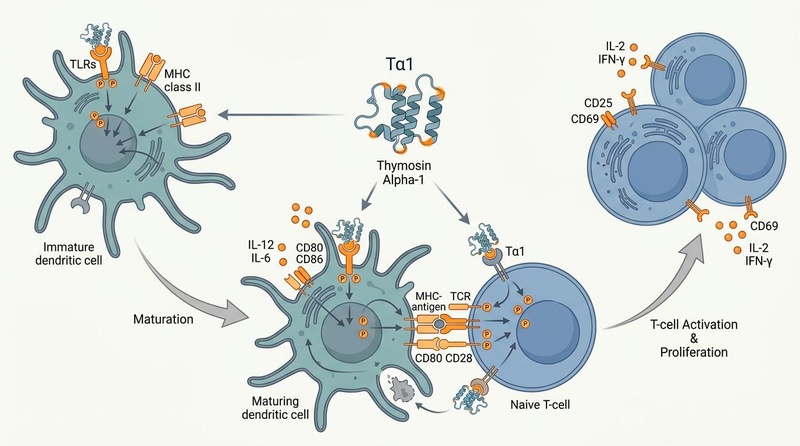
- Primary targets: Tα1 primarily targets immune cells, including T-lymphocytes, dendritic cells, and natural killer (NK) cells. It interacts with Toll-like receptors (TLRs), particularly TLR9, and influences various signaling cascades.
- Core mechanisms:
- T-cell Maturation and Activation: Tα1 promotes the differentiation and maturation of T-lymphocytes, especially CD4+ helper T-cells and CD8+ cytotoxic T-cells, in the thymus and peripheral lymphoid organs. It enhances their proliferation, activation markers (CD69, CD25, HLA-DR), and the production of crucial cytokines like interleukin-2 (IL-2), interferon-gamma (IFN-γ), and tumor necrosis factor-alpha (TNF-α) [1:4].
- Dendritic Cell Modulation: Tα1 acts on dendritic cells, key antigen-presenting cells, by chaperoning microRNA ligands to intracellular Toll-like receptors (TLR7). This interaction leads to the activation of immune responses and the restoration of antitumor immunity, particularly after chemotherapy [5:2].
- Immune Balance Restoration: It helps to restore the balance between T helper 1 (Th1) and T helper 2 (Th2) immune responses, favoring a Th1-dominant response crucial for fighting intracellular pathogens and cancer.
- Reversal of T-cell Exhaustion: Tα1 has been shown to mitigate the expression of exhaustion markers (e.g., PD-1, TIM-3, LAG-3) on T-cells, thereby enhancing their effector function in chronic immune challenges [1:5].
- Senescent Cell Reduction: In conjunction with IL-15, Tα1 contributes to the reduction of senescent CD8+ T-cells (see Cellular Senescence), possibly through the suppression of the PI3K/AKT pathway, which is relevant in conditions like hepatocellular carcinoma [6:2][7:2].
- Pharmacokinetics:
- Half-life: The serum half-life of Tα1 in humans is relatively short, typically around 2 hours, necessitating frequent dosing (e.g., twice weekly).
- Bioavailability by route: Administered primarily by subcutaneous (SC) injection, which provides good bioavailability. Oral administration is not effective due to peptide degradation in the gastrointestinal tract.
- Peak plasma concentration: Achieved within 1-2 hours following subcutaneous injection.
- Metabolism/degradation: Rapidly metabolized by peptidases.
¶ Effects on different systems
¶ Immune Function and Inflammation
Thymosin Alpha-1 is primarily known for its profound effects on the immune system. It enhances both innate and adaptive immunity by stimulating T-cell maturation, promoting cytokine production (IL-2, IFN-γ), and restoring the function of exhausted T-cells. These actions make it valuable in chronic infections and as an adjuvant in cancer therapy. It also helps modulate inflammation by balancing immune responses.
¶ Hepatic Health
In conditions like hepatitis B virus (HBV)-related acute-on-chronic liver failure (ACLF), Tα1 has demonstrated significant benefits. It helps to re-establish immune homeostasis within the liver, reduces excessive inflammatory responses, and contributes to improved patient outcomes and survival rates [2:3]. Its role in reducing senescent hepatic CD8+ T cells is also relevant for liver health in the context of hepatocellular carcinoma [6:3][7:3].
¶ Oncology (Cancer Therapy)
Tα1 is gaining attention as an adjuvant in cancer treatment, particularly in combination with immune checkpoint inhibitors (ICIs). It synergistically remodels the tumor immune microenvironment, turning an immunosuppressive environment into one more conducive to immune attack. This can enhance the efficacy and safety of ICI treatments and restore antitumor immunity following chemotherapy [3:3][5:3].
¶ Infectious Diseases (beyond liver)
Beyond hepatitis, Tα1 shows promise in other infectious diseases. In vitro studies suggest its potential to restrain HIV latency by inducing dendritic cells to secrete the IL-15/IL-15Rα complex, highlighting its broad antiviral and immunomodulatory capabilities [4:3].
¶ Administration, reconstitution, and storage
¶ Reconstitution
Thymosin Alpha-1 is typically supplied as a lyophilized (freeze-dried) powder in sterile vials and requires reconstitution with a sterile diluent, most commonly bacteriostatic water for injection.
| Vial strength | Diluent volume | Final concentration | Example: 0.8 mg dose | Example: 1.6 mg dose |
|---|---|---|---|---|
| 1 mg | 1 mL | 1 mg/mL (1000 mcg/mL) | 0.8 mL (80 units) | 1.6 mL (160 units) |
| 2 mg | 1 mL | 2 mg/mL (2000 mcg/mL) | 0.4 mL (40 units) | 0.8 mL (80 units) |
| 5 mg | 1 mL | 5 mg/mL (5000 mcg/mL) | 0.16 mL (16 units) | 0.32 mL (32 units) |
Note: 100 units on an insulin syringe = 1 mL
¶ Storage requirements
- Lyophilized (powder): Store unopened vials at 2–8°C (refrigerated) or -20°C (freezer). Protect from light. Shelf life can be several years.
- Reconstituted (solution): Store at 2–8°C (refrigerated) and typically use within 7-14 days. Discard if it becomes cloudy, discolored, or contains particulate matter.
- During travel: Transport in an insulated container with ice packs if reconstituted.
- Freeze-thaw stability: Avoid freezing reconstituted Tα1, as it can degrade the peptide.
- Light sensitivity: Store reconstituted solution protected from direct light.
¶ Handling and safety
- Sterile technique importance: Always use aseptic technique during reconstitution and administration to prevent contamination and infection.
- Sharps disposal: Dispose of needles and syringes in a designated sharps container.
- Avoiding contamination: Do not touch the rubber stopper or needle with bare hands. Use alcohol swabs to clean vial tops and injection sites.
¶ Dosage and protocols
Dosage and administration protocols for Thymosin Alpha-1 vary significantly based on the medical condition being treated and regional guidelines. Always follow specific clinical recommendations or a healthcare provider's instructions.
¶ Standard dosing in studies (evidence-based)
- Typical dose range: For conditions like chronic hepatitis B or C, typical doses are 0.8 mg to 1.6 mg administered subcutaneously, one to three times per week.
- Body weight-based dosing: Less commonly used for Tα1 in standard clinical practice, but may be considered in specific research protocols.
- Common dosing schedules: Twice weekly is a common regimen for immunomodulatory effects. For some acute conditions, daily dosing might be used for a limited period.
- Study durations: Treatment courses can range from 6 months to 1 year for chronic conditions, with follow-up periods to assess sustained response.
¶ Community/anecdotal protocols (NOT evidence-based)
- Common off-label dosing patterns: Some individuals use Tα1 for general immune support or anti-aging purposes, with doses ranging from 0.8 mg to 3.2 mg per week, often split into multiple injections.
- Rationale claimed: Users often cite improved immune resilience, reduced frequency of infections, or enhanced overall well-being.
- Evidence level: Anecdotal only; these protocols lack robust clinical trial support and are considered experimental.
- Risks of deviating from studied protocols: Unknown long-term safety, potential for altered efficacy, and increased risk of side effects due to unsupervised higher doses or inappropriate use.
¶ Cycling and timing protocols
- Cycling recommendations: For chronic use, some protocols suggest cycling (e.g., 6-8 weeks on, followed by a break) to prevent potential desensitization, although this is not universally established in clinical guidelines.
- Timing considerations: Generally, the timing of subcutaneous injection (e.g., morning or evening) does not significantly impact efficacy. Consistent administration on designated days is more important.
¶ Special populations
- Dose considerations or lack of data in:
- Kidney or liver impairment: Dosing adjustments may be necessary due to altered peptide metabolism or excretion. Consult a clinician.
- Older adults: Generally considered safe, but close monitoring for side effects is advisable due to age- related physiological changes.
- Pregnant/breastfeeding: Generally contraindicated due to insufficient safety data.
- Children and adolescents: Use is typically limited to specific approved indications under strict medical supervision.
¶ Safety and side effects
Thymosin Alpha-1 is generally well-tolerated, with a favorable safety profile when used under medical supervision for approved indications. Most side effects are mild and transient.
¶ Common side effects
- Injection site reactions: Mild redness, swelling, discomfort, or bruising at the site of subcutaneous injection. These are usually temporary.
- Systemic effects: Infrequently, patients may experience fatigue, headache, nausea, or dizziness. These are typically mild and do not require discontinuation of treatment.
- Fever: A low-grade fever has been reported in some individuals, particularly at the beginning of treatment, which is thought to be related to immune activation.
¶ Less common / serious concerns
- Allergic reactions: Rare, but hypersensitivity reactions, including rash or urticaria, have been reported. Severe anaphylaxis is extremely rare.
- Autoimmune exacerbation: In theory, as an immune stimulant, Tα1 could exacerbate autoimmune conditions. However, clinical data on this risk are limited, and it has also been studied for its potential to modulate autoimmune responses beneficially.
- Immunological changes: While beneficial for immune enhancement, close monitoring of immune parameters is recommended, especially in patients with complex immune dysregulation.
¶ Who should be especially cautious or avoid it
- Individuals with known hypersensitivity: Avoid if there is a history of allergic reactions to Tα1 or its components.
- Pregnant or breastfeeding women: Lack of sufficient safety data in these populations makes its use generally contraindicated.
- Patients with severe autoimmune disease: Use with caution and under strict medical guidance due to its immune-stimulating properties.
- Organ transplant recipients: Due to its immunomodulatory effects, Tα1 might interfere with immunosuppressive regimens.
¶ Drug and supplement interactions
¶ Pharmacodynamic interactions (additive / opposing effects)
- Immunosuppressants: Tα1, as an immune stimulant, may theoretically antagonize the effects of immunosuppressive drugs. Concurrent use should be approached with caution and under medical supervision.
- Chemotherapeutic agents: In some cancer therapies, Tα1 is used as an adjuvant to restore chemotherapy-induced immune suppression, suggesting a beneficial synergistic interaction in specific contexts [5:4].
- Immune checkpoint inhibitors (ICIs): Tα1 has shown synergistic effects when combined with ICIs, improving the remodeling of the tumor immune microenvironment and enhancing therapeutic outcomes [3:4].
- Interleukin-15 (IL-15): Combination with IL-15 has been observed to enhance the reduction of senescent hepatic CD8+ T cells in preclinical models, suggesting a synergistic immunomodulatory effect [6:4][7:4].
¶ Monitoring recommendations
- Immune markers: Regular monitoring of T-cell subsets, cytokine levels, and other immune parameters may be recommended, especially in patients receiving Tα1 for chronic conditions or as an adjuvant to other therapies.
- Liver function tests: Essential for patients being treated for hepatitis or other liver conditions.
- Clinical symptoms: Patients should be advised to report any unusual or severe side effects to their healthcare provider.
¶ Combining Thymosin Alpha-1 with other peptides and supplements ("stacks")
While clinical trials for specific "stacks" involving Thymosin Alpha-1 are rare, mechanistic insights and anecdotal reports suggest potential synergistic combinations for immune optimization.
¶ Common combinations
- Tα1 + Zinc: Zinc is a vital cofactor for many immune enzymes and processes. Combining it with Tα1 might offer enhanced general immune support.
- Tα1 + Vitamin D: Vitamin D is well-known for its immunomodulatory properties. This combination could provide broader immune system regulation.
- Tα1 + Melatonin: Melatonin has immune-enhancing and anti-inflammatory effects, potentially complementing Tα1's actions, especially in sleep-related immune recovery.
- Tα1 + Thymosin Beta-4 (TB-500): While Tα1 focuses on adaptive immunity (T-cells), TB-500 is known for tissue repair and cell migration, offering a broader regenerative and immune-supportive combination.
- Tα1 + Other immunomodulatory peptides: Anecdotal reports sometimes suggest combining Tα1 with other peptides for complex immune challenges, but this is highly experimental.
¶ Evidence level
- Formal combination trials: Extremely limited or non-existent for most "stacks."
- Mechanistic/theoretical reasoning only: Most suggested combinations are based on an understanding of individual component mechanisms.
- Potential risks of combining: Increased complexity of side effects, unknown interactions, and a lack of established safety or efficacy data.
¶ Safety considerations
- Additive side effects: Combining multiple agents may increase the likelihood or severity of side effects.
- Monitoring complexity: It becomes more challenging to identify the cause of any adverse reaction.
- Unknown interactions: The combined pharmacological effects may lead to unpredictable outcomes.
- Legal/regulatory implications: Using multiple research chemicals or off-label substances together carries increased legal and regulatory risks.
¶ Cost considerations
The cost of Thymosin Alpha-1 can vary significantly depending on whether it is obtained as a pharmaceutical-grade product or a research chemical, as well as the dosage and duration of treatment.
¶ Typical costs
- Pharmaceutical grade (prescription): If available by prescription (e.g., Thymalfasin), costs can range from hundreds to thousands of dollars per month, depending on insurance coverage and dosage.
- Research chemical grade: Typically sold in lyophilized powder vials (e.g., 1 mg, 2 mg, 5 mg) by research chemical suppliers. Costs can range from $50 to $200 per vial, with monthly expenses varying widely based on dosage and frequency.
- Cost varies by: Source purity, brand reputation, vial size, and the required dosage for a given protocol.
¶ Cost-benefit considerations
- For FDA-approved indications: The cost-benefit ratio is typically established through clinical trials, and insurance coverage may mitigate out-of-pocket expenses, making it a viable option for medically necessary treatments.
- For off-label use: All costs are typically out-of-pocket. The high cost coupled with limited or anecdotal evidence requires a careful evaluation of uncertain benefits against significant financial investment.
- Long-term financial commitment: Chronic conditions or long-term immune support protocols can lead to substantial cumulative costs.
- Hidden costs: Syringes, bacteriostatic water, alcohol swabs, and potential costs for monitoring (e.g., blood tests for immune markers) should be factored in.
¶ Value assessment
- Strength of evidence: Interventions with strong, high-quality evidence (e.g., for chronic hepatitis) offer a better value proposition than those with weak or anecdotal support (e.g., general "anti-aging" use).
- Magnitude of effect: Consider whether the potential effects justify the financial outlay, especially for small or subjective benefits.
- Alternative options: Explore more affordable or evidence-backed alternatives for immune support or specific health goals.
¶ Practical questions (FAQ)
¶ What is the primary function of Thymosin Alpha-1?
Thymosin Alpha-1 is an immunomodulatory peptide that enhances T-cell function, promotes immune cell activation, and helps restore immune balance, making it beneficial for combating infections and supporting cancer therapies.
¶ How is Thymosin Alpha-1 typically administered?
It is most commonly administered via subcutaneous (SC) injection, usually into fatty tissue. Oral forms are ineffective due to peptide degradation.
¶ Are there any significant side effects of Thymosin Alpha-1?
Thymosin Alpha-1 is generally well-tolerated. Common side effects are mild injection site reactions (redness, swelling). Systemic side effects like fatigue or headache are rare and usually mild. Serious allergic reactions are extremely rare.
¶ Can Thymosin Alpha-1 be used for general immune boosting?
While Tα1 enhances immune function, its use for general "immune boosting" in healthy individuals is largely off-label and lacks extensive clinical trial data. It is primarily studied and used in conditions involving compromised immunity or specific immune challenges.
¶ Does Thymosin Alpha-1 interact with other medications?
Tα1 may interact with immunosuppressants, potentially antagonizing their effects. It has shown synergistic benefits when combined with certain chemotherapies and immune checkpoint inhibitors in cancer treatment. Always consult a healthcare provider regarding potential interactions.
¶ How long does it take to see effects from Thymosin Alpha-1?
The onset of effects can vary. In acute settings (e.g., severe infections), immune responses may improve relatively quickly. For chronic conditions or as an adjuvant therapy, noticeable benefits may take several weeks to months of consistent administration.
¶ Is Thymosin Alpha-1 approved by the FDA?
Thymosin Alpha-1 (as Thymalfasin) has received regulatory approval in several countries for specific indications, such as chronic hepatitis B. Its broad FDA approval status in the United States for all immunomodulatory uses is not established, and it is largely used off-label or in specific approved contexts.
¶ References
Mishra S, Telang G, Sureshbabu A, et al. Thymosin α1 Augments CD8⁺ T-Cell Activation and Reverses Exhaustion In Vitro. Asian Pacific Journal of Cancer Prevention. 2026;27(6):2089-2096. https://pubmed.ncbi.nlm.nih.gov/42345155/ ↩︎ ↩︎ ↩︎ ↩︎ ↩︎ ↩︎
Li ZH, Wu LL, Zhu YQ, et al. Thymosin α1 improves the outcomes of patients with hepatitis B virus-related acute-on-chronic liver failure by restoring immune balance. Immunopharmacology and Immunotoxicology. 2026;48(2):296-304. https://pubmed.ncbi.nlm.nih.gov/41887933/ ↩︎ ↩︎ ↩︎ ↩︎
Guo H, Li R. Thymosin α1 combined with immune checkpoint inhibitors: synergistic remodeling of the tumor immune microenvironment to enhance clinical efficacy and safety. Frontiers in Immunology. 2026;17:1762151. https://pubmed.ncbi.nlm.nih.gov/42292432/ ↩︎ ↩︎ ↩︎ ↩︎ ↩︎
Chen C, Xun J, Wang J, et al. Thymosin α1-induced secretion of the IL-15/RA complex by THP-1-derived dendritic cells restrains HIV latency in vitro. Virulence. 2026;17(1):2645858. https://pubmed.ncbi.nlm.nih.gov/41824632/ ↩︎ ↩︎ ↩︎ ↩︎
Wei Y, Chen J, Zhang Y, et al. Thymosin Alpha-1 Restores Chemotherapy-Induced Antitumor Immunity by Chaperoning a MicroRNA Ligand of TLR7 in Dendritic Cells. Cancer Research. 2026;86(12):2478-2490. https://pubmed.ncbi.nlm.nih.gov/42295795/ ↩︎ ↩︎ ↩︎ ↩︎ ↩︎
Wu F, Guo Z, Guan J, et al. IL-15 Plus Thymosin α1 Reduces Senescent Hepatic CD8(+) T Cells in Hepatocellular Carcinoma via PI3K/AKT Suppression. Journal of Gastroenterology and Hepatology. 2026;41(5):1618-1628. https://pubmed.ncbi.nlm.nih.gov/41883056/ ↩︎ ↩︎ ↩︎ ↩︎ ↩︎
Sengul I, Sengul D. Regarding IL-15 Plus Thymosin α1 Reduces Senescent Hepatic CD8+ T Cells in Hepatocellular Carcinoma via PI3K/AKT Suppression. Journal of Gastroenterology and Hepatology. 2026;41(7):2212-2213. https://pubmed.ncbi.nlm.nih.gov/42212632/ ↩︎ ↩︎ ↩︎ ↩︎ ↩︎