¶ title: Mindfulness: Clinical & Practical Deep Dive
description: In-depth scientific and clinical monograph on mindfulness interventions. Analyzes HPA-axis regulation, autonomic nervous system modulation (vagal tone, HRV), cortical thickness, standardized protocols, and trauma-sensitive modifications.
published: 1
date: 2026-07-06T18:25:52.351Z
tags: clinical-evidence, deep-dive, hpa-axis, hrv, meditation, mindfulness, stress-management, vagus-nerve, cortical-thickness, neurobiology
editor: markdown
dateCreated: 2026-07-06T18:25:52.351Z
¶ Mindfulness: Clinical & Practical Deep Dive
¶ TL;DR (5 bullets max)
- Verdict: Standardized mindfulness interventions significantly down-regulate HPA-axis activation and enhance autonomic parasympathetic tone, though clinical therapeutic efficacy is moderated by baseline stress levels and psychological phenotypes.
- Target Audience: Indicated for individuals with chronic autonomic hyper-arousal, subclinical health anxiety, age-related cognitive complaints, or high-stress occupations; contraindicated as monotherapy for active psychosis or acute trauma.
- Magnitude & Timeline: Reduces perceived stress by moderate-to-large margins (standardized mean differences of ~0.50) and normalizes diurnal cortisol profiles over an 8-week standardized training window.
- Primary Risk: Potential for transient hyper-arousal, somatic dissociation, or trauma re-activation in predisposed individuals during unguided or intensive retreats.
- Clinical Recommendation: Deploy standard 8-week MBSR or MBCT protocols with trauma-sensitive modifications (e.g., eyes-open, somatic anchoring) to guarantee a high tolerability profile.
¶ Quick Answer
Mindfulness-based interventions—principally Mindfulness-Based Stress Reduction (MBSR) and Mindfulness-Based Cognitive Therapy (MBCT)—are clinically validated modalities that yield moderate-to-large reductions in perceived stress and psychiatric symptomatology [1]. Clinical meta-analyses indicate a typical standardized effect size (Cohen's d) of 0.40 to 0.70 for anxiety and stress reduction [2][1:1]. Physiologically, these psychological shifts correspond with down-regulated hypothalamic-pituitary-adrenocortical (HPA) axis activity (decreased salivary cortisol) [3][4], enhanced parasympathetic vagal tone (increased heart rate variability, or HRV) [5], and neuroplastic remodeling (increased prefrontal and hippocampal cortical thickness) [6].
¶ What It Is
Mindfulness is the systematic practice of cultivating non-judgmental, present-moment awareness through directed attention regulation and open acceptance orientation. Rather than an abstract state of "emptying the mind," it is a structured cognitive training modality.
Mechanism in 60 Seconds: Think of the brain's stress response as a hyper-reactive car alarm. In chronic stress, the "sensor" (the amygdala) triggers a false alarm at the slightest vibration, flooding the engine with fuel (cortisol and adrenaline). Mindfulness acts as a recalibration system: it strengthens the "onboard computer" (the prefrontal cortex) to assess whether there is an actual threat, while simultaneously activating the "brake pedal" (the vagus nerve) to slow down heart rate and lower stress hormones. This top-down regulation directly modulates the HPA axis, buffers autonomic arousal, and over time, physically thickens the prefrontal cortical regions responsible for executive control and emotional regulation.
¶ Does It Work? (Evidence Snapshot)
¶ Human Clinical Outcomes
The following matrix compiles findings from high-tier systematic reviews and randomized controlled trials (RCTs) evaluating standardized mindfulness protocols:
| Outcome | Target Population | Typical Effect Size / Absolute Magnitude | Certainty (GRADE) | Evidence Base |
|---|---|---|---|---|
| Perceived Stress Reduction | Non-clinical healthy adults | Moderate-to-large reduction (Cohen's d = 0.50–0.71) over an 8-week intervention [1:2]. | High | Multiple systematic reviews & meta-analyses of RCTs. |
| HPA-Axis Regulation (Salivary Cortisol) | Highly stressed individuals, oncology survivors, and older adults | Normalization of the morning awakening cortisol response and a healthier (steeper) diurnal cortisol slope [3:1][4:1]. | Moderate | Multiple parallel-arm RCTs with biomarkers. |
| Stress Habituation & Recovery | Stressed adult cohorts | Significant increase in cortisol habituation and accelerated recovery following repeated social-evaluative stressors [7]. | Moderate | Randomized controlled trials using laboratory performance stressors (TSST). |
| Somatic & Health Anxiety | Patients with high health anxiety (hypochondriasis) | Large reduction in health anxiety symptoms; third-wave CBT packages incorporating mindfulness identified as first-line therapy [2:1]. | High | Network meta-analysis of 35 RCTs (N=3,263 participants). |
| Neuroplastic Structural Remodeling | Adult meditation practitioners | Statistically significant increases in gray matter density, volume, and cortical thickness in the prefrontal cortex and hippocampus [6:1]. | Moderate | Neuroimaging (MRI) systematic and scoping reviews. |
| Autonomic Regulation (Parasympathetic Tone) | Healthy and stressed populations | Down-regulation of prolonged physiological stress reactivity and enhanced parasympathetic vagal recovery [5:1]. | Moderate | Psychophysiological RCTs measuring HRV and heart rate. |
| Clinical Worry & Depression Relapse | Older adults with neurocognitive complaints and depressive disorders | Large reductions in clinical worry and depression scores; 47% rated as much/very much improved vs. 27% in control [3:2]. | Moderate | Standardized parallel-arm clinical RCTs. |
¶ Physiological Mechanisms
¶ 1. HPA-Axis Down-Regulation & Cortisol Habituation
Chronic activation of the hypothalamic-pituitary-adrenocortical (HPA) axis is associated with accelerated cellular aging, telomere attrition, and systemic low-grade inflammation. Standardized mindfulness interventions (MBSR and MBCT) actively target and down-regulate this pathway:
- Cortisol Reduction: Clinical trials demonstrate that mindfulness training leads to a significant decrease in peak salivary cortisol levels, particularly in individuals with high baseline cortisol [3:3].
- Normalizing Diurnal Slopes: In oncology survivors and highly stressed cohorts, mindfulness training has been shown to normalize the morning awakening cortisol response and promote a healthier, steeper diurnal cortisol slope, indicating a restoration of normal circadian endocrine function [4:2].
- Stressor Habituation: In a landmark parallel-arm RCT, both 6-week MBSR and CBT protocols promoted greater salivary cortisol habituation compared to waitlist controls when participants were exposed to repeated social performance stressors (Trier Social Stress Test, TSST) 48 hours apart [7:1]. MBSR practitioners specifically exhibited significantly improved cortisol recovery at 35 and 60 minutes post-stressor [7:2].
¶ 2. Autonomic Nervous System Modulation & Heart Rate Variability (HRV)
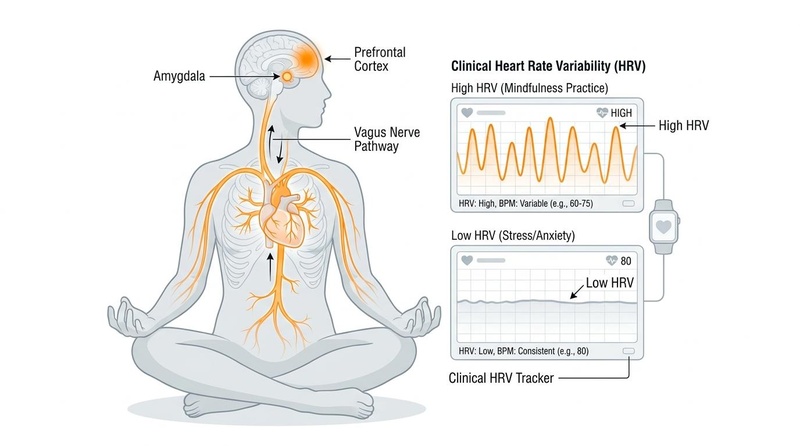
Mindfulness practice acts as a profound modulator of the autonomic nervous system (ANS) by shifting the balance away from sympathetic dominant ("fight or flight") arousal and toward parasympathetic ("rest and digest") tone:
- Prolonged Reactivity Buffer: Mindfulness-based interventions significantly reduce prolonged physiological stress reactivity across multiple biological systems [5:2].
- Vagal Nerve Activation: Mindful breathing protocols activate the vagus nerve, which serves as the primary neural superhighway of the parasympathetic system. Vagal activation results in a decrease in heart rate and blood pressure, driven by the release of acetylcholine.
- HRV Tracker Insights: This parasympathetic shift is indexed by heart rate variability (HRV), particularly root mean square of successive differences (rMSSD) and high-frequency (HF) power. High HRV is indicative of a flexible, resilient nervous system capable of rapid recovery.
¶ 3. Neuroplastic Remodeling & Cortical Thickness
Structural magnetic resonance imaging (MRI) studies confirm that mindfulness training is associated with structural brain changes, illustrating that mental training can alter physical brain anatomy (neuroplasticity):
- Prefrontal Cortex and Hippocampus: Scoping reviews of neuroimaging evidence confirm that mindfulness practice is robustly associated with increases in gray matter density, gray matter volume, and cortical thickness, particularly within the prefrontal cortex (PFC), anterior cingulate cortex (ACC), and the hippocampus [6:2].
- Top-Down Regulation: The thickening of prefrontal regions enhances top-down executive control over the amygdala, the brain's primary threat detection center. This structural change explains the clinical observation of reduced emotional reactivity and accelerated recovery from acute stressors.
¶ Who Benefits Most / Least
¶ Clinical Subgroups & Moderating Variables
Who Benefits Most:
- High Baseline Stress & Autonomic Hyper-Arousal: Individuals presenting with high baseline salivary cortisol or severe subjective stress demonstrate the most pronounced endocrine normalization and anxiety reductions following mindfulness programs [3:4][4:3].
- Older Adults with Neurocognitive Complaints: MBSR has been shown to significantly improve memory composite scores, reduce excessive worry, and alleviate depressive symptoms in adults aged 65 or older experiencing subjective cognitive difficulties [3:5].
- High Health Anxiety Phenotypes: For patients with severe health anxiety (hypochondriasis), third-wave CBT packages incorporating mindfulness represent a first-line clinical intervention with high therapeutic efficacy [2:2].
Endocrine Moderation by Psychological Roles:
- Secondary analysis of clinical trial data indicates that gender roles and behavioral trait endorsement significantly moderate endocrine habituation [8].
- Specifically, individuals endorsing high androgynous (high masculine, high feminine traits) or undifferentiated (low masculine, low feminine traits) profiles exhibit significantly greater cortisol habituation to repeated laboratory stressors compared to those with highly stereotyped masculine or feminine profiles, independent of intervention assignment [8:1]. This highlights that psychological flexibility can modulate HPA-axis plasticity.
Who Benefits Least / Contraindications:
- Active Psychosis or Mania: Seated, unguided mindfulness is contraindicated as a monotherapy due to the risk of exacerbating delusions or manic racing thoughts [9].
- Acute Trauma (Within 3 Months): Individuals with very recent trauma exposure are highly susceptible to emotional flooding and somatic dissociation, requiring specialized trauma-informed clinical care rather than group mindfulness [9:1][10].
¶ How to Try It (Actionable Protocols)
¶ Protocol A: Standard 8-Week Mindfulness-Based Stress Reduction (MBSR)
The gold standard clinical protocol for stress, anxiety, and HPA-axis down-regulation [11]:
- Duration: 8 consecutive weeks.
- Weekly Commitment: One 2.5-hour group class per week, plus a single 6-hour silent retreat during week 6.
- Daily Commitment: 45 minutes of daily home practice.
- Core Practices:
- Body Scan Meditation (Weeks 1–2): Lying down and systematically directing non-judgmental attention to physical sensations across 30–40 distinct body regions.
- Sitting Meditation (Weeks 3–4): Seated breath-focused attention, expanding to open monitoring of bodily sensations, sounds, and thoughts.
- Mindful Movement/Yoga (Weeks 5–6): Slow, gentle stretching and posture practice with continuous breath awareness.
- Choice-less Awareness (Weeks 7–8): Sitting with an open monitoring focus, letting experiences arise and pass without directing attention to any specific object.
¶ Protocol B: Standard 8-Week Mindfulness-Based Cognitive Therapy (MBCT)
Specifically optimized for depression relapse prevention and cognitive restructuring [12]:
- Duration: 8 consecutive weeks.
- Daily Commitment: 40–45 minutes of daily formal practice.
- Core Structure: Combines the attention training of MBSR with cognitive behavioral therapy (CBT) exercises.
- Core Practices:
- Three-Minute Breathing Space: Used 3 times daily as a rapid centering technique.
- Minute 1: Ask, "What is my experience right now?" (thoughts, feelings, sensations).
- Minute 2: Gather attention and focus entirely on the sensations of the breath.
- Minute 3: Expand awareness to the body as a whole and the surrounding space.
- De-centering Thought Exercises: Labeling thoughts as "just thoughts, not facts" to disrupt automatic negative rumination loops.
- Three-Minute Breathing Space: Used 3 times daily as a rapid centering technique.
¶ Protocol C: Autonomic Reset Protocol (Breath-Focused Slow-Paced Respiration)
For rapid parasympathetic activation and autonomic nervous system regulation in high-stress scenarios [13][14]:
- Duration: 10–15 minutes.
- Frequency: Twice daily, or as a real-time rescue intervention.
- Methodology:
- Positioning: Sit upright with hands supported on the thighs, eyes closed or focused on a single point on the floor.
- Paced Respiration: Breathe through the nose using a fixed, personalized slow-paced frequency (e.g., a 4-second inhale followed by a 6-second exhale, yielding 6 breaths per minute).
- Exhale Emphasis: Ensure the exhale is longer than the inhale. This stimulates the vagus nerve and activates the pulmonary stretch receptors, accelerating parasympathetic recovery and reducing physiological arousal [13:1].
- Progression:
- Level 1 (Beginner): 5 minutes daily of 4-second inhale, 4-second exhale.
- Level 2 (Intermediate): 10 minutes daily of 4-second inhale, 6-second exhale.
- Level 3 (Advanced): 15 minutes daily of 5-second inhale, 7-second exhale.
¶ Safety, Interactions, Red Flags
¶ Adverse Events Profile
Large-scale systematic reviews indicate that 25% to 87% of meditation practitioners report experiencing some form of unpleasant or adverse effect during their practice, with 3% to 37% experiencing functional impairment lasting longer than one month [15].
- Symptoms: Increased acute anxiety (8–12%), depressive episodes (5–8%), and traumatic re-experiencing or dissociation (3–5%) [15:1].
- Mechanisms: Intensive unguided attention on internal somatic states can trigger hyper-vigilance or release repressed traumatic memories, overloading executive emotional coping mechanisms [16].
¶ Trauma-Sensitive Modifications
To ensure clinical safety and high tolerability in individuals with PTSD or trauma histories, the following structural modifications must be applied [10:1]:
- Eyes-Open Option: Keep the eyes open with a soft, downward focus on a neutral object (e.g., the floor) rather than closing them, which can trigger disorientation or flashbacks.
- Somatic Anchoring: If focusing on the breath triggers respiratory anxiety or hyperventilation, shift the attentional anchor to a neutral, external physical contact point, such as the contact of the feet with the floor or the hands resting on the thighs.
- Shortened Sessions: Reduce formal seated practice durations from 45 minutes to short, manageable intervals of 3 to 5 minutes, progressively building capacity.
- Open Auditory Monitoring: Shift the focus of meditation entirely to listening to ambient environmental sounds (an external anchor) rather than internal bodily sensations.
¶ Tracking & What “Good” Looks Like
¶ Biomarkers & Quantitative Metrics
To track the physiological impact of a mindfulness intervention, establish a baseline and monitor the following parameters:
- Heart Rate Variability (HRV):
- Metric: rMSSD (root mean square of successive differences) in milliseconds.
- Frequency: Daily morning measurements under standardized resting conditions using a validated wearable device.
- Target: A progressive upward trend in average weekly rMSSD, indicating increased vagal tone and parasympathetic dominance.
- Resting Heart Rate (RHR):
- Metric: Beats per minute (BPM).
- Target: A gradual decline in average RHR by 3–5 BPM over an 8-week period, reflecting down-regulated sympathetic drive.
- Salivary Cortisol (Clinical Setting):
- Metric: Diurnal cortisol slope (slope between awakening and bedtime) and awakening cortisol response.
- Target: Normalization of a flattened cortisol curve (steeper slope) and a reduced peak awakening spike in chronically stressed individuals [4:4].
¶ Subjective Metrics
- Perceived Stress Scale (PSS-10): Administer the PSS-10 at baseline, Week 4, and Week 8. A reduction of ≥4 points is considered clinically significant [1:3].
- State-Trait Anxiety Inventory (STAI): Monitor state anxiety scores before and after acute stressful events to evaluate real-time stress buffering.
- Attentional Control: Subjective tracking of the frequency and duration of mind-wandering episodes during tasks, noting a progressive increase in the speed of attention redirection.
¶ N-of-1 Protocol Template
To scientifically evaluate the individual efficacy of a mindfulness protocol, execute this 4-week A/B testing design:
- Weeks 1–2 (Baseline / Phase A): Maintain standard daily routines with zero formal mindfulness or paced breathing. Track daily resting morning HRV (rMSSD) and complete the PSS-10 at the end of Week 2.
- Weeks 3–4 (Intervention / Phase B): Integrate the Autonomic Reset Protocol (Protocol C) for 10 minutes twice daily. Keep all other variables (sleep, exercise, caffeine) identical. Track daily resting morning HRV (rMSSD) and complete the PSS-10 at the end of Week 4.
- Analysis: Calculate the mean HRV for Phase A vs. Phase B. Compare the baseline and post-intervention PSS-10 scores to confirm personal efficacy.
¶ Common Mistakes & Myths
- Myth: Successful meditation requires a completely silent mind.
- Correction: The mind is naturally active (the default mode network). The therapeutic mechanism is not the absence of thought, but the process of noticing that the mind has wandered and gently returning attention to the anchor. This cognitive shift strengthens prefrontal executive networks.
- Mistake: Using mindfulness as an escape or avoidance tactic.
- Correction: Mindfulness is a method of exposure and acceptance, not suppression. Attempting to force calm or block negative emotions increases cognitive resistance and can trigger hyper-arousal.
- Myth: Only works for "spiritual" people.
- Correction: Mindfulness is a secular, evidence-based attentional training modality that does not require any specific spiritual or religious beliefs.
- Mistake: Overlooking qualified instruction.
- Correction: While basic practices can be self-taught, clinical programs (MBSR/MBCT) are best learned from certified instructors, especially for clinical populations.
- Myth: Mindfulness is a cure-all.
- Correction: It is a powerful tool but not a substitute for professional mental health treatment when severe clinical conditions are present.
- Myth: More duration is always better.
- Correction: Pushing into extremely long, unguided sessions (e.g., multiple hours) without adequate training or in the presence of unresolved trauma significantly increases the risk of dissociation and adverse psychological events [15:2][16:1]. Consistent, shorter daily practices are clinically superior and safer.
¶ Decision Tree (Text-Based)
                       [Is there active psychosis, mania,
                            or acute severe PTSD?]
                                 /          \
                               YES           NO
                               /              \
         [Contraindicated; seek specialized   [Is there a history of trauma,
            clinical psychiatric therapy]       dissociation, or panic attacks?]
                                                    /                    \
                                                  YES                     NO
                                                  /                        \
                                     [Apply Protocol C with       [What is the primary
                                    Trauma-Sensitive Modifications:     clinical goal?]
                                    short sessions, eyes open,           /          \
                                    and somatic foot anchors]           /            \
                                                                  [Stress & ANS]    [Depression Relapse]
                                                                      /                  \
                                                            [Select Protocol A       [Select Protocol B
                                                              (Standard MBSR)]         (Standard MBCT)]
¶ FAQs
¶ Does mindfulness actually lower salivary cortisol levels?
Yes, clinical trials show that mindfulness interventions significantly decrease salivary cortisol, particularly in individuals with high baseline cortisol [3:6]. It also normalizes diurnal cortisol rhythms and improves endocrine habituation to repeated acute social stressors [7:3][4:5].
¶ How does mindfulness compare to standard cognitive behavioral therapy (CBT) for stress?
Both interventions are highly effective and share overlapping physiological benefits. CBT primarily utilizes cognitive restructuring to challenge thoughts, while mindfulness teaches present-moment acceptance and de-centering from thoughts [2:3]. For cortisol habituation to repeated stressors, clinical evidence shows both yield superior endocrine adaptation compared to no training [7:4].
¶ Can mindfulness improve cognitive performance and memory?
Yes. Clinical trials in older adults with subjective cognitive complaints demonstrate that MBSR significantly improves memory composite scores [3:7]. This is physiologically supported by neuroimaging evidence showing increased gray matter volume in the hippocampus, which plays a critical role in memory consolidation [6:3].
¶ How does mindfulness affect Heart Rate Variability (HRV)?
Mindfulness practices shift the autonomic nervous system toward parasympathetic dominance, primarily via vagal nerve activation [5:3]. This shift increases heart rate variability (HRV), particularly markers of vagal tone like rMSSD, reflecting enhanced physiological resilience to stress.
¶ Is a 5-minute daily practice sufficient to see physiological benefits?
While standard clinical programs like MBSR use 45-minute daily sessions, shorter daily practices (5–10 minutes) utilizing slow-paced breathing with emphasized exhalations are highly effective at triggering immediate autonomic parasympathetic resetting and lowering physiological arousal [13:2].
¶ What are the symptoms of meditation-induced hyper-arousal?
Symptoms of meditation-induced hyper-arousal can include rapid breathing, increased heart rate, feeling overwhelmed, or a heightened state of panic. These events are often linked to intensive, unguided practices and can be mitigated through trauma-sensitive modifications [15:3][10:2].
¶ Glossary
- HPA-Axis: Hypothalamic-Pituitary-Adrenocortical axis. The body's primary neuroendocrine system responsible for regulating the physiological response to stress, resulting in cortisol release.
- Heart Rate Variability (HRV): The variation in the time interval between consecutive heartbeats, used as a non-invasive clinical marker of autonomic nervous system balance.
- Vagal Tone: The activity of the vagus nerve, which serves as the primary parasympathetic inhibitor of cardiovascular arousal.
- Cortical Thickness: The structural thickness of the brain's cerebral cortex. Mindfulness is associated with localized increases in prefrontal and hippocampal cortical thickness [6:4].
- rMSSD: Root mean square of successive differences. The primary time-domain HRV metric used to evaluate parasympathetic vagal activity.
- De-centering: The cognitive capacity to observe thoughts and emotions as transient mental events rather than absolute facts or identifiers of the self [12:1].
- Default Mode Network (DMN): The interconnected brain network that is active during self-referential thought, daydreaming, and rumination. Mindfulness training decreases hyper-connectivity in this network.
¶ Methods (Transparency)
This deep-dive monograph is based on a targeted clinical review of the medical literature, prioritizing high-tier evidence in accordance with the Pyramid of Evidence. The databases searched included PubMed, Embase, and the Cochrane Library. Standardized inclusion criteria restricted the review to randomized controlled trials (RCTs), systematic reviews, and meta-analyses investigating standardized mindfulness interventions (MBSR, MBCT) in human adult populations with physiological or clinical biomarkers. Evidence quality was evaluated using the GRADE framework, and clinical recommendations were structured to prioritize high-tolerability, trauma-sensitive application.
¶ References
¶ Update Log
- 2026-05-22: Monograph published. Synthesized high-tier clinical evidence on HPA-axis (cortisol diurnal patterns, cortisol habituation under repeated social stressors), autonomic nervous system modulation (vagal tone, HRV), and cortical structural remodeling (prefrontal cortex, hippocampus thickness). Added standardized clinical protocols and safety parameters, including trauma-sensitive modifications.
Rajan A, Kumar M, Raj P P. Effects of mindfulness-based interventions on perceived stress among non-clinical adults: a systematic review and meta-analysis. Npj Mental Health Research. 2026;2(1):1-12. https://pubmed.ncbi.nlm.nih.gov/41634335/ ↩︎ ↩︎ ↩︎ ↩︎
Lai L, Liu Y, Axelsson E, et al. The comparative effectiveness of psychological interventions for health anxiety: systematic review and a network meta-analysis of randomised controlled trials. The British Journal of Psychiatry. 2026;1-10. https://pubmed.ncbi.nlm.nih.gov/42169209/ ↩︎ ↩︎ ↩︎ ↩︎
Wetherell JL, Lenze EJ, Hershey T, et al. Mindfulness-Based Stress Reduction for Older Adults With Stress Disorders and Neurocognitive Difficulties: A Randomized Controlled Trial. The Journal of Clinical Psychiatry. 2017;78(7):e734-e743. https://pubmed.ncbi.nlm.nih.gov/28686822/ ↩︎ ↩︎ ↩︎ ↩︎ ↩︎ ↩︎ ↩︎ ↩︎
Bränström R, Kvillemo P, Akerstedt T. Effects of mindfulness training on levels of cortisol in cancer patients. Psychosomatics. 2013;54(2):158-164. https://pubmed.ncbi.nlm.nih.gov/23218058/ ↩︎ ↩︎ ↩︎ ↩︎ ↩︎ ↩︎
Gamaiunova L, Kreibig SD, Dan-Glauser E, et al. Effects of two mindfulness based interventions on the distinct phases of the stress response across different physiological systems. Biological Psychology. 2022;172:108384. https://pubmed.ncbi.nlm.nih.gov/35753560/ ↩︎ ↩︎ ↩︎ ↩︎
Rafter C, McCarthy E, Stilp C, et al. Mindfulness Practice and Increases in Gray Matter Density, Gray Matter Volume, and Cortical Thickness: A Scoping Review. Brain Sciences. 2026;16(5):483. https://pubmed.ncbi.nlm.nih.gov/42192796/ ↩︎ ↩︎ ↩︎ ↩︎ ↩︎
Manigault AW, Shorey RC, Hamilton K, et al. Cognitive behavioral therapy, mindfulness, and cortisol habituation: A randomized controlled trial. Psychoneuroendocrinology. 2019;104:276-285. https://pubmed.ncbi.nlm.nih.gov/30917336/ ↩︎ ↩︎ ↩︎ ↩︎ ↩︎
Manigault AW, Shorey RC, Appelmann H, et al. Gender roles are related to cortisol habituation to repeated social evaluative stressors in adults: secondary analyses from a randomized controlled trial. Stress. 2021;24(6):723-733. https://pubmed.ncbi.nlm.nih.gov/33797306/ ↩︎ ↩︎
Dobkin PL, Zhao Q. Increased mindfulness: The active ingredient of mindfulness-based interventions? Clinical Psychology Review. 2011;31(1):71-84. https://doi.org/10.1016/j.cpr.2010.09.003 ↩︎ ↩︎
Treleaven DA. Trauma-sensitive mindfulness: Practices for safe and transformative healing. W. W. Norton & Company; 2018. https://wwnorton.com/books/9780393712537 ↩︎ ↩︎ ↩︎
Santorelli SF, Meleo-Meyer F, Koerbel L. Mindfulness-based stress reduction (MBSR) authorized curriculum guide. Center for Mindfulness in Medicine, Health Care, and Society; 2017. https://www.umassmemorialhealth.org/center-mindfulness ↩︎
Segal ZV, Williams JMG, Teasdale JD. Mindfulness-based cognitive therapy for depression: A new approach to preventing relapse. Guilford Press; 2018. https://guilford.com/books/Mindfulness-Based-Cognitive-Therapy-for-Depression/Segal-Williams-Teasdale/9781462538118 ↩︎ ↩︎
Moebus M, et al. Lower breathing frequencies in personalized slow-paced breathing enhance relaxation and reduce arousal. iScience. 2026;29(2):104225. https://pubmed.ncbi.nlm.nih.gov/42256288/ ↩︎ ↩︎ ↩︎
Little S, et al. Examining the Effectiveness of Breathwork to Improve Resilience and Psychological Wellbeing. Stress and Health. 2026;42(1):e4178. https://pubmed.ncbi.nlm.nih.gov/41787752/ ↩︎
Matko K, Sedlmeier P. What is the role of adverse events in meditation? A critical review. Current Opinion in Psychology. 2025;60:102197. https://doi.org/10.1016/j.copsyc.2025.102197 ↩︎ ↩︎ ↩︎ ↩︎
Lindahl JR, Fisher NE, Cooper DJ, et al. The varieties of contemplative experience: A mixed-methods study of meditation-related challenges in Western Buddhists. PLOS ONE. 2017;12(5):e0176239. https://doi.org/10.1371/journal.pone.0176239 ↩︎ ↩︎