¶ Alpha-GPC
| Type | Choline compound |
| Active Cmpd | L-alpha-glycerylphosphorylcholine |
| Source | Endogenous, milk, soy (often semi-synthetic) |
| Dose Range | 300-1200 mg/day |
| Half-life | Unknown/Variable |
| Main Benefit | Cognition, neuroprotection, strength |
| Absorption | High |
L-alpha-glycerylphosphorylcholine (Alpha-GPC) is a highly bioavailable choline compound that serves as a precursor to acetylcholine, a critical neurotransmitter for memory and learning, and provides building blocks for neuronal cell membranes. It is clinically studied for its benefits in cognitive decline and shows promise for athletic performance.
¶ At a glance
Aliases
- Also known as: Choline alphoscerate
- Chemical / botanical name: L-alpha-glycerylphosphorylcholine
- Category: Choline compound, phospholipid derivative
Key points (high-level summary)
- In patients with Alzheimer's disease and vascular dementia, Alpha-GPC significantly slows cognitive decline and improves behavioral symptoms when combined with standard therapies [1][2][3][4].
- Alpha-GPC can mitigate brain atrophy in key cognitive areas in dementia patients, as shown by MRI evidence [5].
- Acute high doses of Alpha-GPC may transiently increase exercise-induced growth hormone secretion and improve lower-body isometric strength after chronic loading [6][7].
- Alpha-GPC is generally well-tolerated, with mild cholinergic side effects at high doses, but theoretical concerns exist regarding TMAO production [8][9].
What people use it for
- Main goals: Cognitive enhancement, memory, focus, neuroprotection, athletic performance (strength, power), mood support.
- Evidence quality (overall): Moderate to High for cognitive decline; Low to Moderate for athletic performance in healthy individuals.
¶ What is Alpha-GPC?
Alpha-GPC (L-alpha-glycerylphosphorylcholine) is a naturally occurring choline-containing phospholipid present in trace amounts in the brain and certain foods like milk and soy [10][9:1]. It is distinct from other choline sources due to its ability to efficiently cross the blood-brain barrier (BBB), delivering choline directly to the brain [4:1][10:1]. It is approximately 40% choline by weight, making it a highly concentrated and bioavailable choline donor [10:2].
- Definition: A water-soluble phospholipid derivative of choline that readily crosses the blood-brain barrier.
- Natural sources: Found in small amounts in the brain and in foods like milk and soy lecithin.
- Traditional / historical use: In Europe, it is an approved prescription medication for cognitive impairment, vascular dementia, and Alzheimer's disease [10:3].
- Current regulatory status: Classified as a dietary supplement in many regions, while being a prescription drug in others.
- Key pharmacological property: A direct precursor for acetylcholine synthesis and a source of phosphatidylcholine for neuronal membrane repair.
¶ What are Alpha-GPC's main benefits?
Alpha-GPC offers a range of benefits, primarily focusing on brain health and, to a lesser extent, physical performance. Its efficacy is most pronounced in populations experiencing cognitive decline.
Cognitive Decline in Dementia
- Outcome: Stabilization or improvement of cognitive function, reduction in behavioral symptoms, and preservation of functional independence.
- Direction of effect:
Large Improvement - Magnitude: Large; significant improvements in MMSE, ADAS-cog, and NPI scores.
- Population studied: Patients with mild-to-moderate Alzheimer's disease and vascular dementia, often co-administered with acetylcholinesterase inhibitors.
- Evidence quality: High; supported by multiple randomized controlled trials (e.g., ASCOMALVA trial) and systematic meta-analyses [1:1][2:1][3:1][4:2].
- Summary sentence: Alpha-GPC significantly slows cognitive decay, improves behavioral symptoms, and preserves daily function in patients with dementia.
Neuroprotection and Brain Atrophy
- Outcome: Mitigation of gray and white matter atrophy in brain regions like the frontal lobe, temporal lobe, and hippocampus.
- Direction of effect:
Medium Improvement - Magnitude: Moderate; significant preservation of brain tissue volume over several years.
- Population studied: Alzheimer's patients with cerebrovascular injury.
- Evidence quality: Moderate; supported by MRI substudies of long-term RCTs [5:1].
- Summary sentence: Long-term Alpha-GPC use has been shown to physically preserve brain tissue, slowing the progression of atrophy in vulnerable areas.
Mood and Psychiatric Support
- Outcome: Improvement in mood regulation, motivation, and reduction in apathy and subthreshold depression.
- Direction of effect:
Medium Improvement - Magnitude: Moderate; significant reductions in apathy scores and improvement in depressive symptoms.
- Population studied: Elderly individuals with subthreshold depression or major depressive disorder (MDD) with memory complaints.
- Evidence quality: Moderate; supported by systematic reviews and ongoing clinical trials [11].
- Summary sentence: Alpha-GPC appears to improve mood, motivation, and reduce apathy, particularly in elderly populations and those with depressive symptoms.
Athletic Performance (Strength & Power)
- Outcome: Increased lower-body isometric strength and potentially augmented peak force during resistance exercise.
- Direction of effect:
Small Improvement - Magnitude: Small to Moderate; approximately 3% increase in isometric mid-thigh pull peak force.
- Population studied: Resistance-trained males.
- Evidence quality: Low to Moderate; mixed results with acute doses, more consistent with chronic loading [12][7:1].
- Summary sentence: Chronic Alpha-GPC supplementation may lead to modest improvements in lower-body strength and power, likely by optimizing neuromuscular function.
Athletic Performance (Cognitive & Psychomotor)
- Outcome: Enhanced reaction time, mental focus, and performance on complex cognitive tasks under physical exertion.
- Direction of effect:
Medium Improvement - Magnitude: Moderate; significant improvements in Stroop test scores and serial subtraction tests post-exercise.
- Population studied: Healthy, physically active males.
- Evidence quality: Moderate; consistently observed cognitive benefits during and after exercise [13][14].
- Summary sentence: Alpha-GPC can improve an athlete's focus, reaction time, and ability to process information under the stress of physical activity.
Growth Hormone Secretion
- Outcome: Transient augmentation of exercise-induced growth hormone (GH) secretion and elevated GH in resting states.
- Direction of effect:
Small Increase - Magnitude: Variable; from a significant spike (e.g., 44-fold) in some studies to no change in others. The clinical relevance for muscle growth is debated.
- Population studied: Healthy young males, resistance-trained men.
- Evidence quality: Low to Moderate; conflicting results and dependence on specific protocols [6:1][7:2].
- Summary sentence: Alpha-GPC may acutely increase growth hormone levels, but the consistency and long-term impact on body composition or muscle hypertrophy are unclear.
¶ Evidence summary table (human outcomes)
| Outcome / Goal | Effect* | Consistency** | Evidence quality | Trials*** | Notes (population, duration, dose) |
|---|---|---|---|---|---|
| Cognitive Decline (Dementia) | High | High | 7 RCTs, 1 cohort, 2 meta-analyses | 1200 mg/day for 6 months to 2 years in AD/vascular dementia [1:2][2:2][3:2][4:3][15] | |
| Brain Atrophy Mitigation | High | Moderate | 1 RCT (MRI substudy) | 1200 mg/day for 3 years in AD patients [5:2] | |
| Behavioral Symptoms (BPSD, Apathy) | High | High | Multiple RCTs | 1200 mg/day in dementia patients [3:3][11:1] | |
| Subthreshold Depression/Mood | Moderate | Moderate | Systematic reviews, ongoing RCTs | Indicated treatment in elderly; ongoing Phase IV trials [11:2] | |
| Lower-body Isometric Strength | Moderate | Low | 1 RCT | 600 mg/day for 6 days in resistance-trained men [12:1] | |
| Cognitive Performance (Athletic) | High | Moderate | 3 RCTs | 200-630 mg acute or short-term in healthy adults [13:1][14:1][12:2] | |
| Growth Hormone Secretion | Low | Low | 2 RCTs | 600-1000 mg acute in healthy young males [6:2][7:3] | |
| Fat Oxidation | Low | Low | 1 RCT | 1000 mg acute in healthy young males [7:4] |
¶ How does Alpha-GPC work?
Alpha-GPC exerts its effects primarily through two fundamental mechanisms: enhancing cholinergic neurotransmission and supporting neuronal membrane integrity.
- Primary targets: Choline acetyltransferase (ChAT) for acetylcholine synthesis, and the Kennedy Pathway for phosphatidylcholine synthesis.
- Core mechanisms:
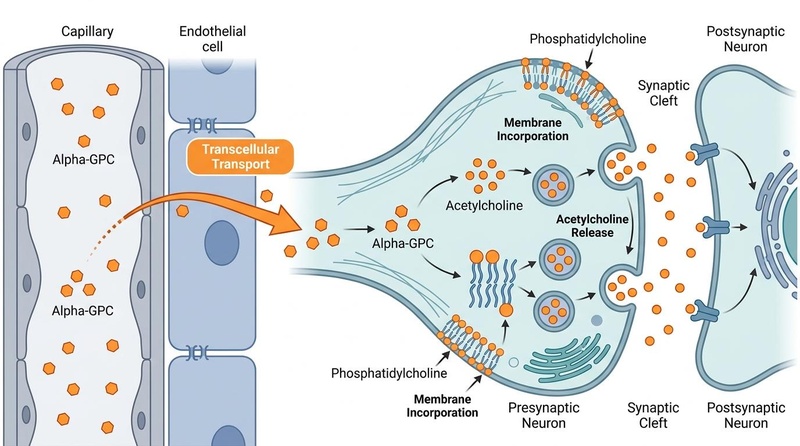
- Acetylcholine Synthesis: Alpha-GPC readily crosses the blood-brain barrier and is hydrolyzed into free choline. This choline is then used by choline acetyltransferase (ChAT) to synthesize acetylcholine (ACh) [16]. ACh is a key neurotransmitter involved in memory, learning, attention, and muscle contraction [10:4]. In neurodegenerative diseases like Alzheimer's, the cholinergic system is severely compromised, and Alpha-GPC helps replenish ACh levels [1:3][10:5].
- Neuronal Cell Membrane Repair: Choline is a vital component of phosphatidylcholine (PC), the primary phospholipid in neuronal cell membranes [10:6][8:1]. Alpha-GPC acts as an intermediate in the Kennedy Pathway, supplying the necessary raw materials for PC synthesis and thus supporting the structural integrity, repair, and formation of new neuronal membranes and synapses [16:1][8:2]. This neuroprotective role helps prevent neuronal "auto-cannibalism" where the brain breaks down its own membranes to get choline for ACh synthesis [10:7].
- Pharmacokinetics basics: Alpha-GPC is highly water-soluble and lipid-integrated, leading to rapid and efficient absorption in the upper gastrointestinal tract [10:8]. This bypasses significant microbial degradation in the lower intestine, contributing to its high bioavailability and effective delivery of choline to the brain [10:9].
¶ Effects on different systems
¶ Brain & mental health (cognition, mood, sleep)
Alpha-GPC's most well-established effects are on brain and mental health. In older adults with dementia or cognitive impairment, it consistently improves memory, attention, and executive function. Studies have shown significant benefits in slowing cognitive decline as measured by standardized tests like MMSE and ADAS-cog [1:4][2:3][4:4].
Beyond just cognitive function, Alpha-GPC also positively impacts mood and behavior, particularly in neurodegenerative conditions. It has been shown to reduce symptoms of apathy, depression, and other behavioral and psychological symptoms of dementia (BPSD), leading to a better quality of life for patients and reduced caregiver distress [3:4][11:3]. Its ability to modulate monoaminergic systems, increasing dopamine and serotonin levels in certain brain regions, likely contributes to these mood-enhancing effects [16:2]. For healthy individuals, benefits are less clear cut, but some studies suggest improved focus and reaction time, especially under mental or physical stress [13:2][14:2].
¶ Athletic performance
Alpha-GPC has been explored for its potential to enhance physical performance, primarily through its role in optimizing neuromuscular function. By increasing available choline, it can support acetylcholine synthesis at the neuromuscular junction, which is crucial for efficient muscle contraction [10:10][9:2].
While some acute studies show mixed results for explosive power, chronic supplementation (e.g., 600 mg/day for 6 days) has demonstrated modest but statistically significant increases in lower-body isometric strength [12:3]. The effects on growth hormone secretion are also variable, with some studies showing a transient increase post-exercise or at rest, while others do not replicate these findings [6:3][7:5]. The practical implications for elite athletes often revolve around maintaining strength and mental acuity during prolonged, fatiguing efforts, rather than dramatic increases in maximal output [17]. It is not a raw stimulant like caffeine, nor a direct muscle-builder like creatine.
¶ Metabolic health
Limited research suggests Alpha-GPC may have some influence on substrate metabolism. One study found that a high acute dose (1000 mg) could increase serum free fatty acid levels and elevate biomarkers of hepatic fat oxidation (acetoacetate and 3-hydroxybutyrate) in young adults [7:6]. This indicates a potential role in shifting energy utilization towards fat burning, which could be relevant for endurance athletes or those managing body composition. However, more extensive research is needed to fully understand these metabolic effects and their clinical significance [7:7].
¶ Dosage and how to take it
Alpha-GPC dosing varies significantly depending on the target outcome and population.
Standard dosing in studies
- Typical daily dose range: For cognitive decline in clinical settings, dosages often range from 600 mg to 1200 mg per day [1:5][4:5]. For nootropic or athletic purposes in healthy individuals, doses commonly range from 300 mg to 600 mg per day [14:3][12:4].
- Common dosing schedules: Clinical trials for cognitive decline frequently split 1200 mg into 2-3 daily doses. For acute athletic performance, doses are typically taken 30-90 minutes before exercise [14:4][6:4].
- Study durations: Clinical trials for dementia can last from 6 months to 3 years [1:6][2:4][5:3]. Athletic performance studies are often acute (single dose) or short-term (6 days to 2 weeks) [14:5][12:5].
Forms and bioavailability
- Common forms: Alpha-GPC is typically available as a powder or in capsules. It is highly water-soluble.
- With or without food: Most studies do not specify administration with food, suggesting it can be taken independently, though some prefer it with meals to mitigate potential gastrointestinal upset.
Special populations
- Kidney or liver impairment: Data are limited, but as a choline source, caution may be warranted in severe hepatic or renal dysfunction.
- Older adults: Alpha-GPC is widely studied and often prescribed in older adults for cognitive support, with a favorable safety profile at clinical doses [4:6][8:3].
- Pregnancy and breastfeeding: Insufficient data; avoidance is generally recommended unless under strict medical supervision.
¶ Safety and side effects
Alpha-GPC is generally considered safe and well-tolerated, especially within typical dosing ranges.
Common side effects
- When side effects occur, they are usually mild and associated with higher doses (above 1200 mg/day). These include headache, dizziness, fatigue, nausea, and general gastrointestinal distress [10:11][8:4]. These effects are often attributed to increased cholinergic activity.
- Late-day dosing may lead to insomnia due to its stimulant-like effects on brain activity [10:12].
Who should be especially cautious or avoid it
- Individuals prone to headaches or digestive issues may experience these symptoms at higher doses.
- Those with cardiovascular concerns should be aware of the theoretical TMAO risk, though Alpha-GPC's rapid absorption may reduce this compared to other choline sources [10:13].
- Individuals with bipolar disorder or other conditions sensitive to cholinergic upregulation should exercise caution or avoid it.
- Pregnant or breastfeeding women due to insufficient safety data.
¶ Drug and supplement interactions
Alpha-GPC's primary mechanism of action—increasing acetylcholine—suggests potential interactions with medications that also affect the cholinergic system.
Pharmacodynamic interactions (additive / opposing effects)
- Acetylcholinesterase Inhibitors (AChEIs): Given that Alpha-GPC increases acetylcholine levels, combining it with prescription AChEIs (e.g., donepezil, rivastigmine, galantamine, used for Alzheimer's disease) could lead to an additive effect. This synergy is clinically utilized in some studies to enhance efficacy [1:7][2:5], but excessive cholinergic activity could theoretically increase side effects like nausea, diarrhea, or bradycardia. Medical supervision is essential.
- Anticholinergic Medications: Drugs with anticholinergic properties (e.g., some antihistamines, tricyclic antidepressants, certain medications for irritable bowel syndrome or overactive bladder) could have their effects diminished by Alpha-GPC, which aims to increase acetylcholine.
¶ Combining Alpha-GPC with other supplements (“stacks”)
Alpha-GPC is a popular component in nootropic stacks designed to enhance cognitive function and neuroplasticity.
- The "Mr. Happy Stack" (Uridine + Omega-3 DHA + Alpha-GPC): This combination is based on the rationale that neuronal membrane synthesis requires uridine, DHA (an omega-3 fatty acid), and choline. Administering all three synergistically promotes phosphatidylcholine formation and synaptogenesis (the growth of new neuronal synapses), leading to enhanced memory and protection against oxidative stress [10:14]. While CDP-Choline provides both choline and a uridine precursor, some prefer Alpha-GPC with separate Uridine Monophosphate (UMP) and fish oil to precisely control ratios.
- Racetams: Alpha-GPC is commonly stacked with racetam-class nootropics (e.g., Piracetam, Aniracetam). Racetams are believed to increase the demand for choline, potentially depleting acetylcholine stores and causing headaches. Alpha-GPC provides a readily available choline source to prevent this depletion, thereby enhancing the cognitive benefits of racetams and preventing common side effects [10:15][9:3].
¶ Practical questions (FAQ)
-
How long does it take for Alpha-GPC to work?
For acute cognitive or athletic benefits (e.g., focus, strength), effects can be noticeable within 30-90 minutes after ingestion [13:3][6:5]. For long-term neuroprotective effects or improvements in dementia, benefits are typically observed over several weeks to months of consistent daily use [1:8][2:6]. -
Can I take Alpha-GPC long term?
Long-term clinical trials (up to 3 years) in older adults with cognitive impairment have shown a favorable safety profile [5:4]. However, long-term data for healthy populations, especially at high doses, is less extensive. Theoretical concerns regarding TMAO should be considered with any chronic choline supplementation [10:16]. -
Can I take Alpha-GPC with common medications like SSRIs or statins?
There is limited specific interaction data with SSRIs or statins. However, Alpha-GPC's cholinergic effects mean caution is advised if taking medications that affect acetylcholine levels. Always consult a healthcare professional before combining Alpha-GPC with prescription medications. -
Is Alpha-GPC useful if I am otherwise healthy?
While research strongly supports its use in cognitive impairment, evidence for significant cognitive or physical enhancement in healthy, young individuals is less robust and often shows mixed results, especially for dramatic physical benefits [13:4][17:1]. The most consistent benefit in healthy adults appears to be related to maintaining focus and psychomotor speed under stressful conditions [13:5]. -
Does Alpha-GPC help with weight loss or energy?
Some limited data suggest Alpha-GPC may enhance hepatic fat oxidation, which could theoretically support fat metabolism [7:8]. However, it is not primarily marketed or studied as a weight loss or direct energy-boosting supplement. Its impact on "energy" is more related to sustained mental clarity than direct caloric energy.
¶ How we evaluated the evidence
Our evaluation of Alpha-GPC's efficacy and safety prioritizes evidence according to a strict hierarchy:
- Tier 1 (High): Includes systematic reviews, meta-analyses, and large-scale randomized controlled trials (RCTs). For Alpha-GPC, this includes the ASCOMALVA trial [1:9][2:7][3:5][5:5] and comprehensive meta-analyses comparing it to other choline sources [4:7][15:1].
- Tier 2 (Moderate): Comprises smaller RCTs, clinical guidelines, and high-impact observational studies. Many of the athletic performance studies fall into this category due to smaller sample sizes [13:6][12:6][6:6][7:9].
- Tier 3 (Low): Consists of in vitro, animal studies, case reports, or expert opinions. Mechanistic studies explaining Alpha-GPC's biochemical pathways are included here [16:3][8:5].
Evidence quality was graded based on study design, sample size, consistency of results across multiple studies, and the directness of the evidence to human outcomes. Magnitude and clinical relevance were assessed by evaluating the reported effect sizes and their practical impact on health or performance endpoints. This page will be updated as new meta-analyses or large RCTs become available.
¶ References
Amenta F, Carotenuto A, Fasanaro AM, et al. Association between the cholinesterase inhibitor donepezil and the cholinergic precursor choline alphoscerate in Alzheimer's disease with cerebrovascular injury: interim results (ASCOMALVA). Journal of the Neurological Sciences. 2012;322(1-2):109-113. https://pubmed.ncbi.nlm.nih.gov/22959283/ ↩︎ ↩︎ ↩︎ ↩︎ ↩︎ ↩︎ ↩︎ ↩︎ ↩︎ ↩︎
Amenta F, Carotenuto A, Fasanaro AM, et al. The ASCOMALVA Trial: interim results after two years of treatment. Journal of Alzheimer's Disease. 2014;42 Suppl 3:S281-288. https://pubmed.ncbi.nlm.nih.gov/24898643/ ↩︎ ↩︎ ↩︎ ↩︎ ↩︎ ↩︎ ↩︎ ↩︎
Carotenuto A, et al. Behavioral and Psychological Symptoms of Dementia (BPSD) in the ASCOMALVA Trial. Journal of Alzheimer's Disease. 2017;56(2):805-815. https://pubmed.ncbi.nlm.nih.gov/28035924/ ↩︎ ↩︎ ↩︎ ↩︎ ↩︎ ↩︎
Sagaro GG, Traini E, & Amenta F. Activity of Choline Alphoscerate on Adult-Onset Cognitive Dysfunctions: A Systematic Review and Meta-Analysis. Journal of Alzheimer's Disease. 2023;92(1):59-70. https://pubmed.ncbi.nlm.nih.gov/36683513/ ↩︎ ↩︎ ↩︎ ↩︎ ↩︎ ↩︎ ↩︎ ↩︎
Traini E, Carotenuto A, Fasanaro AM, & Amenta F. Volume Analysis of Brain Cognitive Areas in Alzheimer's Disease: Interim 3-Year Results from the ASCOMALVA Trial. Journal of Alzheimer's Disease. 2020;76(1):317-329. https://pubmed.ncbi.nlm.nih.gov/32508323/ ↩︎ ↩︎ ↩︎ ↩︎ ↩︎ ↩︎
Ziegenfuss T, Landis J, & Hofheins J. Acute supplementation with alpha-glycerylphosphorylcholine augments growth hormone response to, and peak force production during, resistance exercise. Journal of the International Society of Sports Nutrition. 2008;5(Suppl 1):P15. https://pmc.ncbi.nlm.nih.gov/articles/PMC3313098/ ↩︎ ↩︎ ↩︎ ↩︎ ↩︎ ↩︎ ↩︎
Kawamura T, Okubo T, Sato K, Fujita S, Goto K, Hamaoka T, & Iemitsu M. Glycerophosphocholine enhances growth hormone secretion and fat oxidation in young adults. Nutrition. 2012;28(11-12):1122-1126. https://pubmed.ncbi.nlm.nih.gov/22673596/ ↩︎ ↩︎ ↩︎ ↩︎ ↩︎ ↩︎ ↩︎ ↩︎ ↩︎ ↩︎
Stolarczyk A, & Bartosiewicz A. Choline: An Underappreciated Component of a Mother-to-Be's Diet. Nutrients. 2024;16(11):1651. https://pmc.ncbi.nlm.nih.gov/articles/PMC11174651/ ↩︎ ↩︎ ↩︎ ↩︎ ↩︎ ↩︎
Kansakar U, et al. Choline supplements: an update. Frontiers in Endocrinology. 2023;14:1222341. https://pmc.ncbi.nlm.nih.gov/articles/PMC10709661/ ↩︎ ↩︎ ↩︎ ↩︎
Che X, et al. Unlocking the Potential of l-α-Glycerylphosphorylcholine: From Metabolic Pathways to Therapeutic Applications. Nutrition Reviews. 2025;83(8):1594-1608. https://academic.oup.com/nutritionreviews/article/83/8/1594/8046191 ↩︎ ↩︎ ↩︎ ↩︎ ↩︎ ↩︎ ↩︎ ↩︎ ↩︎ ↩︎ ↩︎ ↩︎ ↩︎ ↩︎ ↩︎ ↩︎ ↩︎
ClinicalTrials.gov. Evaluation of Clinical Effectiveness of Choline Alphoscerate for Older Adults With Major Depression and Subjective Memory Complaints (CHOLDEPS). Identifier: NCT05257902. 2022. https://clinicaltrials.gov/study/NCT05257902 ↩︎ ↩︎ ↩︎ ↩︎
Bellar D, LeBlanc NR, & Campbell B. The effect of 6 days of alpha glycerylphosphorylcholine on isometric strength. Journal of the International Society of Sports Nutrition. 2015;12:42. https://pmc.ncbi.nlm.nih.gov/articles/PMC4650143/ ↩︎ ↩︎ ↩︎ ↩︎ ↩︎ ↩︎ ↩︎
Kerksick CM, et al. Acute Alpha-Glycerylphosphorylcholine Supplementation Enhances Cognitive Performance in Healthy Men. Nutrients. 2024;16(23):4240. https://pmc.ncbi.nlm.nih.gov/articles/PMC11644786/ ↩︎ ↩︎ ↩︎ ↩︎ ↩︎ ↩︎ ↩︎
Parker AG, Byars A, Purpura M, & Jäger R. The effects of alpha-glycerylphosphorylcholine, caffeine or placebo on markers of mood, cognitive function, power, speed, and agility. Journal of the International Society of Sports Nutrition. 2015;12(Suppl 1):P41. https://pmc.ncbi.nlm.nih.gov/articles/PMC4595381/ ↩︎ ↩︎ ↩︎ ↩︎ ↩︎ ↩︎
Sagaro GG, & Amenta F. Comparison of the effects of choline alphoscerate and citicoline in patients with dementia disorders: a systematic review and meta-analysis. Frontiers in Neurology. 2025;16:1649661. https://www.frontiersin.org/journals/neurology/articles/10.3389/fneur.2025.1649661/full ↩︎ ↩︎
Tayebati SK, Tomassoni D, et al. Modulation of monoaminergic transporters by choline-containing phospholipids in rat brain. CNS & Neurological Disorders Drug Targets. 2013;12(1):94-103. https://pubmed.ncbi.nlm.nih.gov/23244432/ ↩︎ ↩︎ ↩︎ ↩︎
Marcus L, Soileau J, Judge LW, & Bellar D. Evaluation of the effects of two doses of alpha glycerylphosphorylcholine on physical and psychomotor performance. Journal of the International Society of Sports Nutrition. 2017;14:39. https://pmc.ncbi.nlm.nih.gov/articles/PMC5629791/ ↩︎ ↩︎