¶ Astaxanthin
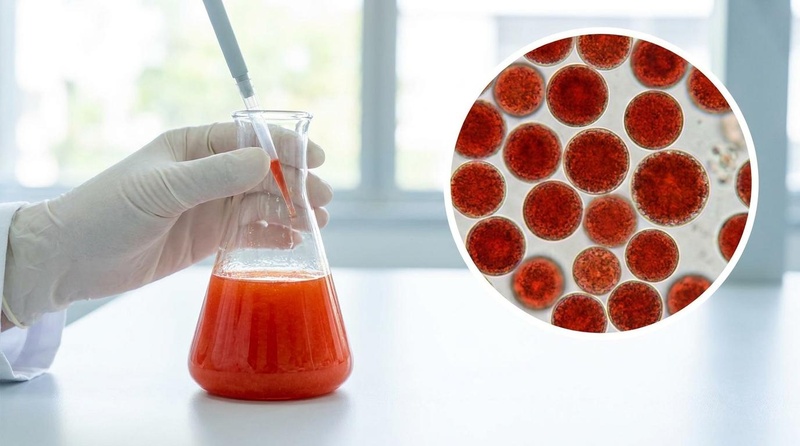
| Type | Xanthophyll Carotenoid |
| Active Cmpd | Astaxanthin |
| Source | Haematococcus pluvialis, Sockeye Salmon |
| Dose Range | 4–12 mg/day |
| Half-life | ~16–30 hours |
| Main Benefit | Skin & Ocular Health, Antioxidant |
| Absorption | Lipid-dependent |
Astaxanthin is a potent, lipid-soluble xanthophyll carotenoid primarily derived from the microalgae Haematococcus pluvialis. Recognized for its unique molecular structure that spans the entire cell membrane, it provides comprehensive antioxidant protection and is backed by moderate evidence for improving skin elasticity, reducing digital eye strain, and modulating systemic inflammation [1][2][3].
¶ At a glance
Aliases
- Also known as: 3,3'-dihydroxy-β,β-carotene-4,4'-dione
- Chemical / botanical name: Haematococcus pluvialis (primary source)
- Category: Xanthophyll Carotenoid / Marine Antioxidant
Key points (high-level summary)
- Best-supported benefit: Daily supplementation of 4–6 mg significantly improves skin moisture retention, elasticity, and wrinkle depth in aging adults [1:1].
- Eye health: It is highly effective at reducing subjective eye fatigue and improving visual accommodation (focusing speed) in individuals with high screen exposure [3:1][4].
- Absorption requirement: Astaxanthin is nearly insoluble in water; its bioavailability is increased 2.4-fold when taken with a fat-containing meal or in lipid-based formulations [5].
- Safety: Extremely well-tolerated with no known upper toxicity limit; the only common "side effect" is a harmless red/orange tinting of the stool at higher doses [6][7].
What people use it for
- Main goals: Skin rejuvenation, digital eye strain relief, athletic recovery, and systemic antioxidant support.
- Evidence quality (overall): Moderate
¶ What is Astaxanthin?
Astaxanthin is a naturally occurring pigment that gives salmon, shrimp, and flamingos their characteristic pinkish-red hue.
- Definition: It belongs to the xanthophyll class of carotenoids, which are oxygenated derivatives of carotenes. Unlike beta-carotene, it cannot be converted into Vitamin A, thus avoiding any risk of hypervitaminosis A [8].
- Natural sources: The highest concentrations are found in the chlorophyte microalgae Haematococcus pluvialis, which produces the pigment as a survival mechanism against intense UV radiation. Dietary sources include sockeye salmon (the most concentrated animal source), krill, and shellfish [8:1].
- Traditional / historical use: While not a staple of ancient herbalism, sockeye salmon—rich in astaxanthin—has been a foundational longevity food in many coastal indigenous cultures.
- Regulatory status: Generally Recognized as Safe (GRAS) by the FDA and approved as a dietary supplement in the EU (EFSA). It is also widely used as a pigment in aquaculture.
- Pharmacological property: A "pure" antioxidant that never becomes a pro-oxidant, capable of neutralizing singlet oxygen and free radicals across both the lipid and aqueous phases of the cell membrane [2:1].
¶ What are Astaxanthin’s main benefits?
Astaxanthin's benefits are primarily driven by its ability to accumulate in tissues high in oxidative stress, such as the skin, eyes, and mitochondrial membranes.
-
Outcome: Skin Elasticity and Wrinkle Reduction
-
Direction of effect: Decrease in wrinkle depth; Increase in elasticity and moisture content.
-
Magnitude: Moderate; typically noticeable after 6–8 weeks of consistent use.
-
Population studied: Middle-aged women and men.
-
Evidence quality: Moderate (several meta-analyses and RCTs) [1:2].
-
Summary sentence: Daily use of 3–6 mg improves skin texture and reduces signs of photo-aging.
-
Outcome: Visual Fatigue and Accommodation
-
Direction of effect: Decrease in eye strain; Increase in focusing speed.
-
Magnitude: Moderate to Large.
-
Population studied: Adults working with Video Display Terminals (VDTs).
-
Evidence quality: Moderate (consistent positive results across multiple small-to-midsize RCTs) [3:2][4:1].
-
Summary sentence: Supplementing with 6 mg daily helps the eyes recover faster from digital strain and improves focus.
-
Outcome: Fatigue and Motor Function
-
Direction of effect: Decrease in mental/physical fatigue; Increase in motor speed.
-
Magnitude: Small to Moderate.
-
Population studied: Healthy adults and those with subjective fatigue.
-
Evidence quality: Moderate (2024 Meta-analysis) [9].
-
Summary sentence: Astaxanthin reduces the sensation of physical and mental exhaustion and may improve reaction time.
¶ Evidence summary table (human outcomes)
| Outcome / Goal | Effect* | Consistency** | Evidence quality | Trials*** | Notes (population, duration, dose) |
|---|---|---|---|---|---|
| Skin Elasticity | High | Moderate | 7+ RCTs | 3–6 mg/day for 6–8 weeks improves skin aging markers [1:3]. | |
| Visual Fatigue | High | Moderate | 10+ RCTs | 6 mg/day reduces screen-induced eye strain [3:3][4:2]. | |
| Mental Fatigue | Moderate | Moderate | Meta-analysis | 12 mg/day significantly reduced mental exhaustion [9:1]. | |
| Physical Fatigue | Moderate | Moderate | Meta-analysis | Improved physical recovery and reduced subjective fatigue [9:2]. | |
| Motor Function | Moderate | Moderate | Meta-analysis | Improvements in motor speed and reaction times [9:3]. | |
| Systemic Inflammation | Moderate | Moderate | Meta-analysis | Mild reduction in CRP and malondialdehyde [10]. | |
| Cognitive Function | Low | Low | Meta-analysis | No significant effect on memory or executive function in healthy adults [9:4]. | |
| Lipid Profile (Triglycerides) | Low | Low | 3 RCTs | Modest reduction in triglycerides; inconsistent impact on LDL/HDL [10:1]. | |
| Erythrocyte Oxidation | High | Moderate | 2 RCTs | Reduced phospholipid hydroperoxides in red blood cells [11]. |
- *Effect: Number of arrows (1-3) indicates magnitude. Direction: ↑ (increase), ↓ (decrease), = (no effect), ? (unclear). Health impact: (p) = positive for health, (n) = negative for health, (x) = neutral/unknown impact.
- **Consistency: Low (results conflict), Moderate (mixed but leaning one way), High (most trials agree)
- ***Trials: Number of RCTs or total trials informing this outcome.