¶ Berberine
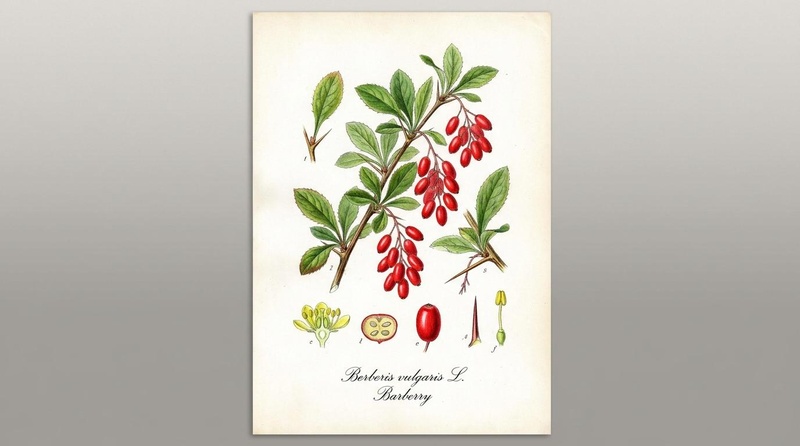
| Type | Botanical Alkaloid |
| Active Cmpd | Berberine |
| Source | Berberis spp., Coptis spp. |
| Dose Range | 500–1,500 mg/day |
| Half-life | ~5 hours |
| Main Benefit | Blood Glucose Control |
| Absorption | Low (Standard HCl) |
Berberine is a potent plant-derived alkaloid widely utilized for its multi-target effects on metabolic health, specifically blood glucose regulation and lipid management. Human clinical evidence, including multiple meta-analyses of randomized controlled trials (RCTs), indicates that berberine is highly effective for improving insulin sensitivity and dyslipidemia, often demonstrating efficacy comparable to pharmaceutical agents like metformin.[1][2]
¶ At a glance
Aliases
- Also known as: BBR, "Natural Metformin"
- Chemical / botanical name: Berberine chloride / Berberis vulgaris, Coptis chinensis
- Category: Botanical alkaloid
Key points (high-level summary)
- Glycemic Control: In adults with type 2 diabetes or metabolic syndrome, berberine significantly lowers fasting blood glucose (-0.5 to -0.8 mmol/L) and HbA1c (-0.5% to -0.7%).[3][2:1]
- Lipid Management: It effectively reduces LDL cholesterol and triglycerides by activating AMPK and inhibiting PCSK9.[1:1][4]
- Bioavailability Gap: Standard berberine HCl has extremely low oral bioavailability (<1%); modern phytosome, dihydroberberine (DHB), and newer technology-driven formulations like Metaberine™ offer significantly higher absorption.[5][6]
- Strong Drug Interactions: Berberine is a potent inhibitor of CYP2D6 and CYP3A4, which can dangerously elevate levels of many common medications (e.g., statins, beta-blockers, SSRIs).[7]
What people use it for
- Main goals: Blood glucose control, lipid profile improvement, weight management, PCOS management, gut microbiome modulation (SIBO).
- Evidence quality (overall): High for metabolic health; Moderate for weight loss and PCOS.
¶ What is Berberine?
Berberine is a quaternary ammonium salt from the protoberberine group of isoquinoline alkaloids. It is characterized by its intense yellow color and bitter taste.
- Definition: A naturally occurring alkaloid found in the roots, rhizomes, and stem bark of various medicinal plants.
- Natural sources: Common sources include Berberis vulgaris (Barberry), Berberis aristata (Tree Turmeric), Hydrastis canadensis (Goldenseal), and Coptis chinensis (Goldthread).
- Traditional / historical use: Historically used in Traditional Chinese Medicine (TCM) and Ayurveda for its antimicrobial and anti-diarrheal properties.
- Current regulatory status: Sold as a dietary supplement in most jurisdictions (USA, EU); used as an over-the-counter medicine in some Asian countries for gastrointestinal infections.
- Key pharmacological property: A multi-target metabolic regulator that acts as a potent AMPK activator and PCSK9 inhibitor.
¶ What are Berberine’s main benefits?
Berberine's primary strength lies in its ability to address metabolic syndrome components simultaneously.
- Blood Glucose: Significant reduction in HbA1c and fasting glucose in diabetic and pre-diabetic populations. Magnitude is comparable to 1,500mg of Metformin.[2:2]
- Lipids: Large reductions in LDL-C (approx. -20 to -45 mg/dL) and Triglycerides. Unlike many other supplements, its lipid-lowering mechanism (PCSK9 inhibition) is well-validated in humans.[1:2][4:1]
- Body Weight: Moderate reduction in BMI and waist circumference. While not a primary weight-loss drug, it supports metabolic flexibility.[1:3][8]
- PCOS: Improves insulin sensitivity, reduces androgen levels, and may enhance fertility in women with Polycystic Ovary Syndrome.[9]
- Gut Health: Exhibits antimicrobial properties equivalent to rifaximin for the clearance of Small Intestinal Bacterial Overgrowth (SIBO) in some studies.[10]
¶ Evidence summary table (human outcomes)
| Outcome / Goal | Effect* | Consistency | Evidence quality | Trials | Notes (population, duration, dose) |
|---|---|---|---|---|---|
| Fasting Blood Glucose | High | High | 40+ RCTs | -0.77 mmol/L in metabolic disorders [3:1][2:3] | |
| HbA1c | High | High | 40+ RCTs | -0.5% to -0.7% reduction over 12 weeks [3:2][2:4] | |
| LDL Cholesterol | High | High | 30+ RCTs | -9.6 mg/dL to -20 mg/dL reduction [1:4][4:2] | |
| Triglycerides | High | High | 30+ RCTs | -0.37 mmol/L to -23 mg/dL reduction [1:5][4:3] | |
| BMI / Weight | Moderate | Moderate | 20+ RCTs | Small but significant reduction (-0.4 kg/m²) [1:6][8:1] | |
| PCOS (Metabolic) | Moderate | Moderate | 10+ RCTs | Improves insulin sensitivity and androgens [9:1] | |
| SIBO Clearance | Moderate | Low | 1-2 RCTs | Non-inferior to rifaximin in pilot studies [10:1] |
- *Effect:
Large Improvement (Large decrease, positive),Medium Improvement (Moderate decrease, positive),Small Improvement (Small decrease, positive).
¶ LongeviData outcomes widget
¶ How does Berberine work?
Berberine acts as a "metabolic master switch" by influencing several critical intracellular pathways.
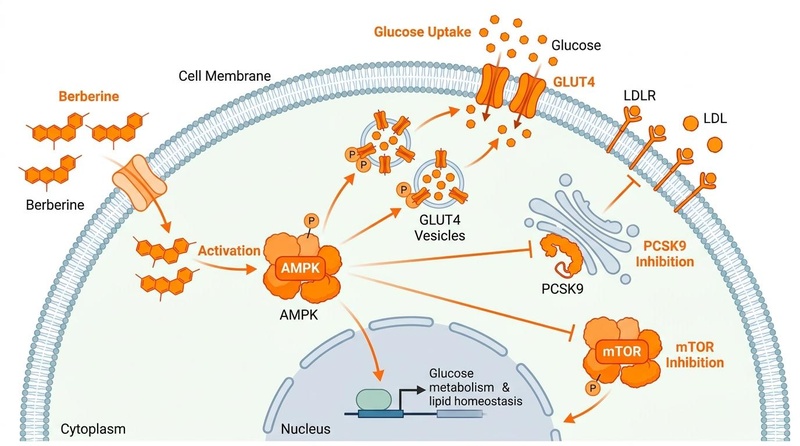
Figure: Proposed berberine mechanisms including AMPK activation and downstream metabolic signaling.
- Primary targets:
- AMPK (AMP-activated protein kinase): Berberine inhibits mitochondrial Complex I, rising the AMP:ATP ratio and activating AMPK.
- PCSK9 (Proprotein Convertase Subtilisin/Kexin Type 9): Berberine suppresses PCSK9 expression, which prevents the degradation of LDL receptors (LDLR) in the liver.
- PTP1B: Inhibits Protein Tyrosine Phosphatase 1B, enhancing insulin signaling.
- Core mechanisms:
- Glucose Uptake: Activated AMPK triggers the translocation of GLUT4 to the cell membrane, allowing muscles to absorb glucose independently of insulin.[1:7]
- Lipid Clearance: Increased LDLR density on the liver surface allows more LDL cholesterol to be cleared from the blood.[4:4]
- Autophagy & Senescence: Chronic AMPK activation inhibits mTOR, promoting cellular cleanup (autophagy) and potentially slowing cellular senescence.[11]
- Pharmacokinetics basics:
- Bioavailability: Standard Berberine HCl is poorly absorbed due to its high crystallinity and P-gp-mediated efflux.
- Metabolism: Extensively metabolized by the liver; Berberrubine is a major active metabolite.
- Half-life: Approximately 5 hours, requiring multiple daily doses for stable plasma levels.
¶ Effects on different systems
¶ Metabolic health (glucose, insulin, lipids)
Berberine is most robustly studied here. In head-to-head trials against Metformin, 500mg of berberine 3x daily was identical to metformin in reducing HbA1c (9.5% down to 7.5%) and fasting glucose.[2:5] It also significantly improves HOMA-IR (insulin resistance) across metabolic syndrome populations.
¶ Cardiovascular health
Beyond lipids, berberine may reduce systolic blood pressure by a small margin (approx. -2 to -5 mmHg), likely by downregulating the TMAO-mediated endoplasmic reticulum stress pathway.[1:8][12] Its effect on PCSK9 makes it a unique botanical for reducing cardiovascular risk factors.
¶ Brain & mental health (Cognition & PCOS)
In PCOS, berberine reduces the LH/FSH ratio and total testosterone, likely secondary to its insulin-sensitizing effects.[9:2] Preclinical meta-analyses show neuroprotective effects in Alzheimer's models via reduction of amyloid-beta and tau phosphorylation, though human clinical trials are lacking.[13]
¶ Gut & digestion
Berberine modulates the gut microbiome, increasing the abundance of beneficial species like Akkermansia muciniphila. A 2026 systematic review of RCTs confirmed that berberine's cardiometabolic benefits are significantly mediated through its modulation of the gut microbiota and the production of short-chain fatty acids (SCFAs).[14] In SIBO patients, a berberine-dominant herbal protocol (4 weeks) showed a 46% success rate in breath test normalization, comparable to rifaximin (34%).[10:2]
¶ Emerging Research: Autoimmunity and Oncology
Recent research has explored berberine's potential beyond metabolic health:
- Autoimmunity: Emerging evidence suggests berberine may manage neuroinflammation in conditions like Multiple Sclerosis (MS) by expanding Treg and Th2 cell populations.[15]
- Oncology: In breast cancer, berberine induces apoptosis in triple-negative breast cancer (TNBC) cells by modulating the sirtuin/p65 signaling axis.[16][17] It is also being investigated in gastric cancer chemotherapy via microbiota-orchestrating nanocapsules.[18]
- Diabetic Retinopathy: Berberine may protect retinal ganglion cells from pyroptosis in diabetic retinopathy by regulating AKT1 and STAT3 pathways.[19]
¶ Dosage and how to take it
¶ Standard dosing in studies
- Typical daily dose range: 900–1,500 mg/day of Berberine HCl.
- Common dosing schedules: 500 mg, three times daily (t.i.d.), taken with or immediately before meals.
- Study durations: Most clinical trials last 12–24 weeks.
¶ Forms and bioavailability
- Standard Berberine HCl: Most common and cheapest. Requires high doses (1,500mg) and often causes GI distress.
- Berberine Phytosome (Berbevis®): Complexed with lecithin. A 550mg dose (providing ~200mg BBR) yields 5–10x higher plasma exposure than standard HCl.[5:1][20]
- Metaberine™: A formulation using BioSOLVE technology that significantly enhances peak plasma concentration and systemic exposure compared to conventional berberine HCl.[6:1]
- Dihydroberberine (DHB): A hydrogenated form (SuperBerberine) that is highly soluble and bypasses the P-gp pump. Doses of 100–200mg are typically sufficient.
¶ Special populations
- Exercise: Avoid taking berberine immediately before or after resistance training. Like metformin, its AMPK activation may theoretically blunt mTOR-mediated muscle hypertrophy.
- Pregnancy & Breastfeeding: Contraindicated. Berberine can displace bilirubin from albumin, increasing the risk of kernicterus (brain damage) in newborns.
¶ Safety and side effects
Berberine is generally well-tolerated at studied doses, but gastrointestinal issues are common with the HCl form.