¶ Bromantane

| Type | Synthetic Actoprotector |
| Active Cmpd | Bromantane |
| Aliases | Ladasten |
| Dose Range | 50–100 mg/day |
| Half-life | ~11.5 hours (Human) |
| Main Benefit | Fatigue Resistance (Asthenia) |
| Absorption | High (Oral) |
Bromantane (trade name Ladasten) is a synthetic adaptogen and actoprotector that enhances physical and mental performance under extreme conditions without increasing oxygen consumption or heat production. Unlike traditional psychostimulants that deplete neurotransmitter stores, Bromantane upregulates the biosynthesis of dopamine and neurotrophic factors, providing a sustainable improvement in motivation and stamina with an inherent anxiolytic effect[1][2][3].
¶ At a glance
Aliases
- Also known as: Ladasten, Bromantane
- Chemical name: N-(2-adamantyl)-N-(4-bromophenyl)amine
- Category: Actoprotector, Synthetic Adaptogen, Nootropic
Key points (high-level summary)
- Reduces Clinical Asthenia: In large multicenter studies, Bromantane demonstrated significant reduction in fatigue and weakness in patients with neurasthenia and psychoautonomic syndrome, with effects appearing within 3 days[3:1][4].
- Dual Stimulant-Anxiolytic Action: It simultaneously improves vigilance and alertness while reducing anxiety, avoiding the "crash" or jitteriness typical of releasers like amphetamines[2:1][5][6].
- Sustainable Performance: By upregulating dopamine synthesis enzymes (Tyrosine Hydroxylase), it avoids the depletion of synaptic vesicles, supporting long-term physical and cognitive endurance[7][8].
- Favorable Safety Profile: Clinical trials report low adverse event rates (~3%) and a notable lack of withdrawal syndrome or addictive potential[2:2][3:2].
What people use it for
- Main goals: Fatigue management (asthenia), cognitive stamina, motivation, anxiety reduction, and physical performance under stress.
- Evidence quality (overall): Moderate-High (supported by a multicenter trial of 728 patients and multiple randomized controlled trials)[2:3][3:3][4:1].
¶ What is Bromantane?
Bromantane is an adamantane derivative originally developed in the 1980s by the Russian Academy of Medical Sciences to enhance the performance of soldiers and astronauts in extreme environments[9]. It is classified as an actoprotector, a pharmacological class that increases resistance to physical loads and improves mental recovery without excessive stimulation or depletion of cellular energy stores[9:1][10].
- Definition: A synthetic aminoadamantane derivative with unique stimulant and anxiolytic properties.
- Natural sources: None; it is a synthetic laboratory compound.
- Traditional use: Developed for military and aerospace medicine in the Soviet Union; later approved as a pharmaceutical in Russia (as Ladasten) for treating asthenic disorders.
- Regulatory status: Approved pharmaceutical (Ladasten) in Russia; sold as a dietary supplement or research chemical in many other jurisdictions.
- Key pharmacological property: "Stimulating anxiolytic" that upregulates dopamine synthesis and neurotrophin expression.
¶ What are Bromantane’s main benefits?
Bromantane's therapeutic spectrum is characterized by a "balanced" effect: it stimulates mental and physical activity while providing an anxiolytic (anti-anxiety) effect that stabilizes the autonomic nervous system.
- Fatigue and Asthenia: Bromantane is primarily used to treat "neurasthenia" (chronic fatigue). A multicenter study of 728 patients found that 50–100 mg daily led to a 76–90% responder rate, with significant improvements in physical weakness, energy levels, and overall quality of life[3:4][4:2].
- Cognitive Performance & Stamina: In healthy volunteers, single doses (100 mg) improved psychophysiological parameters (reaction time, mental work capacity) during mental fatigue, particularly in stress-labile individuals[11][5:1].
- Anxiety Reduction: Unlike pure stimulants, Bromantane reduces anxiety symptoms. EEG analysis shows that in individuals with high baseline anxiety/low alpha rhythm, the drug produces an anxiolytic-like pattern, whereas in sthenic individuals, it produces a stimulant-like pattern[6:1].
- Physical Endurance: Preclinical models show physical work capacity improvements (e.g., swimming and treadmill performance) that exceed those of amphetamines by up to 1.6 times, with effects lasting over 24 hours without causing mitochondrial damage in heart or skeletal muscle[12][10:1].
¶ Evidence summary table (human outcomes)
| Outcome / Goal | Effect* | Consistency | Evidence quality | Trials | Notes (population, duration, dose) |
|---|---|---|---|---|---|
| Fatigue / Asthenia | High | Moderate-High | 728 patients (Multicenter) | 50–100 mg/day for 28 days; onset by Day 3[3:5][4:3] | |
| Anxiety Symptoms | Moderate | Moderate | RCT | 50–100 mg/day; superior to placebo in neurasthenia[2:4] | |
| Cognitive Stamina | High | Moderate | 10 volunteers + clinical trials | Single 100 mg dose improves focus under fatigue[11:1][5:2] | |
| Sleep Quality | Moderate | Moderate | Multicenter Trial | Normalization of sleep-wake cycles in asthenic patients[4:4] | |
| Autonomic Stability | Moderate | Moderate | Multicenter Trial | Reduces symptoms of autonomic dysfunction/dystonia[3:6][4:5] |
- *Effect: Number of arrows (1-3) indicates magnitude. Direction: ↑ (increase), ↓ (decrease), = (no effect), ? (unclear). Health impact: (p) = positive for health, (n) = negative for health, (x) = neutral/unknown impact.
- Consistency: High (most trials agree)
- *Trials: Total clinical trial sample size or trial count.
¶ How does Bromantane work?
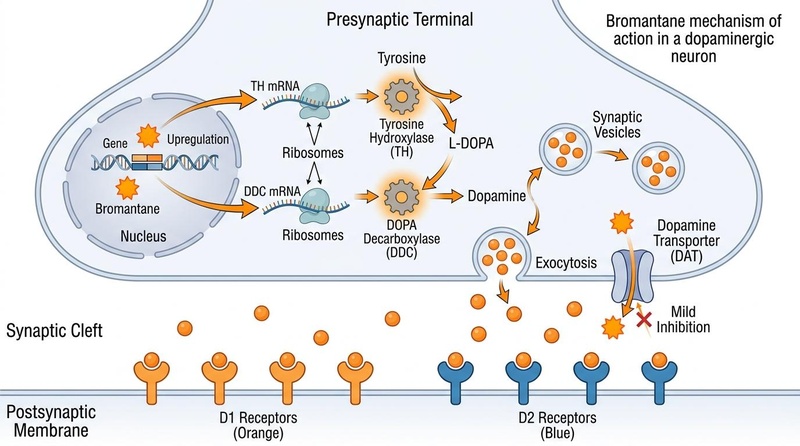
Unlike conventional psychostimulants that work by releasing neurotransmitters or blocking their breakdown, Bromantane acts primarily by modulating the transcription of genes involved in the dopaminergic and neurotrophic systems.
- Primary targets: Transcription of Tyrosine Hydroxylase (TH) and Aromatic L-amino acid Decarboxylase (AAAD)[7:1][8:1].
- Core mechanisms:
- Dopamine Upregulation: Bromantane induces the de novo expression of genes regulating dopamine biosynthesis. This increases the brain's capacity to synthesize dopamine from tyrosine, rather than just releasing stored reserves[7:2][8:2][13].
- Neurotrophic Support: Single doses have been shown to increase the expression of Brain-Derived Neurotrophic Factor (BDNF) and Nerve Growth Factor (NGF) in the striatum, hypothalamus, and hippocampus[14][15].
- Mild Reuptake Inhibition: It exerts a moderate inhibitory effect on the Dopamine Transporter (DAT), slowing reuptake (IC50 = 3.56 μM) without significantly affecting serotonin reuptake[2:5][13:1].
- GABAergic Modulation: Bromantane may modulate GABA receptors, which likely accounts for its unique anxiolytic properties[1:1][16][6:2].
- Pharmacokinetics:
¶ Effects on different systems
¶ Brain & Mental Health
In clinical populations with neurasthenia, Bromantane improves the "psychoautonomic" state. It reduces emotional lability and physical weakness while improving mood and cognitive clarity. EEG studies demonstrate that the drug shifts the brain into a state of "productive vigilance"—increasing alpha-rhythm power and reducing slow-wave (delta) activity associated with drowsiness[17][11:3][18][6:3].
¶ Physical Performance
Bromantane is recognized as an actoprotector. In animal studies, it significantly delayed the onset of fatigue and accelerated recovery after exhaustion. Unlike amphetamine-like stimulants, Bromantane is cardioprotective and heat-protective; it prevents the mitochondrial damage often seen in muscles during extreme exertion and helps maintain body temperature during hyperthermia[1:2][12:1][19][10:2][20].
¶ Immune System
Under conditions of chronic stress, Bromantane acts as an immunostimulator. It has been shown to normalize the level of cytokines and restore immune resistance (secondary stress-induced immunodeficiency) by acting as a membrane protector for immune cells[1:3][10:3][8:3].
¶ Dosage and how to take it
¶ Standard dosing in studies
- Typical daily dose: 50–100 mg per day.
- Common schedules: Typically taken once in the morning (for 50 mg) or split into two doses (morning and early afternoon) for 100 mg.
- Study durations: Most clinical trials involved continuous use for 28 days[2:6][3:7][4:6].
¶ Forms and bioavailability
- Oral: Tablets (as Ladasten) or capsules.
- Sublingual: Users often report higher potency via sublingual administration due to high lipophilicity, although most clinical studies utilized the oral route.
- With or without food: Taking with food (especially fats) is expected to improve absorption.
¶ Special populations
- Cardiovascular disease: One study confirmed safety and efficacy in patients with cardiovascular conditions, noting improvements in psychological and autonomic health[21].
- Withdrawal: Clinical studies specifically noted a lack of "withdrawal syndrome" after 28 days of use[2:7].
¶ Safety and side effects
Bromantane is generally considered to have very low toxicity. In animal models, the LD50 is extremely high (8,100 mg/kg), indicating a wide therapeutic window[22][7:4].
¶ Common side effects
In the multicenter study of 728 patients, adverse effects occurred in only 3% of cases.
- Mild insomnia: Most common, typically if taken too late in the day.
- Agitation/Hyper-excitation: Rarely observed at standard doses.
- Dizziness: Reported in a small minority of users.
¶ Who should avoid it
- Late-day use: May interfere with sleep onset due to its long-lasting effects on vigilance.
- Pregnancy & Breastfeeding: Insufficient human data; avoid use.
¶ Drug and supplement interactions
- CNS Depressants: Bromantane acts as an antagonist to substances with depressing neuropsychotropic effects (e.g., alcohol, benzodiazepines)[22:1].
- Other Stimulants: While no formal clinical combination trials exist, anecdotal evidence suggests synergy with caffeine or other dopaminergics. Mechanistically, Bromantane should be used cautiously with MAOIs or other drugs that significantly increase dopamine levels.
- Sydnocarb: One study compared the two, noting that Bromantane acts via de novo synthesis while Sydnocarb (another Russian stimulant) acts differently on serotonin levels[13:2].
¶ Practical questions (FAQ)
-
Does Bromantane cause a crash?
No. Clinical studies specifically highlight the absence of a "crash" or withdrawal syndrome after cessation, likely because it supports dopamine production rather than merely draining stores[2:8]. -
How long does it take to work?
While some psychophysiological benefits are seen within hours of a single dose, the full clinical anti-fatigue (antiasthenic) effect typically peaks after 3 days of consistent use[3:8][4:7]. -
Can I use it for weight loss?
While it increases physical work capacity, it is not primarily used or marketed as a thermogenic weight loss agent. -
Is it a banned substance in sports?
Yes. Bromantane is on the World Anti-Doping Agency (WADA) Prohibited List under "S6. Stimulants" due to its performance-enhancing effects.
¶ How we evaluated the evidence
Evidence for Bromantane was graded based on Russian clinical pharmaceutical data, including a large multicenter trial () and multiple randomized controlled trials (RCTs). Because Bromantane is a registered pharmaceutical in Russia (Ladasten), the level of human clinical data is significantly higher than that of most "nootropic" supplements, although much of the primary literature is in Russian. Mechanistic and safety data were corroborated by extensive preclinical (animal/in vitro) studies.
¶ References
Morozov IS, Klimova NV, Sergeeva SA. (1999). [Adamantane derivatives enhancing body's resistance to emergencies]. Vestnik Rossiiskoi akademii meditsinskikh nauk. https://pubmed.ncbi.nlm.nih.gov/10222828/ ↩︎ ↩︎ ↩︎ ↩︎
Neznamov GG, et al. (2009). [Ladasten, the new drug with psychostimulant and anxiolytic actions in treatment of neurasthenia (results of the comparative clinical study with placebo)]. Zhurnal nevrologii i psikhiatrii imeni S.S. Korsakova. https://pubmed.ncbi.nlm.nih.gov/19491814/ ↩︎ ↩︎ ↩︎ ↩︎ ↩︎ ↩︎ ↩︎ ↩︎ ↩︎
Seredenin SB, et al. (2010). [Treatment of asthenic disorders in patients with psychoautonomic syndrome: results of a multicenter study on efficacy and safety of ladasten]. Zhurnal nevrologii i psikhiatrii imeni S.S. Korsakova. https://pubmed.ncbi.nlm.nih.gov/21322821/ ↩︎ ↩︎ ↩︎ ↩︎ ↩︎ ↩︎ ↩︎ ↩︎ ↩︎
Neznamov GG, et al. (2010). [Treatment of asthenic disorders in patients with psychoautonomic syndrome: results of a multicenter study on efficacy and safety of ladasten]. Zhurnal nevrologii i psikhiatrii imeni S.S. Korsakova. https://pubmed.ncbi.nlm.nih.gov/20559263/ ↩︎ ↩︎ ↩︎ ↩︎ ↩︎ ↩︎ ↩︎ ↩︎
Bogdan NG, et al. (2009). [Effect of ladasten on the psychophysiological parameters of healthy volunteers]. Eksperimental'naia i klinicheskaia farmakologiia. https://pubmed.ncbi.nlm.nih.gov/19642584/ ↩︎ ↩︎ ↩︎
Seredenin SB, et al. (2008). [Characteristics of ladasten effect in neurasthenia patients with various EEG parameters]. Eksperimental'naia i klinicheskaia farmakologiia. https://pubmed.ncbi.nlm.nih.gov/18819436/ ↩︎ ↩︎ ↩︎ ↩︎
Morozov IS, et al. (2000). [An acute toxicity study of bromantane]. Eksperimental'naia i klinicheskaia farmakologiia. https://pubmed.ncbi.nlm.nih.gov/10763112/ ↩︎ ↩︎ ↩︎ ↩︎ ↩︎
Vakhitova YV, et al. (2004). [Ladasten induces the expression of genes regulating dopamine biosynthesis in various structures of rat brain]. Eksperimental'naia i klinicheskaia farmakologiia. https://pubmed.ncbi.nlm.nih.gov/15500036/ ↩︎ ↩︎ ↩︎ ↩︎
Siuniakov SA, et al. (2006). [Pilot clinical trial of ladasten]. Eksperimental'naia i klinicheskaia farmakologiia. https://pubmed.ncbi.nlm.nih.gov/16995430/ ↩︎ ↩︎
Seredenin SB, et al. (2011). [Effect of antiasthenic drug ladasten on the level of cytokines and behavior in experimental model of anxious depression in C57BL/6 male mice]. Eksperimental'naia i klinicheskaia farmakologiia. https://pubmed.ncbi.nlm.nih.gov/22288152/ ↩︎ ↩︎ ↩︎ ↩︎
Voenno-meditsinskii zhurnal. (2000). [The neuro- and psychophysiological effects of bromantane]. https://pubmed.ncbi.nlm.nih.gov/10998997/ ↩︎ ↩︎ ↩︎ ↩︎
Morozov IS, et al. (1998). [The effect of bromantane on the physical work capacity of laboratory animals]. Eksperimental'naia i klinicheskaia farmakologiia. https://pubmed.ncbi.nlm.nih.gov/9929819/ ↩︎ ↩︎
Zimin IA, et al. (2010). [Role of the brain dopaminergic and serotoninergic systems in psychopharmacological effects of ladasten and sydnocarb]. Eksperimental'naia i klinicheskaia farmakologiia. https://pubmed.ncbi.nlm.nih.gov/20369592/ ↩︎ ↩︎ ↩︎
Salimgareeva MK, et al. (2012). Mechanisms of action of ladasten: activation of gene expression for neurotrophins and mitogen-activated kinases. Bulletin of experimental biology and medicine. https://pubmed.ncbi.nlm.nih.gov/22803074/ ↩︎
Salimgareeva MK, et al. (2012). Mechanisms of Action of Ladasten: Activation of Gene Expression for Neurotrophins and Mitogen-Activated Kinases. Bulletin of Experimental Biology and Medicine. https://doi.org/10.1007/s10517-012-1516-z ↩︎
Iezhitsa IN, et al. (1995). [The effect of bromantane on the dopamin- and serotoninergic systems of the rat brain]. Eksperimental'naia i klinicheskaia farmakologiia. https://pubmed.ncbi.nlm.nih.gov/7580761/ ↩︎
Seredenin SB, et al. (1993). [A quantitative pharmaco-electroencephalographic analysis of the action of bromantane]. Biulleten' eksperimental'noi biologii i meditsiny. https://pubmed.ncbi.nlm.nih.gov/8312546/ ↩︎
Seredenin SB, et al. (2012). [Ladasten versus placebo effect self-evaluated by neurasthenia patients with different EEG alpha rhythm types]. Eksperimental'naia i klinicheskaia farmakologiia. https://pubmed.ncbi.nlm.nih.gov/22834121/ ↩︎
Morozov IS, et al. (1995). [Study of heat-protective effects of bromantane at various levels of overheating]. Voprosy meditsinskoi khimii. https://pubmed.ncbi.nlm.nih.gov/7793100/ ↩︎
Iarkova MA, et al. (2005). [Studying the mechanisms of ladasten action]. Eksperimental'naia i klinicheskaia farmakologiia. https://pubmed.ncbi.nlm.nih.gov/16047669/ ↩︎
CardioSomatika. (2010). Study of the efficiency and safety of Ladasten therapy in patients with cardiovascular disease. https://doi.org/10.26442/cs44966 ↩︎
Morozov IS, et al. (1999). [The characteristics of the neuropsychotropic activity of bromantane in laboratory animals]. Eksperimental'naia i klinicheskaia farmakologiia. https://pubmed.ncbi.nlm.nih.gov/10340117/ ↩︎ ↩︎