¶ Calcium
Calcium is the most abundant mineral in the human body, serving as the primary structural component of the skeletal system and teeth while acting as a vital second messenger for neuromuscular, cardiovascular, and endocrine functions. Approximately 99% of body calcium is sequestered in bone tissue, providing mechanical strength and acting as a metabolic reservoir to maintain tightly regulated serum ionized calcium levels. High-level evidence indicates that while calcium is essential for maintaining bone mineral density (BMD) and preventing osteoporotic fractures, isolated supplementation without critical co-factors carries potential clinical risks, including vascular calcification and nephrolithiasis.
| Type | Mineral |
| Active Cmpd | Elemental Calcium (Ca²⁺) |
| Source | Dairy, Leafy Greens, Fortified Foods |
| Dose Range | 500–1,200 mg/day (total intake) |
| Half-life | Homeostatically regulated |
| Main Benefit | Bone mineralization and BMD maintenance |
| Absorption | Variable (~20–40%) |
Calcium is widely used for bone health and the prevention of fractures in older adults, often paired with Vitamin D. However, recent evidence synthesis highlights the importance of obtaining calcium primarily through diet, using supplements only to fill dietary gaps, due to concerns regarding cardiovascular disease and kidney stone risks with high-dose supplementation.
¶ At a glance
Aliases
- Also known as: Elemental Calcium, Calcium Ions, Ca²⁺, Calcium Carbonate, Calcium Citrate.
- Chemical / botanical name: Calcium (Ca).
- Category: Essential macromineral.
Key points (high-level summary)
- In older adults, combined calcium and vitamin D supplementation modestly increases bone mineral density and has shown mixed evidence for reducing the risk of fractures, especially in institutionalized populations with low baseline intakes.
- During pregnancy, calcium supplementation significantly reduces the risk of gestational hypertension and preeclampsia in women with low dietary calcium.
- High-dose calcium supplementation (especially without vitamin D or K) has been associated with a potential increase in cardiovascular disease risk and coronary artery calcification in some meta-analyses, though results remain somewhat controversial.
- Supplemental calcium slightly increases the risk of kidney stones, whereas dietary calcium is protective against them.
What people use it for
- Main goals: Osteoporosis management, fracture prevention, preeclampsia prophylaxis.
- Evidence quality (overall): High for skeletal health and gestational hypertension; Moderate for cardiovascular risk considerations.
¶ What is Calcium?
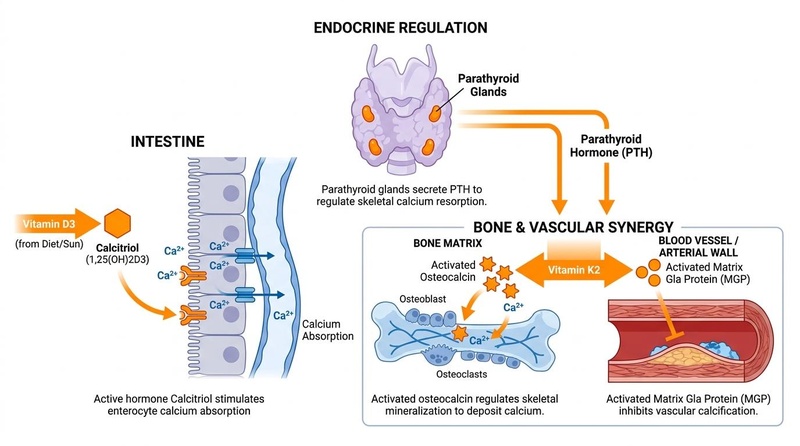
Calcium is a group 2 alkaline earth metal and an essential macromineral required for every physiological process in the human body. Because the body cannot synthesize calcium, it must be acquired through dietary sources or supplementation. Serum calcium levels are maintained within a extremely narrow range (8.5–10.2 mg/dL) through a complex homeostatic feedback loop involving the parathyroid glands, kidneys, and bones.
- Definition: A primary structural element of the skeleton and a critical signaling cation (Ca²⁺) for cellular function.
- Natural sources: Dairy (milk, cheese, yogurt), cruciferous vegetables (kale, broccoli), calcium-set tofu, sardines (with bones), and fortified foods like orange juice and plant-based milks.
- Traditional / historical use: Known since antiquity for skeletal strength; first identified as an element in 1808.
- Current regulatory status: Classified as a dietary supplement and essential nutrient worldwide, with age-dependent RDAs (typically 1,000–1,200 mg for adults).
- Key pharmacological property: Essential cation for bone matrix hydroxyapatite formation and a central second messenger in neuromuscular and cardiac action potentials.
¶ What are Calcium’s main benefits?
For Skeletal Health and Fractures:
- Outcome: Fracture incidence and bone mineral density.
- Direction of effect: Decrease in fractures, increase in BMD.
- Magnitude: Moderate (up to 15% reduction in total fractures).
- Population studied: Postmenopausal women and older adults.
- Evidence quality: High, driven by numerous large RCTs and meta-analyses.
- Summary sentence: Calcium combined with vitamin D modestly prevents bone loss and has mixed evidence regarding fracture risk reduction in older individuals.
For Gestational Hypertension:
- Outcome: Preeclampsia and high blood pressure during pregnancy.
- Direction of effect: Decrease.
- Magnitude: Moderate to Large.
- Population studied: Pregnant women, especially those with low dietary calcium intake.
- Evidence quality: High.
- Summary sentence: Supplementing with calcium during pregnancy significantly lowers the risk of developing preeclampsia.
¶ Evidence summary table (human outcomes)
| Outcome / Goal | Effect* | Consistency** | Evidence quality | Trials*** | Notes (population, duration, dose) |
|---|---|---|---|---|---|
| Bone Mineral Density (BMD) | High | High | 20+ RCTs | [Increases BMD slightly when combined with Vitamin D][1][2] | |
| Gestational Hypertension & Preeclampsia | High | High | 15+ RCTs | [Reduces risk in pregnant women with low baseline dietary calcium][3][4] | |
| Skeletal Fracture Risk | Moderate | High | 20+ RCTs | [Mixed evidence; some trials show modest reduction, others no significant effect][5][6][2:1][7][8] | |
| Cardiovascular Disease Risk | Moderate | Moderate | Meta-analyses | [Mixed evidence; some meta-analyses suggest increased risk, while others show no association][9][10][11] | |
| Kidney Stone Formation | High | High | 10+ RCTs | [Small increased risk of nephrolithiasis in susceptible individuals][7:1][12][13] |
*Effect: Direction and magnitude. **Consistency: Agreement across studies. ***Trials: Number of supporting studies.
¶ How does Calcium work?
- Primary targets: Bone matrix (hydroxyapatite), voltage-gated calcium channels, troponin (in muscle).
- Core mechanisms:
- Skeletal mineralization: Calcium combines with phosphorus to form hydroxyapatite crystals, which are deposited in the collagen matrix of bone by osteoblasts, providing structural rigidity.
- Cellular signaling: Calcium acts as an intracellular second messenger. Influx of Ca²⁺ through ion channels triggers neurotransmitter release, muscle contraction, and enzyme activation.
- Evidence source:
- Human data: Extensive biomarker and clinical trial data validate its role in bone turnover and vascular calcification.
- Pharmacokinetics basics: Intestinal absorption is strictly regulated by active Vitamin D (calcitriol). Absorption efficiency is inversely related to intake (higher single doses have a lower percentage absorbed). Calcium carbonate requires stomach acid for absorption, while calcium citrate does not.
¶ Effects on different systems
¶ Skeletal System and Bone Health
The primary clinical application of calcium supplementation is the prevention of osteoporosis and fractures. Meta-analyses consistently show that calcium, particularly when co-administered with Vitamin D, reduces bone turnover markers and slows the age-related decline in bone mineral density. The fracture risk reduction is most pronounced in institutionalized elderly patients and those with documented dietary deficiencies.
¶ Cardiovascular System
The cardiovascular impact of calcium supplementation is a subject of ongoing debate. While dietary calcium is considered cardioprotective, rapid spikes in serum calcium following bolus supplementation may contribute to vascular calcification and stiffening of the arteries. Some large meta-analyses suggest a modest increase in the risk of myocardial infarction associated with isolated calcium supplements, prompting guidelines to recommend dietary sources over pills when possible.
¶ Renal System
While high dietary calcium intake paradoxically lowers the risk of kidney stones by binding oxalates in the gut, supplemental calcium taken between meals can increase urinary calcium excretion (hypercalciuria), slightly elevating the risk of nephrolithiasis (kidney stones).
¶ Dosage and how to take it
Standard dosing in studies
- Typical daily dose range: 500–1,000 mg/day (supplemental), aimed at reaching a total daily intake (diet + supplement) of 1,000–1,200 mg.
- Common dosing schedules: Split into doses of 500 mg or less, as the intestine cannot efficiently absorb more than ~500 mg at one time.
- Study durations: Years (often 2–5 years for fracture outcomes).
Forms and bioavailability
- Common forms: Calcium carbonate (cheaper, higher elemental calcium, requires food/acid for absorption) and Calcium citrate (more expensive, lower elemental calcium, absorbed with or without food).
- With or without food: Calcium carbonate must be taken with meals for optimal absorption. Calcium citrate can be taken anytime.
Special populations
- Older adults: Often require supplementation due to reduced intestinal absorption and lower dietary intake, but should not exceed 2,000 mg/day from all sources.
- Pregnancy: World Health Organization recommends 1.5–2.0 g/day for pregnant women with low dietary calcium to prevent preeclampsia.
¶ Safety and side effects
Common side effects
- Gastrointestinal distress: Constipation, bloating, and gas are very common, especially with calcium carbonate.
- Hypercalciuria: Increased calcium in the urine.
Less common but serious side effects
- Kidney stones: Approximately a 17% increased relative risk in postmenopausal women taking supplements.
- Cardiovascular events: Potential increased risk of coronary artery calcification and myocardial infarction with high doses.
- Milk-alkali syndrome: A rare but serious condition of hypercalcemia and renal failure caused by massive calcium and antacid intake.
¶ Drug and supplement interactions
Pharmacokinetic interactions (how drugs are processed)
- Antibiotics (Fluoroquinolones and Tetracyclines): Calcium binds to these drugs in the gut, reducing their absorption. Separate by 2–4 hours.
- Thyroid hormone (Levothyroxine): Calcium severely impairs absorption. Separate by at least 4 hours.
- Bisphosphonates: Calcium decreases absorption. Take bisphosphonates on an empty stomach and delay calcium.
Pharmacodynamic interactions (additive / opposing effects)
- Thiazide Diuretics: These reduce urinary calcium excretion, which can lead to hypercalcemia if taking high-dose calcium supplements.
- Iron and Zinc: High doses of calcium can competitively inhibit the absorption of non-heme iron and zinc if taken simultaneously.
¶ Combining Calcium with other supplements ("stacks")
- Vitamin D3: Essential co-factor required for intestinal calcium absorption. Most clinical trials evaluating fracture risk utilize combined Calcium + Vitamin D3.
- Vitamin K2: Helps direct calcium into the bone matrix (activating osteocalcin) and away from soft tissues, theoretically reducing the risk of vascular calcification.
- Magnesium: Competes with calcium for absorption. Maintaining a proper Ca:Mg ratio is often considered important for bone and cardiovascular health.
¶ Practical questions (FAQ)
¶ How long does it take for Calcium to improve bone density?
Changes in bone mineral density are typically measured after 1 to 2 years of continuous supplementation, though biochemical markers of bone turnover decline within weeks.
¶ Is calcium carbonate or calcium citrate better?
Calcium citrate is more easily absorbed, especially in older adults with low stomach acid or those on proton pump inhibitors. Calcium carbonate is more concentrated but must be taken with food.
¶ Can I take Calcium long term?
Yes, but the goal should be to meet the RDA (1,000-1,200 mg) primarily through diet, using supplements only to make up the shortfall. Long-term high-dose supplementation carries risks.
¶ Do I need to take Vitamin D with Calcium?
Yes. Vitamin D is essential for the active transport of calcium across the intestinal lining. Without adequate Vitamin D, calcium absorption is severely limited.
¶ Does calcium cause heart attacks?
Some meta-analyses suggest isolated calcium supplements may slightly increase cardiovascular risk by promoting arterial calcification, but this risk is minimized if calcium is obtained from food or kept within the recommended total daily limit.
¶ How we evaluated the evidence
- Study types prioritized: Randomized controlled trials and large meta-analyses evaluating fracture incidence, bone density, preeclampsia, and cardiovascular outcomes.
- How you graded evidence quality:
- High: Consistent results from large RCTs for fracture prevention and gestational hypertension.
- Moderate: Conflicting but statistically significant findings regarding cardiovascular risk from meta-analyses.
¶ References
Cong B, Zhang H. (2025). The effects of combined calcium and vitamin D supplementation on bone mineral density and fracture risk in postmenopausal women with osteoporosis: a systematic review and meta-analysis of randomized controlled trials. BMC Musculoskeletal Disorders. https://pubmed.ncbi.nlm.nih.gov/41063100/ ↩︎
Tang BM, et al. (2007). Use of calcium or calcium in combination with vitamin D supplementation to prevent fractures and bone loss in people aged 50 years and older: a meta-analysis. The Lancet. https://pubmed.ncbi.nlm.nih.gov/17720017/ ↩︎ ↩︎
Hofmeyr GJ, et al. (2018). Calcium supplementation during pregnancy for preventing hypertensive disorders and related problems. Cochrane Database of Systematic Reviews. https://pubmed.ncbi.nlm.nih.gov/30277579/ ↩︎
Chen WY, et al. (2023). Clinical efficacy of low-dose aspirin combined with calcium in preventing preeclampsia: A systematic review and meta-analysis. Medicine. https://pubmed.ncbi.nlm.nih.gov/37653760/ ↩︎
Weaver CM, et al. (2016). Calcium plus vitamin D supplementation and risk of fractures: an updated meta-analysis from the National Osteoporosis Foundation. Osteoporosis International. https://pubmed.ncbi.nlm.nih.gov/26510847/ ↩︎
Zhao JG, et al. (2017). Association Between Calcium or Vitamin D Supplementation and Fracture Incidence in Community-Dwelling Older Adults: A Systematic Review and Meta-analysis. JAMA. https://pubmed.ncbi.nlm.nih.gov/29279934/ ↩︎
Jackson RD, et al. (2006). Calcium plus vitamin D supplementation and the risk of fractures. New England Journal of Medicine. https://pubmed.ncbi.nlm.nih.gov/16481635/ ↩︎ ↩︎
Massé O, et al. (2026). Calcium, vitamin D, or combined supplementation to prevent fractures and falls: systematic review and meta-analysis. BMJ. https://pubmed.ncbi.nlm.nih.gov/42161415/ ↩︎
Yang C, et al. (2020). The Evidence and Controversy Between Dietary Calcium Intake and Calcium Supplementation and the Risk of Cardiovascular Disease: A Systematic Review and Meta-Analysis of Cohort Studies and Randomized Controlled Trials. Journal of the American College of Nutrition. https://pubmed.ncbi.nlm.nih.gov/31625814/ ↩︎
Chung M, et al. (2016). Calcium Intake and Cardiovascular Disease Risk: An Updated Systematic Review and Meta-analysis. Annals of Internal Medicine. https://pubmed.ncbi.nlm.nih.gov/27776363/ ↩︎
Sim MG, et al. (2023). Association Between Calcium Supplementation and the Risk of Cardiovascular Disease and Stroke: A Systematic Review and Meta-Analysis. Heart, Lung and Circulation. https://pubmed.ncbi.nlm.nih.gov/37743221/ ↩︎
Bargagli M, et al. (2021). Calcium and Vitamin D Supplementation and Their Association with Kidney Stone Disease: A Narrative Review. Nutrients. https://pubmed.ncbi.nlm.nih.gov/34959915/ ↩︎
Shi L, et al. (2025). Association between calcium and vitamin D supplementation and increased risk of kidney stone formation in patients with osteoporosis in Southwest China: a cross-sectional study. BMJ open. https://pubmed.ncbi.nlm.nih.gov/39956606/ ↩︎