¶ Citicoline
| Type | Endogenous Nucleotide / Choline Donor |
| Active Cmpd | CDP-Choline |
| Source | Synthesized / Yeast Fermentation |
| Dose Range | 250–2,000 mg/day |
| Half-life | ~56–71 hours (biphasic) |
| Main Benefit | Memory support & neuroprotection |
| Absorption | Very High (>90%) |
Citicoline (cytidine-5'-diphosphocholine or CDP-Choline) is a highly bioavailable choline donor and cytidine precursor utilized to support brain membrane synthesis, enhance cognitive function, and serve as an adjunctive treatment in neurodegenerative conditions. Human evidence shows moderate efficacy for supporting age-associated memory loss and adjunctive motor-symptom therapy, but robust systematic reviews have proven its inefficacy in acute emergency settings like ischemic stroke and traumatic brain injury.
¶ At a glance
¶ Aliases
- Also known as: CDP-Choline, Cytidine diphosphate-choline, Cytidine-5'-diphosphocholine, Cognizin® (branded form)
- Chemical name: cytidine 5'-(trihydrogen diphosphate), P'-[2-(trimethylammonio)ethyl] ester, inner salt
- Category: Choline precursor, nucleotide derivative
¶ Key points
- In healthy older adults, citicoline modestly enhances episodic memory, though overall clinical trials are often limited in size and may present a risk of bias.[1][2]
- In patients with Parkinson's disease, adjunctive citicoline significantly improves motor symptoms like rigidity and tremor, enabling a reduction in levodopa (L-DOPA) requirements.[3]
- Recent comprehensive systematic reviews indicate that citicoline is ineffective for improving functional outcomes in acute ischemic stroke and acute traumatic brain injury (TBI).[4][5][6][7]
- In glaucoma, modern systematic reviews show a lack of high-quality evidence that oral citicoline slows disease progression, contradicting results from earlier, smaller observational studies.[8]
¶ What people use it for
- Main goals: Cognitive enhancement, memory support, age-related cognitive decline, adjunctive Parkinson's therapy, ocular health, and reduction of substance cravings.
- Evidence quality (overall): Moderate (for cognitive decline and Parkinson's) to Low (for glaucoma and addiction), and High (for ineffectiveness in acute stroke/TBI).
¶ What is Citicoline?
Citicoline is an endogenous intermediate in the synthesis of phosphatidylcholine, the major phospholipid of eukaryotic cell membranes.
- Definition: Citicoline is a naturally occurring mononucleotide composed of ribose, pyrophosphate, cytosine, and choline. It serves as a rate-limiting intermediate in the "Kennedy pathway"—the biochemical process that builds and repairs cell membranes.
- Natural sources: While synthesized in all human cells, citicoline is not found in significant quantities in the diet. Nutritional precursors like choline (from eggs/liver) and uridine (from organ meats) are used by the body to synthesize its own CDP-choline. Commercial supplements are typically produced via microbial fermentation.
- Traditional / historical use: Originally synthesized in Japan in the 1970s, it was developed as a prescription drug for Parkinson's disease, stroke recovery, and head trauma. It has since transitioned into a widely available dietary supplement marketed for nootropic and neuroprotective benefits.
- Current regulatory status: Sold as an over-the-counter dietary supplement in the US and Canada. In several European and Asian countries (e.g., Italy, Japan), it remains available as a prescription drug for cognitive decline and ophthalmic neuroprotection.
- Key pharmacological property: A highly bioavailable cholinergic membrane precursor and cellular energy promoter.
¶ What are Citicoline’s main benefits?
Citicoline is primarily utilized for its ability to support the structural integrity of neurons and enhance neurotransmitter synthesis.
¶ Cognitive Function & Memory (Age-Associated Memory Impairment)
- Direction of effect: Increase
- Magnitude: Moderate
- Population: Healthy older adults (ages 50–85) with mild memory concerns.
- Evidence quality: Moderate
- Summary: Randomized controlled trials indicate that oral citicoline at 500 mg/day for 12 weeks significantly improves episodic memory and attention compared to placebo.[1:1][9]
¶ Vascular Cognitive Impairment & Dementia
- Direction of effect: Increase / Stabilization
- Magnitude: Small to Moderate
- Population: Elderly adults with vascular cognitive impairment or Alzheimer’s disease.
- Evidence quality: Moderate (noting a risk of bias in older trials)
- Summary: Systematic reviews suggest that citicoline helps stabilize cognitive decline over 6–12 months. However, a 2025 meta-analysis suggests that Choline Alphoscerate (Alpha-GPC) may provide superior clinical benefit in dementia compared to citicoline.[2:1][10][11]
¶ Parkinson's Disease (Adjunctive Therapy)
- Direction of effect: Increase (motor function) and Decrease (L-DOPA dosage)
- Magnitude: Moderate
- Population: Patients with Parkinson's disease on levodopa therapy.
- Evidence quality: Moderate
- Summary: A 2021 systematic review confirmed that adjunctive citicoline significantly improves motor symptoms (rigidity, tremor) and allows for a 30% to 50% reduction in levodopa dosage.[3:1]
¶ Ocular Health & Glaucoma
- Direction of effect: No consistent effect / Unclear
- Magnitude: Unclear
- Population: Patients with primary open-angle glaucoma (POAG).
- Evidence quality: Low
- Summary: While some studies show visual evoked potential (VEP) improvements, a 2023 systematic review found a lack of sufficient evidence that citicoline slows glaucoma progression, showing no significant impact on intraocular pressure or retinal nerve thickness.[8:1][12]
¶ Evidence summary table (human outcomes)
| Outcome / Goal | Effect* | Consistency** | Evidence quality | Trials*** | Notes (population, duration, dose) |
|---|---|---|---|---|---|
| Cognitive Enhancement (AAMI) | Moderate | Moderate | 2 RCTs | 500 mg/day for 12 weeks; improved episodic memory in healthy older adults[1:2][9:1]. | |
| Vascular Dementia / VCI | Moderate | Moderate | 12+ RCTs | 1,000 mg/day; stabilizes cognitive decline; Alpha-GPC may be superior[2:2][10:1][11:1]. | |
| Parkinson's Disease (Adjunctive) | High | Moderate | 7 studies | 500-1,000 mg/day; improves motor symptoms and allows L-DOPA dose reduction[3:2]. | |
| Glaucoma Progression | Low | Low | 10+ trials | 500-1,600 mg/day; modern systematic review finds no evidence of slowed progression[8:2]. | |
| Acute Ischemic Stroke Recovery | High | High | 10+ RCTs | 500-2,000 mg/day; meta-analyses show futility in acute emergency phase[4:1][5:1][7:1][13]. | |
| Traumatic Brain Injury (Acute) | High | Moderate | 4+ RCTs | 1,000-2,000 mg/day; no benefit in acute TBI (COBRIT trial halted)[6:1]. | |
| Cocaine Craving / Addiction | Low | Low | 5 trials | Up to 2,000 mg/day; modest reduction in cravings in cocaine dependence[14]. | |
| Neurotrophic Keratopathy | Low | Low | 1 RCT | Topical Cit-B12 drops; improved corneal nerve density in pilot diabetic neuropathy data[15]. |
- *Effect:
<effect e="u2p"></effect>= Moderate increase (positive);<effect e="d1p"></effect>= Small decrease (positive);<effect e="e0x"></effect>= No directional effect (neutral). - **Consistency: High, Moderate, or Low.
- ***Trials: Number of RCTs or systematic reviews supporting the outcome.
¶ How does Citicoline work?
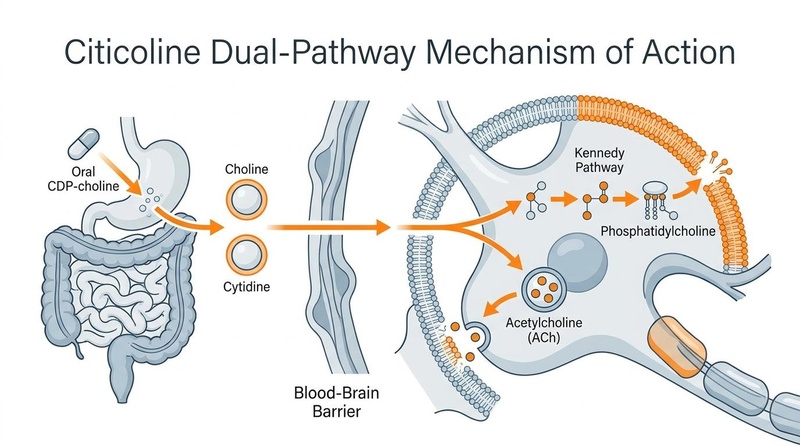
Citicoline acts as a rate-limiting intermediate in the synthesis of cell membrane phospholipids and serves as a precursor for the neurotransmitter acetylcholine.
- Primary targets: Neuronal cell membranes (Kennedy pathway enzymes), Acetylcholine receptors, Mitochondrial cardiolipin.
- Core mechanisms:
- Kennedy Pathway (Membrane Repair): Upon ingestion, citicoline is hydrolyzed into choline and cytidine (which is converted to uridine in humans). These metabolites cross the blood-brain barrier and are recombined into CDP-choline internally to synthesize phosphatidylcholine, the primary component of neuronal membranes.
- Acetylcholine Synthesis: Provides a highly bioavailable source of choline for the synthesis of acetylcholine, supporting cognitive processes such as attention and memory.
- Prevention of "Autocannibalism": When brain choline levels are low, neurons may catabolize their own membrane phospholipids to obtain choline for acetylcholine synthesis. Citicoline supplementation provides exogenous choline, sparing the membrane from this destructive process.
- Mitochondrial Support: Restores levels of cardiolipin in the inner mitochondrial membrane, ensuring optimal electron transport and cellular energy (ATP) production.
- Evidence source:
¶ Effects on different systems
¶ Brain & mental health (Cognition, mood, sleep)
Citicoline's most robust application is in supporting cognitive health. In healthy adults, it has been shown to improve sustained attention and reaction times, particularly in women and healthy older adults with age-associated memory impairment (AAMI).[1:4][13:1].
In individuals with addictive disorders, citicoline (1,000–2,000 mg/day) may reduce substance cravings and drug use, particularly for cocaine in patients with co-occurring bipolar disorder.[14:1] It does not alter the subjective or cardiovascular effects of cocaine, suggesting a non-stimulant neuroprotective mechanism.
¶ Ocular health
The retinal ganglion cells and optic nerve are highly sensitive to cholinergic signaling and membrane integrity. In glaucoma, citicoline has been proposed to stabilize visual fields; however, recent systematic reviews have cast doubt on its efficacy in slowing long-term disease progression.[8:3][12:1]
In Neurotrophic Keratopathy (corneal nerve damage), pilot data suggests that topical citicoline and vitamin B12 (Cit-B12) drops may improve corneal nerve fiber density and sensation in diabetic patients.[15:1]
¶ Other domains (Parkinson's & TBI)
In Parkinson’s Disease, citicoline serves as a potent neuro-adjuvant. It increases dopamine synthesis and inhibits dopamine uptake, allowing patients to maintain motor control on lower doses of levodopa.[3:3]
In Traumatic Brain Injury (TBI), while it was once widely used, the large multicenter COBRIT trial demonstrated that citicoline provides no benefit for functional or cognitive recovery when administered in the acute phase of injury.[6:2]
¶ Dosage and how to take it
¶ Standard dosing in studies
- Cognitive Support / Nootropic: 250 mg to 500 mg daily.
- Age-Associated Memory Impairment: 500 mg once daily.[1:5]
- Parkinson's Disease (Adjunctive): 500 mg to 1,000 mg daily.
- Substance Use Disorders / Cravings: 1,000 mg to 2,000 mg daily (often split into two doses).
- Study Durations: Most healthy adult trials last 12 weeks, while neurodegenerative studies often extend to 6–12 months.
¶ Forms and bioavailability
- Oral Citicoline: Highly bioavailable (>90%). Common forms include Citicoline Sodium and branded Cognizin®.
- Topical Citicoline: Used in specialized eye drops (e.g., OMK2) for ophthalmic applications.
- Timing: Best taken in the morning or early afternoon. Due to its cholinergic nature, evening dosing may cause mild insomnia or heightened alertness.
¶ Special populations
- Older adults: Well-tolerated and frequently studied in this group.
- Pregnancy & Breastfeeding: Insufficient data; use is generally avoided.
- Children: Limited data, though some studies have evaluated use in pediatric attention-deficit disorders under clinical supervision.
¶ Safety and side effects
¶ Common side effects
Citicoline is classified as remarkably safe. When side effects occur, they are typically mild and transient:
- Neurological: Headaches, insomnia, or mild jitteriness.
- Gastrointestinal: Nausea, stomach pain, or diarrhea.
- Cardiovascular: Rare reports of transient blood pressure changes or flushing.
¶ Less common / serious concerns
- High doses (over 2,000 mg/day) may occasionally lead to significant gastrointestinal distress or excessive cholinergic stimulation.
¶ Who should be especially cautious
- Individuals with Trimethylaminuria (Fish Odor Syndrome): Like all choline donors, citicoline may exacerbate symptoms.
- Bipolar Disorder: While studied in co-occurring addiction, high cholinergic activity should be monitored for impacts on mood stability.
¶ Drug and supplement interactions
¶ Pharmacodynamic interactions
- Levodopa (L-DOPA): Citicoline potentiates the effects of levodopa. Co-administration often necessitates a reduction in levodopa dosage to prevent dyskinesias.[3:4]
- Meclofenoxate (Centrophenoxine): Concurrent use is generally discouraged due to the risk of excessive cholinergic stimulation.
- Acetylcholinesterase Inhibitors (AChEIs): May have synergistic effects with drugs like donepezil in Alzheimer's patients, potentially allowing for better cognitive stabilization.[11:3]
¶ Pharmacokinetic interactions
- Citicoline is not known to significantly inhibit or induce major Cytochrome P450 (CYP) enzymes, leading to a low risk of metabolic drug interactions.
¶ Combining Citicoline with other supplements (“stacks”)
- With Uridine Monophosphate: While citicoline already provides a cytidine/uridine precursor, some "nootropic stacks" combine additional uridine to maximize the Kennedy pathway's substrate availability.
- With Caffeine: Studies have shown that a combination of citicoline and caffeine can synergistically improve sustained attention and reduce reaction times compared to either substance alone.[16]
- With Alpha-GPC: Some protocols alternate or combine these to provide both immediate (Alpha-GPC) and long-term (Citicoline) cholinergic and membrane support.
¶ Practical questions (FAQ)
How long does it take for Citicoline to work?
For healthy cognitive enhancement, significant improvements in memory and attention are typically observed after 12 weeks of consistent daily use. In acute applications like motor symptom support in Parkinson's, effects may be noted sooner, but long-term stabilization is the primary goal.
Can I take Citicoline long-term?
Yes. Clinical trials have safely utilized citicoline for up to 12 months in elderly populations with no evidence of toxicity or tolerance development.
How does Citicoline compare to Alpha-GPC?
Alpha-GPC is roughly 40% choline and spikes acetylcholine levels rapidly, making it popular for immediate focus and athletic performance. Citicoline is ~18% choline but provides cytidine/uridine, making it superior for long-term neuronal membrane repair and neuroprotection.
Is Citicoline useful if I am otherwise healthy?
Evidence suggests that healthy adults (particularly those over 50) may experience modest improvements in episodic memory and attention. Younger adults may see benefits in sustained concentration, though the effect size is generally smaller.
¶ How we evaluated the evidence
Evidence for citicoline was graded based on the availability of systematic reviews, meta-analyses, and randomized controlled trials (RCTs).
- High Certainty: Assigned to acute ischemic stroke and TBI findings, where large-scale multicenter trials (ICTUS, COBRIT) and Cochrane reviews have definitively demonstrated futility.
- Moderate Certainty: Assigned to healthy cognitive enhancement (AAMI) and Parkinson's motor symptom support, where multiple smaller RCTs and systematic reviews show consistent benefit.
- Low Certainty: Assigned to glaucoma progression and addictive disorders, where data are either highly conflicting (glaucoma) or based on limited pilot studies (addiction).
¶ References
Nakazaki, E., et al. (2021). Citicoline and Memory Function in Healthy Older Adults: A Randomized, Double-Blind, Placebo-Controlled Clinical Trial. The Journal of Nutrition. https://pubmed.ncbi.nlm.nih.gov/33978188/ ↩︎ ↩︎ ↩︎ ↩︎ ↩︎ ↩︎
Bonvicini, M., et al. (2023). Is Citicoline Effective in Preventing and Slowing Down Dementia?-A Systematic Review and a Meta-Analysis. Nutrients. https://pubmed.ncbi.nlm.nih.gov/36678257/ ↩︎ ↩︎ ↩︎
Que, D. S., & Jamora, R. D. (2021). Citicoline as Adjuvant Therapy in Parkinson's Disease: A Systematic Review. Clinical Therapeutics. https://pubmed.ncbi.nlm.nih.gov/33279231/ ↩︎ ↩︎ ↩︎ ↩︎ ↩︎
Zhao, X., et al. (2025). The efficacy of different doses of citicoline in improving the prognosis of patients with acute ischemic stroke based on network meta-analysis. Frontiers in Pharmacology. https://pubmed.ncbi.nlm.nih.gov/40255575/ ↩︎ ↩︎
Agarwal, S., & Patel, B. M. (2017). Is aura around citicoline fading? A systemic review. Indian Journal of Pharmacology. https://pubmed.ncbi.nlm.nih.gov/28458415/ ↩︎ ↩︎
Meshkini, A., et al. (2017). Citicoline for traumatic brain injury: a systematic review & meta-analysis. Journal of Injury & Violence Research. https://pubmed.ncbi.nlm.nih.gov/28039682/ ↩︎ ↩︎ ↩︎
Martí-Carvajal, A. J., et al. (2020). Citicoline for treating people with acute ischemic stroke. Cochrane Database of Systematic Reviews. https://www.cochranelibrary.com/cdsr/doi/10.1002/14651858.CD013066.pub2/full/hu ↩︎ ↩︎
Prinz, J., et al. (2023). Efficacy of citicoline as a supplement in glaucoma patients: A systematic review. PloS One. https://pubmed.ncbi.nlm.nih.gov/37768938/ ↩︎ ↩︎ ↩︎ ↩︎
McGlade, E., et al. (2012). Improved Attentional Performance Following Citicoline Administration in Healthy Adult Women. Food and Nutrition Sciences. https://www.scirp.org/journal/paperinformation?paperid=19921 ↩︎ ↩︎
Sagaro, G. G., & Amenta, F. (2025). Comparison of the effects of choline alphoscerate and citicoline in patients with dementia disorders: a systematic review and meta-analysis. Frontiers in Neurology. https://pubmed.ncbi.nlm.nih.gov/41426989/ ↩︎ ↩︎
Cotroneo, A. M., et al. (2013). Effectiveness and safety of citicoline in mild vascular cognitive impairment: the IDEALE study. Clinical Interventions in Aging. https://www.dovepress.com/the-role-of-citicoline-in-cognitive-impairment-pharmacological-charact-peer-reviewed-fulltext-article-CIA ↩︎ ↩︎ ↩︎ ↩︎
Faiq, M. A., et al. (2020). Citicoline for Glaucoma. Nutrients. https://www.mdpi.com/2072-6643/12/3/793 ↩︎ ↩︎
Secades, J. J., et al. (2016). Citicoline for Acute Ischemic Stroke: A Systematic Review and Formal Meta-analysis. Journal of Stroke and Cerebrovascular Diseases. https://pubmed.ncbi.nlm.nih.gov/27234918/ ↩︎ ↩︎
Wignall, N. D., & Brown, E. S. (2014). Citicoline in addictive disorders: a review of the literature. The American Journal of Drug and Alcohol Abuse. https://pubmed.ncbi.nlm.nih.gov/24950234/ ↩︎ ↩︎
Kruoch, Z., et al. (2025). Medical and surgical interventions for neurotrophic keratopathy. The Cochrane Database of Systematic Reviews. https://pubmed.ncbi.nlm.nih.gov/41347649/ ↩︎ ↩︎
Bruce, S. E., et al. (2014). Improvements in Concentration, Working Memory, and Sustained Attention Following Consumption of a Natural Citicoline-Caffeine Beverage. Journal of Attention Disorders. https://pubmed.ncbi.nlm.nih.gov/25136544/ ↩︎