¶ Collagen
| Type | Structural Protein |
| Active Cmpd | Pro-Hyp & Hyp-Gly Dipeptides |
| Source | Bovine, Marine, Porcine, Avian connective tissues |
| Dose Range | 2.5g – 15g daily (Hydrolyzed) |
| Half-life | Peptide forms elevate in blood within 1–2 hours |
| Main Benefit | Dermal hydration/elasticity and joint cartilage integrity |
| Absorption | High bioavailability as hydrolyzed peptides |
Collagen is the primary structural protein in human connective tissues, widely utilized as an oral supplement to support skin elasticity, joint cartilage, and musculotendinous recovery. Backed by extensive meta-analyses of randomized clinical trials, oral hydrolyzed collagen peptides act as both cellular signaling cues and direct building blocks to stimulate endogenous tissue remodeling.
¶ At a glance
¶ Aliases
- Also known as: Collagen hydrolysate, hydrolyzed gelatin, collagen peptides, Type I/II/III collagen
- Chemical / botanical name: Collagen Peptides
- Category: Structural protein, amino acid derivative, dietary peptide
¶ Key points (high-level summary)
- Dermal Health: Daily oral intake of 2.5g to 5g of hydrolyzed collagen significantly improves skin hydration, elasticity, and dermal density in healthy and aging adults [1][2].
- Joint Protection: In individuals with knee osteoarthritis or activity-related joint pain, doses of 10g daily of hydrolyzed collagen or 40mg of undenatured type II collagen consistently improve cartilage markers and reduce subjective pain indices [3][4][5].
- Anabolic Support: Co-administration with resistance training assists in enhancing fat-free mass and muscle strength in sarcopenic populations and healthy active adults [6][7].
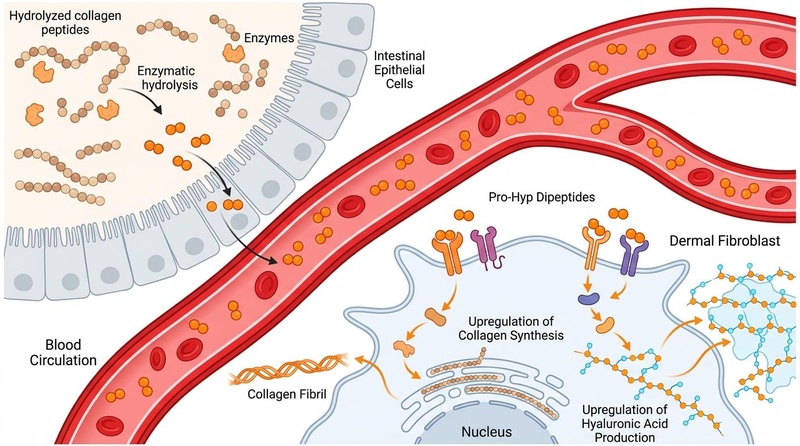
- Bioavailability: enzymatically cleaved peptides survive gastrointestinal digestion and appear in the blood as bioactive dipeptides (specifically Proline-Hydroxyproline), which directly stimulate fibroblasts [8][9].
- Clinical Versatility: Collagen matrices and cross-linking techniques are gold standards in endodontics, corneal stabilization, and soft-tissue augmentation [10][11][12].
¶ What people use it for
- Main goals: Skin hydration and wrinkle reduction, osteoarthritis and joint discomfort management, tendon and ligament repair, wound healing, muscle preservation.
- Evidence quality (overall): High
¶ What is Collagen?
Collagen is the most abundant protein in the human body, accounting for approximately 30% of total protein mass. It constitutes the primary extracellular matrix (ECM) of skin, bone, cartilage, tendons, and ligaments.
- Definition: A structural fibrous protein characterized by a unique triple-helix structure composed of three polypeptide chains. Each chain contains a repetitive sequence of Glycine-X-Y, where X and Y are frequently Proline and Hydroxyproline [13].
- Natural sources: Collagen is exclusively derived from animal tissues. Commercial supplements are typically produced via the enzymatic hydrolysis of connective tissues from bovine hides, porcine skin, fish scales/skin (marine), or poultry cartilage.
- Regulatory status: Recognized globally as a dietary supplement and safe food ingredient (GRAS status).
- Key pharmacological property: Bioactive peptide signaling and nitrogen donor for extracellular matrix synthesis.
¶ What are Collagen’s main benefits?
Collagen supplementation has been extensively validated across multiple human health domains, with the strongest evidence supporting its dermatological and musculoskeletal applications.
¶ Skin Rejuvenation and Elasticity
Dermal aging is characterized by a decrease in collagen density and fragmentation of elastic fibers. Oral supplementation with hydrolyzed collagen peptides (2.5g–10g daily) has been shown in multiple meta-analyses to significantly increase skin hydration, improve elasticity, and reduce the volume of facial wrinkles after 8–12 weeks of consistent use [1:1][14][2:1][15]. These effects are particularly pronounced in older populations or those with significant photodamage. Marine sources of collagen are often highlighted for their high bioavailability and specialized hydroxyproline profile [16][4:1].
¶ Joint Health and Osteoarthritis
Cartilage relies on a dense network of Type II collagen to withstand compressive forces. In clinical trials of knee osteoarthritis, collagen peptide supplementation (10g daily) significantly reduces pain and stiffness as measured by the WOMAC (Western Ontario and McMaster Universities Osteoarthritis Index) and VAS (Visual Analog Scale) scores [3:1][17][18]. Low-dose undenatured type II collagen (40mg/day) has also demonstrated efficacy by modulating the immune response to joint cartilage degradation [4:2][5:1].
¶ Muscle Mass and Performance Recovery
While not a complete protein for general muscle protein synthesis (as it lacks tryptophan), collagen is highly effective for reinforcing the connective tissue matrix within skeletal muscle. When paired with resistance training, 15g of collagen daily significantly increases fat-free mass and muscle strength in older adults with sarcopenia [6:1][7:1]. Furthermore, collagen peptides have been shown to reduce muscle damage markers (like creatine kinase) and perceived fatigue following intense physical activity, accelerating functional recovery [19][20].
¶ Tendon and Ligament Integrity
Tendons and ligaments are primarily composed of Type I collagen. Supplementation has been shown to improve the cross-sectional area and structural density of tendons, potentially reducing the risk of injury and supporting recovery from conditions like Achilles tendinopathy [21][20:1].
¶ Wound Healing and Pressure Injury Management
In clinical settings, collagen-enriched nutritional interventions (often combined with arginine and zinc) significantly accelerate the healing of stage 2–4 pressure injuries (bedsores) [22]. In-vivo studies also indicate that marine collagen peptides enhance the migration of keratinocytes and fibroblasts to the wound site, speeding up re-epithelialization [23].
¶ Evidence summary table (human outcomes)
| Outcome / Goal | Effect | Consistency | Evidence quality | Trials | Notes (population, duration, dose) |
|---|---|---|---|---|---|
| Skin Hydration & Elasticity | High | High | >30 RCTs | 2.5–5g/day for 8–12 weeks improves dermal moisture and elasticity [1:2][14:1][2:2] | |
| Knee Osteoarthritis Pain | High | High | >15 RCTs | Significant reduction in WOMAC pain and stiffness at 10g/day [3:2][18:1] | |
| Muscle Sarcopenia (FFM) | Moderate | Moderate | >5 RCTs | Increases fat-free mass when combined with resistance training [6:2][7:2] | |
| Tendon Structural Density | Moderate | Moderate | >10 RCTs | Improves tendon remodeling and reduces activity-related joint pain [21:1][20:2] | |
| Pressure Injury Healing | Moderate | Moderate | 18 RCTs | Accelerates healing in stage 2–4 ulcers in elderly populations [22:1] | |
| Bone Mineral Density | Moderate | Moderate | >5 RCTs | Long-term (12m) use increases BMD in postmenopausal women [7:3] | |
| Cardiovascular Markers | Low | Low | 5 RCTs | Modest improvements in arterial stiffness and lipid profiles [24] |
¶ How does Collagen work?
The efficacy of oral collagen peptides is driven by a unique dual-action mechanism that goes beyond simple amino acid provision.
¶ The Signaling Pathway (Peptide Bioactivity)
Unlike whole proteins that are completely broken down into individual amino acids, a significant portion of hydrolyzed collagen peptides survive digestion as bioactive dipeptides and tripeptides, such as Prolyl-hydroxyproline (Pro-Hyp) and Hydroxyprolyl-glycine (Hyp-Gly) [8:1][9:1].
- Fibroblast Activation: These peptides enter the bloodstream and bind to specialized receptors on the surface of dermal fibroblasts. This binding signals the cell that "collagen breakdown" has occurred, triggering a compensatory increase in the synthesis of endogenous collagen, elastin, and hyaluronic acid [8:2].
- Chondrocyte Support: In joint tissue, collagen fragments stimulate chondrocytes (cartilage cells) to produce new Type II collagen and proteoglycans, reinforcing the articular matrix [3:3].
¶ The Substrate Pathway (Nitrogen Sourcing)
Collagen is the body's primary source of the amino acids Glycine, Proline, and Hydroxyproline. By providing these specific building blocks in high concentrations, supplementation ensures the body has an optimal nitrogen pool for the high-turnover synthesis of structural proteins in the skin, bones, and joints [13:1].
¶ Pharmacokinetics
- Absorption: Hydrolyzed peptides are rapidly absorbed in the small intestine via the PEPT1 transporter. Peak plasma concentrations of bioactive dipeptides occur within 1–2 hours [8:3].
- Distribution: Radiolabeled studies in animal models show that ingested collagen peptides preferentially accumulate in the skin and articular cartilage for up to 96 hours post-ingestion [20:3].
¶ Effects on different systems
¶ Musculoskeletal System
Collagen peptides are essential for the structural integrity of the entire musculoskeletal system.
- Joints: Supports cartilage repair and reduces inflammation in the synovial fluid [17:1][4:3].
- Tendons/Ligaments: Enhances cross-linking and mechanical strength of ligaments [21:2][20:4].
- Bones: Increases bone mineral density (BMD) and modulates bone turnover markers (e.g., C-telopeptide) [25][7:4].
¶ Integumentary System (Skin, Hair, Nails)
- Dermal Density: Increases the thickness and organization of the dermal layer [1:3][2:3].
- Neck Rejuvenation: Collagen-stimulating interventions (both oral and injectable) are used to address neck skin laxity and "tech-neck" lines [26][27].
- Wound Healing: Accelerates tissue repair in acute wounds and chronic pressure injuries [22:2][23:1].
¶ Clinical and Regenerative Applications
Beyond dietary supplementation, collagen is a critical tool in modern regenerative medicine:
- Corneal Cross-Linking (CXL): A procedure using riboflavin and UV light to strengthen corneal collagen, stabilizing conditions like keratoconus [11:1][28][29].
- Dental/Periodontal: Xenogeneic collagen matrices are used to augment soft tissue around dental implants and treat gingival recession [12:1][30][31][32].
- Nerve Repair: Collagen conduits provide a structural scaffold for peripheral nerve regeneration [33].
¶ Dosage and how to take it
¶ Standard Dosing in Studies
- Skin Health: 2.5g – 5g daily of hydrolyzed peptides (Type I/III) [1:4][2:4].
- Joint Support & Osteoarthritis: 10g daily of hydrolyzed collagen OR 40mg of undenatured type II collagen (UC-II) [3:4][4:4].
- Muscle mass & Sarcopenia: 15g daily, ideally consumed within 60 minutes of resistance training [6:3][7:5].
- Tendon repair: 5g – 15g daily.
¶ Forms and Bioavailability
- Hydrolyzed Collagen (Peptides): The most common and best-absorbed form for systemic benefits.
- Undenatured Type II Collagen: Primarily used for its immune-modulating effects on joint cartilage at much lower doses (40mg).
- Gelatin: Effectively the same amino acid profile as collagen, but less soluble and slower to absorb.
¶ Administration
- Timing: Can be taken at any time. For connective tissue repair, some research suggests taking it 30–60 minutes prior to exercise to take advantage of increased blood flow to tendons and ligaments.
- Synergy: Essential to take with Vitamin C (at least 50mg), as it is a required cofactor for the enzymes (prolyl and lysyl hydroxylase) that cross-link collagen fibers [13:2].
¶ Safety and side effects
¶ Common Side Effects
Oral collagen is exceptionally well-tolerated. Rare side effects (affecting <1% of users) include:
- Mild gastrointestinal bloating or a feeling of heaviness.
- A lingering unpleasant aftertaste, particularly with some marine or bovine sources.
¶ Serious Concerns & Toxicology
- Heavy Metals: As collagen is derived from animal tissues, low-quality products can potentially accumulate heavy metals (lead, cadmium). It is critical to select third-party tested, high-purity sources.
- Allergies: Marine collagen is strictly contraindicated for individuals with fish or shellfish allergies.
- Biostimulator Complications: Injectable collagen biostimulators (like PLLA or CaHA), while generally safe, can rarely cause foreign body granulomas [34].
¶ Drug and supplement interactions
- No Known Major Drug Interactions: Collagen peptides do not interact with the hepatic CYP450 enzyme system and have no documented interactions with common medications.
- Synergistic Stacks:
- Vitamin C: Essential for collagen synthesis.
- [[supplements/boswellia|Boswellia serrata]]: Often combined for joint health to provide both structural support (collagen) and anti-inflammatory action [5:2].
- [[supplements/hyaluronic-acid|Hyaluronic Acid]]: Frequently co-supplemented to enhance skin hydration and joint lubrication [10:1].
¶ Practical questions (FAQ)
How long does it take to see results?
For skin hydration and elasticity, most clinical trials report significant results after 8 to 12 weeks of daily use. For joint pain and osteoarthritis, consistent intake for 3 to 6 months is typically required for peak analgesic effect.
Is "Vegan Collagen" real?
No. True collagen is only found in animals. "Vegan collagen" products are typically blends of amino acids (glycine, proline), Vitamin C, and silica intended to support your body's own production, but they do not contain actual collagen peptides.
Does stomach acid destroy collagen?
This is a misconception. Hydrolyzed collagen is specifically processed to contain dipeptides and tripeptides that are highly resistant to gastric degradation, allowing them to enter the bloodstream intact and reach target tissues like the skin and joints [8:4].
Can I take collagen if I have kidney issues?
Collagen is a protein. Individuals with advanced chronic kidney disease (CKD) on protein-restricted diets should account for collagen intake in their daily protein totals.
¶ How we evaluated the evidence
Evidence was graded using the GRADE (Grading of Recommendations, Assessment, Development, and Evaluation) framework.
- High: Multiple high-quality meta-analyses and systematic reviews of RCTs with consistent results (e.g., skin health, osteoarthritis pain).
- Moderate: Robust data from multiple RCTs, but with some heterogeneity in dosing or populations (e.g., sarcopenia, wound healing).
- Low: Emerging evidence with fewer trials or conflicting results (e.g., cardiovascular markers).
This page is updated quarterly as new high-tier clinical evidence emerges.
¶ References
Danessa G, et al. (2025). Effects of collagen-based supplements on skin's hydration and elasticity: A systematic review and meta-analysis. Indian Journal of Dermatology, Venereology and Leprology. https://pubmed.ncbi.nlm.nih.gov/40826844/ ↩︎ ↩︎ ↩︎ ↩︎ ↩︎
Myung SK, et al. (2025). Effects of Collagen Supplements on Skin Aging: A Systematic Review and Meta-Analysis of Randomized Controlled Trials. The American Journal of Medicine. https://pubmed.ncbi.nlm.nih.gov/40324552/ ↩︎ ↩︎ ↩︎ ↩︎ ↩︎
Lin CR, et al. (2023). Analgesic efficacy of collagen peptide in knee osteoarthritis: a meta-analysis of randomized controlled trials. Journal of Orthopaedic Surgery and Research. https://pubmed.ncbi.nlm.nih.gov/37717022/ ↩︎ ↩︎ ↩︎ ↩︎ ↩︎
Kumar P, et al. (2023). Efficacy of undenatured collagen in knee osteoarthritis: review of the literature with limited meta-analysis. American Journal of Translational Research. https://pubmed.ncbi.nlm.nih.gov/37854210/ ↩︎ ↩︎ ↩︎ ↩︎ ↩︎
Zapata A, et al. (2023). Management of Osteoarthritis and Joint Support Using Feed Supplements: A Scoping Review of Undenatured Type II Collagen and Boswellia serrata. Animals. https://pubmed.ncbi.nlm.nih.gov/36899726/ ↩︎ ↩︎ ↩︎
Bischof K, et al. (2024). Impact of Collagen Peptide Supplementation in Combination with Long-Term Physical Training on Strength, Musculotendinous Remodeling, Functional Recovery, and Body Composition in Healthy Adults: A Systematic Review with Meta-analysis. Sports Medicine. https://pubmed.ncbi.nlm.nih.gov/39060741/ ↩︎ ↩︎ ↩︎ ↩︎
Brueckheimer PJ, et al. (2025). The Effects of Type I Collagen Hydrolysate Supplementation on Bones, Muscles, and Joints: A Systematic Review. Orthopedic Reviews. https://pubmed.ncbi.nlm.nih.gov/39980497/ ↩︎ ↩︎ ↩︎ ↩︎ ↩︎ ↩︎
Inacio PAQ, et al. (2024). Effects of Hydrolyzed Collagen as a Dietary Supplement on Fibroblast Activation: A Systematic Review. Nutrients. https://pubmed.ncbi.nlm.nih.gov/38892477/ ↩︎ ↩︎ ↩︎ ↩︎ ↩︎
Shahrajabian MH, et al. (2024). Mechanism of Action of Collagen and Epidermal Growth Factor: A Review on Theory and Research Methods. Mini Reviews in Medicinal Chemistry. https://pubmed.ncbi.nlm.nih.gov/37587815/ ↩︎ ↩︎
Ahmad AMF, et al. (2026). Hyaluronic Acid vs. PRP, PRF, and Collagen in Regenerative Endodontics: A Systematic Review. Journal of Clinical Medicine. https://pubmed.ncbi.nlm.nih.gov/42279118/ ↩︎ ↩︎
Yeh CY, et al. (2025). Accelerated versus conventional corneal collagen cross-linking for keratoconus: A meta-analysis of randomized controlled trials. European Journal of Ophthalmology. https://pubmed.ncbi.nlm.nih.gov/39539159/ ↩︎ ↩︎
Dadlani S, et al. (2024). Efficacy of Xenogeneic Collagen Matrices in Augmenting Peri-Implant Soft Tissue: A Systematic Review and Meta-Analysis. Clinical and Experimental Dental Research. https://pubmed.ncbi.nlm.nih.gov/39104130/ ↩︎ ↩︎
Shenoy M, et al. (2022). Collagen Structure, Synthesis, and Its Applications: A Systematic Review. Cureus. https://pubmed.ncbi.nlm.nih.gov/35702467/ ↩︎ ↩︎ ↩︎
Dewi DAR, et al. (2023). Exploring the Impact of Hydrolyzed Collagen Oral Supplementation on Skin Rejuvenation: A Systematic Review and Meta-Analysis. Cureus. https://pubmed.ncbi.nlm.nih.gov/38192916/ ↩︎ ↩︎
Ravindran R, et al. (2026). Collagen Supplementation for Skin and Musculoskeletal Health: An Umbrella Review of Meta-Analyses on Elasticity, Hydration, and Structural Outcomes. Aesthetic Surgery Journal Open Forum. https://pubmed.ncbi.nlm.nih.gov/41809116/ ↩︎
Rahman A, et al. (2024). Unlocking the Therapeutic Potential of Marine Collagen: A Scientific Exploration for Delaying Skin Aging. Marine Drugs. https://pubmed.ncbi.nlm.nih.gov/38667776/ ↩︎
Jabbari M, et al. (2022). Is collagen supplementation friend or foe in rheumatoid arthritis and osteoarthritis? A comprehensive systematic review. International Journal of Rheumatic Diseases. https://pubmed.ncbi.nlm.nih.gov/35791039/ ↩︎ ↩︎
García-Coronado JM, et al. (2019). Effect of collagen supplementation on osteoarthritis symptoms: a meta-analysis of randomized placebo-controlled trials. International Orthopaedics. https://pubmed.ncbi.nlm.nih.gov/30368550/ ↩︎ ↩︎
Inacio PAQ, et al. (2024). The Effects of Collagen Peptides as a Dietary Supplement on Muscle Damage Recovery and Fatigue Responses: An Integrative Review. Nutrients. https://pubmed.ncbi.nlm.nih.gov/39408370/ ↩︎
Khatri M, et al. (2021). The effects of collagen peptide supplementation on body composition, collagen synthesis, and recovery from joint injury and exercise: a systematic review. Amino Acids. https://pubmed.ncbi.nlm.nih.gov/34491424/ ↩︎ ↩︎ ↩︎ ↩︎ ↩︎
Buchalski A, et al. (2026). Collagen Supplementation on Tendon-Related Structural and Performance Outcomes: A Systematic Review. Journal of Functional Morphology and Kinesiology. https://pubmed.ncbi.nlm.nih.gov/41900537/ ↩︎ ↩︎ ↩︎
Yildirim D, et al. (2026). Does Nutrition Intervention Prevent and Heal Pressure Injury? A Systematic Review of Randomized Controlled Trials. Advances in Skin & Wound Care. https://pubmed.ncbi.nlm.nih.gov/41587302/ ↩︎ ↩︎ ↩︎
Cruz MA, et al. (2021). Collagen from Marine Sources and Skin Wound Healing in Animal Experimental Studies: a Systematic Review. Marine Biotechnology. https://pubmed.ncbi.nlm.nih.gov/33404918/ ↩︎ ↩︎
Jalili Z, et al. (2023). Effects of collagen peptide supplementation on cardiovascular markers: a systematic review and meta-analysis of randomised, placebo-controlled trials. The British Journal of Nutrition. https://pubmed.ncbi.nlm.nih.gov/35658958/ ↩︎
Enciso R, et al. (2016). Assessing the utility of serum C-telopeptide cross-link of type 1 collagen as a predictor of bisphosphonate-related osteonecrosis of the jaw. Journal of the American Dental Association. https://pubmed.ncbi.nlm.nih.gov/27040417/ ↩︎
Bommareddy K, et al. (2026). A Comprehensive Review of Dermal Fillers and Biostimulators for Neck Rejuvenation. Dermatologic Surgery. https://pubmed.ncbi.nlm.nih.gov/42377479/ ↩︎
Ferreira ACM, et al. (2026). Efficacy, Durability, and Safety of Collagen Biostimulators Based on Poly-L-Lactic Acid (PLLA) and Calcium Hydroxyapatite (CaHA) in the Face: A Systematic Review. Aesthetic Plastic Surgery. https://pubmed.ncbi.nlm.nih.gov/41184662/ ↩︎
Alajmi TS, et al. (2026). Comparison of epithelium-off versus iontophoresis-assisted transepithelial corneal collagen cross-linking in keratoconus: a systematic review and meta-analysis. International Ophthalmology. https://pubmed.ncbi.nlm.nih.gov/41661382/ ↩︎
Davis SA, et al. (2020). Corneal collagen cross-linking for bacterial infectious keratitis. Cochrane Database of Systematic Reviews. https://pubmed.ncbi.nlm.nih.gov/32557558/ ↩︎
Liu Y, et al. (2026). Clinical efficacy of free gingival graft versus collagen matrix for peri-implant soft tissue augmentation: a systematic review and meta-analysis. Odontology. https://pubmed.ncbi.nlm.nih.gov/41420763/ ↩︎
Ríos-Osorio N, et al. (2026). Comparative outcomes of xenogeneic collagen matrices and autogenous graft-based techniques to increase mucosal thickness and keratinised mucosa width at implant sites: are autologous grafts still the gold standard? Journal of Periodontal & Implant Science. https://pubmed.ncbi.nlm.nih.gov/41332230/ ↩︎
Pranckevičienė A, et al. (2025). Comparison of a Subepithelial Connective Tissue Graft and a Xenogeneic Collagen Matrix in Combination with a Coronally Advanced Flap for Gingival Recession Coverage with 12-Month Follow-Up. Medicina (Kaunas). https://pubmed.ncbi.nlm.nih.gov/41010989/ ↩︎
Hoang A, et al. (2026). The Role of Collagen in Peripheral Nerve Regeneration and Emerging Repair Strategies. Annals of Plastic Surgery. https://pubmed.ncbi.nlm.nih.gov/42233784/ ↩︎
Wang H, et al. (2025). Foreign Body Granulomas Reaction Related to Collagen Stimulatory Cosmetic Fillers: A Systematic Review. Journal of Cosmetic Dermatology. https://pubmed.ncbi.nlm.nih.gov/41132036/ ↩︎