¶ Collagen
| Type | Structural Protein |
| Active Cmpd | Pro-Hyp & Hyp-Gly Dipeptides |
| Source | Bovine, Marine, Porcine, Avian connective tissues |
| Dose Range | 2.5g – 15g daily (Hydrolyzed) |
| Half-life | Peptide forms elevate in blood within 1–2 hours |
| Main Benefit | Dermal hydration/elasticity and joint cartilage integrity |
| Absorption | High bioavailability as hydrolyzed peptides |
Collagen is the primary structural protein in human connective tissues, widely utilized as an oral supplement to support skin elasticity, joint cartilage, and musculotendinous recovery. Backed by extensive meta-analyses of randomized clinical trials, oral hydrolyzed collagen peptides act as both cellular signaling cues and direct building blocks to stimulate endogenous tissue remodeling.
¶ At a glance
¶ Aliases
- Also known as: Collagen hydrolysate, hydrolyzed gelatin, collagen peptides, Type I/II/III collagen
- Chemical / botanical name: Collagen Peptides
- Category: Structural protein, amino acid derivative, dietary peptide
¶ Key points (high-level summary)
- Dermal Health: Daily oral intake of 2.5g to 5g of hydrolyzed collagen significantly improves skin hydration, elasticity, and dermal density in healthy and aging adults [1][2].
- Joint Protection: In individuals with knee osteoarthritis or activity-related joint pain, doses of 10g daily of hydrolyzed collagen or 40mg of undenatured type II collagen consistently improve cartilage markers and reduce subjective pain indices [3][4][5].
- Anabolic Support: Co-administration with resistance training assists in enhancing fat-free mass and muscle strength in sarcopenic populations and healthy active adults [6][7].
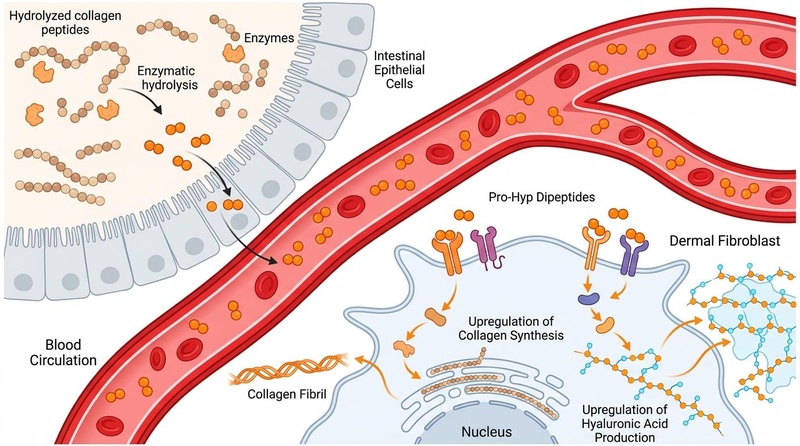
- Bioavailability: enzymatically cleaved peptides survive gastrointestinal digestion and appear in the blood as bioactive dipeptides (specifically Proline-Hydroxyproline), which directly stimulate fibroblasts [8][9].
- Clinical Versatility: Collagen matrices and cross-linking techniques are gold standards in endodontics, corneal stabilization, and soft-tissue augmentation [10][11][12].
¶ What people use it for
- Main goals: Skin hydration and wrinkle reduction, osteoarthritis and joint discomfort management, tendon and ligament repair, wound healing, muscle preservation.
- Evidence quality (overall): High
¶ What is Collagen?
Collagen is the most abundant protein in the human body, accounting for approximately 30% of total protein mass. It constitutes the primary extracellular matrix (ECM) of skin, bone, cartilage, tendons, and ligaments.
- Definition: A structural fibrous protein characterized by a unique triple-helix structure composed of three polypeptide chains. Each chain contains a repetitive sequence of Glycine-X-Y, where X and Y are frequently Proline and Hydroxyproline [13].
- Natural sources: Collagen is exclusively derived from animal tissues. Commercial supplements are typically produced via the enzymatic hydrolysis of connective tissues from bovine hides, porcine skin, fish scales/skin (marine), or poultry cartilage.
- Regulatory status: Recognized globally as a dietary supplement and safe food ingredient (GRAS status).
- Key pharmacological property: Bioactive peptide signaling and nitrogen donor for extracellular matrix synthesis.
¶ What are Collagen’s main benefits?
Collagen supplementation has been extensively validated across multiple human health domains, with the strongest evidence supporting its dermatological and musculoskeletal applications.
¶ Skin Rejuvenation and Elasticity
Dermal aging is characterized by a decrease in collagen density and fragmentation of elastic fibers. Oral supplementation with hydrolyzed collagen peptides (2.5g–10g daily) has been shown in multiple meta-analyses to significantly increase skin hydration, improve elasticity, and reduce the volume of facial wrinkles after 8–12 weeks of consistent use [1:1][14][2:1][15]. These effects are particularly pronounced in older populations or those with significant photodamage. Marine sources of collagen are often highlighted for their high bioavailability and specialized hydroxyproline profile [16][4:1].
¶ Joint Health and Osteoarthritis
Cartilage relies on a dense network of Type II collagen to withstand compressive forces. In clinical trials of knee osteoarthritis, collagen peptide supplementation (10g daily) significantly reduces pain and stiffness as measured by the WOMAC (Western Ontario and McMaster Universities Osteoarthritis Index) and VAS (Visual Analog Scale) scores [3:1][17][18]. Low-dose undenatured type II collagen (40mg/day) has also demonstrated efficacy by modulating the immune response to joint cartilage degradation [4:2][5:1].
¶ Muscle Mass and Performance Recovery
While not a complete protein for general muscle protein synthesis (as it lacks tryptophan), collagen is highly effective for reinforcing the connective tissue matrix within skeletal muscle. When paired with resistance training, 15g of collagen daily significantly increases fat-free mass and muscle strength in older adults with sarcopenia [6:1][7:1]. Furthermore, collagen peptides have been shown to reduce muscle damage markers (like creatine kinase) and perceived fatigue following intense physical activity, accelerating functional recovery [19][20].
¶ Tendon and Ligament Integrity
Tendons and ligaments are primarily composed of Type I collagen. Supplementation has been shown to improve the cross-sectional area and structural density of tendons, potentially reducing the risk of injury and supporting recovery from conditions like Achilles tendinopathy [21][20:1].
¶ Wound Healing and Pressure Injury Management
In clinical settings, collagen-enriched nutritional interventions (often combined with arginine and zinc) significantly accelerate the healing of stage 2–4 pressure injuries (bedsores) [22]. In-vivo studies also indicate that marine collagen peptides enhance the migration of keratinocytes and fibroblasts to the wound site, speeding up re-epithelialization [23].
¶ Evidence summary table (human outcomes)
| Outcome / Goal | Effect | Consistency | Evidence quality | Trials | Notes (population, duration, dose) |
|---|---|---|---|---|---|
| Skin Hydration & Elasticity | High | High | >30 RCTs | 2.5–5g/day for 8–12 weeks improves dermal moisture and elasticity [1:2][14:1][2:2] | |
| Knee Osteoarthritis Pain | High | High | >15 RCTs | Significant reduction in WOMAC pain and stiffness at 10g/day [3:2][18:1] | |
| Muscle Sarcopenia (FFM) | Moderate | Moderate | >5 RCTs | Increases fat-free mass when combined with resistance training [6:2][7:2] | |
| Tendon Structural Density | Moderate | Moderate | >10 RCTs | Improves tendon remodeling and reduces activity-related joint pain [21:1][20:2] | |
| Pressure Injury Healing | Moderate | Moderate | 18 RCTs | Accelerates healing in stage 2–4 ulcers in elderly populations [22:1] | |
| Bone Mineral Density | Moderate | Moderate | >5 RCTs | Long-term (12m) use increases BMD in postmenopausal women [7:3] | |
| Cardiovascular Markers | Low | Low | 5 RCTs | Modest improvements in arterial stiffness and lipid profiles [24] |
¶ How does Collagen work?
The efficacy of oral collagen peptides is driven by a unique dual-action mechanism that goes beyond simple amino acid provision.
¶ The Signaling Pathway (Peptide Bioactivity)
Unlike whole proteins that are completely broken down into individual amino acids, a significant portion of hydrolyzed collagen peptides survive digestion as bioactive dipeptides and tripeptides, such as Prolyl-hydroxyproline (Pro-Hyp) and Hydroxyprolyl-glycine (Hyp-Gly) [8:1][9:1].
- Fibroblast Activation: These peptides enter the bloodstream and bind to specialized receptors on the surface of dermal fibroblasts. This binding signals the cell that "collagen breakdown" has occurred, triggering a compensatory increase in the synthesis of endogenous collagen, elastin, and hyaluronic acid [8:2].
- Chondrocyte Support: In joint tissue, collagen fragments stimulate chondrocytes (cartilage cells) to produce new Type II collagen and proteoglycans, reinforcing the articular matrix [3:3].
¶ The Substrate Pathway (Nitrogen Sourcing)
Collagen is the body's primary source of the amino acids Glycine, Proline, and Hydroxyproline. By providing these specific building blocks in high concentrations, supplementation ensures the body has an optimal nitrogen pool for the high-turnover synthesis of structural proteins in the skin, bones, and joints [13:1].
¶ Pharmacokinetics
- Absorption: Hydrolyzed peptides are rapidly absorbed in the small intestine via the PEPT1 transporter. Peak plasma concentrations of bioactive dipeptides occur within 1–2 hours [8:3].
- Distribution: Radiolabeled studies in animal models show that ingested collagen peptides preferentially accumulate in the skin and articular cartilage for up to 96 hours post-ingestion [20:3].
¶ Effects on different systems
¶ Musculoskeletal System
Collagen peptides are essential for the structural integrity of the entire musculoskeletal system.