¶ Creatine
| Type | Amino acid derivative (Endogenous) |
| Active Cmpd | Creatine monohydrate |
| Source | Red meat, seafood, endogenous synthesis |
| Dose Range | 3–5 g/day (Maintenance) |
| Half-life | ~3 hours (Plasma) |
| Main Benefit | Muscle mass, strength, memory |
| Absorption | High (~99% bioavailability) |
Creatine is a foundational bioenergetic compound that maintains high-energy phosphate pools required for cellular ATP regeneration, particularly in skeletal muscle and neural tissues. Clinically recognized as one of the most effective interventions for age-related sarcopenia and cognitive decline, it serves as a cornerstone of evidence-based longevity protocols with an exceptional safety profile.[1][2][3]
¶ At a glance
Aliases
- Also known as: Methylguanidinoacetic acid, Cr, Creatine monohydrate
- Chemical name: N-(aminoiminomethyl)-N-methylglycine
- Category: Amino acid derivative / Nitrogenous organic acid
Key points
- Sarcopenia & Physical Performance: In older adults and clinical populations, creatine combined with resistance training robustly increases lean body mass, muscular strength, and functional capacity.[4][3:1]
- Cognitive Enhancement: Supplemental creatine enhances brain energy buffering, significantly improving memory and processing speed in older adults and individuals under metabolic or sleep-related stress.[2:1][5]
- Saturation & Synergy: Ergogenic benefits are dependent on tissue saturation; however, network meta-analyses show that co-supplementing beta-alanine offers no synergistic benefit over creatine monotherapy.[1:1][6]
- Safety & Renal Stability: Creatine monohydrate is highly safe for renal, hepatic, and metabolic health, though it can cause non-pathological elevations in serum creatinine which may lead to clinical misdiagnosis.[7][8]
What people use it for
- Main goals: Prevention of sarcopenia and osteosarcopenia, cognitive optimization, neuromuscular recovery, and mitochondrial health.
- Evidence quality (overall): High (supported by dozens of systematic reviews and meta-analyses).
¶ What is Creatine?
Creatine is a naturally occurring nitrogenous organic acid that is synthesized endogenously from the amino acids arginine, glycine, and methionine, primarily in the liver, kidneys, and pancreas.
- Definition: It is a pivotal bioenergetic shuttle that facilitates the rapid resynthesis of adenosine triphosphate (ATP) from adenosine diphosphate (ADP) via the enzyme creatine kinase.[1:2][5:1]
- Natural sources: Found predominantly in red meat and seafood; an omnivorous diet typically provides 1–2 g/day, whereas endogenous synthesis contributes another 1 g/day.[3:2]
- Historical use: Identified in 1832 by Michel Eugène Chevreul, it has been utilized in sports medicine since the early 1990s and has since evolved into a mainstream clinical tool for geriatric and rehabilitative medicine.[9][10]
- Regulatory status: Classified as a dietary supplement in the United States (GRAS status) and widely available as an over-the-counter health product globally.
- Key pharmacological property: High-energy phosphate donor and cellular bioenergetic buffer.
¶ What are Creatine’s main benefits?
Creatine's clinical utility spans musculoskeletal, neurological, and metabolic domains, with the strongest evidence supporting its role in performance and age-related tissue preservation.
¶ Musculoskeletal Health & Aging
- Outcome: Lean body mass and skeletal muscle strength.
- Direction of effect: Increase.
- Magnitude: Moderate to Large (especially when combined with resistance training).
- Population studied: Older adults, sarcopenic patients, and healthy athletes.
- Evidence quality: High (Multiple Tier-1 Meta-analyses).
- Summary: Creatine significantly mitigates age-related muscle wasting (sarcopenia) and enhances functional measures like gait speed and sit-to-stand performance.[4:1][3:3]
¶ Cognitive Function
- Outcome: Memory and global cognitive performance.
- Direction of effect: Increase.
- Magnitude: Moderate.
- Population studied: Older adults, vegetarians, and healthy individuals under stress.
- Evidence quality: High (Systematic Reviews & Meta-analyses).
- Summary: By replenishing brain phosphocreatine stores, it improves short-term memory and executive function, particularly in populations with lower baseline levels.[2:2][5:2]
¶ Metabolic and Systemic Safety
- Outcome: Lipid profile and Renal/Hepatic markers.
- Direction of effect: No consistent detrimental effect.
- Magnitude: Neutral.
- Population studied: Healthy adults, adolescents, and clinical populations (T2DM, SLE).
- Evidence quality: High.
- Summary: Clinical data consistently shows that creatine does not adversely affect kidney function, liver enzymes, or blood lipids.[11][7:1][8:1]
¶ Evidence summary table (human outcomes)
| Outcome / Goal | Effect* | Consistency | Evidence Quality | Trials | Notes |
|---|---|---|---|---|---|
| Lean Body Mass | High | High | 50+ RCTs | Significant gains when combined with resistance exercise across all ages.[4:2][3:4] | |
| Memory & Cognition | High | High | 16 RCTs | Validated improvements in memory and processing speed in older adults.[2:3] | |
| Upper-Body Strength | High | High | Many RCTs | Enhances maximal strength and endurance in upper-body movements.[12] | |
| Lower-Body Strength | High | High | Many RCTs | Robust leg power and functional performance enhancement.[12:1] | |
| Bone Mineral Density | Moderate | Moderate | Multiple RCTs | Supports bone health in postmenopausal women with osteopenia.[13][14] | |
| Endurance Capacity | Moderate | Moderate | Meta-analysis | Modest but significant benefits in repeated-effort aerobic performance.[15] | |
| Lipid Profile | High | High | Meta-analysis | No significant or detrimental changes to blood cholesterol or triglycerides.[11:1] | |
| Renal Health (GFR) | High | High | Meta-analysis | Safety confirmed; no adverse effects on measured glomerular filtration rate.[8:2] |
- *Effect: Direction: ↑ (u), ↓ (d), = (e), ? (q). Magnitude: 0-3. Impact: p (positive), n (negative), x (neutral).
¶ How does Creatine work?
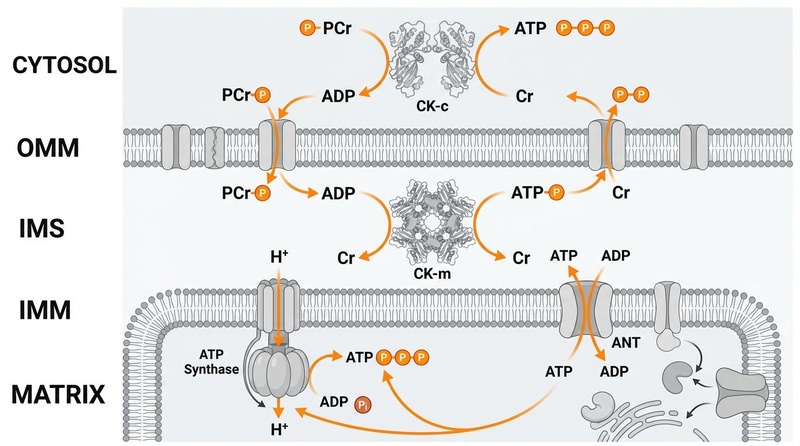
Creatine serves as the primary reservoir for high-energy phosphate groups in the cytoplasm and mitochondria, creating a metabolic "shuttle" that supports cellular vitality.
- Primary targets: Cytosolic and mitochondrial Creatine Kinase (CK), cellular ATP/PCr energy shuttles, and sodium-dependent creatine transporters (Crt/SLC6A8).[5:3]
- Core mechanisms:
- ATP-Phosphocreatine Shuttle: Creatine kinase transfers a phosphate group from phosphocreatine (PCr) to ADP, rapidly regenerating ATP during high-demand bursts. This prevents cellular energy depletion and maintains a high ATP/ADP ratio.[1:3][5:4]
- Intracellular Osmoregulation: Creatine is an osmotically active substance; its uptake into muscle cells increases intracellular water, promoting cell swelling. This swelling serves as an anabolic signal that activates the mTOR pathway and stimulates myogenic regulatory factors.[9:1][3:5]
- Antioxidant and Anti-inflammatory Effects: Recent evidence suggests creatine reduces oxidative stress and markers of inflammation in intestinal and neural tissues, protecting cellular membranes and barriers.[16][5:5]
- Neuromodulation: In the CNS, creatine acts as a metabolic neuromodulator, protecting neurons from hypoxia and oxidative neurotoxicity while supporting neurotransmitter systems.[5:6][17]
- Evidence source: Extensive human clinical trials demonstrate these effects in vivo, while rodent models provide high-resolution neurochemical and behavioral validation.[18][5:7][17:1]
- Pharmacokinetics: Creatine monohydrate has nearly 100% bioavailability. It is cleared by the kidneys via glomerular filtration; however, because creatine is spontaneously converted to creatinine (Crn), supplementation typically leads to a predictable, non-pathological rise in serum Crn.[8:3]
¶ Effects on different systems
¶ Musculoskeletal & Aging
Creatine is the clinical gold standard for treating sarcopenia (muscle loss) and osteopenia (bone loss) in the elderly. When paired with resistance training, it significantly increases lean tissue mass and functional independence.[3:6][14:1] It also aids in pediatric and adolescent orthopedic rehabilitation by mitigating muscle atrophy during immobilization.[19]
¶ Brain & Mental Health
In the brain, creatine buffers glucose hypometabolism and oxidative stress. Meta-analyses confirm it enhances memory performance and executive function in older adults and healthy individuals under metabolic stress.[2:4][5:8] In psychiatric contexts like schizophrenia, while brain creatine levels are tightly regulated, support of the energy buffer system may improve neuro-metabolic stability.[17:2]

¶ Metabolic & Cardiovascular Health
Creatine supplementation does not adversely alter blood lipid profiles (total cholesterol, LDL, triglycerides).[11:2] In clinical settings, intravenous creatine phosphate sodium has been used effectively to support myocardial bioenergetics in conditions like viral myocarditis.[20] Furthermore, it is safe for metabolic markers in both healthy adolescents and clinical populations like those with systemic lupus erythematosus.[7:2][21]
¶ Gut & Digestion
Emerging research identifies creatine as a potential protective agent for the intestinal barrier. By replenishing enterocyte energy reserves and providing antioxidant support, it may reduce oxidative damage and inflammation in the gastrointestinal tract.[16:1]
¶ Dosage and how to take it
¶ Standard dosing in studies
- Maintenance Phase: 3–5 g/day (or ~0.1 g/kg/day) is the most common clinical protocol for long-term health and tissue saturation.[3:7]
- Loading Phase: 20 g/day (split into 4 doses of 5 g) for 5–7 days can rapidly saturate tissue stores, though it is not strictly necessary for long-term benefits.[1:4]
- Study durations: Clinical trials for sarcopenia and bone health typically range from 12 weeks to 2 years.[3:8][14:2]
¶ Forms and bioavailability
- Creatine Monohydrate: The most researched, effective, and bioavailable form (gold standard).[1:5][8:4]
- Creatine Ethyl Ester: A more unstable molecule that breaks down into creatinine before entering muscle tissue; clinical trials show it is significantly less effective than monohydrate.[8:5]
- Creatine Phosphate Sodium: Used in specific clinical/intravenous settings for myocardial support.[20:1]
¶ Special populations
- Older Adults: Require consistent maintenance (3–5 g) to offset age-related declines in muscle and brain energy reserves.[3:9]
- Adolescents: Systematic reviews confirm high safety for renal and hepatic markers in this group.[7:3]
- Vegetarians: Often exhibit lower baseline stores and may experience more pronounced cognitive and physical gains from supplementation.[2:5]
¶ Safety and side effects
¶ Common side effects
- Water Retention: Mild intracellular fluid increase (typically 1–2 kg) may occur during the initial loading phase. This is an anabolic, non-pathological finding.[1:6]
- GI Distress: Can occur if high doses (>10 g single dose) are taken with insufficient water.[8:6]
¶ Serious concerns & Misdiagnosis
- Renal Function: There is no evidence that creatine damages healthy kidneys. Meta-analyses of measured GFR show no detrimental effect.[8:7]
- Creatinine Confounding: Supplementation elevates serum creatinine (Crn), a biomarker often used to estimate kidney health. This can lead to a false-positive diagnosis of kidney dysfunction on standard lab tests. For accurate monitoring, clinicians should utilize Cystatin C, which is independent of creatine metabolism.[8:8]
¶ Who should avoid it
- Individuals with severe pre-existing renal disease (e.g., GFR < 30 mL/min) should consult their clinical team, as evidence in this subpopulation is limited.[8:9]
¶ Drug and supplement interactions
¶ Pharmacokinetic interactions
- Serum Creatinine Labs: Creatine directly interferes with the accuracy of Crn-based eGFR (estimated Glomerular Filtration Rate). Recommend clinical monitoring via Cystatin C or 24-hour urine clearance for those on long-term protocols.[8:10]
¶ Pharmacodynamic interactions
- Beta-Alanine: While popular in "stacks," network meta-analyses of 52 RCTs show no synergistic benefit from combining beta-alanine with creatine; the ergogenic effect is primarily driven by creatine alone.[1:7][6:1]
- Resistance Training: Displays a strong positive synergistic interaction with creatine for musculoskeletal outcomes (sarcopenia mitigation).[3:10]
¶ Combining Creatine with other supplements ("stacks")
- Creatine + Carbohydrates/Protein: Co-ingestion with carbohydrates or protein may enhance creatine uptake via insulin-stimulated sodium-dependent transport.[3:11]
- Creatine + Resistance Exercise: The most robust clinical "stack" for longevity, essential for maximizing lean body mass gains and strength in aging.[4:3][3:12]
- Creatine + HMB: Often combined in geriatric protocols (osteosarcopenia) to prevent muscle breakdown and support bone mineralization.[14:3]
¶ Practical questions (FAQ)
How long does it take for creatine to work?
Physical performance improvements and tissue saturation typically occur within 5–7 days with a loading protocol, or 3–4 weeks with a standard 3–5 g daily maintenance dose.
Do I need to cycle creatine?
Can I take creatine if I don't exercise?
Does creatine cause hair loss?
Current clinical evidence does not support a causal link between creatine supplementation and hair loss; this concern originated from a single small study on DHT levels that has not been replicated.
Is creatine safe for my kidneys?
Yes. Systematic reviews and meta-analyses confirm that creatine is safe for the kidneys in healthy individuals. However, it can raise serum creatinine levels, which may be misinterpreted as kidney dysfunction.[8:12]
¶ How we evaluated the evidence
Evidence for this monograph was evaluated using the GRADE (Grading of Recommendations, Assessment, Development, and Evaluations) framework.
- High Certainty: Meta-analyses of RCTs for muscle mass, strength, and safety.
- Moderate Certainty: Memory and bone mineral density outcomes.
- Priority: Peer-reviewed systematic reviews and meta-analyses from PubMed/Cochrane were prioritized over narrative reviews or animal data.
- Magnitude: Defined based on Standardized Mean Differences (SMD) and clinically significant changes in functional capacity.
¶ References
Bai X, Xu T. Effects of combined versus single supplementation of creatine and beta-alanine on aerobic and anaerobic performance: a systematic review and network meta-analysis. Journal of the International Society of Sports Nutrition. 2026. https://pubmed.ncbi.nlm.nih.gov/42384726/ ↩︎ ↩︎ ↩︎ ↩︎ ↩︎ ↩︎ ↩︎ ↩︎
Prokopidis K, et al. Effects of creatine supplementation on memory in healthy individuals: a systematic review and meta-analysis of randomized controlled trials. Nutrition Reviews. 2023. https://pubmed.ncbi.nlm.nih.gov/35984306/ ↩︎ ↩︎ ↩︎ ↩︎ ↩︎ ↩︎ ↩︎
Sharifian G, et al. Impact of creatine supplementation and exercise training in older adults: a systematic review and meta-analysis. European Review of Aging and Physical Activity. 2025. https://pubmed.ncbi.nlm.nih.gov/41062952/ ↩︎ ↩︎ ↩︎ ↩︎ ↩︎ ↩︎ ↩︎ ↩︎ ↩︎ ↩︎ ↩︎ ↩︎ ↩︎ ↩︎
Delpino FM, et al. Influence of age, sex, and type of exercise on the efficacy of creatine supplementation on lean body mass: A systematic review and meta-analysis. Nutrition. 2022. https://pubmed.ncbi.nlm.nih.gov/35986981/ ↩︎ ↩︎ ↩︎ ↩︎
Meftahi GH, et al. Creatine Activity as a Neuromodulator in the Central Nervous System. Archives of Razi Institute. 2023. https://pubmed.ncbi.nlm.nih.gov/38226371/ ↩︎ ↩︎ ↩︎ ↩︎ ↩︎ ↩︎ ↩︎ ↩︎ ↩︎
Ashtary-Larky D, et al. Effects of Creatine and β-Alanine Co-Supplementation on Exercise Performance and Body Composition: A Systematic Review. Nutrients. 2025. https://pubmed.ncbi.nlm.nih.gov/40647180/ ↩︎ ↩︎
Rubinchuk A, et al. Evaluating the Safety of Creatine Monohydrate in Adolescents: A Systematic Review of Renal, Hepatic, and Cardiometabolic Outcomes. Cureus. 2026. https://pubmed.ncbi.nlm.nih.gov/42124755/ ↩︎ ↩︎ ↩︎ ↩︎
Naeini EK, et al. Effect of creatine supplementation on kidney function: a systematic review and meta-analysis. BMC Nephrology. 2025. https://pubmed.ncbi.nlm.nih.gov/41199218/ ↩︎ ↩︎ ↩︎ ↩︎ ↩︎ ↩︎ ↩︎ ↩︎ ↩︎ ↩︎ ↩︎ ↩︎ ↩︎
Wu SH, et al. Creatine Supplementation for Muscle Growth: A Scoping Review of Randomized Clinical Trials from 2012 to 2021. Nutrients. 2022. https://pubmed.ncbi.nlm.nih.gov/35334912/ ↩︎ ↩︎
Ashtary-Larky D, et al. Creatine Supplementation in Combat Sport Athletes: A Narrative Systematic Review. Journal of Dietary Supplements. 2025. https://pubmed.ncbi.nlm.nih.gov/40755023/ ↩︎
Gimenez FVM, et al. Does creatine affect lipid profile? a systematic review and meta-analysis of randomized placebo-controlled trials. Frontiers in Nutrition. 2026. https://pubmed.ncbi.nlm.nih.gov/42180567/ ↩︎ ↩︎ ↩︎
Kazeminasab F, et al. The Effects of Creatine Supplementation on Upper- and Lower-Body Strength and Power: A Systematic Review and Meta-Analysis. Nutrients. 2025. https://pubmed.ncbi.nlm.nih.gov/40944139/ ↩︎ ↩︎
Chen KH, et al. Nutritional Supplementation Combined with Exercise for Musculoskeletal Health in Women: A Systematic Review and Meta-Analysis. International Journal of Medical Sciences. 2026. https://pubmed.ncbi.nlm.nih.gov/42158825/ ↩︎
Moreira-Velasco JE, et al. Beyond Calcium and Vitamin D: Exploring Creatine, β-Hydroxy-β-methylbutyrate, Prebiotics and Probiotics in Osteosarcopenia. Nutrients. 2025. https://pubmed.ncbi.nlm.nih.gov/40732957/ ↩︎ ↩︎ ↩︎ ↩︎
Fernández-Landa J, et al. Effects of Creatine Monohydrate on Endurance Performance in a Trained Population: A Systematic Review and Meta-analysis. Sports Medicine. 2023. https://pubmed.ncbi.nlm.nih.gov/36877404/ ↩︎
Oliveira JT, Pieniz S. Role of creatine supplementation in intestinal health: a narrative review of its antioxidant and anti-inflammatory potential. Nutrition. 2026. https://pubmed.ncbi.nlm.nih.gov/42202735/ ↩︎ ↩︎
Yang YS, et al. Meta-analytic evidence of elevated choline, reduced N-acetylaspartate, and normal creatine in schizophrenia. NeuroImage. Clinical. 2023. https://pubmed.ncbi.nlm.nih.gov/37406595/ ↩︎ ↩︎ ↩︎
Sal-Sarria S, Fernández-Blanco A. Creatine and cognitive function in rodents: A systematic review of behavioral and neurobiological evidence. Behavioural Brain Research. 2026. https://pubmed.ncbi.nlm.nih.gov/42331064/ ↩︎
Hoffman ID, Combs K. Creatine Supplementation in Pediatric Orthopedic Rehabilitation: A Translational Review and Proposed Clinical Trial Framework. Journal of Orthopaedic Case Reports. 2026. https://pubmed.ncbi.nlm.nih.gov/42273503/ ↩︎ ↩︎
Wang L, et al. Efficacy and safety of creatine phosphate sodium in the treatment of viral myocarditis: A systematic review and meta-analysis. PloS One. 2025. https://pubmed.ncbi.nlm.nih.gov/39854433/ ↩︎ ↩︎
Aleksovska K, et al. What Are the Normal Serum Creatine Kinase Values for Skeletal Muscle? A Worldwide Systematic Review. European Journal of Neurology. 2025. https://pubmed.ncbi.nlm.nih.gov/40511619/ ↩︎