¶ Dasatinib
| Label | Value |
|---|---|
| Type | Synthetic Small Molecule / TKI |
| Active Cmpd | Dasatinib (BMS-354825) |
| Source | Synthetic |
| Dose Range | 50–100 mg (intermittent) |
| Half-life | 3–5 hours |
| Main Benefit | Cellular Senescence Clearance |
| Absorption | Highly variable (pH-dependent) |
Dasatinib is a second-generation synthetic tyrosine kinase inhibitor (TKI) originally developed to treat Philadelphia chromosome-positive leukemias. In longevity medicine, it serves as a foundational senolytic agent, typically administered intermittently in combination with quercetin (D+Q) to target and eliminate senescent cells that accumulate during biological aging.
¶ At a glance
¶ Aliases
- Also known as: BMS-354825, Sprycel
- Chemical name:
N-(2-chloro-6-methylphenyl)-2-[[6-[4-(2-hydroxyethyl)-1-piperazinyl]-2-methyl-4-pyrimidinyl]amino]-5-thiazolecarboxamide - Category: Synthetic small molecule tyrosine kinase inhibitor (TKI); Senolytic agent
¶ Key points
- Targeted senescent cell ablation: Combined with quercetin (D+Q), dasatinib transiently disables the pro-survival networks of senescent cells, leading to selective apoptosis[1][2].
- Demonstrated human efficacy: Human clinical pilots show that a short oral course of D+Q reduces senescent cell burden in adipose and skin tissues[1:1], and improves physical mobility in patients with idiopathic pulmonary fibrosis (IPF)[3][4].
- High clinical-use risks: Common adverse events include pleural effusions, myelosuppression, and gastrointestinal distress, requiring careful clinical oversight and risk mitigation[5][6].
- Fetal toxicity: Due to high teratogenicity and embryofetal toxicity, dasatinib is strictly contraindicated during pregnancy[7].
¶ What people use it for
- Main goals: Selective clearance of senescent cells (cellular rejuvenation), ameliorating physical frailty, mitigating tissue fibrosis, and clinical management of tyrosine kinase-driven malignancies[8][9][1:2][3:1].
- Evidence quality: Moderate for established oncological indications and systemic senescent cell clearance; Low for longevity-specific physical and cognitive outcomes in healthy humans.
¶ What is Dasatinib?
Dasatinib is an orally active, synthetic small molecule multi-kinase inhibitor designed as a highly potent therapeutic agent[9:1]. It was developed to overcome imatinib resistance in chronic myeloid leukemia (CML)[6:1].
- Definition: A synthetic thiazole-carboxamide compound that acts as a multi-targeted inhibitor of BCR-ABL and Src family tyrosine kinases[2:1].
- Natural sources: None. Dasatinib is entirely synthetic.
- Traditional use: None. It is a highly modern pharmaceutical, FDA-approved in 2006 for hematological malignancies.
- Current regulatory status: Prescription-only medication (Rx) globally. Longevity applications (as a senolytic) are entirely off-label and limited to clinical research or specialized clinical supervision.
- Key pharmacological property: Ultra-potent, multi-targeted tyrosine kinase inhibitor targeting BCR-ABL, Src, c-Kit, and Eph receptors (such as EphA2)[2:2].
¶ What are Dasatinib’s main benefits?
In clinical and preclinical trials, dasatinib has shown several distinct therapeutic outcomes:
- Clearance of Senescent Cells: In human pilot trials, a 3-day oral protocol of dasatinib combined with quercetin (D+Q) significantly decreased the abundance of p16- and p21-positive senescent cells in adipose tissue and skin. This clearance was accompanied by a reduction in macrophages and circulating senescence-associated secretory phenotype (SASP) cytokines[1:3].
- Improvement in Physical Function: In open-label and randomized clinical pilots of patients with idiopathic pulmonary fibrosis (IPF)—a cellular senescence-driven progressive disease—intermittent D+Q significantly improved physical performance. Clinically meaningful improvements were observed in 6-minute walk distance, 4-meter gait speed, and physical performance batteries[3:2][4:1].
- Oncological Management: Dasatinib exhibits exceptional efficacy in achieving deep molecular response and high complete remission rates in adults with Philadelphia chromosome-positive acute lymphoblastic leukemia (Ph+ ALL) and CML, functioning as a primary targeted chemotherapeutic[9:2][6:2]. It has also demonstrated cytostatic benefits and improved overall survival in subset analyses of certain solid tumors, such as non-small cell lung cancer (NSCLC)[8:1][10].
- Preclinical Diabetic Retinopathy: Preclinical models indicate that senolytic therapy using D+Q clears senescent vascular and neural cells, mitigating blood-retinal barrier breakdown and retinal inflammation in diabetic retinopathy[11].
¶ Evidence summary table (human outcomes)
| Outcome / Goal | Effect* | Consistency | Evidence quality | Trials | Notes (population, duration, dose) |
|---|---|---|---|---|---|
| Senescent cell clearance | High | Moderate | 1 Pilot RCT | D+Q (100 mg dasatinib + 1250 mg quercetin) for 3 days reduced p16/p21 expression in adipose/skin in diabetic kidney disease.[1:4] | |
| Physical function (IPF) | Moderate | Low | 2 Pilots (1 RCT) | Intermittent D+Q (100 mg/1250 mg) for 3 weeks improved 6-minute walk distance and gait speed in idiopathic pulmonary fibrosis.[3:3][4:2] | |
| Cognitive function (AD) | High | Low | 1 Pilot | Intermittent D+Q (100 mg/1250 mg) for 12 weeks was feasible and safe in early Alzheimer's but showed no cognitive changes.[12][13] | |
| Complete Remission (Ph+ ALL) | High | High | Multiple RCTs | Monotherapy or combination therapy in adult Ph+ ALL achieves rapid and deep molecular remission.[9:3][6:3] | |
| Overall Survival (NSCLC) | Moderate | Moderate | Meta-analysis | Improved overall survival as combination therapy in specific EGFR-mutated or Src-driven solid tumors.[8:2][10:1] |
*Effect: Number of arrows (1-3) indicates magnitude. Direction: ↑ (increase), ↓ (decrease), = (no effect), ? (unclear). Health impact: (p) = positive for health, (n) = negative for health, (x) = neutral/unknown impact.
¶ How does Dasatinib work?
¶ Primary Targets
Dasatinib is a potent, ATP-competitive, multi-kinase inhibitor that binds to both the active and inactive conformations of targeted tyrosine kinases[9:4]. It exerts its primary pharmacological effects by blocking:
- BCR-ABL: The oncogenic fusion protein responsible for CML pathogenesis[6:4].
- Src Family Kinases: Key intracellular signaling proteins (including Src, Lck, Yes, Fyn) that regulate cell survival, proliferation, and cell-matrix adhesion[2:3][14].
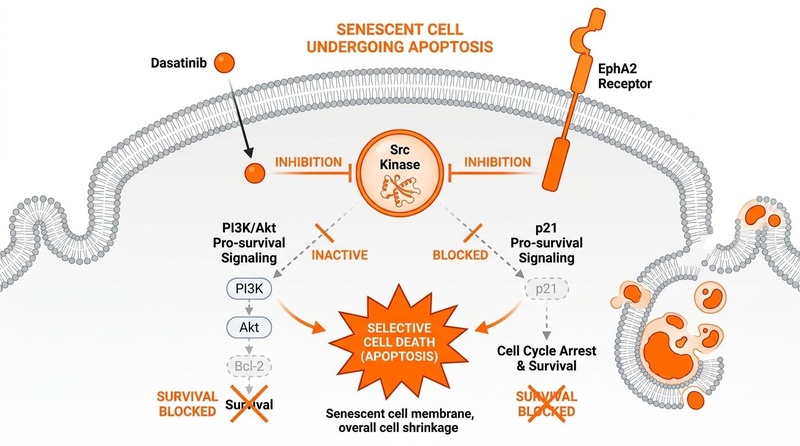
- Eph Receptors: Particularly Eph receptor A2 (EphA2), which is highly expressed on senescent cells and acts as a critical transmembrane survival receptor[2:4].
- c-Kit and PDGFR-β: Transmembrane receptor tyrosine kinases involved in hematopoiesis and connective tissue homeostasis[2:5].
¶ Senolytic Mechanism (The SCAP Pathway)
Senescent cells resist apoptosis by upregulating protective Senescent Cell Anti-Apoptotic Pathways (SCAPs)[2:6]. These pathways act as molecular shields, keeping the damaged, hyper-inflammatory cell alive despite intracellular stress.
[Senescent Cell Survival Shield (SCAP)]
        │   ├── Src Kinase Signaling
        │   └── EphA2 Receptor Network
        ▼
   Dasatinib blocks Src & EphA2
        ▼
   Disrupts PI3K/Akt / p21 Pro-survival Signaling
        ▼
   Senescent Cell Vulnerability Exposed
        ▼
   Selective Apoptosis (Cell Death) ──► Cleared by Macrophages
Dasatinib acts as a senolytic by disrupting specific nodes within these SCAP networks:
- Src-Kinase and EphA2 Receptor Targeting: Senescent preadipocytes depend heavily on Src kinase and EphA2 receptor networks to inhibit apoptotic cascades[2:7].
- Synergy with Quercetin: While dasatinib disables Src- and EphA2-dependent survival pathways, quercetin acts complementarily by inhibiting BCL-xL and PI3K/Akt survival loops[2:8]. Combined, they strip away the survival shields of heterogeneous senescent populations.
- Intermittent "Hit-and-Run" Kinetics: Because apoptosis is triggered within hours of target inhibition, dasatinib does not require continuous systemic exposure. A brief, high-concentration pulse (intermittent dosing) is sufficient to initiate apoptosis in senescent cells, minimizing the toxicities associated with chronic kinase inhibition[1:5][5:1].
¶ Pharmacokinetics
- Absorption: Rapidly absorbed but highly dependent on gastric acidity. Acid-suppressive medications (like PPIs) severely impair absorption[6:5].
- Metabolism: Extensively metabolized in the liver, primarily via the CYP3A4 pathway[6:6].
- Half-life: Short terminal half-life of 3 to 5 hours, which aligns perfectly with intermittent, brief-exposure senolytic dosing protocols[1:6].
¶ Effects on different systems
¶ Cellular Senescence & Longevity
In preclinical models, systemic clearance of senescent cells using dasatinib plus quercetin (D+Q) improves cardiac function, enhances carotid vascular reactivity, and prolongs healthy life expectancy (healthspan) in chronologically aged mice[2:9]. In human trials, tissue biopsies confirm a significant down-regulation of key senescence biomarkers (p16INK4A, p21CIP1) and a notable decrease in the density of inflammatory macrophages in adipose tissue, demonstrating successful translation of senolysis from rodents to humans[1:7].
¶ Cardiovascular Health
Preclinical animal studies demonstrate that clearing senescent endothelial cells with D+Q restores nitric oxide bioavailability and reverses arterial stiffness[2:10]. However, in human cancer treatment, chronic high-dose dasatinib is associated with severe cardiovascular toxicities, including pulmonary arterial hypertension (PAH) and QT-interval prolongation, necessitating baseline and serial electrocardiographic and echocardiographic evaluations[5:2][6:7].
¶ Pulmonary Health
While intermittent D+Q has shown exceptional clinical signals of functional improvement in patients with idiopathic pulmonary fibrosis (IPF)[3:4][4:3], chronic oncology-dose dasatinib is strongly linked to significant pulmonary adverse events. Chief among these is pleural effusion, affecting 7–18% of oncology patients[5:3], and rare cases of dasatinib-associated chylothorax due to lymphatic vessel leakage[15][14:1].
¶ Dosage and how to take it
¶ Standard Dosing in Clinical Studies
For longevity applications, dasatinib is never administered on the continuous daily schedules used in oncology. Instead, clinical research utilizes highly structured, intermittent "hit-and-run" protocols:
- The D+Q Cocktail Protocol:
- Administration with Food: Can be taken with or without food. However, it must not be taken with grapefruit juice or fresh grapefruit, as these strongly inhibit CYP3A4, causing unpredictable increases in drug exposure[6:8].
¶ Forms and Bioavailability
- Chemical Form: Dasatinib is typically supplied as anhydrous dasatinib tablets (commercial name Sprycel) or generic equivalents.
- pH Dependence: Absorption requires an acidic gastric environment. Co-administration with antacids, H2 receptor antagonists (e.g., famotidine), or proton pump inhibitors (e.g., omeprazole) dramatically reduces oral bioavailability and must be avoided[6:9].
¶ Special Populations
- Pregnancy and Breastfeeding: Strictly contraindicated. Dasatinib can cause profound fetal harm (including limb malformations and severe fetal cytopenias) when administered to a pregnant woman[7:1].
- Hepatic Impairment: Since dasatinib is primarily metabolized by the liver, moderate-to-severe hepatic impairment significantly increases systemic drug exposure, requiring extreme caution or dosage reduction.
¶ Safety and side effects
CRITICAL CLINICAL CAUTION
Dasatinib is a highly potent antineoplastic agent with a narrow therapeutic window. Chronic use is associated with high-severity toxicities. For longevity applications, intermittent dosing is utilized to mitigate these risks, but clinical laboratory monitoring is required.
¶ Common Side Effects (Oncology Dosing)
When administered daily for oncological indications, dasatinib carries a high rate of adverse events:
- Myelosuppression: Severe (Grade 3/4) neutropenia, thrombocytopenia, and anemia occur in a significant portion of patients, typically requiring temporary dose suspension[5:4][6:10].
- Fluid Retention: Superficial edema (pleural, pericardial, or peripheral) is common, with pleural effusions occurring in 7–18% of patients[5:5].
- Gastrointestinal Distress: Nausea, vomiting, diarrhea, and abdominal pain are frequent but generally manageable[6:11].
¶ Pleural Effusions and Chylothorax
- Pleural Effusion Risk: Fluid accumulation around the lungs is dose-dependent. Transitioning from 70 mg twice daily to 100 mg once daily reduces the incidence of pleural effusions from approximately 16% to 7%[5:6].
- Dasatinib-Induced Chylothorax: A rare but distinct complication of dasatinib therapy characterized by the accumulation of lymphatic chyle in the pleural space[15:1]. Pharmacovigilance reviews demonstrate that this adverse effect can occur even after long-term treatment exceeding 5 years, indicating there is no "safe" exposure duration limit[14:2].
¶ Who should avoid it
- Pregnant or Lactating Individuals: Complete contraindication due to embryofetal toxicity[7:2].
- Individuals with Pre-existing Lung Disease: Patients with active pleural effusions, pulmonary hypertension, or severe COPD are at highly elevated risk for respiratory complications.
- Patients with Long QT Syndrome: Dasatinib can prolong the QT interval and should be avoided in patients with congenital long QT syndrome or severe, uncontrolled cardiovascular disease[6:12].
¶ Drug and supplement interactions
¶ Pharmacokinetic Interactions (CYP3A4)
Dasatinib is a major substrate of the cytochrome P450 enzyme CYP3A4. Any substance that modulates CYP3A4 activity will profoundly alter dasatinib blood levels:
- Strong CYP3A4 Inhibitors: Ketoconazole, itraconazole, clarithromycin, and grapefruit juice. These block dasatinib metabolism, significantly increasing blood levels and elevating the risk of severe toxicities[6:13].
- Strong CYP3A4 Inducers: Rifampin, carbamazepine, phenobarbital, and St. John’s wort. These accelerate dasatinib clearance, rendering the drug ineffective[6:14].
¶ Gastric pH Modulators
Because dasatinib solubility is highly pH-dependent, drugs that elevate gastric pH severely suppress its absorption:
- Proton Pump Inhibitors (PPIs): Omeprazole, esomeprazole, pantoprazole. These cause long-term suppression of gastric acid, reducing dasatinib exposure by up to 60–80%. Avoid completely[6:15].
- H2 Receptor Antagonists: Famotidine, ranitidine. These must be taken at least 2 hours before or 10 hours after dasatinib[6:16].
- Antacids: Aluminum hydroxide/magnesium hydroxide. Must be taken at least 2 hours before or 2 hours after dasatinib[6:17].
¶ Pharmacodynamic Interactions
- Anticoagulants and Antiplatelets: Dasatinib inhibits platelet aggregation and can cause thrombocytopenia[5:7][6:18]. Co-administration with aspirin, clopidogrel, warfarin, or novel oral anticoagulants (NOACs) significantly escalates bleeding and hemorrhage risks.
¶ Combining Dasatinib with other supplements (“stacks”)
The only clinically studied combination involving dasatinib in longevity research is the Dasatinib and Quercetin (D+Q) stack.
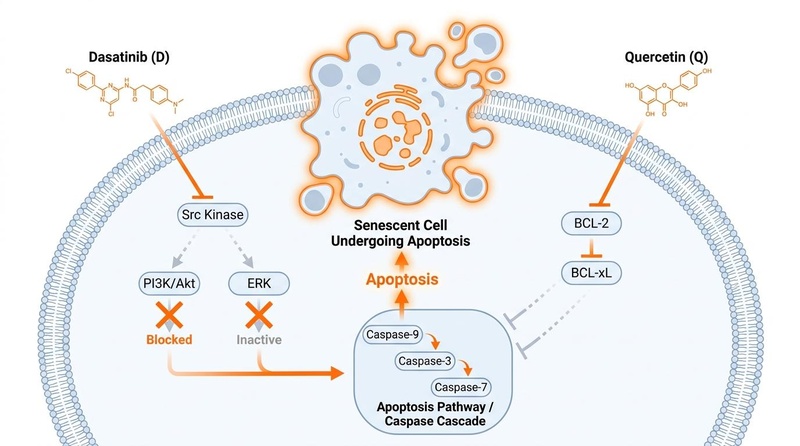
- The Rationale: Dasatinib selectively kills senescent preadipocytes, while quercetin is highly effective against senescent human endothelial cells and mouse bone marrow-derived mesenchymal stem cells[2:11]. Combining them broadens the spectrum of senescent cell types targeted, providing a synergistic senolytic effect that neither compound can achieve alone[1:11][2:12].
- Theoretical Stacks: Some biohacking communities discuss alternating D+Q with other senolytics like fisetin, but there are currently no human clinical trials evaluating the safety, pharmacokinetics, or efficacy of such rotational regimens.
¶ Practical questions (FAQ)
¶ How long does dasatinib stay in the body?
Dasatinib has a very short terminal half-life of 3 to 5 hours[1:12]. It is rapidly metabolized and cleared by the liver, which allows for true "hit-and-run" senolytic dosing where the drug clears the system quickly after triggering senescent cell apoptosis.
¶ Is dasatinib safe to take for general anti-aging?
Currently, dasatinib is not approved or established as safe for general, unsupervised anti-aging use in healthy individuals. The clinical trials completed to date are small pilot studies in specific patient populations (such as diabetic kidney disease or idiopathic pulmonary fibrosis)[1:13][3:8]. Because of its high risk profile, clinical laboratory monitoring is required.
¶ Can I take dasatinib if I am taking an acid reflux medication?
Proton pump inhibitors (like omeprazole) completely block dasatinib absorption, making it ineffective[6:19]. If dasatinib must be taken, H2 blockers (like famotidine) or antacids can be used but must be carefully timed (at least 2 hours apart from the dasatinib dose) to avoid impairing bioavailability.
¶ What biomarkers can measure the efficacy of senolytic therapy?
In clinical trials, researchers measure senolytic efficacy through tissue biopsies assessing p16INK4A and p21CIP1 expression, alongside blood panels evaluating senescence-associated secretory phenotype (SASP) markers such as IL-1α, IL-6, and matrix metalloproteinases (MMPs)[1:14]. However, standard commercial blood tests cannot currently measure systemic senescent cell clearance with high accuracy.
¶ How we evaluated the evidence
To compile this comprehensive monograph, we performed a systematic analysis prioritizing high-authority scientific literature:
- Tier 1 (Meta-Analyses & Clinical Registries): Handled oncology data using peer-reviewed systematic reviews[8:3][14:3].
- Tier 2 (Human Pilot Clinical Trials): All human clinical statements on senolytic outcomes (adipose tissue clearance, IPF physical functional improvement, AD safety) were sourced from peer-reviewed, published pilot human studies and phase I trials[1:15][3:9][4:4][12:2][13:1].
- Tier 3 (Preclinical Discovery): Mechanistic models, target affinity profiles, and the initial synergistic pairing with quercetin were derived from primary rodent and in vitro molecular research[2:13][11:1].
Our evaluations focused on clinical outcomes, ensuring clear distinctions between animal-model hypotheses and human-trial realities.
¶ References
Hickson LJ, Langhi Prata LGP, Bobart SA, et al. Senolytics decrease senescent cells in humans: preliminary report from a clinical trial of dasatinib plus quercetin in individuals with diabetic kidney disease. EBioMedicine. 2019. https://pubmed.ncbi.nlm.nih.gov/31542391/ ↩︎ ↩︎ ↩︎ ↩︎ ↩︎ ↩︎ ↩︎ ↩︎ ↩︎ ↩︎ ↩︎ ↩︎ ↩︎ ↩︎ ↩︎ ↩︎
Zhu Y, Tchkonia T, Pirtskhalava T, et al. The Achilles' heel of senescent cells: from transcriptome to senolytic drugs. Aging Cell. 2015. https://doi.org/10.1111/acel.12344 ↩︎ ↩︎ ↩︎ ↩︎ ↩︎ ↩︎ ↩︎ ↩︎ ↩︎ ↩︎ ↩︎ ↩︎ ↩︎ ↩︎
Justice JN, Nambiar AM, Tchkonia T, et al. Senolytics in idiopathic pulmonary fibrosis: results from a first-in-human, open-label, pilot study. EBioMedicine. 2019. https://pubmed.ncbi.nlm.nih.gov/30616998/ ↩︎ ↩︎ ↩︎ ↩︎ ↩︎ ↩︎ ↩︎ ↩︎ ↩︎ ↩︎
Nambiar A, Kellogg D, Justice J, et al. Senolytics dasatinib and quercetin in idiopathic pulmonary fibrosis: results of a phase I, single-blind, single-center, randomized, placebo-controlled pilot trial on feasibility and tolerability. EBioMedicine. 2023. https://pubmed.ncbi.nlm.nih.gov/36857968/ ↩︎ ↩︎ ↩︎ ↩︎ ↩︎
Wong SF. New dosing schedules of dasatinib for CML and adverse event management. Journal of hematology & oncology. 2009. https://pubmed.ncbi.nlm.nih.gov/19236716/ ↩︎ ↩︎ ↩︎ ↩︎ ↩︎ ↩︎ ↩︎ ↩︎
Wong SF. Dasatinib dosing strategies in Philadelphia chromosome-positive leukemia. Journal of oncology pharmacy practice. 2009. https://pubmed.ncbi.nlm.nih.gov/18753186/ ↩︎ ↩︎ ↩︎ ↩︎ ↩︎ ↩︎ ↩︎ ↩︎ ↩︎ ↩︎ ↩︎ ↩︎ ↩︎ ↩︎ ↩︎ ↩︎ ↩︎ ↩︎ ↩︎ ↩︎
Zhang N, Jiang Y, Li X, et al. Leukemia during pregnancy and survivorship: gestational age-stratified multidisciplinary management framework. Clinical and experimental medicine. 2026. https://pubmed.ncbi.nlm.nih.gov/42001344/ ↩︎ ↩︎ ↩︎
Abdalla BA, Ali RM, Kakamad FH. Role of dasatinib in the management of lung cancer: A meta-analysis of clinical trials. Biomedical reports. 2025. https://pubmed.ncbi.nlm.nih.gov/39926044/ ↩︎ ↩︎ ↩︎ ↩︎
Brattås MK, Reikvam H, Tvedt THA. Dasatinib as an investigational drug for the treatment of Philadelphia chromosome-positive acute lymphoblastic leukemia in adults. Expert opinion on investigational drugs. 2019. https://pubmed.ncbi.nlm.nih.gov/30916583/ ↩︎ ↩︎ ↩︎ ↩︎ ↩︎
Kim LC, Rix U, Haura EB. Dasatinib in solid tumors. Expert opinion on investigational drugs. 2010. https://pubmed.ncbi.nlm.nih.gov/20113198/ ↩︎ ↩︎
Hassan JW, Bhatwadekar AD. Senolytics in the treatment of diabetic retinopathy. Frontiers in pharmacology. 2022. https://pubmed.ncbi.nlm.nih.gov/36091769/ ↩︎ ↩︎
Gonzales MM, Garbarino VR, Marques Zilli E, et al. Senolytic Therapy to Modulate the Progression of Alzheimer's Disease (SToMP-AD): A Pilot Clinical Trial. Journal of Prevention of Alzheimer's Disease. 2022. https://pubmed.ncbi.nlm.nih.gov/35098970/ ↩︎ ↩︎ ↩︎
Evaluation of exploratory fluid biomarkers from a phase 1 senolytic trial in mild Alzheimer's disease. European Journal of Internal Medicine / PMC. 2025. https://pubmed.ncbi.nlm.nih.gov/40274471/ ↩︎ ↩︎
Garcia-Zamalloa A, Basauri B, Urcelay G. Dasatinib-Induced Chylothorax Beyond 5 Years of Treatment: Is There Actually Any Limit? European journal of case reports in internal medicine. 2023. https://pubmed.ncbi.nlm.nih.gov/37455693/ ↩︎ ↩︎ ↩︎ ↩︎
Castellana E, Budau PM, Miglietta C. Dasatinib-Associated Chylothorax: A Scoping Review and Pharmacovigilance Analysis. Therapeutic innovation & regulatory science. 2026. https://pubmed.ncbi.nlm.nih.gov/42115566/ ↩︎ ↩︎