¶ Fisetin
Fisetin (3,3',4',7-tetrahydroxyflavone) is a naturally occurring flavonoid found in various fruits and vegetables that has gained significant attention in longevity research for its senolytic properties—its ability to selectively eliminate senescent cells. Beyond its role in clearing "zombie cells," Fisetin demonstrates potent anti-inflammatory, antioxidant, and neuroprotective activities in emerging human clinical trials and robust preclinical models.
| Label | Value |
|---|---|
| Type | Flavonol (Polyphenol) |
| Active Cmpd | Fisetin |
| Source | Strawberries, Apples, Smoke Tree |
| Dose Range | 100–2,000 mg/day |
| Half-life | Short (rapidly metabolized) |
| Main Benefit | Senolytic & Anti-inflammatory |
| Absorption | Low (improved by hydrogels) |
¶ At a glance
Aliases
- Also known as: 3,3',4',7-tetrahydroxyflavone, 5-deoxyquercetin
- Chemical name: 2-(3,4-dihydroxyphenyl)-3,7-dihydroxy-4H-1-benzopyran-4-one
- Category: Flavonol subclass of flavonoids
Key points (high-level summary)
- Senolytic activity: Fisetin is one of the most potent natural compounds for selectively inducing apoptosis in senescent cells, thereby reducing the pro-inflammatory Senescence-Associated Secretory Phenotype (SASP)[1].
- Metabolic & Inflammatory Benefits: In human RCTs, Fisetin has been shown to significantly reduce systemic inflammation (IL-6, TNF-α) and improve glycemic control (insulin resistance) in men with obesity[2].
- Neuroprotection & Recovery: Clinical evidence suggests Fisetin improves recovery scores and extends the therapeutic window in acute ischemic stroke patients[3].
- Bioavailability challenges: Standard Fisetin has poor oral absorption, but novel hybrid-hydrogel formulations can increase bioavailability by up to 24-fold[4].
What people use it for
- Main goals: Senescent cell clearance, reducing chronic inflammation, metabolic health, cognitive protection.
- Evidence quality (overall): Moderate (based on multiple human RCTs and systematic reviews).
¶ What is Fisetin?
Fisetin is a plant-derived flavonol that belongs to the polyphenolic group of compounds. It was first identified for its antioxidant properties but has since emerged as a lead candidate in the field of senotherapeutics.
- Definition: A bio-active flavonoid found in various flora, characterized by a unique structure that allows it to cross the blood-brain barrier and modulate multiple longevity-related signaling pathways.
- Natural sources: The richest dietary source is strawberries (approx. 160 μg/g), followed by apples, persimmons, onions, and grapes[5]. Most supplements are derived from the smoke tree (Cotinus coggygria).
- Traditional / historical use: Extracts from Fisetin-rich plants have been used in traditional medicine for their anti-inflammatory and wound-healing properties for centuries.
- Current regulatory status: Sold widely as a dietary supplement in the US and Europe; currently being investigated in Phase II clinical trials for frailty, COVID-19 recovery, and osteoarthritis.
- Key pharmacological property: A multi-targeted senolytic and anti-inflammatory polyphenol.
¶ What are Fisetin’s main benefits?
Fisetin's therapeutic potential spans several major health domains, with human evidence increasingly supporting its roles in inflammation and metabolism.
-
Outcome: Systemic Inflammation
- Direction of effect: Decrease
- Magnitude: Moderate to Large
- Population studied: Men with obesity, colorectal cancer patients, stroke patients.
- Evidence quality: Moderate (Consistent results across multiple RCTs).
- Summary: Fisetin significantly lowers pro-inflammatory cytokines like IL-6, TNF-α, and IL-8, while increasing pro-resolving mediators like Maresin-1[2:1][6].
-
Outcome: Metabolic Health (Glycemic Control)
- Direction of effect: Decrease (FBS, Insulin, HOMA-IR)
- Magnitude: Moderate
- Population studied: Adults with obesity.
- Evidence quality: Moderate (One high-quality RCT).
- Summary: 12 weeks of Fisetin supplementation (200 mg/day) significantly improved insulin sensitivity and fasting blood sugar levels[2:2].
-
Outcome: Stroke Recovery
- Direction of effect: Increase (Functional recovery)
- Magnitude: Moderate
- Population studied: Acute ischemic stroke patients.
- Evidence quality: Moderate (RCT with 192 patients).
- Summary: Oral Fisetin (100 mg/day) extended the rt-PA treatment window and improved clinical stroke recovery scores (NIHSS, mRS)[3:1].
¶ Evidence summary table (human outcomes)
| Outcome / Goal | Effect* | Consistency** | Evidence quality | Trials*** | Notes (population, duration, dose) |
|---|---|---|---|---|---|
| Systemic Inflammation (IL-6, TNF-α) | High | Moderate | 2 RCTs | [Reduces IL-6/TNF-α in obese men (200mg/d) and cancer patients (100mg/d)][2:3][6:1] | |
| Glycemic Control (HOMA-IR) | Moderate | Moderate | 1 RCT | [Improves insulin sensitivity in obese men over 12 weeks][2:4] | |
| Ischemic Stroke Recovery | Moderate | Moderate | 1 RCT | [Improves functional scores and reduces hemorrhagic risk (100mg/d)][3:2] | |
| Knee Osteoarthritis Symptoms | Low | Low | 1 Phase I/II | [Preliminary results show improved pain and function scores][7] | |
| Senescent Cell Clearance | Moderate | Moderate | 1 Phase I/II | [Reduces senescent cell markers in peripheral blood of healthy adults and OA patients][7:1] | |
| Bioavailability | High | High | 1 RCT | [24-fold increase in absorption using fenugreek-derived hybrid hydrogel][4:1] |
- *Effect: Compact renderer encoding:
<effect e="[dir][mag][impact]"></effect>wheredir=u|d|e|q,mag=0|1|2|3,impact=p|n|x. - **Consistency: Low (results conflict), Moderate (mixed but leaning one way), High (most trials agree).
- ***Trials: Number of RCTs or total trials informing this outcome.
¶ How does Fisetin work?
Fisetin's primary distinction is its role as a senolytic—a compound that clears cellular senescence.
- Primary targets: PI3K/Akt/mTOR pathway, BCL-2 family proteins, NF-κB, and Nrf2.
- Core mechanisms:
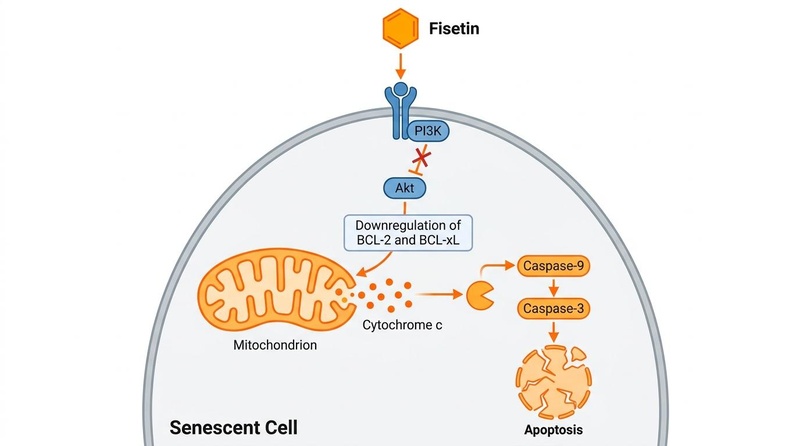
- Senolysis: Fisetin inhibits the PI3K/Akt pathway, which senescent cells rely on for survival. This suppression leads to the down-regulation of anti-apoptotic proteins (BCL-2, BCL-xL), triggering programmed cell death in "zombie" cells[1:1][8].
- Anti-inflammation: It suppresses the NF-κB signaling pathway, thereby inhibiting the production of SASP factors like IL-1β, IL-6, and TNF-α[9].
- Antioxidant Defense: It activates the Nrf2 pathway, upregulating endogenous antioxidant enzymes (SOD, catalase) and enhancing glutathione levels[10].
- Evidence source:
- Pharmacokinetics: Fisetin is rapidly metabolized into its sulfate and glucuronide forms (such as geraldol). Its native oral bioavailability is low (<10%), necessitating fats or advanced delivery systems for clinical efficacy[4:2].
¶ Effects on different systems
¶ Metabolic health (glucose, insulin, lipids)
Fisetin acts as a metabolic sensitizer. In a 2026 RCT, 200 mg/day of Fisetin significantly reduced fasting blood sugar and HOMA-IR in obese individuals[2:6]. This is likely mediated by its ability to inhibit mTOR signaling and reduce inflammation in adipose tissue, where senescent cells frequently accumulate and drive insulin resistance.
¶ Cardiovascular health
In stroke patients, Fisetin has shown a remarkable ability to protect neural tissue and improve vascular recovery. By reducing oxidative stress and inhibiting matrix metalloproteinases (MMP-2, MMP-9), it minimizes hemorrhagic transformation and blood-brain barrier leakage after ischemia[3:3][12].
¶ Joint & Bone health
Systematic reviews indicate that Fisetin preserves bone mineral density and prevents cartilage degradation[13]. Preliminary clinical results in knee osteoarthritis (NCT04210986) suggest that intermittent high-dose Fisetin reduces joint pain and improves physical function by clearing senescent chondrocytes[7:3].
¶ Brain & mental health
Fisetin is neuroprotective. It crosses the blood-brain barrier and has been shown to reduce neuroinflammation by inhibiting microglial activation. Preclinical studies suggest it may support memory consolidation and protect against age-related cognitive decline, though larger human cognitive trials are still ongoing[14].
¶ Dosage and how to take it
Standard dosing in studies
- Continuous Dosing: 100–200 mg/day has been used for 7–12 weeks in trials for stroke, cancer, and obesity[2:7][[3:4][6:2].
- Intermittent "Senolytic" Dosing: 20 mg/kg/day (approx. 1,400 mg for a 70kg adult) taken for 2 consecutive days, repeated monthly or every few months, is the most common protocol in longevity research (e.g., Mayo Clinic AFFIRM trial)[7:4][15].
Forms and bioavailability
- Standard Powder: Low bioavailability; should be taken with a high-fat meal to improve absorption.
- Hybrid-Hydrogel (e.g., FenuMAT): Shown to increase absorption by 24-fold compared to standard powder[4:3].
- Liposomal Fisetin: Often marketed for improved delivery, though comparative human data are less robust than hydrogels.
Special populations
- Older adults: Studied in frailty and osteoarthritis protocols with no reported serious adverse events.
- Pregnancy & Breastfeeding: Avoid use due to lack of safety data and potential phytoestrogenic activity.
¶ Safety and side effects
Common side effects
- Fisetin is generally well-tolerated. In clinical trials using doses up to 1,000 mg/day, the most common reports were mild gastrointestinal upset (nausea, bloating), which typically resolved after the first few days of use[4:4][7:5].
Less common / serious concerns
- Bleeding Risk: Fisetin has mild anticoagulant and antiplatelet effects. Use caution if undergoing surgery or if diagnosed with bleeding disorders.
- Liver/Kidney: Clinical monitoring in human trials up to 12 weeks has shown no significant adverse changes in liver enzymes or renal function markers[2:8][15:1].
Who should be especially cautious or avoid it
- Individuals on blood thinners (Warfarin, Aspirin).
- Women with estrogen-sensitive conditions (due to mild phytoestrogenic activity).
- Individuals scheduled for surgery (discontinue 2 weeks prior).
¶ Drug and supplement interactions
Pharmacokinetic interactions
- CYP Enzymes: Fisetin inhibits CYP3A4, CYP2C9, and CYP2C8 in vitro[16]. It may increase the plasma levels and potential toxicity of drugs metabolized by these enzymes, such as certain statins, benzodiazepines, and calcium channel blockers.
- P-glycoprotein: Fisetin may modulate P-gp transporters, affecting the absorption of various medications.
Pharmacodynamic interactions
- Anticoagulants: Additive effects with drugs like warfarin or clopidogrel may increase bruising or bleeding risk.
- Hypoglycemics: Fisetin may enhance the blood-sugar-lowering effects of Metformin or insulin, potentially increasing the risk of hypoglycemia.
¶ Combining Fisetin with other compounds (“stacks”)
- Fisetin + Quercetin: A common natural senolytic stack. While they share similar mechanisms, they show cell-type specificity; Fisetin is more effective in endothelial cells, while Quercetin is more effective in senescent fat cell progenitors[1:2].
- Fisetin + Dasatinib: Investigated in clinical trials for childhood cancer survivors to clear a broader range of senescent cell types.
- Fisetin + Piperine: Piperine is often added to improve Fisetin’s bioavailability by inhibiting glucurnidation in the liver.
¶ Practical FAQ
How long does it take for Fisetin to work?
For inflammatory and metabolic benefits, trials show measurable changes in biomarkers (IL-6, Insulin) after 8–12 weeks of daily use. For senolytic effects, "hit-and-run" protocols may show functional improvements over 3–6 months of periodic cycling.
Can I get a senolytic dose from food?
No. To reach the 1,400 mg dose used in the Mayo Clinic protocol, you would need to consume approximately 8.7 kilograms (19 lbs) of strawberries in a single day[5:1].
Is Fisetin better than Quercetin?
They are complementary. Fisetin has demonstrated more potent senolytic activity in human umbilical vein endothelial cells (HUVECs), whereas Quercetin is often paired with Dasatinib for other cell types.
Can I take Fisetin long-term?
Daily doses of 100–200 mg have been studied for up to 3 months with safety. Long-term (multi-year) daily data are currently unavailable; many longevity practitioners prefer intermittent monthly cycles to mimic the "hit-and-run" senolytic approach.
¶ How we evaluated the evidence
- Study types prioritized: Double-blind, placebo-controlled human RCTs (Wang 2019, Farsad-Naeimi 2018, Alipour 2026), human pharmacokinetic studies (Krishnakumar 2022), and high-impact systematic reviews.
- How we graded evidence quality:
- High: Multiple consistent RCTs or large-scale meta-analyses.
- Moderate: Single high-quality RCT or multiple small RCTs with consistent signals.
- Low: Phase I trials, observational data, or conflicting results.
- Very Low: Animal or in vitro data only.
¶ References
Kirkland JL, Tchkonia T. The Achilles' heel of senescent cells: from transcriptome to senolytic drugs. Aging Cell. 2015. https://doi.org/10.1111/acel.12344 ↩︎ ↩︎ ↩︎
Alipour M, et al. 12‑weeks fisetin supplementation and interval resistance with aerobic training: changes in Maresin‑1 and inflammatory markers in men with obesity: a randomized controlled trial. J Int Soc Sports Nutr. 2026. https://doi.org/10.1080/15502783.2026.2679718 ↩︎ ↩︎ ↩︎ ↩︎ ↩︎ ↩︎ ↩︎ ↩︎ ↩︎
Wang L, et al. Fisetin Prolongs Therapy Window of Brain Ischemic Stroke Using Tissue Plasminogen Activator: A Double-Blind Randomized Placebo-Controlled Clinical Trial. Clin Appl Thromb Hemost. 2019. https://doi.org/10.1177/1076029619871359 ↩︎ ↩︎ ↩︎ ↩︎ ↩︎
Krishnakumar IM, et al. Enhanced bioavailability and pharmacokinetics of a novel hybrid-hydrogel formulation of fisetin. J Nutr Sci. 2022. https://pmc.ncbi.nlm.nih.gov/articles/PMC9574875/ ↩︎ ↩︎ ↩︎ ↩︎ ↩︎
Khan N, et al. Fisetin: A Dietary Antioxidant for Health Promotion. Antioxid Redox Signal. 2013. https://pmc.ncbi.nlm.nih.gov/articles/PMC3689181/ ↩︎ ↩︎
Farsad-Naeimi A, et al. Effect of fisetin supplementation on inflammatory factors and matrix metalloproteinase enzymes in colorectal cancer patients. Food Funct. 2018. https://doi.org/10.1039/C7FO01898C ↩︎ ↩︎ ↩︎
Tashman S, et al. RESULTS: FROM A RANDOMIZED CLINICAL TRIAL EVALUATING THE SENOLYTIC FISETIN FOR TREATING KNEE OSTEOARTHRITIS. Osteoarthritis Cartilage. 2025. https://doi.org/10.1016/j.joca.2025.02.667 ↩︎ ↩︎ ↩︎ ↩︎ ↩︎ ↩︎
Kim S, et al. Fisetin induces apoptosis in HCT116 human colon cancer cells through inhibition of the PI3K/Akt signaling pathway. J Cell Biochem. 2019. https://pubmed.ncbi.nlm.nih.gov/30390312/ ↩︎
Peng HL, et al. Fisetin inhibits the generation of inflammatory mediators in interleukin-1β-induced human lung epithelial cells by suppressing the NF-κB and ERK1/2 pathways. Int Immunopharmacol. 2018. https://pubmed.ncbi.nlm.nih.gov/29758489/ ↩︎
Hassan SSU, et al. The neuroprotective effects of fisetin, a natural flavonoid in neurodegenerative diseases: Focus on the role of oxidative stress. Front Pharmacol. 2022. https://pubmed.ncbi.nlm.nih.gov/36299900/ ↩︎
Yousefzadeh MJ, et al. Fisetin is a senotherapeutic that extends health and lifespan. EBioMedicine. 2018. https://pmc.ncbi.nlm.nih.gov/articles/PMC6197652/ ↩︎
Prem PN, et al. Recent advances in potential of Fisetin in the management of myocardial ischemia-reperfusion injury-A systematic review. Phytomedicine. 2022. https://pubmed.ncbi.nlm.nih.gov/35533608/ ↩︎
Yamaura K, et al. The effects of fisetin on bone and cartilage: A systematic review. Pharmacol Res. 2022. https://pubmed.ncbi.nlm.nih.gov/36243333/ ↩︎
Lucke-Wold B, et al. Supplement and nutraceutical therapy in traumatic brain injury. Nutr Neurosci. 2025. https://pubmed.ncbi.nlm.nih.gov/40440029/ ↩︎
ClinicalTrials.gov. Alleviation by Fisetin of Frailty, Inflammation, and Related Measures (AFFIRM). NCT03430037. https://clinicaltrials.gov/study/NCT03430037 ↩︎ ↩︎
Selective inhibition of CYP2C8 by fisetin and geraldol. Drug Metab Pharmacokinet. 2018. https://pubmed.ncbi.nlm.nih.gov/29454704/ ↩︎