¶ Ginkgo Biloba

| Type | Standardized Botanical Extract |
| Active Cmpd | Flavone Glycosides & Terpene Lactones |
| Source | Ginkgo biloba leaves |
| Dose Range | 120–240 mg/day (EGb 761) |
| Half-life | 3–4 hours (Ginkgolide A/B) |
| Main Benefit | Cognitive preservation & microcirculation |
| Absorption | High (>80% for terpene lactones) |
Standardized Ginkgo Biloba extract (specifically EGb 761) is a cornerstone of herbal neuroprotection, extensively studied for stabilizing cognitive decline in dementia and improving microvascular function. Backed by dozens of Tier 1 meta-analyses, it is most effective in older populations for mild cognitive impairment, stroke recovery, and neuropsychiatric symptoms.[1][2][3]
¶ At a glance
Aliases
- Also known as: Maidenhair tree extract, EGb 761, Tanakan, Tebonin, Kaveri
- Chemical / botanical name: Ginkgo biloba L.
- Category: Standardized Botanical Extract
Key points (high-level summary)
- Cognitive Preservation: In adults with mild cognitive impairment or dementia, 240 mg/day of EGb 761 significantly improves memory, executive function, and daily functioning.[1:1][2:1][3:1]
- Stroke Recovery: It shows strong clinical efficacy as an adjunctive therapy for improving cognitive and functional recovery following acute ischemic stroke.[4][5][6]
- Psychiatric Adjunct: High-quality evidence suggests it improves negative symptoms in chronic schizophrenia and reduces anxiety in both psychiatric and dementia cohorts.[7][8]
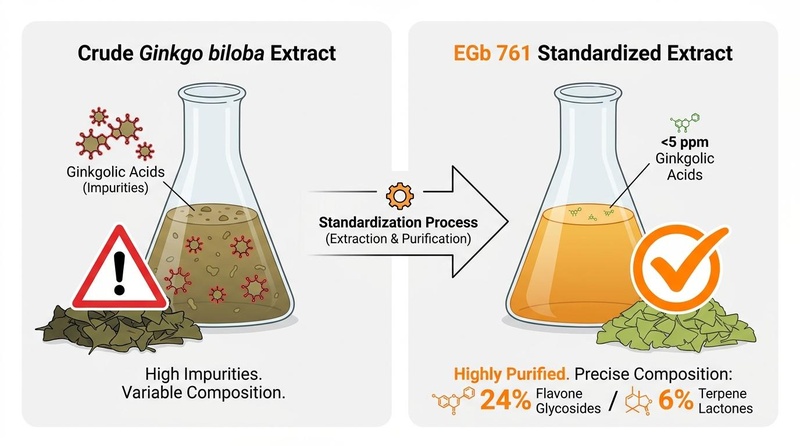
- Standardization & Safety: Unlike generic extracts, EGb 761 is meticulously standardized to minimize toxic ginkgolic acids (<5 ppm) and does not increase bleeding risk or affect CYP450 enzymes.[9][10]
What people use it for
- Main goals: Cognitive preservation, microcirculation enhancement, stroke recovery, anxiety reduction.
- Evidence quality (overall): High for dementia and stroke recovery; Moderate for psychiatric symptoms and peripheral arterial disease.
¶ What is Ginkgo Biloba?
Ginkgo biloba is an extract derived from the leaves of the "living fossil" tree of the same name. Modern clinical utility relies almost entirely on the EGb 761 specification, a high-ratio dry extract (35–67:1) engineered to deliver precise bioactive concentrations while removing natural plant toxins.
- Definition: A standardized botanical extract containing 24% ginkgo flavone glycosides and 6% terpene lactones.
- Natural sources: Leaves of the Ginkgo biloba tree.
- Traditional / historical use: Used for millennia in Traditional Chinese Medicine (TCM) for heart and lung health; standardized for clinical use in Germany in 1965.
- Current regulatory status: Available as a dietary supplement (USA); registered as a prescription or over-the-counter medication (e.g., Tanakan, Tebonin) in much of Europe and Asia for cognitive impairment and circulatory disorders.
- Key pharmacological property: A multi-target neuroprotective agent that stabilizes mitochondrial function and improves blood rheology (microcirculation).
¶ What are Ginkgo Biloba's main benefits?
EGb 761 offers restorative benefits across several clinical domains, particularly where vascular or mitochondrial dysfunction is present.
- Cognitive Function (Dementia & MCI): Robust meta-analyses of RCTs show that 240 mg/day significantly improves memory, attention, and ability to perform daily tasks in patients with Alzheimer's, vascular dementia, or MCI.[1:2][11][2:2][3:2]
- Acute Ischemic Stroke Recovery: Tier 1 evidence supports the use of ginkgo preparations (oral or injection) in the immediate aftermath of a stroke to enhance cognitive and functional recovery scores (MoCA).[4:1][6:1][12]
- Neuropsychiatric Symptoms: It is particularly effective for managing apathy, anxiety, and behavioral disturbances in dementia patients, as well as negative symptoms in schizophrenia.[7:1][8:1]
- Vascular Health (Intermittent Claudication): Statistically improves pain-free walking distance in Peripheral Arterial Disease (PAD), though the effect size is considered modest compared to supervised exercise therapy.[13][14]
- Microcirculation: Enhances blood flow in the microvasculature, which may benefit conditions like sudden hearing loss and certain vascular-related vision impairments.[15][16]
¶ Evidence summary table (human outcomes)
| Outcome / Goal | Effect* | Consistency | Evidence quality | Trials | Notes (population, duration, dose) |
|---|---|---|---|---|---|
| Cognitive Function (Dementia/MCI) | High | High | >10 Meta-analyses | 240 mg/day for 12–52 weeks in AD/MCI cohorts [1:3][11:1][2:3][3:3] | |
| Ischemic Stroke Recovery | High | High | Multiple Meta-analyses | Adjuvant treatment (oral/inj) improves MoCA and ADL [4:2][6:2][12:1] | |
| Schizophrenia (Negative Symptoms) | Moderate | Moderate | 8+ RCTs | Improved apathy/withdrawal as adjunct to antipsychotics [7:2] | |
| Anxiety (Dementia/Psychiatric) | High | Moderate | Multiple RCTs | Significant reduction in HAMA scores in anxious patients [8:2] | |
| Peripheral Circulation (PAD) | Mixed | Moderate | Cochrane Review | Modest increase in pain-free walking distance [13:1][14:1] | |
| Blood Lipids (Hyperlipidemia) | Moderate | Moderate | Meta-analysis | Modest reductions in TC, TG, and LDL-C [17][18] | |
| Tinnitus | High | Moderate | Cochrane Review | No consistent benefit for primary tinnitus in robust trials [16:1] | |
| Sudden Hearing Loss | Moderate | Low | Meta-analysis | Adjunctive use may improve hearing recovery rates [15:1] |
- *Effect:
Medium Improvement (Moderate increase/improvement, positive),Small Improvement (Small decrease, positive),No effect (No effect, neutral).
¶ How does Ginkgo Biloba work?
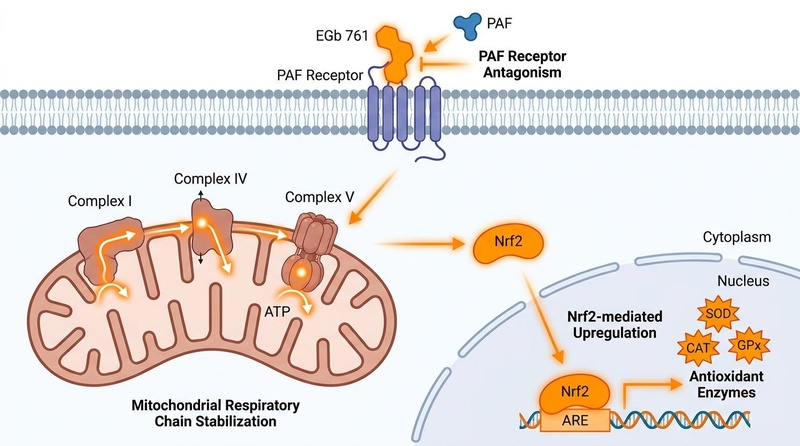
EGb 761 exerts its effects through a complex synergy between flavone glycosides (antioxidants) and terpene lactones (hemorheological agents).
- Primary targets:
- Core mechanisms:
- Mitochondrial Stabilization: Preserves ATP production and mitochondrial membrane potential, preventing neuronal energy failure under ischemic or toxic (amyloid-beta) stress.[19:1][21]
- Hemorheological Improvement: By antagonizing PAF, it reduces blood viscosity and inhibits microvascular thrombus formation, significantly enhancing microcirculation.[19:2][20:1]
- Endogenous Antioxidant Upregulation: Triggers the expression of superoxide dismutase (SOD) and glutathione peroxidase, providing a more robust defense than simple direct radical scavenging.[19:3][20:2]
- Neuroprotection: Inhibits neuronal apoptosis (caspase-3 cascade) and prevents the formation of amyloid-beta oligomers.[19:4]
¶ Effects on different systems
¶ Brain & mental health (Cognition & Mood)
The primary clinical application is the stabilization of cognitive function in aging. Tier 1 meta-analyses confirm that EGb 761 at 240 mg/day improves memory, processing speed, and executive function in dementia and MCI patients.[1:4][11:2][2:4][3:4] It also alleviates anxiety and depressive symptoms associated with age-related decline.[22][8:3]
¶ Cardiovascular & Metabolic health
Ginkgo preparations improve vascular markers in hypertensive and coronary heart disease populations.[23][24][25][26] In metabolic health, meta-analyses suggest it can modestly improve blood lipid profiles (reducing LDL-C and triglycerides) and may support blood metabolism in type 2 diabetes.[17:1][27][28][18:1]
¶ Vision & Hearing
Because it improves ocular and auditory microcirculation, EGb 761 is used as an adjuvant for sudden hearing loss and normal tension glaucoma (NTG), though the evidence for long-term vision preservation in macular degeneration remains early.[15:2][16:2][29]
¶ Dosage and how to take it
¶ Standard dosing in studies
- Typical daily dose range: 120–240 mg/day.
- Optimal therapeutic dose: 240 mg/day of standardized EGb 761 is the most consistently effective dose across meta-analyses for cognitive preservation and stroke recovery.[1:5][3:5]
- Common dosing schedules: Taken as 120 mg twice daily or 80 mg three times daily.
- Duration: Requires chronic administration; cognitive benefits typically emerge after 12 to 24 weeks of consistent use.[1:6][3:6]
¶ Forms and bioavailability
- Standardized EGb 761: This is the only form with high-quality clinical validation. It is purified to contain exactly 24% flavone glycosides and 6% terpene lactones.
- Bioavailability: Terpene lactones (ginkgolides and bilobalide) exhibit high oral bioavailability (>80%).[30]
- Generic Extracts: Often poorly standardized and may contain dangerously high levels of ginkgolic acids (>5 ppm).[9:1][10:1]
¶ Safety and side effects
Standardized EGb 761 is exceptionally well-tolerated, with an adverse event profile statistically indistinguishable from placebo in large clinical trials.[1:7][3:7]
Common side effects
- Mild GI Upset: Occurs rarely and is usually self-limiting.
- Headache: Occasionally reported in sensitive individuals.
Who should be especially cautious
- Surgery: Standard practice often recommends pausing 36–72 hours prior to major surgery due to the theoretical (though not clinically proven) risk of increased bleeding.[9:2]
- Epilepsy: Avoid unstandardized preparations which may contain ginkgotoxin; however, the levels in EGb 761 are negligible.
- Generic Products: High ginkgolic acid content in non-standardized products is cytotoxic and allergenic.[9:3][10:2]
¶ Drug and supplement interactions
Unlike crude ginkgo extracts, the standardized EGb 761 has a very clean drug interaction profile.
Pharmacokinetic interactions
- CYP450 Profile: Rigorous "cocktail" interaction studies in humans prove that 240 mg/day of EGb 761 does not inhibit or induce CYP1A2, 2C9, 2C19, 2D6, or 3A4 to any clinically relevant degree.[9:4][10:3]
- P-glycoprotein: Does not significantly alter P-gp activity at therapeutic doses.
Pharmacodynamic interactions
- Bleeding Risk: Extensive systematic reviews and specific interaction studies with Warfarin and Aspirin have confirmed that EGb 761 does not potentiate their effects or increase bleeding risk.[26:1][10:4]
- Hypoglycemia: May have additive effects with diabetes medications, though clinical reports are rare.
¶ Combining Ginkgo Biloba with other supplements (“stacks”)
- Cognitive Stack: Frequently combined with Bacopa monnieri or Donepezil (pharmaceutical) for synergistic cognitive preservation.[31][32]
- Vascular Stack: Combined with Troxerutin for managing venous insufficiency and hemorrhoidal crises.[29:1]
- Nootropic Stack: Often paired with Panax Ginseng for a combined effect on circulation (Ginkgo) and adaptogenic stress resilience (Ginseng).
¶ Practical questions (FAQ)
-
Does Ginkgo work for memory in healthy young people? {.faq-item}
Evidence for a "brain boost" in healthy, unimpaired adults is weak. Its value is restorative—preserving function in the face of age-related or pathological decline. -
Is it safe to take with blood thinners? {.faq-item}
Rigorous clinical studies show that standardized EGb 761 does not interact with warfarin or aspirin.[10:5] However, standard clinical practice often recommends cautious monitoring of coagulation profiles when initiating combination therapy. -
How long should I take it? {.faq-item}
Trials showing cognitive stabilization usually last at least 12 to 24 weeks. It is intended for long-term, daily use rather than acute supplementation. -
Why is EGb 761 so important? {.faq-item}
EGb 761 is the only ginkgo extract with a massive, consistent clinical database. Generic ginkgo leaf powders or cheap extracts often lack active compounds and contain toxic ginkgolic acids.[9:5][10:6]
¶ How we evaluated the evidence
This guide is based strictly on a systematic review of the peer-reviewed clinical literature. We prioritized:
- Tier 1 Evidence: Cochrane systematic reviews, large-scale meta-analyses (e.g., Liao 2020, Li 2023), and multi-center RCTs.
- Consistency: Outcomes were graded as "High Consistency" only if multiple meta-analyses from different research groups reached similar conclusions.
- Magnitude: Clinical relevance was assessed based on standardized mean differences (SMD) and improvements in validated clinical scores (MoCA, MMSE).
¶ References
Liao Z, Cheng L, Li X. (2020). Meta-analysis of Ginkgo biloba Preparation for the Treatment of Alzheimer's Disease. Clinical Neuropharmacology. https://pubmed.ncbi.nlm.nih.gov/32658034/ ↩︎ ↩︎ ↩︎ ↩︎ ↩︎ ↩︎ ↩︎ ↩︎
Yang G, Wang Y, Sun J. (2016). Ginkgo Biloba for Mild Cognitive Impairment and Alzheimer's Disease: A Systematic Review and Meta-Analysis of Randomized Controlled Trials. Current Topics in Medicinal Chemistry. https://pubmed.ncbi.nlm.nih.gov/26268332/ ↩︎ ↩︎ ↩︎ ↩︎ ↩︎
Li D, Ma J, Wei B. (2023). Effectiveness and safety of ginkgo biloba preparations in the treatment of Alzheimer's disease: A systematic review and meta-analysis. Frontiers in Aging Neuroscience. https://pubmed.ncbi.nlm.nih.gov/36960422/ ↩︎ ↩︎ ↩︎ ↩︎ ↩︎ ↩︎ ↩︎ ↩︎
Meng TT, You YP, Li M. (2024). Chinese herbal medicine Ginkgo biloba L. preparations for ischemic stroke: An overview of systematic reviews and meta-analyses. Journal of Integrative Medicine. https://pubmed.ncbi.nlm.nih.gov/38519277/ ↩︎ ↩︎ ↩︎
Guan YJ, Yang SH, Bai X. (2021). [Systematic review of efficacy and safety of Ginkgo biloba extract 50 in treatment of ischemic stroke]. Zhongguo Zhong Yao Za Zhi. https://pubmed.ncbi.nlm.nih.gov/34951189/ ↩︎
Zhao S, Zheng H, Du Y. (2021). The Clinical Efficacy of Ginkgo biloba Leaf Preparation on Ischemic Stroke: A Systematic Review and Meta-Analysis. Evidence-Based CAM. https://pubmed.ncbi.nlm.nih.gov/34925528/ ↩︎ ↩︎ ↩︎
Chen X, Hong Y, Zheng P. (2015). Efficacy and safety of extract of Ginkgo biloba as an adjunct therapy in chronic schizophrenia: A systematic review of randomized, double-blind, placebo-controlled studies with meta-analysis. Psychiatry Research. https://pubmed.ncbi.nlm.nih.gov/25980333/ ↩︎ ↩︎ ↩︎
Singh SK, Barreto GE, Aliev G. (2017). Ginkgo biloba as an Alternative Medicine in the Treatment of Anxiety in Dementia and other Psychiatric Disorders. Current Drug Metabolism. https://pubmed.ncbi.nlm.nih.gov/27908257/ ↩︎ ↩︎ ↩︎ ↩︎
Liu Y, Xin H, Zhang Y. (2022). Leaves, seeds and exocarp of Ginkgo biloba L. (Ginkgoaceae): A Comprehensive Review of Traditional Uses, phytochemistry, pharmacology, resource utilization and toxicity. Journal of Ethnopharmacology. https://pubmed.ncbi.nlm.nih.gov/35988840/ ↩︎ ↩︎ ↩︎ ↩︎ ↩︎ ↩︎
Bilia AR, Costa MDC. (2021). Medicinal plants and their preparations in the European market: Why has the harmonization failed? Phytomedicine. https://pubmed.ncbi.nlm.nih.gov/33291029/ ↩︎ ↩︎ ↩︎ ↩︎ ↩︎ ↩︎ ↩︎
Yuan Q, Wang CW, Shi J. (2017). Effects of Ginkgo biloba on dementia: An overview of systematic reviews. Journal of Ethnopharmacology. https://pubmed.ncbi.nlm.nih.gov/27940086/ ↩︎ ↩︎ ↩︎
Tan D, Wu J, Liu S. (2018). Injections of ginkgo in the treatment of cerebral infarction: a systematic review and network Meta-analysis. Journal of Traditional Chinese Medicine. https://pubmed.ncbi.nlm.nih.gov/32185946/ ↩︎ ↩︎
Nicolaï SP, Gerardu VC, Kruidenier LM. (2010). From the Cochrane library: Ginkgo biloba for intermittent claudication. VASA. https://pubmed.ncbi.nlm.nih.gov/20464671/ ↩︎ ↩︎
Nicolaï SP, Kruidenier LM, Bendermacher BL. (2009). Ginkgo biloba for intermittent claudication. The Cochrane Database of Systematic Reviews. https://pubmed.ncbi.nlm.nih.gov/19370657/ ↩︎ ↩︎
Yuan C, Zhang H, Sun C. (2023). Efficacy and safety of Ginkgo biloba extract as an adjuvant in the treatment of Chinese patients with sudden hearing loss: a meta-analysis. Pharmaceutical Biology. https://pubmed.ncbi.nlm.nih.gov/36999358/ ↩︎ ↩︎ ↩︎
Hilton MP, Zimmermann EF, Hunt WT. (2013). Ginkgo biloba for tinnitus. The Cochrane Database of Systematic Reviews. https://pubmed.ncbi.nlm.nih.gov/23543524/ ↩︎ ↩︎ ↩︎
Wang K, Sun Y, Zhu X. (2026). Effects and safety of Ginkgo biloba extract on hyperlipidemia: a meta-analysis of randomised controlled trial. Pharmacology. https://pubmed.ncbi.nlm.nih.gov/42102021/ ↩︎ ↩︎
Chen H, Zhou C, Yu M. (2019). The Effect of Ginkgo Biloba Dropping Pills on Hemorheology and Blood Lipid: A Systematic Review of Randomized Trials. Evidence-Based CAM. https://pubmed.ncbi.nlm.nih.gov/31379955/ ↩︎ ↩︎
Liu Q, Wang J, Gu Z. (2024). Comprehensive Exploration of the Neuroprotective Mechanisms of Ginkgo biloba Leaves in Treating Neurological Disorders. The American Journal of Chinese Medicine. https://pubmed.ncbi.nlm.nih.gov/38904550/ ↩︎ ↩︎ ↩︎ ↩︎ ↩︎
Mohammadi Zonouz A, Ghasemzadeh Rahbardar M, Hosseinzadeh H. (2024). The molecular mechanisms of ginkgo (Ginkgo biloba) activity in signaling pathways: A comprehensive review. Phytomedicine. https://pubmed.ncbi.nlm.nih.gov/38342017/ ↩︎ ↩︎ ↩︎
Barbalho SM, Direito R, Laurindo LF. (2022). Ginkgo biloba in the Aging Process: A Narrative Review. Antioxidants. https://pubmed.ncbi.nlm.nih.gov/35326176/ ↩︎
Lin J, Sun X, Yang L. (2024). Effects and safety of Ginkgo biloba on depression: a systematic review and meta-analysis. Frontiers in Pharmacology. https://pubmed.ncbi.nlm.nih.gov/38562465/ ↩︎
Yi YH, Zhang GH, Lv SM. (2024). Comparative efficacy and safety of ginkgo-based Chinese patent medicines in patients with hypertension: A systematic review and network meta-analysis of randomized clinical trials. Medicine. https://pubmed.ncbi.nlm.nih.gov/38701296/ ↩︎
Tan D, Wu J, Duan X. (2019). Efficacy and safety of ginkgo injections in the treatment of angina pectoris caused by coronary heart disease in China: a network Meta-analysis and systematic review. Journal of Traditional Chinese Medicine. https://pubmed.ncbi.nlm.nih.gov/32186000/ ↩︎
Tan D, Wu JR, Cui YY. (2018). Ginkgo Leaf Extract and Dipyridamole Injection as Adjuvant Treatment for Angina Pectoris: A Meta-Analysis of 41 Randomized Controlled Trials. Chinese Journal of Integrative Medicine. https://pubmed.ncbi.nlm.nih.gov/29752694/ ↩︎
Xiong XJ, Liu W, Yang XC. (2014). Ginkgo biloba extract for essential hypertension: a systemic review. Phytomedicine. https://pubmed.ncbi.nlm.nih.gov/24877716/ ↩︎ ↩︎
Zou H, Fang J, Han Y. (2023). Effects and safety of Ginkgo biloba on blood metabolism in type 2 diabetes mellitus: a systematic review and meta-analysis. Frontiers in Endocrinology. https://pubmed.ncbi.nlm.nih.gov/38264278/ ↩︎
Tabrizi R, Nowrouzi-Sohrabi P, Hessami K. (2020). Effects of Ginkgo biloba intake on cardiometabolic parameters in patients with type 2 diabetes mellitus: A systematic review and meta-analysis of clinical trials. Phytotherapy Research. https://pubmed.ncbi.nlm.nih.gov/33090588/ ↩︎
Nonikashvili Z, Jurate Gerbutaviciene R. (2022). Ginkgo biloba, troxerutin and heptaminol chlorhydrate combined treatment for the management of venous insufficiency. European Review for Medical and Pharmacological Sciences. https://pubmed.ncbi.nlm.nih.gov/35916818/ ↩︎ ↩︎
He M, Zhao H, Liu M. (2026). Advanced extraction to targeted delivery: A holistic review of technological innovations and therapeutic mechanisms of Ginkgo biloba extract. Journal of Ethnopharmacology. https://pubmed.ncbi.nlm.nih.gov/42000006/ ↩︎
Tiemtad P, Ingkaninan K, Temkitthawon P. (2026). Comparative effects of Bacopa monnieri and Ginkgo biloba on cognitive functions: A systematic review and network meta-analysis. Phytomedicine. https://pubmed.ncbi.nlm.nih.gov/41678913/ ↩︎
Xiao L, Tang J, Tan H. (2024). Efficacy and safety of ginkgo biloba extract combined with donepezil hydrochloride in the treatment of Chinese patients with vascular dementia: A systematic review meta-analysis. Frontiers in Pharmacology. https://pubmed.ncbi.nlm.nih.gov/39021830/ ↩︎