¶ Glucosamine
| Type | Amino sugar |
| Active Cmpd | Glucosamine (Sulfate/HCl) |
| Source | Shellfish shells, fungi |
| Dose Range | 1,500 mg/day |
| Half-life | ~15 hours |
| Main Benefit | Joint health & Osteoarthritis |
| Absorption | High (90% absorbed) |
Glucosamine is a naturally occurring amino sugar and a fundamental building block of joint cartilage. It is widely supplemented to reduce joint pain, delay osteoarthritis progression, and potentially support long-term metabolic and systemic health.
¶ At a glance
Aliases
- Also known as: 2-amino-2-deoxy-D-glucose, chitosamine, glucosamine sulfate, glucosamine hydrochloride
- Chemical / botanical name: (3R,4R,5S,6R)-3-amino-6-(hydroxymethyl)oxane-2,4,5-triol
- Category: Amino sugar derivative
Key points (high-level summary)
- Glucosamine sulfate (specifically prescription crystalline glucosamine sulfate) significantly reduces pain and improves physical function in adults with knee osteoarthritis [1][2][3].
- Glucosamine hydrochloride is widely considered ineffective, failing to outperform placebo in multiple large-scale meta-analyses [3:1][4].
- Emerging meta-analytic evidence suggests habitual glucosamine use is associated with a decreased risk of colorectal and lung cancers [5][6].
- A critical safety concern is a severe interaction with Warfarin, which can dangerously elevate INR and increase bleeding risks [1:1].
What people use it for
- Main goals: Osteoarthritis symptom relief, joint cartilage preservation, reduction of systemic inflammation, and potential cancer prevention.
- Evidence quality (overall): Moderate to High (for knee osteoarthritis using the crystalline sulfate form); Low (for structure-modifying and cancer preventive effects).
¶ What is glucosamine?
Glucosamine is an endogenous amino sugar synthesized from glucose and glutamine, representing a key precursor in the biochemical synthesis of glycosylated proteins and lipids.
- Definition: It is a prominent component of cartilage matrix glycoproteins and synovial fluid, acting as a structural substrate for glycosaminoglycans (GAGs) such as hyaluronic acid and keratan sulfate.
- Natural sources: While endogenous to human joint tissue, exogenous dietary sources are virtually non-existent in typical foods. Commercial supplements are manufactured via chemical hydrolysis of chitin from shellfish exoskeletons (shrimp, crab, lobster) or via fungal fermentation (Aspergillus niger) for vegan formulations.
- Traditional / historical use: First isolated in 1876, glucosamine gained clinical prominence in the late 20th century as a "symptomatic slow-acting drug in osteoarthritis" (SYSADOA).
- Current regulatory status: Regulated as a prescription drug in Europe and highly regulated clinical contexts, but widely available as an over-the-counter dietary supplement in the United States and other regions.
- Key pharmacological property: Chondroprotective and anti-inflammatory amino sugar.
¶ What are glucosamine’s main benefits?
¶ Osteoarthritis and Joint Pain
In knee and hip osteoarthritis, glucosamine sulfate works by supplying the rate-limiting substrates for cartilage matrix synthesis and down-regulating local inflammatory pathways [1:2][2:1][7]. Multiple high-quality systematic reviews demonstrate that crystalline glucosamine sulfate significantly reduces joint pain (standardized mean difference [SMD] values around -1.11 in positive trials) and improves functional mobility, matching the long-term efficacy of non-steroidal anti-inflammatory drugs (NSAIDs) like celecoxib while avoiding their cardiovascular and gastrointestinal adverse profiles [8][9]. However, glucosamine hydrochloride (HCl) consistently fails to provide clinically meaningful symptom relief [3:2][4:1].
¶ Temporomandibular Joint (TMJ) Osteoarthritis
Oral glucosamine has emerged as an effective therapy for TMJ osteoarthritis [10][11]. Systematic and umbrella reviews of clinical trials show that oral glucosamine (typically 1,200–1,500 mg/day) significantly reduces TMJ pain, decreases joint sounds, and improves physical jaw function, specifically increasing maximum mouth opening [10:1][11:1]. It exhibits comparable efficacy to standard NSAIDs for TMJ symptoms, with a superior safety profile [10:2].
¶ Colorectal and Lung Cancer Prevention
Large-scale prospective epidemiological trials and systematic meta-analyses have highlighted a protective association between habitual glucosamine use and cancer risk [5:1][6:1]. A comprehensive meta-analysis of thirteen clinical and cohort studies found that glucosamine and/or chondroitin intake was associated with a 9% reduction in the risk of colorectal cancer (OR 0.91, 95% CI 0.87–0.94) and a 16% reduction in the risk of lung cancer (OR 0.84, 95% CI 0.79–0.89) [5:2]. These protective associations are hypothesized to stem from systemic anti-inflammatory actions and inhibition of oncogenic signaling pathways [6:2].
¶ Evidence summary table (human outcomes)
| Outcome / Goal | Effect* | Consistency** | Evidence quality | Trials*** | Notes (population, duration, dose) |
|---|---|---|---|---|---|
| Knee OA: Pain (Sulfate Form) | High | High | >100 RCTs | 1,500 mg/day of crystalline glucosamine sulfate reduces pain and stiffness [1:3][2:2][12] | |
| Knee OA: Pain (HCl Form) | High | Moderate | Multiple RCTs | Glucosamine hydrochloride fails to show clinical benefit over placebo [3:3][4:2][13] | |
| TMJ OA: Pain & Function | Moderate | Moderate | 8 RCTs | 1,200–1,500 mg/day significantly decreases jaw pain and increases maximum mouth opening [10:3][11:2] | |
| Colorectal Cancer Risk | Moderate | Low | Cohort studies | Habitual use associated with reduced colorectal cancer risk (OR 0.91) [5:3][6:3] | |
| Lung Cancer Risk | Moderate | Low | Cohort studies | Associated with reduced lung cancer risk (OR 0.84) in meta-analysis [5:4] | |
| Joint Space Narrowing | Low | Low | Meta-analysis | Long-term use of pharmaceutical-grade sulfate may delay joint space narrowing [14][15][7:1] | |
| Combination with Exercise | Moderate | Moderate | 6 RCTs | Adding glucosamine to exercise programs does not yield additional pain or functional benefits [16] |
- *Effect: Number of arrows (1-3) indicates magnitude. Direction: ↑ (increase), ↓ (decrease), = (no effect), ? (unclear). Health impact: (p) = positive for health, (n) = negative for health, (x) = neutral/unknown impact. Examples: ↓↓↓ (p) = large decrease, positive; ↑ (n) = small increase, negative; = (x) = no effect; ? = unclear.
- **Consistency: Low (results conflict), Moderate (mixed but leaning one way), High (most trials agree)
- ***Trials: Number of RCTs or total trials informing this outcome (shows evidence depth at a glance)
¶ How does glucosamine work?
¶ Chondroprotection and Structural Substrate
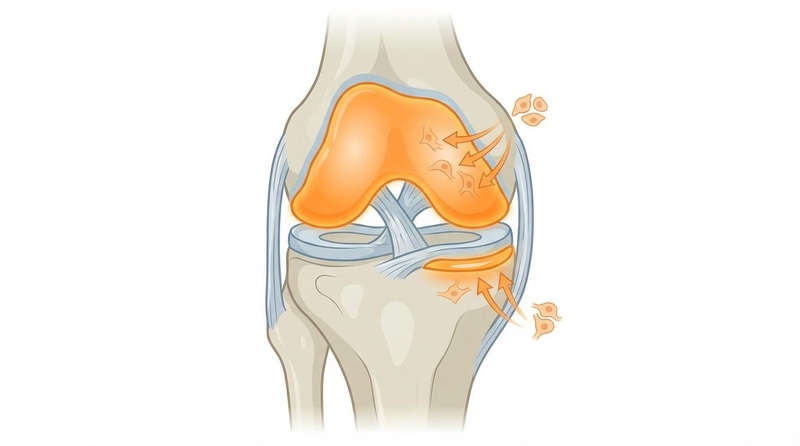
Glucosamine is a fundamental rate-limiting precursor in the biosynthesis of glycosaminoglycans (GAGs) and proteoglycans, which form the structural backbone of articular cartilage and synovial fluid [13:1]. Exogenous glucosamine is rapidly taken up by chondrocytes via glucose transporters (GLUT1, GLUT2, GLUT4) and phosphorylated into glucosamine-6-phosphate, stimulating the synthesis of aggrecan and collagen type II [17][13:2]. Preclinical systematic reviews confirm that chronic administration down-regulates matrix metalloproteinases (MMPs) and aggrecanases, arresting cartilage matrix degradation [17:1].
¶ Anti-Inflammatory Pathways (NF-κB Inhibition)
At the cellular level, glucosamine exerts profound anti-inflammatory properties by inhibiting the Nuclear Factor-kappa B (NF-κB) signaling pathway [6:4][13:3]. It prevents the intracellular cascade of Interleukin-1 beta (IL-1β), suppressing the transcription of pro-inflammatory cytokines (such as IL-6, IL-8, and TNF-α) as well as cyclooxygenase-2 (COX-2) and inducible nitric oxide synthase (iNOS) [6:5]. This molecular action is highly synergistic with other joint-health agents [12:1].
¶ Autophagy and Longevity Mechanics
Glucosamine acts as a cellular caloric restriction mimetic, inducing autophagy through the inhibition of the mTOR (mammalian target of rapamycin) pathway [1:4]. This preserves cellular homeostasis, clears damaged proteins and organelles within senescent chondrocytes, and promotes cell survival under metabolic stress [1:5].
¶ Pharmacokinetics
- Absorption: Oral absorption is highly efficient (~90%), but extensive first-pass hepatic metabolism and gut microflora degradation reduce absolute oral bioavailability to approximately 26% [4:3].
- Distribution: Free glucosamine actively concentrates in articular cartilage and synovial fluid, where it remains detectable above baseline levels for up to 48 hours [13:4].
- Half-life: The elimination half-life from human plasma is estimated to be approximately 15 hours [1:6].
¶ Effects on different systems
¶ Metabolic Health
Early animal models utilizing massive intravenous doses of glucosamine suggested potential impairment of insulin sensitivity. However, high-quality human systematic reviews and clinical trials have conclusively demonstrated that standard oral doses (1,500 mg/day) do not adversely affect fasting blood glucose, insulin resistance, or HbA1c levels in healthy individuals, pre-diabetic patients, or those with well-controlled type 2 diabetes [1:7].