¶ Glutamine
| Type | Amino Acid |
| Active Cmpd | L-Glutamine |
| Source | Endogenous synthesis; meat, dairy, eggs, beans |
| Dose Range | 5–30 g/day |
| Half-life | ~1 hour |
| Main Benefit | Intestinal barrier integrity & clinical recovery |
| Absorption | High (near 100%) |
L-Glutamine is the most abundant amino acid in the human body, acting as a critical metabolic fuel for immune cells and the intestinal lining. While well-supported for reducing intestinal permeability and aiding clinical recovery in critical illness or oncology protocols, robust human evidence does not support its use for muscle hypertrophy or athletic performance in healthy individuals.
¶ At a glance
Aliases
- Also known as: L-Glutamine, Gln, Q, 2-Aminoglutaramic acid
- Chemical / botanical name: (S)-2,5-Diamino-5-oxopentanoic acid
- Category: Amino acid (conditionally essential)
Key points (high-level summary)
- In adults with increased intestinal permeability, oral glutamine significantly reduces "leaky gut" markers by supporting enterocyte integrity.
- For patients in intensive care or with severe burns, glutamine supplementation reduces infectious complications and hospital length of stay.
- Despite heavy marketing in sports nutrition, glutamine fails to increase muscle mass, strength, or prevent post-exercise immunosuppression in healthy athletes.
- Use caution in cancer patients (unless part of a specific toxicity-reduction protocol) as some tumors are "glutamine-addicted" and use it for rapid growth.
What people use it for
- Main goals: Intestinal barrier support (leaky gut), recovery from surgery/trauma, reduction of chemotherapy/radiotherapy side effects, and muscle recovery.
- Evidence quality (overall): Moderate to High (clinical recovery/gut health); Low (sports performance).
¶ What is Glutamine?
L-Glutamine is a non-essential amino acid that becomes "conditionally essential" during periods of extreme physiological stress. Under normal conditions, the body synthesizes sufficient amounts in skeletal muscle and the lungs. However, during major trauma, surgery, or chronic illness, the demand from the immune system and gut mucosa can exceed the body's biosynthetic capacity, leading to systemic depletion.
- Definition: A proteogenic amino acid and the primary nitrogen carrier in the bloodstream.
- Natural sources: High-protein foods including beef, chicken, fish, dairy products, eggs, and plant sources like beans, cabbage, and spinach.
- Traditional / historical use: Historically used in clinical nutrition since the mid-20th century to manage hypermetabolic states and severe malnutrition.
- Current regulatory status: Generally Recognized as Safe (GRAS) in the US; widely available as a dietary supplement.
- Key pharmacological property: Primary metabolic substrate for rapidly dividing cells (enterocytes and lymphocytes).
¶ What are Glutamine’s main benefits?
Glutamine’s primary clinical value lies in its ability to maintain the structural integrity of the intestinal barrier and fuel the immune response during hypercatabolic states.
Intestinal Barrier Integrity
- Outcome: Reduction in intestinal permeability ("Leaky Gut").
- Direction of effect: Decrease.
- Magnitude: Moderate to Large.
- Population studied: Adults with increased permeability (e.g., post-infectious, exercise-induced, or clinical stress).
- Evidence quality: Moderate (Systematic reviews of RCTs).
- Summary sentence: Oral glutamine (up to 30g/day) significantly reduces the translocation of bacteria and endotoxins by supporting tight junction protein synthesis.
Clinical Recovery (ICU, Surgery, & Burns)
- Outcome: Hospital length of stay and infectious complications.
- Direction of effect: Decrease.
- Magnitude: Large.
- Population studied: Critically ill patients, post-operative surgical patients, and severe burn victims.
- Evidence quality: High (Multiple meta-analyses).
- Summary sentence: Supplements significantly shorten ICU stays and reduce the risk of secondary sepsis in severe trauma and burn patients.
Oncology Toxicity Mitigation
- Outcome: Severity of chemotherapy-induced diarrhea, oral mucositis, and radiodermatitis.
- Direction of effect: Decrease.
- Magnitude: Moderate.
- Population studied: Cancer patients undergoing chemotherapy or radiation.
- Evidence quality: Moderate (Mixed but leaning positive in meta-analyses).
- Summary sentence: Specific protocols utilizing oral glutamine can reduce the incidence of severe radiation-induced skin damage and mucositis.
¶ Evidence summary table (human outcomes)
| Outcome / Goal | Effect* | Consistency** | Evidence quality | Trials*** | Notes (population, duration, dose) |
|---|---|---|---|---|---|
| Intestinal Permeability | High | Moderate | 10+ RCTs | [Reduces L/M ratio; doses up to 30g/day for 2 weeks][1] | |
| ICU Length of Stay | High | High | 20+ RCTs | [Significantly reduces hospital stay in critically ill][2][3] | |
| Burn Recovery | High | High | 10+ RCTs | [Reduces mortality and sepsis in severe burn patients][4][5] | |
| Chemo-Induced Diarrhea | Moderate | Moderate | 8 RCTs | [Oral glutamine reduces severity in CRC patients][6] | |
| Radiodermatitis | High | Moderate | 5+ RCTs | [Significantly reduces radiation skin burn severity][7] | |
| Oral Mucositis | Moderate | Moderate | 15 RCTs | [Reduces duration/severity; results mixed in head/neck cancer][8][9] | |
| Muscle Hypertrophy | High | Low | 10+ RCTs | [No effect on muscle mass or strength in healthy athletes][10] | |
| Inflammation (CRP) | Moderate | Moderate | 12 RCTs | [Small to moderate reduction in serum CRP in chronic disease][11][12] |
- *Effect: Direction/Magnitude encoding (↑=increase, ↓=decrease, ==no effect, ?=unclear). (p)=positive, (n)=negative, (x)=neutral.
- **Consistency: Low (results conflict), Moderate (mixed), High (most trials agree).
- ***Trials: Number of RCTs informing the outcome.
- REQUIRED: See References section for corresponding meta-analyses and trials.
¶ How does Glutamine work?
Glutamine serves as a versatile metabolic hub, providing nitrogen for biosynthetic pathways and carbon for energy production.
- Primary targets: Enterocytes (intestinal cells), lymphocytes (immune cells), and skeletal muscle transporters (SNAT1/2).
- Core mechanisms:
- Enterocyte Metabolism: Glutamine is the preferred fuel for the intestinal mucosa. It is oxidized to provide ATP, maintaining the energy-intensive assembly of tight junction proteins like claudin-1 and occludin.
- Tight Junction Synthesis: By activating the mTOR and MAPK pathways, glutamine upregulates the expression of proteins that seal the gaps between intestinal cells, preventing "leaky gut" [13].
- Immune Proliferation: Lymphocytes and macrophages consume glutamine at rates similar to or higher than glucose. It provides the nitrogen required for nucleotide synthesis during rapid immune cell proliferation [2:1].
- Glutathione Precursor: Glutamine is converted to glutamate, a direct precursor for glutathione (GSH), the primary intracellular antioxidant.
- Pharmacokinetics:
- Absorption: Rapid and near-complete in the small intestine.
- Metabolic Splanchnic Extraction: Up to 70% of oral glutamine is consumed by the gut and liver before reaching systemic circulation, which explains why oral supplementation has limited effects on muscle tissues compared to the gut.
- Half-life: Approximately 1 hour in plasma.
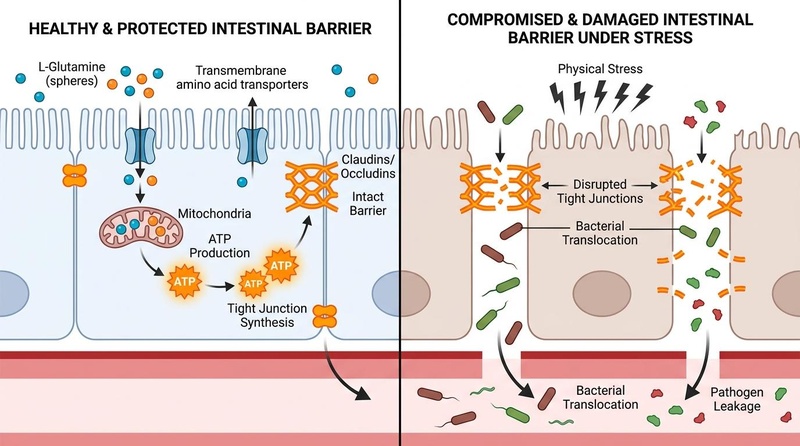
Figure 1: Molecular role of L-glutamine in enterocyte metabolism and tight junction maintenance. Glutamine acts as a primary energy substrate for intestinal mucosal cells and fuels the expression of tight junction proteins (claudin, occludin), preventing paracellular bacterial translocation.
¶ Effects on different systems
¶ Gut & Digestion
The most robust application of glutamine is the maintenance of the intestinal barrier. In conditions of stress (strenuous exercise, infection, or surgery), the gut barrier often fails, allowing endotoxins to enter the blood. Glutamine supplementation (0.5g/kg body weight) has been shown to stabilize the barrier and prevent this translocation in numerous human trials [14][1:1]. In patients with IBD, clinical results remain mixed, with better evidence for barrier support than for reducing active disease inflammation [15].
¶ Clinical Recovery & Critical Illness
In the ICU, glutamine is considered a "conditionally essential" nutrient. Meta-analyses of dozens of RCTs show that either enteral or parenteral glutamine reduces hospital length of stay and infectious complications by roughly 20-30% in critically ill adults [2:2][3:1].
¶ Oncology Support
Glutamine is used off-label to manage the toxic side effects of cancer treatment. Meta-analyses confirm it reduces the severity of radiodermatitis [7:1], radiation enteritis [16], and chemotherapy-induced diarrhea [6:1]. It may also mitigate peripheral neuropathy [17], although evidence for oral mucositis is conflicting in head and neck cancers [9:1].
¶ Muscle & Athletic Performance
Systematic reviews consistently show that glutamine supplementation does not increase muscle mass, improve strength, or enhance aerobic performance in healthy, well-fed individuals [10:1]. While it may modestly reduce markers of muscle damage (creatine kinase) and muscle soreness, it does not provide a meaningful ergogenic edge for bodybuilders or endurance athletes [18].
¶ Dosage and how to take it
¶ Standard dosing in studies
- Intestinal Health: 5–15 g/day, often divided into 2–3 doses.
- Clinical/High-Dose Protocol: 20–30 g/day (or 0.3–0.5 g/kg of body weight) in acute settings like post-surgery or for severe permeability issues [1:2].
- Study durations: Typically 2–8 weeks for gut barrier support; 1–4 weeks for oncology toxicity.
¶ Forms and bioavailability
- L-Glutamine Powder: The most common and cost-effective form. It is tasteless and highly soluble in water or juice.
- Glutamine Dipeptides (e.g., L-Alanyl-L-Glutamine): Used primarily in parenteral nutrition; offers higher stability and solubility than free L-glutamine [3:2].
- Timing: Ideally taken on an empty stomach or between meals to minimize competition for amino acid transporters and maximize availability for enterocytes.
¶ Special populations
- Kidney Impairment: High doses increase renal nitrogen load and may increase glomerular filtration rate (GFR). Use caution in chronic kidney disease [19].
- Liver Disease: Individuals with cirrhosis or hepatic encephalopathy must avoid high-dose glutamine due to the risk of ammonia accumulation.
- Pregnancy & Breastfeeding: Limited safety data; standard dietary intake is safe, but high-dose supplementation is typically avoided.
¶ Safety and side effects
Glutamine is generally well-tolerated at doses up to 30 g/day for short durations.
Common side effects
- Mild gastrointestinal distress (bloating, gas, or nausea) at very high doses (>40 g/day).
- Transient constipation.
Less common / serious concerns
- Ammonia Toxicity: High-dose glutamine is metabolized into ammonia. In healthy individuals, this is safely cleared via the urea cycle, but in those with liver dysfunction, it can trigger or worsen hepatic encephalopathy.
- Tumor Growth: Many tumors exhibit "glutamine addiction." While glutamine protects healthy cells from chemo/radiation, there is theoretical concern that it could fuel certain MYC-driven cancers. Use in oncology should be overseen by a specialist.
Who should be especially cautious or avoid it
- Patients with advanced liver or kidney disease.
- Individuals with active cancer (unless specifically prescribed for toxicity management).
- Those with bipolar disorder (theoretical risk of mania via glutamate/GABA pathways).
¶ Drug and supplement interactions
Pharmacokinetic interactions
- Amino Acid Transporters: High-dose glutamine may compete with other neutral amino acids (like leucine or tryptophan) for the LAT1 or ASCT2 transporters, potentially altering their absorption if taken simultaneously at extreme doses.
Pharmacodynamic interactions
- Chemotherapy Drugs: Glutamine may reduce the toxicity (and potentially the efficacy, though debated) of certain chemotherapeutic agents.
- Lactulose: Glutamine may reduce the effectiveness of lactulose in treating hepatic encephalopathy by increasing ammonia production.
¶ Combining Glutamine with other supplements ("stacks")
- The "Leaky Gut" Stack: Frequently combined with Zinc Carnosine, Probiotics (e.g., Saccharomyces boulardii), and Quercetin for synergistic intestinal barrier support.
- Immune Support: Combined with Vitamin C and Zinc during acute illness, although human data on synergy is limited.
¶ Practical questions (FAQ)
-
How long does it take for Glutamine to work for gut health?
Clinical studies on intestinal permeability often show measurable improvements within 10–14 days of consistent high-dose (20-30g/day) supplementation. -
Can I take Glutamine long-term?
While safe for short-term clinical use, long-term supra-physiological dosing (>30g/day for months) has not been extensively studied in healthy populations. Most practitioners recommend cycling or using lower doses (5g) for maintenance. -
Does it help with weight loss?
No. Meta-analyses show no significant effect on body weight, fat mass, or metabolic rate. -
Is Glutamine good for "brain fog"?
There is limited human data. While it may help cognitive function under conditions of extreme hypoxia (high altitude), there is no evidence it improves focus or cognition in healthy individuals at sea level.
¶ How we evaluated the evidence
Evidence for this monograph was prioritized based on a pyramid of evidence, starting with meta-analyses of randomized controlled trials (RCTs) from journals like Clinical Nutrition, Amino Acids, and BMC Gastroenterology. Systematic reviews were used to establish consensus on intestinal barrier protection, clinical recovery in ICU/burns, and oncological toxicity support. Findings regarding athletic performance were cross-referenced against multiple systematic reviews that confirmed a lack of ergogenic benefit.
¶ References
Abbasi F, et al. (2024). A systematic review and meta-analysis of clinical trials on the effects of glutamine supplementation on gut permeability in adults. Amino Acids. https://pubmed.ncbi.nlm.nih.gov/39397201/ ↩︎ ↩︎ ↩︎
Liang B, et al. (2024). Glutamine enteral therapy for critically ill adult patients: An updated meta-analysis and trial sequential analysis. Clinical Nutrition. https://pubmed.ncbi.nlm.nih.gov/38041938/ ↩︎ ↩︎ ↩︎
Stehle P, et al. (2017). Glutamine dipeptide-supplemented parenteral nutrition improves the clinical outcomes of critically ill patients. Clinical Nutrition ESPEN. https://pubmed.ncbi.nlm.nih.gov/28361751/ ↩︎ ↩︎ ↩︎
Yue HY, et al. (2024). Enteral glutamine supplements for patients with severe burns: A systematic review and meta-analysis. Chinese Journal of Traumatology. https://pubmed.ncbi.nlm.nih.gov/37460347/ ↩︎
Tao W, et al. (2024). Glutamine Supplementation on Burn Patients: A Systematic Review and Meta-analysis. Journal of Burn Care & Research. https://pubmed.ncbi.nlm.nih.gov/38243579/ ↩︎
Chen L, et al. (2025). Glutamine prevents diarrhea in colorectal cancer patients undergoing chemotherapy or chemoradiotherapy: a meta-analysis. BMC Gastroenterology. https://pubmed.ncbi.nlm.nih.gov/41053591/ ↩︎ ↩︎
Chang HC, et al. (2024). Effectiveness of glutamine for the treatment of radiodermatitis in cancer patients: a meta-analysis. Supportive Care in Cancer. https://pubmed.ncbi.nlm.nih.gov/38427125/ ↩︎ ↩︎
Tang G, et al. (2022). Role of Glutamine in the Management of Oral Mucositis in Patients with Cancer: A Meta-Analysis. Nutrition and Cancer. https://pubmed.ncbi.nlm.nih.gov/33605813/ ↩︎
Shuai T, et al. (2020). Oral Glutamine May Have No Clinical Benefits to Prevent Radiation-Induced Oral Mucositis in Adult Patients With Head and Neck Cancer. Frontiers in Nutrition. https://pubmed.ncbi.nlm.nih.gov/32363198/ ↩︎ ↩︎
Ramezani Ahmadi A, et al. (2019). The effect of glutamine supplementation on athletic performance, body composition, and immune function: A systematic review and a meta-analysis. Clinical Nutrition. https://pubmed.ncbi.nlm.nih.gov/29784526/ ↩︎ ↩︎
Movahed S, et al. (2026). The effects of glutamine supplementation on inflammatory and oxidative stress indices in chronic diseases: a systematic review. Amino Acids. https://pubmed.ncbi.nlm.nih.gov/42366260/ ↩︎
Hasani M, et al. (2021). Effect of glutamine supplementation on cardiometabolic risk factors and inflammatory markers: a systematic review and meta-analysis. BMC Cardiovascular Disorders. https://pubmed.ncbi.nlm.nih.gov/33865313/ ↩︎
Wang J, et al. (2025). Glutamine Peptides: Preparation, Analysis, Applications, and Their Role in Intestinal Barrier Protection. Nutrients. https://pubmed.ncbi.nlm.nih.gov/40290078/ ↩︎
Shu XL, et al. (2016). Effects of glutamine on markers of intestinal inflammatory response and mucosal permeability in abdominal surgery patients: A meta-analysis. Experimental and Therapeutic Medicine. https://pubmed.ncbi.nlm.nih.gov/28105083/ ↩︎
Severo JS, et al. (2021). Effects of glutamine supplementation on inflammatory bowel disease: A systematic review of clinical trials. Clinical Nutrition ESPEN. https://pubmed.ncbi.nlm.nih.gov/33745622/ ↩︎
Cao DD, et al. (2017). Therapeutic role of glutamine in management of radiation enteritis: a meta-analysis of 13 randomized controlled trials. Oncotarget. https://pubmed.ncbi.nlm.nih.gov/28427169/ ↩︎
Amara S. (2008). Oral glutamine for the prevention of chemotherapy-induced peripheral neuropathy. The Annals of Pharmacotherapy. https://pubmed.ncbi.nlm.nih.gov/18698011/ ↩︎
Coqueiro AY, et al. (2019). Glutamine as an Anti-Fatigue Amino Acid in Sports Nutrition. Nutrients. https://pubmed.ncbi.nlm.nih.gov/30999561/ ↩︎
Davani-Davari D, et al. (2019). The Renal Safety of L-Carnitine, L-Arginine, and Glutamine in Athletes and Bodybuilders. Journal of Renal Nutrition. https://pubmed.ncbi.nlm.nih.gov/30341034/ ↩︎