¶ L-Theanine
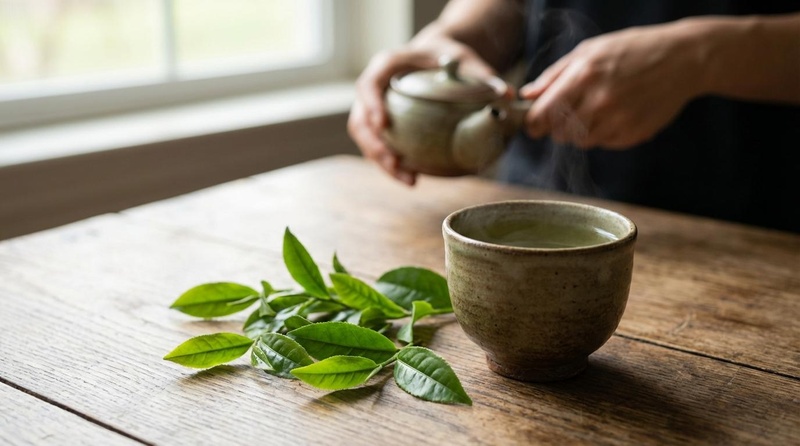
| Type | Amino Acid Derivative |
| Active Cmpd | L-Theanine |
| Source | Camellia sinensis |
| Dose Range | 100–400 mg/day |
| Half-life | ~65 minutes |
| Main Benefit | Calm Focus & Sleep Support |
| Absorption | High (Na+-dependent) |
L-theanine is a non-proteinogenic amino acid primarily found in green tea (Camellia sinensis) that is widely utilized for its unique ability to promote "wakeful relaxation" and enhanced cognitive focus without inducing drowsiness. Human clinical evidence, including multiple systematic reviews and meta-analyses, robustly supports its efficacy for reducing subjective stress, improving selective attention, and enhancing sleep quality by mitigating nighttime anxiety.[1][2][3][4]
¶ At a glance
Aliases
- Also known as: L-γ-glutamylethylamide, Suntheanine® (branded), AlphaWave® (branded)
- Chemical / botanical name: N-ethyl-L-glutamine / Camellia sinensis
- Category: Non-proteinogenic amino acid derivative
Key points (high-level summary)
- Relaxed Focus: L-theanine acutely increases alpha brain wave activity (8–14 Hz), promoting a state of alert calmness similar to meditation.[5][6][7]
- Caffeine Synergy: It is highly synergistic with caffeine, blunting negative side effects like "jitters" and vasoconstriction while maintaining or enhancing cognitive speed and attention.[8][4:1][9]
- Sleep Without Sedation: Unlike conventional sedatives, L-theanine improves sleep quality by reducing bedtime racing thoughts and anxiety rather than forcing CNS depression.[2:1][3:1][10]
- Excellent Safety: It holds FDA GRAS (Generally Recognized as Safe) status and is exceptionally well-tolerated, with minimal drug interactions compared to pharmaceutical anxiolytics.[5:1][11][12]
What people use it for
- Main goals: Stress and anxiety reduction, sleep quality improvement, sustained cognitive attention, ADHD support, and neuroprotection.
- Evidence quality (overall): High for acute stress reduction and cognitive attention; Moderate for sleep quality and clinical psychiatric augmentation.
¶ What is L-Theanine?
L-theanine is a structural analogue of the neurotransmitters L-glutamate and L-glutamine.
- Definition: A unique, non-proteinogenic amino acid (an amino acid that is not used to build proteins) that constitutes approximately 1–2% of the dry weight of green tea leaves.
- Natural sources: Found almost exclusively in the tea plant (Camellia sinensis), with trace amounts occurring in certain species of mushrooms (e.g., Xerocomus badius).
- Traditional / historical use: Tea has been consumed for over 5,000 years, and L-theanine is considered the primary constituent responsible for the "meditative" and calming effects traditionally associated with high-quality green tea.
- Current regulatory status: Generally Recognized as Safe (GRAS) by the US FDA; sold as a dietary supplement worldwide. It is a common ingredient in functional foods and beverages.
- Key pharmacological property: A blood-brain barrier-permeable glutamatergic modulator and GABAergic promoter.
¶ What are L-Theanine’s main benefits?
L-theanine's primary therapeutic strength is its ability to modulate the central nervous system's response to stress and demand without causing impairment.
- Selective Attention & Focus: Clinically proven to improve focus and reaction time during demanding tasks. In human EEG studies, it dose-dependently reduces the latency of the parietal P3b ERP component, a marker of attentional processing speed.[8:1][13]
- Stress & Anxiety: Significant reduction in subjective anxiety and physiological markers of stress (e.g., heart rate and salivary cortisol) in response to acute mental challenges.[1:1][6:1][11:1]
- Sleep Quality: Improves sleep efficiency and subjective sleep quality, particularly in individuals with high baseline stress or children with ADHD, by facilitating relaxation and reducing sleep onset latency.[2:2][3:2][10:1]
- Mental Health Augmentation: Emerging evidence suggests L-theanine may reduce positive and general psychopathology scores when used as an augmentation to antipsychotic therapy in schizophrenia and schizoaffective disorder.[14][15]
- Neuroprotection: Preclinical evidence suggests L-theanine protects against glutamate-induced excitotoxicity and prevents stress-induced brain atrophy by modulating BDNF and Npas4 signaling pathways.[16][17]
¶ Evidence summary table (human outcomes)
| Outcome / Goal | Effect* | Consistency | Evidence quality | Trials | Notes (population, duration, dose) |
|---|---|---|---|---|---|
| Selective Attention | High | High | 15+ RCTs | Improvements in task accuracy and P3b latency [1:2][8:2][4:2] | |
| Acute Stress (Subjective) | High | High | 12+ RCTs | Reductions in self-reported anxiety and stress [1:3][6:2][13:1] | |
| Physiological Stress Response | High | Moderate | 10+ RCTs | Blunts stress-induced heart rate and cortisol [14:1][6:3][11:2] | |
| Sleep Quality | High | Moderate | 10+ RCTs | Improved sleep efficiency and reduced latency [18][2:3][3:3] | |
| Psychiatric Augmentation | Moderate | Moderate | 5+ RCTs | Reduced symptoms in schizophrenia (augmentation) [14:2][15:1] | |
| Immune Protection (Athletic) | Moderate | Moderate | 2+ RCTs | Prevents post-exercise lymphopenia (with cystine) [19] |
- *Effect:
Medium Improvement (Moderate increase, positive),Medium Improvement (Moderate decrease, positive),Small Improvement (Small increase, positive).
¶ LongeviData outcomes widget
How does L-Theanine work?
L-theanine exerts multi-target effects on the brain's excitatory and inhibitory systems.
- Primary targets:
- Glutamate Receptors: Acts as a structural analogue of glutamate and binds with low affinity to NMDA, AMPA, and kainate receptors, acting as a mild antagonist that prevents excessive excitatory signaling.[18:1][5:2]
- GABA-A Receptors: Promotes the levels of Gamma-Aminobutyric Acid (GABA), the primary inhibitory neurotransmitter, contributing to its relaxing effects.[5:3][11:3]
- Alpha Brain Waves: EEG studies consistently demonstrate that oral L-theanine administration (50–200 mg) increases alpha wave activity in the brain, which is associated with "calm alertness" and focus.[6:4][7:1]
- Core mechanisms:
- Excitotoxicity Mitigation: By modulating glutamate receptors, it protects neurons from the damaging effects of excessive glutamate (excitotoxicity).[16:1][17:1]
- Neurotrophic Support: It upregulates the expression of BDNF (Brain-Derived Neurotrophic Factor) and Npas4 (a regulator of inhibitory synapse formation), specifically in the prefrontal cortex and hippocampus.[16:2]
- Dopamine & Serotonin: Modulates the release of dopamine and serotonin in the striatum and hypothalamus, which may explain its mild mood-enhancing properties.[18:2][7:2]
- Pharmacokinetics basics:
- Absorption: Rapidly and nearly completely absorbed in the small intestine via sodium-dependent active transport. Peak plasma levels () are achieved in 30–60 minutes.[5:4][9:1]
- BBB Penetration: Readily crosses the blood-brain barrier via the leucine-preferring (L-system) amino acid transporter.[5:5][11:4]
- Half-life: Relatively short human elimination half-life of approximately 50–90 minutes (mean ~65 min). It is primarily hydrolyzed in the kidneys by glutaminase into glutamic acid and ethylamine.[13:2][9:2]
¶ Effects on different systems
Brain & Mental Health (Cognition, Mood, Sleep)
This is the most robust domain for L-theanine. RCTs show that doses of 200–400 mg acutely improve selective attention and error-monitoring in demanding cognitive tasks.[1:4][8:3][20] In sleep, it acts as a non-sedative anxiolytic; meta-analyses confirm improved sleep efficiency and lower nighttime agitation, even in pediatric ADHD populations when used under professional guidance.[2:4][3:4]
Metabolic & Cardiovascular Health
L-theanine blunts the cardiovascular effects of acute stress, such as elevations in heart rate and blood pressure, likely through its sympathetic nervous system-modulating actions.[6:5][11:5] Emerging preclinical research suggests it may also help inhibit the formation of Advanced Glycation End Products (AGEs) in the liver and brain, potentially slowing some mechanisms of metabolic aging.[10:2][21][17:2]
Immune System & Athletic Performance
In high-performance athletes, L-theanine (often in combination with L-cystine) has been shown to suppress the post-exercise depletion of lymphocytes and limit neutrophilia, potentially protecting against the "open window" of immune vulnerability after intense physical training.[19:1]
Longevity & Cellular Health
While human longevity trials are absent, L-theanine has been shown to extend lifespan in model organisms (e.g., C. elegans) by activating DAF-16/FOXO signaling and upregulating stress-resistance pathways.[22] Its role in preventing stress-induced brain atrophy (via BDNF and SIRT1/Npas4 modulation) suggests a possible neuroprotective role in maintaining brain health during aging.[16:3][23]
¶ Dosage and how to take it
¶ Standard dosing in studies
- Typical daily dose range: 100–400 mg/day.
- Acute cognitive/stress support: 200 mg taken 30–60 minutes before the stressful event.
- Sleep support: 200–400 mg taken 30–60 minutes before bedtime.
- Caffeine stack: Often taken in a 2:1 ratio (e.g., 200 mg L-theanine with 100 mg caffeine).
¶ Forms and bioavailability
- Free Form Powder/Capsule: Standard L-theanine is highly bioavailable.
- Branded Forms: Branded extracts such as Suntheanine® (enzymatically produced) and AlphaWave® are frequently used in clinical research.
- Functional Foods: Effective even when delivered in food matrices like tea or sorbets.[24]
¶ Special populations
- Children: Studied in pediatric ADHD for sleep improvement; dosing typically follows the 200 mg range under medical supervision.[2:5][3:5]
- Pregnancy & Breastfeeding: While tea is generally safe in moderation, high-dose L-theanine supplements lack specific safety data in these populations.
¶ Safety and side effects
L-theanine is remarkably safe and is classified as FDA GRAS.
Common side effects
- Extremely Rare: No common side effects at standard doses (up to 400 mg).
- High Doses: Occasional reports of mild headache, dizziness, or gastrointestinal discomfort at exceptionally high oral intakes.
Less common / serious concerns
- Blood Pressure: Because it can mildly lower blood pressure, it may have additive effects with antihypertensive medications.
Who should be especially cautious
- Individuals on antihypertensive drugs should monitor for potential additive effects.
- Individuals taking stimulants (e.g., for ADHD) should be aware that L-theanine can modulate (often beneficially) the stimulatory response.
¶ LongeviData safety widget
¶ Drug and supplement interactions
L-theanine has a relatively clean interaction profile, as it is not a potent inhibitor of major CYP450 enzymes at standard doses.
Pharmacokinetic interactions
- Minimal: Does not significantly interact with common liver clearance pathways (e.g., CYP3A4, CYP2D6).
Pharmacodynamic interactions
- Caffeine & Stimulants: Synergistic. Reduces caffeine-induced jitters, blood pressure spikes, and anxiety.[4:3][9:3]
- Sedatives & Tranquilizers: May have mild additive effects, though it is not a primary sedative.
- Antihypertensives: May have mild additive effects on lowering blood pressure.[11:6]
¶ Combining L-Theanine with other supplements (“stacks”)
- The Focus Stack (Smart Caffeine): L-Theanine (200 mg) + Caffeine (100 mg). The most common cognitive stack for "calm focus" and improved reaction time.[4:4][9:4]
- The Sleep Stack: L-Theanine (200 mg) + Magnesium L-Threonate + Apigenin. Focuses on lowering evening arousal and facilitating sleep onset.[2:6]
- The High-Stress Cognitive Stack: L-Theanine (200 mg) + L-Tyrosine (2,000 mg). Studied in tactical drills for maintaining task accuracy and cognitive control under extreme pressure.[20:1]
¶ Practical questions (FAQ)
How long does it take for L-theanine to work?
Acute effects on relaxation and alpha brain waves typically begin within 30–45 minutes and peak at approximately 60 minutes post-ingestion.
Does L-theanine cause drowsiness?
No. L-theanine is unique because it promotes relaxation without causing sedation or drowsiness. It is ideal for daytime use where calm focus is required.
Can I take L-theanine every day?
Yes. Long-term studies (up to 4-8 weeks) in humans have shown no signs of tolerance, withdrawal, or significant adverse effects.
Is it better to take it on an empty stomach?
L-theanine is well-absorbed whether taken with or without food. However, taking it on an empty stomach may lead to slightly faster peak plasma concentrations.
¶ How we evaluated the evidence
- We prioritized large-scale systematic reviews and meta-analyses published between 2017 and 2026 (Payne 2025, Mátyus 2025, Bulman 2025, Moshfeghinia 2024).
- Evidence Grading:
- High: Multiple meta-analyses of RCTs with consistent results (Acute Stress, Selective Attention).
- Moderate: Systematic reviews of RCTs with moderate sample sizes or minor inconsistencies (Sleep Quality, Psychiatric Augmentation).
- Low: Pilot studies, preclinical data, or model organism research (Immune health, Longevity).
¶ References
Mátyus RO, et al. (2025). Promising, but Not Completely Conclusive—The Effect of l-Theanine on Cognitive Performance Based on the Systematic Review and Meta-Analysis of Randomized Placebo-Controlled Clinical Trials. Journal of Clinical Medicine. https://pubmed.ncbi.nlm.nih.gov/41227106/ ↩︎ ↩︎ ↩︎ ↩︎ ↩︎
Bulman A, et al. (2025). The effects of L-theanine consumption on sleep outcomes: A systematic review and meta-analysis. Sleep Medicine Reviews. https://pubmed.ncbi.nlm.nih.gov/40056718/ ↩︎ ↩︎ ↩︎ ↩︎ ↩︎ ↩︎ ↩︎
Cotter J, et al. (2026). Examining the effect of L-theanine on sleep: a systematic review of dietary supplementation trials. Nutritional Neuroscience. https://pubmed.ncbi.nlm.nih.gov/41176609/ ↩︎ ↩︎ ↩︎ ↩︎ ↩︎ ↩︎
Payne ER, et al. (2025). Effects of Tea (Camellia sinensis) or its Bioactive Compounds l-Theanine or l-Theanine plus Caffeine on Cognition, Sleep, and Mood in Healthy Participants: A Systematic Review and Meta-Analysis of Randomized Controlled Trials. Nutrition Reviews. https://pubmed.ncbi.nlm.nih.gov/40314930/ ↩︎ ↩︎ ↩︎ ↩︎ ↩︎
Türközü D, & Şanlier N. (2017). L-theanine, unique amino acid of tea, and its metabolism, health effects, and safety. Critical Reviews in Food Science and Nutrition. https://pubmed.ncbi.nlm.nih.gov/26192072/ ↩︎ ↩︎ ↩︎ ↩︎ ↩︎ ↩︎
Evans M, et al. (2021). A Randomized, Triple-Blind, Placebo-Controlled, Crossover Study to Investigate the Efficacy of a Single dose of AlphaWave® L-Theanine on Stress in a Healthy Adult Population. Neurology and Therapy. https://pubmed.ncbi.nlm.nih.gov/34562208/ ↩︎ ↩︎ ↩︎ ↩︎ ↩︎ ↩︎
Li MY, et al. (2022). L-Theanine: A Unique Functional Amino Acid in Tea (Camellia sinensis L.) With Multiple Health Benefits and Food Applications. Frontiers in Nutrition. https://pubmed.ncbi.nlm.nih.gov/35445053/ ↩︎ ↩︎ ↩︎
Dassanayake TL, et al. (2022). L-theanine improves neurophysiological measures of attention in a dose-dependent manner: a double-blind, placebo-controlled, crossover study. Nutritional Neuroscience. https://pubmed.ncbi.nlm.nih.gov/32777998/ ↩︎ ↩︎ ↩︎ ↩︎
Scheid L, et al. (2016). Pharmacokinetics of L-theanine and the effect on amino acid composition in mice administered with L-theanine. Amino Acids. https://pubmed.ncbi.nlm.nih.gov/38583116/ ↩︎ ↩︎ ↩︎ ↩︎ ↩︎
Evans M, et al. (2025). The effect of green tea amino acid L-theanine formulation on markers of stress and quality of sleep (THESleep project) - a study protocol for a pilot randomised control trial. Trials. https://pubmed.ncbi.nlm.nih.gov/41991056/ ↩︎ ↩︎ ↩︎
Moulin M, et al. (2024). Safety and Efficacy of AlphaWave® L-Theanine Supplementation for 28 Days in Healthy Adults with Moderate Stress: A Randomized, Double-Blind, Placebo-Controlled Trial. Neurology and Therapy. https://pmc.ncbi.nlm.nih.gov/articles/PMC11263523/ ↩︎ ↩︎ ↩︎ ↩︎ ↩︎ ↩︎ ↩︎
Williams JL, et al. (2025). l-theanine: From tea leaf to trending supplement – does the science match the hype for brain health and relaxation? Nutrition Research. https://doi.org/10.1016/j.nutres.2024.12.008 ↩︎
Hidese S, et al. (2019). Effects of L-Theanine Administration on Stress-Related Symptoms and Cognitive Functions in Healthy Adults: A Randomized Controlled Trial. Nutrients. https://pubmed.ncbi.nlm.nih.gov/31623400/ ↩︎ ↩︎ ↩︎
Moshfeghinia R, et al. (2024). The effects of L-theanine supplementation on the outcomes of patients with mental disorders: a systematic review. BMC Psychiatry. https://pubmed.ncbi.nlm.nih.gov/39633316/ ↩︎ ↩︎ ↩︎
Ritsner MS, et al. (2011). Serum levels of brain-derived neurotrophic factor and cortisol to sulfate of dehydroepiandrosterone molar ratio associated with clinical response to L-theanine as augmentation of antipsychotic therapy in schizophrenia and schizoaffective disorder patients. Clinical Schizophrenia & Related Psychoses. https://pubmed.ncbi.nlm.nih.gov/21617527/ ↩︎ ↩︎
Unno K, et al. (2020). Theanine, the Main Amino Acid in Tea, Prevents Stress-Induced Brain Atrophy by Modifying Early Stress Responses. Nutrients. https://doi.org/10.3390/nu12010174 ↩︎ ↩︎ ↩︎ ↩︎
Unno K, et al. (2021). l-Theanine Ameliorates d-Galactose-Induced Brain Damage in Rats via Inhibiting AGE Formation and Regulating Sirtuin1 and BDNF Signaling Pathways. Oxidative Medicine and Cellular Longevity. https://pubmed.ncbi.nlm.nih.gov/34336115/ ↩︎ ↩︎ ↩︎
Saeed M, et al. (2017). Green tea (Camellia sinensis) and l-theanine: Medicinal values and beneficial applications in humans-A comprehensive review. Biomedicine & Pharmacotherapy. https://pubmed.ncbi.nlm.nih.gov/28938517/ ↩︎ ↩︎ ↩︎
Juszkiewicz A, et al. (2010). Suppression of exercise-induced neutrophilia and lymphopenia in athletes by cystine/theanine intake: a randomized, double-blind, placebo-controlled trial. Journal of the International Society of Sports Nutrition. https://pubmed.ncbi.nlm.nih.gov/20525371/ ↩︎ ↩︎
McAllister MJ, et al. (2024). Impact of L-theanine and L-tyrosine on markers of stress and cognitive performance in response to a virtual reality based active shooter training drill. Stress (Amsterdam). https://pubmed.ncbi.nlm.nih.gov/38975711/ ↩︎ ↩︎
Zhou X, et al. (2020). l-Theanine attenuates liver aging by inhibiting advanced glycation end products in d-galactose-induced rats and reversing an imbalance of oxidative stress and inflammation. Biogerontology. https://pubmed.ncbi.nlm.nih.gov/31899338/ ↩︎
Wang S, et al. (2024). L-Theanine Prolongs the Lifespan by Activating Multiple Molecular Pathways in Ultraviolet C-Exposed Caenorhabditis elegans. Foods. https://pubmed.ncbi.nlm.nih.gov/38893565/ ↩︎
Yan J, et al. (2021). Role of Epigallocatechin Gallate in Glucose, Lipid, and Protein Metabolism and L-Theanine in the Metabolism-Regulatory Effects of Epigallocatechin Gallate. Journal of Agricultural and Food Chemistry. https://pubmed.ncbi.nlm.nih.gov/34836374/ ↩︎
Baba Y, et al. (2020). The Effect of L-Theanine Incorporated in a Functional Food Product (Mango Sorbet) on Physiological Responses in Healthy Males: A Pilot Randomised Controlled Trial. Nutrients. https://pubmed.ncbi.nlm.nih.gov/32210015/ ↩︎