¶ Lion's Mane Mushroom
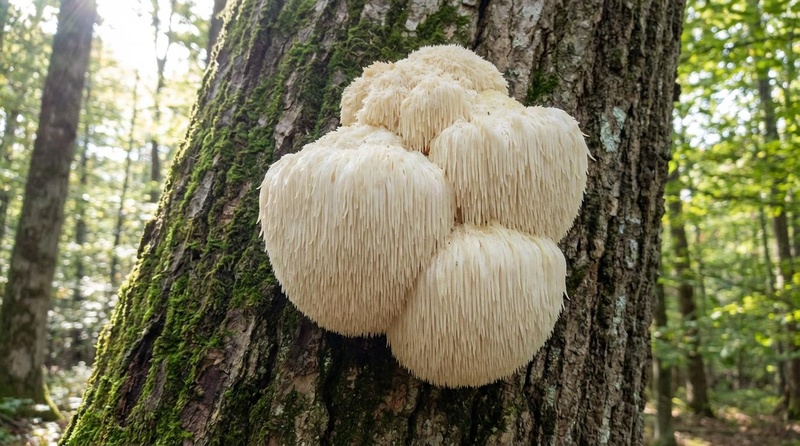
| Type | Medicinal Fungus |
| Active Cmpd | Erinacines, Hericenones, Polysaccharides (Beta-glucans) |
| Source | Hericium erinaceus (fruiting body and mycelium) |
| Dose Range | 1,000–3,000 mg/day (standard extract) |
| Half-life | ~8 hours (Erinacine A) |
| Main Benefit | Neuroprotection, cognitive enhancement, and mood support |
| Absorption | Variable; active terpenoids cross the blood-brain barrier |
Lion's Mane Mushroom (Hericium erinaceus) is a well-studied medicinal fungus widely utilized to support cognitive function, stimulate neurotrophin synthesis, and modulate systemic mood and gut health [1][2]. Human evidence from randomized controlled trials (RCTs) and systematic reviews supports its role as an adjunctive, maintenance-level nootropic, particularly in aging populations experiencing mild cognitive decline [1:1][3].
¶ At a glance
Aliases
- Also known as: Yamabushitake, Bearded Tooth Fungus, Monkey Head Mushroom, Pom-Pom Mushroom, Houtou, Hedgehog Mushroom
- Chemical / botanical name: Hericium erinaceus
- Category: Medicinal mushroom / fungal nootropic
Key points (high-level summary)
- In older adults with mild cognitive impairment, continuous daily supplementation of Lion's Mane Mushroom improves global cognitive scores, though benefits are transient and reverse to baseline upon cessation of therapy [1:2].
- In healthy young adults, acute administration has been shown to improve cognitive processing speed, and chronic daily use over four weeks may reduce subjective stress and anxiety [4][5].
- Clinical and pharmacological outcomes are highly dependent on the preparation, with mycelium-derived erinacines exhibiting superior blood-brain barrier permeability and nerve growth factor (NGF) stimulation compared to fruiting body hericenones [2:1].
- Lion's Mane is exceptionally well tolerated, with negligible risk of hepatotoxicity and only mild, infrequent gastrointestinal side effects reported [1:3][6].
What people use it for
- Main goals: Cognitive enhancement, neuroprotection, stress and anxiety support, gut health, and systemic antioxidant protection.
- Evidence quality (overall): Moderate
¶ What is Lion's Mane Mushroom?
Hericium erinaceus, widely known as Lion's Mane, is an edible and medicinal wood-rot fungus characterized by its unique cascade of white, icicle-like spines rather than standard caps and gills [2:2][7].
- Definition: Lion's Mane is a basidiomycete fungus native to North America, Europe, and Asia, belonging to the Hericiaceae family. It is classified as a functional food and dietary supplement due to its high concentration of secondary metabolites, including cyathane diterpenoids and meroterpenoids [1:4][2:3].
- Natural sources: Naturally found growing on dead or decaying hardwood trees, such as oak, maple, and beech. It can also be cultivated on wood-based substrates (e.g., sawdust or grains) under controlled laboratory conditions [2:4][7:1].
- Traditional / historical use: Historically utilized in Traditional Chinese Medicine (TCM) and Asian folk medicine to treat digestive ailments, support gastric mucosa, support spleen health, and promote general cognitive vitality [1:5][2:5].
- Current regulatory status: Widely sold as an over-the-counter dietary supplement in the United States and Europe. It is classified as a "Novel Food" in some jurisdictions and holds GRAS (Generally Recognized as Safe) status for food and beverage formulations in several countries [1:6][2:6][6:1].
- Key pharmacological property in one line: A neurotrophin-stimulating and neuroprotective medicinal mushroom rich in blood-brain barrier-permeable cyathane diterpenoids [2:7].
¶ What are Lion's Mane Mushroom’s main benefits?
The primary therapeutic interest in Lion's Mane centers on its neuroprotective and cognitive-enhancing properties, backed by systematic reviews of randomized controlled trials [1:7][3:1]. Clinical research indicates that daily oral supplementation supports mental energy, slows the progression of age-related Cognitive Decline with Aging, and modulates mood by upregulating key neurotrophic pathways [1:8][2:8][3:2].
¶ Cognition and Neuroprotection in Older Adults
- Outcome: Mini-Mental State Examination (MMSE) and Revised Hasegawa Dementia Scale (HDS-R) scores.
- Direction of effect: Increase (Improvement)
- Magnitude: Moderate
- Population studied: Older adults with Mild Cognitive Impairment (MCI) or age-related cognitive decline.
- Evidence quality: Moderate
- Summary sentence: In randomized, double-blind trials, daily oral intake of 2.4g to 3.0g of Lion's Mane over 12 to 16 weeks significantly improved global cognitive function, but these gains returned to baseline within 4 weeks of stopping supplementation [1:9].
¶ Stress, Mood, and Mental Energy
- Outcome: Subjective stress, anxiety, depression, and perceived mental energy.
- Direction of effect: Decrease in anxiety/depression, increase in perceived mental energy.
- Magnitude: Small to Moderate
- Population studied: Healthy young adults and overweight adults experiencing mood or sleep dysregulation.
- Evidence quality: Moderate
- Summary sentence: Clinical trials demonstrate that chronic supplementation for 4 to 8 weeks significantly reduces subjective stress and anxiousness, accompanied by improvements in processing speed and overall mental energy [3:3][4:1][5:1].
¶ Gut Health and Microbiota Modulation
- Outcome: Gut microbiome diversity and short-chain fatty acid (SCFA) production.
- Direction of effect: Increase
- Magnitude: Moderate
- Population studied: Healthy volunteers and preclinical models of gut dysbiosis.
- Evidence quality: Low to Moderate
- Summary sentence: Supplementation with Lion's Mane polysaccharides acts as a prebiotic, enhancing the abundance of beneficial, SCFA-producing bacterial taxa and reinforcing gut-barrier integrity [1:10][2:9].
¶ Evidence summary table (human outcomes)
| Outcome / Goal | Effect* | Consistency** | Evidence quality | Trials*** | Notes (population, duration, dose) |
|---|---|---|---|---|---|
| Cognitive Function (Older Adults with MCI) | High | Moderate | 3 RCTs | 2.4g to 3.0g/day of whole powder for 12–16 weeks; benefits are transient and revert to baseline post-cessation [1:11][2:10]. | |
| Stress and Anxiety Reduction | Moderate | Moderate | 3 RCTs | 1.8g to 2.0g/day of extract/powder for 4–8 weeks; reduces subjective stress and anxious symptoms [1:12][4:2][5:2]. | |
| Cognitive Processing Speed (Healthy Young Adults) | Moderate | Low | 1 RCT | 1.8g/day of SO-DSX1 standardized extract; acute improvement in speed of performance on cognitive batteries [4:3][5:3]. | |
| Global Cognition (Healthy Young Adults) | High | Moderate | 2 RCTs | 1.8g to 10g/day of powder/extract for 4 weeks; no change in baseline global cognitive performance in high-functioning cohorts [8][4:4]. | |
| Sleep Quality and Disturbances | Moderate | Low | 2 RCTs | Significant decrease in sleep disturbances over 4–8 weeks, often secondary to improvements in anxiety and mood [1:13][3:4]. | |
| Metabolic Flexibility & Aerobic Capacity | High | Moderate | 1 RCT | 10g/day of whole powder for 4 weeks in college-aged athletes; no impact on metabolic flexibility, fat oxidation, or VO2 max [8:1]. | |
| Gut Microbiota Diversity | Moderate | Low | 1 RCT | Prebiotic action of beta-glucans; increases short-chain fatty acid-producing bacteria and improves intestinal ecology [1:14][2:11]. |
- *Effect: Number of arrows (1-3) indicates magnitude. Direction: ↑ (increase), ↓ (decrease), = (no effect), ? (unclear). Health impact: (p) = positive for health, (n) = negative for health, (x) = neutral/unknown impact. Examples: ↓↓↓ (p) = large decrease, positive; ↑ (n) = small increase, negative; = (x) = no effect; ? = unclear.
- **Consistency: Low (results conflict), Moderate (mixed but leaning one way), High (most trials agree)
- ***Trials: Number of RCTs or total trials informing this outcome (shows evidence depth at a glance)
¶ How does Lion's Mane Mushroom work?
The central neuropharmacological mechanism of Hericium erinaceus relies on its ability to induce the synthesis of Nerve Growth Factor (NGF) and Brain-Derived Neurotrophic Factor (BDNF) [1:15][2:12]. These neurotrophins are essential for the survival, maintenance, and plasticity of neurons in the central and peripheral nervous systems [2:13].
¶ Primary Targets
- TrkB Receptor Activation: Stimulated downstream by BDNF upregulation, activating cell survival and synaptic plasticity cascades [1:16][2:14].
- Nrf2 Pathway: Upregulated by erinacines to activate the master antioxidant response [2:15].
- NF-κB Inhibition: Downregulated to reduce pro-inflammatory cytokines (such as TNF-α and IL-6) [2:16].
¶ Core Mechanisms
- Neurotrophin Stimulation (NGF & BDNF): The low-molecular-weight compounds in Lion's Mane—particularly the erinacines—directly stimulate astrocytes to synthesize and secrete NGF and BDNF [2:17]. This promotes dendritic branching and supports active myelination.
- Mitigation of Neuroinflammation: Erinacines A and C accumulate in astrocytes where they induce the transcription factor Nrf2, while concurrently suppressing NF-κB [2:18]. This dual action mitigates microglial activation and protects neurons against oxidative stress and cytokine-induced apoptosis.
- Amyloid-β Plaque Reduction: In vivo models demonstrate that erinacine-enriched mycelium significantly reduces cerebral amyloid-β plaque burden and attenuates microglial activation in the hippocampus, helping to maintain synaptic density [1:17][2:19].
¶ Bioavailability and Pharmacokinetics of Erinacines vs. Hericenones
The pharmacologically active components of Lion's Mane are divided between the above-ground fruiting body and the vegetative mycelium [2:20].
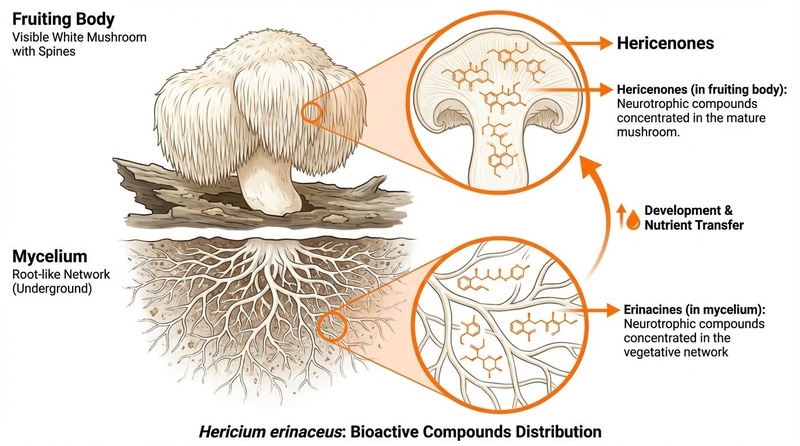
- Hericenones (Fruiting Body): These aromatic meroterpenoids are concentrated in the fruiting body. While early in vitro studies suggested they stimulate NGF, subsequent structural evaluations indicate they have poor permeability across the Blood-Brain Barrier (BBB) [2:21].
- Erinacines (Mycelium): These cyathane diterpenoids are concentrated in the cultured mycelium. Erinacine A is the most biologically active compound, possessing a low molecular weight that allows it to passively diffuse across the BBB to directly stimulate NGF in the brain [2:22][9].
- Erinacine A Kinetics: Following oral administration, the absolute bioavailability of Erinacine A is approximately 24.39%. It is detectable in cerebrospinal fluid (CSF) within 10 minutes, peaks in CSF at 30 minutes, and reaches maximum concentration in brain tissue at 8 hours. Its terminal half-life is approximately 8.1 hours (491 minutes), and it is eliminated primarily via feces [1:18][2:23].
- Erinacine S Kinetics: Exhibits an absolute oral bioavailability of 15.13%. It reaches maximum plasma concentration in 270 minutes, has a terminal half-life of 439 minutes, and distributes widely across the stomach, brain, heart, lungs, and liver [1:19][2:24].
¶ Effects on different systems
¶ Brain & Mental Health (Cognition, Mood, Sleep)
This is the primary system affected by Lion's Mane.
- Cognition: Daily supplementation of 2.4g to 3.0g of H. erinaceus improves global cognitive scores in older adults with MCI, though these benefits are strictly maintenance-dependent and disappear within four weeks of stopping the supplement [1:20]. In young, high-functioning adults, daily supplementation of 1.8g of SO-DSX1 extract significantly improved performance speed on cognitive batteries, with no change in global composite scores, indicating that Lion's Mane acts as a processing speed optimizer rather than a general cognitive enhancer in healthy cohorts [4:5][5:4]. Conversely, a trial using 10g of whole powder daily for four weeks in young adults reported no cognitive changes, highlighting that standard whole powders may lack the active concentration of specialized extracts in young populations [8:2].
- Mood and Anxiety: Clinical trials demonstrate that chronic daily use over 4 to 8 weeks reduces indices of anxiety, depression, and subjective stress, correlating with an increased ratio of peripheral pro-BDNF to mature BDNF in blood serum [1:21][3:5][4:6].
- Sleep Quality: Modest improvements in sleep quality and a reduction in sleep disturbances have been documented as a secondary endpoint, primarily driven by the alleviation of underlying anxiety and stress [1:22][3:6].
¶ Gut & Digestion
In addition to its neurological effects, the polysaccharides (beta-glucans) in Lion's Mane act as prebiotics.
- Microbiota diversity: Human and in vivo studies indicate that Lion's Mane increases the abundance of beneficial, short-chain fatty acid (SCFA)-producing bacteria (such as Bifidobacterium and Lactobacillus species), which supports the integrity of the intestinal epithelial barrier and modulates the gut-brain axis [1:23][2:25].
- Gastroprotection: Preclinical models demonstrate that water extracts of the mushroom exert gastroprotective effects, protecting the stomach lining against ulceration and suppressing localized inflammatory pathways [2:26].
¶ Metabolic and Cardiovascular Health
- Metabolic Flexibility: In clinical trials, short-term supplementation of high-dose Lion's Mane (10g daily for 4 weeks) in healthy young athletes did not affect markers of metabolic flexibility, fat oxidation, or aerobic capacity [8:3].
- Cardiovascular Biomarkers: Preclinical data suggest aqueous extracts may mildly inhibit platelet aggregation and protect vascular endothelial cells from oxidative damage, but clinical evidence in humans remains insufficient [1:24][2:27].
¶ Other Domains (Liver, Longevity, Cancer)
- Liver Health: Lion's Mane has an exceptional safety profile regarding the liver. The National Institutes of Health (NIH) LiverTox database profiles H. erinaceus as having no association with serum enzyme elevations or clinically apparent drug-induced liver injury [6:2].
- Longevity and Frailty: Lion's Mane primordium is a rich source of ergothioneine, a mitochondrial antioxidant. Long-term administration in aging animal models has been shown to rescue age-related declines in locomotor performance and physical frailty index [10].
- Preclinical Oncology: Specialized cyathane diterpenes, including erinacine A, have been investigated preclinically for anti-proliferative and apoptosis-inducing activities in gastric and leukemia cancer cell lines, though human clinical trial data is currently lacking [9:1].
¶ Dosage and how to take it
¶ Standard Dosing in Studies
- Whole Mushroom Powder: The typical clinical dose utilized for older adults experiencing cognitive decline is 2,000 mg to 3,000 mg (2.0 to 3.0 grams) daily [1:25][2:28]. This is typically split into three equal doses of 660 mg to 1,000 mg taken with meals [1:26].
- Standardized Extracts: If utilizing highly concentrated, standardized mycelium extracts (such as SO-DSX1) or erinacine-enriched preparations, the standard clinical dose is 1,000 mg to 1,800 mg daily, taken in divided doses [4:7][5:5].
- Study Durations: Clinical benefits are typically assessed and observed between 4 and 16 weeks of continuous daily intake [1:27][4:8].
¶ Forms and Bioavailability
- Fruiting Body vs. Mycelium Extracts: Fruiting body extracts are primarily rich in water-soluble beta-glucans and hericenones, while mycelium extracts (grown in liquid submergence) are rich in alcohol-soluble, BBB-permeable erinacines [2:29]. Dual-extraction (using both hot-water and ethanol) is preferred to capture the full spectrum of active compounds [2:30].
- Quality Control & Standardizations: Consumers should seek products displaying a guaranteed beta-glucan percentage (typically >15% or >20%) and negligible alpha-glucan (starch) content (typically <5%) [1:28]. High alpha-glucan content indicates the product is primarily myceliated grain biomass (starch) rather than concentrated active fungus [1:29].
- With or Without Food: Due to the presence of fat-soluble diterpenoids (erinacines) and water-soluble polysaccharides, Lion's Mane can be taken with or without food. However, taking it with a meal containing healthy fats may optimize the absorption of its active lipophilic diterpenoids.
¶ Special Populations
- Older Adults: Clinical trials demonstrate that older adults tolerating other supplements can safely consume 3.0g daily without age-specific adverse events [1:30].
- Pregnancy and Breastfeeding: There is a lack of rigorous safety data regarding the use of H. erinaceus during pregnancy and lactation. Avoid therapeutic supplementation in these cohorts due to insufficient evidence.
- Children and Adolescents: Clinical safety and efficacy trials have not been conducted in pediatric populations.
¶ Safety and side effects
¶ Common Side Effects
- Gastrointestinal Mild Discomfort: Occurs in fewer than 10% of users and is typically characterized by mild bloating, gas, nausea, or abdominal softness [1:31][6:3]. This is often due to the high chitin (fungal fiber) content in crude mushroom preparations [1:32].
- Mild Skin Itching: Some individuals report transient, mild cutaneous itching (pruritus) which is non-pathological and typically resolves spontaneously.
¶ Less Common / Serious Concerns
- Hypersensitivity and Asthma: Extremely rare but documented cases of severe allergic reactions (hypersensitivity) exist, manifesting as acute dermatitis or respiratory distress (bronchial asthma) [1:33][6:4]. Supplementation must be stopped immediately if any respiratory or systemic allergic signs occur [6:5].
- No Hepatotoxicity: According to the NIH LiverTox database, there are no documented cases of clinically apparent liver injury or enzyme elevations associated with H. erinaceus [6:6].
¶ Who Should Be Especially Cautious
- Mushroom Allergies: Individuals with known allergies to other fungi or mushrooms must avoid Lion's Mane.
- Upcoming Surgery: Due to preclinical evidence of mild inhibition of platelet aggregation, supplementation should be discontinued at least two weeks before any scheduled surgical procedure [1:34].
- Autoimmune Disorders: The high concentration of beta-glucans in the mushroom can stimulate immune pathways (macrophages and natural killer cells), which could theoretically interfere with immunosuppressive therapies in individuals with autoimmune conditions (such as Multiple Sclerosis or Rheumatoid Arthritis) [1:35][2:31].
¶ Drug and supplement interactions
¶ Pharmacokinetic Interactions
- CYP450 Metabolism: Lion's Mane does not significantly induce or inhibit major cytochrome P450 enzymes (such as CYP3A4, CYP2D6, or CYP1A2) at standard dietary doses, indicating a very low risk of altering the clearance rates of most pharmaceutical drugs [6:7].
¶ Pharmacodynamic Interactions
- Anticoagulants and Antiplatelets: Because Lion's Mane extracts may exhibit mild antiplatelet aggregation activity, combining it with blood thinners (such as Warfarin, Clopidogrel, or high-dose Aspirin) may theoretically increase the risk of bruising and bleeding [1:36].
- Antidiabetic Agents: Preclinical models suggest aqueous extracts of Lion's Mane can exert mild hypoglycemic effects and improve insulin sensitivity [1:37][2:32]. Patients taking glucose-lowering medications (such as Insulin or Metformin) should monitor blood glucose levels, as combining these agents could theoretically have an additive effect.
- Immunosuppressants: The immunomodulatory and immune-stimulating properties of Lion's Mane polysaccharides may counteract the intended therapeutic effects of immunosuppressive medications [1:38][2:33].
¶ Combining Lion's Mane Mushroom with other supplements (“stacks”)
In nootropic and longevity regimens, Lion's Mane is frequently stacked with other synergistic compounds:
- Cognitive & Neurogenesis Stack: Brahmi (Bacopa monnieri) or Huperzine A paired with Lion's Mane [1:39]. The rationale is to pair the long-term neurotrophic and synaptic-survival effects of erinacines with the immediate acetylcholinesterase-inhibiting and memory-consolidation properties of Bacopa or Huperzine.
- Mitochondrial & Cellular Longevity Stack: Ergothioneine combined with Lion's Mane [10:1]. This pairs the mitochondrial antioxidant protection of ergothioneine with the neuroprotective and neurogenic properties of erinacines to mitigate physical frailty and cognitive aging.
- Stress & Mental Energy Stack: Ashwagandha or L-Theanine with Lion's Mane [3:7][4:9]. This stack targets the gut-brain axis and adrenal response, pairing the adaptogenic stress-reducing effects of Ashwagandha with the neurogenesis-supporting and cognitive-processing properties of Lion's Mane.
¶ Practical questions (FAQ)
¶ 1. How long does it take for Lion's Mane to work?
For cognitive decline and mood support, benefits typically require 4 to 8 weeks of daily, continuous supplementation to become measurable [1:40][4:10]. However, acute improvements in cognitive processing speed may be noticeable within 60 to 120 minutes of a single, standardized extract dose in some individuals [4:11][5:6].
¶ 2. Can I take Lion's Mane long-term?
Yes. Clinical trials and preclinical toxicology studies (up to 90 days of high-dose administration) have demonstrated excellent safety with no organ toxicity or tolerance development [1:41][6:8]. However, because cognitive and neuroprotective benefits are strictly maintenance-dependent and revert to baseline within 4 weeks of stopping, continuous daily use is necessary to preserve therapeutic gains [1:42].
¶ 3. Is Lion's Mane useful if I am young and healthy?
In young, high-functioning adults, Lion's Mane does not appear to improve global, baseline cognitive performance [8:4][4:12]. It can, however, improve cognitive performance speed and significantly reduce subjective stress and anxiety during prolonged periods of mental demand [4:13][5:7].
¶ 4. Does Lion's Mane interact with caffeine?
There are no documented negative interactions between Lion's Mane and caffeine. Many users combine them in "mushroom coffee" formulations, where the calming, anxiety-reducing properties of Lion's Mane help mitigate the jitteriness or acute stress response associated with caffeine [3:8].
¶ 5. Can I take Lion's Mane if I have an autoimmune disease?
Caution is recommended. Because the beta-glucans in Lion's Mane stimulate the activity of macrophages and natural killer cells, it could theoretically interfere with immunosuppressive medications or exacerbate autoimmune flare-ups [1:43][2:34].
¶ How we evaluated the evidence
This profile was evaluated by prioritizing randomized, double-blind, placebo-controlled human clinical trials (RCTs) and comprehensive systematic reviews published in peer-reviewed journals.
- High Evidence Quality: Synthesized findings from multiple independent, double-blind RCTs or systematic reviews with consistent results, high methodological quality, and minimal risk of bias.
- Moderate Evidence Quality: Supported by at least two double-blind RCTs with minor limitations (such as small sample sizes or limited study durations) or high-quality narrative reviews that integrate consistent human clinical observations.
- Low Evidence Quality: Supported by a single human RCT with significant limitations, pilot studies without robust control cohorts, or trials showing mixed and conflicting results.
- Very Low Evidence Quality: Supported solely by preclinical in vivo animal models, in vitro cell culture studies, or historical and traditional use reports without modern clinical validation.
¶ References
Menon A, Jalal A, Arshad Z. Benefits, side effects, and uses of Hericium erinaceus as a supplement: a systematic review. Frontiers in Nutrition. 2025. https://pubmed.ncbi.nlm.nih.gov/40959699/ ↩︎ ↩︎ ↩︎ ↩︎ ↩︎ ↩︎ ↩︎ ↩︎ ↩︎ ↩︎ ↩︎ ↩︎ ↩︎ ↩︎ ↩︎ ↩︎ ↩︎ ↩︎ ↩︎ ↩︎ ↩︎ ↩︎ ↩︎ ↩︎ ↩︎ ↩︎ ↩︎ ↩︎ ↩︎ ↩︎ ↩︎ ↩︎ ↩︎ ↩︎ ↩︎ ↩︎ ↩︎ ↩︎ ↩︎ ↩︎ ↩︎ ↩︎ ↩︎ ↩︎
Contato AG, Conte-Junior CA. Lion's Mane Mushroom (Hericium erinaceus): A Neuroprotective Fungus with Antioxidant, Anti-Inflammatory, and Antimicrobial Potential-A Narrative Review. Nutrients. 2025. https://pubmed.ncbi.nlm.nih.gov/40284172/ ↩︎ ↩︎ ↩︎ ↩︎ ↩︎ ↩︎ ↩︎ ↩︎ ↩︎ ↩︎ ↩︎ ↩︎ ↩︎ ↩︎ ↩︎ ↩︎ ↩︎ ↩︎ ↩︎ ↩︎ ↩︎ ↩︎ ↩︎ ↩︎ ↩︎ ↩︎ ↩︎ ↩︎ ↩︎ ↩︎ ↩︎ ↩︎ ↩︎ ↩︎ ↩︎
Nieman KM, Zhu Y, Tucker M. The Role of Dietary Ingredients in Mental Energy - A Scoping Review of Randomized Controlled Trials. Journal of the American Nutrition Association. 2024. https://pubmed.ncbi.nlm.nih.gov/37561965/ ↩︎ ↩︎ ↩︎ ↩︎ ↩︎ ↩︎ ↩︎ ↩︎ ↩︎
Docherty S, et al. The Acute and Chronic Effects of Lion's Mane Mushroom Supplementation on Cognitive Function, Stress and Mood in Young Adults: A Double-Blind, Parallel Groups, Pilot Study. Nutrients. 2023. https://pubmed.ncbi.nlm.nih.gov/38004235/ ↩︎ ↩︎ ↩︎ ↩︎ ↩︎ ↩︎ ↩︎ ↩︎ ↩︎ ↩︎ ↩︎ ↩︎ ↩︎ ↩︎
Docherty S, et al. The Acute and Chronic Effects of Lion's Mane Mushroom Supplementation on Cognitive Function, Stress and Mood in Young Adults: A Double-Blind, Parallel Groups, Pilot Study. PMC Full Text. 2023. https://pmc.ncbi.nlm.nih.gov/articles/PMC10675414/ ↩︎ ↩︎ ↩︎ ↩︎ ↩︎ ↩︎ ↩︎ ↩︎
National Institutes of Health. Lion’s Mane - LiverTox® - NCBI Bookshelf. 2024. https://www.ncbi.nlm.nih.gov/books/NBK599740/ ↩︎ ↩︎ ↩︎ ↩︎ ↩︎ ↩︎ ↩︎ ↩︎ ↩︎
Lion’s Mane - PubMed. National Library of Medicine. 2024. https://pubmed.ncbi.nlm.nih.gov/38289992/ ↩︎ ↩︎
Grozier CD, et al. Four Weeks of Hericium erinaceus Supplementation Does Not Impact Markers of Metabolic Flexibility or Cognition. International Journal of Exercise Science. 2022. https://pmc.ncbi.nlm.nih.gov/articles/PMC9762243/ ↩︎ ↩︎ ↩︎ ↩︎ ↩︎
Bangay G, Brauning FZ, Rosatella A. Anticancer diterpenes of African natural products: Mechanistic pathways and preclinical developments. Phytomedicine. 2024. https://pubmed.ncbi.nlm.nih.gov/38718637/ ↩︎ ↩︎
Roda E, et al. Searching for a Longevity Food, We Bump into Hericium erinaceus Primordium Rich in Ergothioneine: The “Longevity Vitamin” Improves Locomotor Performances during Aging. Nutrients. 2022. https://pmc.ncbi.nlm.nih.gov/articles/PMC8950371/ ↩︎ ↩︎