¶ Metformin
| Type | Biguanide / Synthetic compound |
| Active Cmpd | Metformin Hydrochloride |
| Source | French lilac derivative (synthetic) |
| Dose Range | 500–2,000 mg/day |
| Half-life | 4.5–6.5 hours |
| Main Benefit | Insulin sensitizer, glucose control |
| Absorption | Moderate (50–60% bioavailability) |
Metformin is a biguanide compound widely prescribed as the first-line medication for type 2 diabetes. Highly regarded for its robust clinical safety record and exceptional efficacy in improving insulin sensitivity, metformin has emerged as a premier drug candidate for repurposing as a geroprotective agent to extend healthy human lifespan and healthspan [1][2].
¶ At a glance
Aliases
- Also known as: Glucophage, Fortamet, Riomet, Glumetza, 1,1-dimethylbiguanide, metformin hydrochloride
- Chemical / botanical name: -Dimethylimidodicarbonimidic diamide
- Category: Biguanide (synthetic derivative of galegine from Galega officinalis)
Key points (high-level summary)
- Glycemic Control: In adults with type 2 diabetes, metformin significantly lowers glycated hemoglobin (HbA1c) and fasting blood glucose with minimal risk of hypoglycemia [3].
- Cardiovascular and Mortality Reduction: Epidemiological and clinical trial data in diabetic cohorts demonstrate that metformin therapy is associated with reduced cardiovascular risk and all-cause mortality [4].
- Geroprotective Potential: Theoretical mechanisms include cellular energy regulation and anti-inflammatory pathways [5][6], but clinical proof of life extension in healthy, non-diabetic human cohorts remains lacking [2:1].
- Interactions & Transport: Highly dependent on organic cation transporters (such as OCT3) for absorption and tissue distribution, which also drives localized side effects such as taste disturbances [7].
What people use it for
- Main goals: Blood glucose control, insulin resistance management, weight management, polycystic ovary syndrome (PCOS), and off-label longevity promotion.
- Evidence quality (overall): High (for type 2 diabetes and metabolic outcomes); Moderate to Low (for cardioprotection, cancer prevention, and geroprotection).
¶ What is Metformin?
Metformin is an orally active biguanide compound developed in the mid-20th century. It acts as an insulin-sensitizing agent, effectively lowering circulating glucose levels without stimulating insulin secretion, thereby avoiding the classic risk of hypoglycemia associated with other antidiabetic therapies [3:1].
- Definition: Metformin is a synthetic biguanide compound consisting of two joined guanidine rings with dual methyl substitutions.
- Natural sources: While synthetic, metformin was chemically derived from galegine, a guanidine-like alkaloid naturally present in Galega officinalis (French lilac or goat's rue), a plant traditionally used in Europe to treat symptoms of diabetes.
- Traditional / historical use: Extract of French lilac was utilized for centuries in European folk medicine to treat polyuria and diabetes-like conditions before the active compounds were isolated and optimized in the 1920s to 1950s.
- Current regulatory status: Metformin is a prescription-only pharmaceutical globally, approved by the FDA and other regulatory authorities as first-line therapy for type 2 diabetes. Its use in longevity, prediabetes, or PCOS is strictly off-label.
- Key pharmacological property: Insulin-sensitizing biguanide that inhibits hepatic gluconeogenesis and increases peripheral glucose utilization.
¶ What are Metformin's main benefits?
Metformin's benefits span multiple physiological domains, characterized by direct metabolic improvements and broader, indirect cellular protective effects.
-
Fasting Blood Glucose and HbA1c:
- Direction of effect: Decrease
- Magnitude: Large (typically reduces HbA1c by 1.0–1.5% and fasting blood glucose by 50–60 mg/dL)
- Population studied: Adults and pediatric patients with type 2 diabetes or insulin resistance [8][3:2]
- Evidence quality: High
- Summary sentence: Metformin is exceptionally effective at lowering glucose levels by suppressing hepatic gluconeogenesis and increasing muscle glucose sensitivity.
-
All-Cause Mortality:
- Direction of effect: Decrease
- Magnitude: Small to Moderate (hazard ratio ~0.80–0.90 in long-term cohorts)
- Population studied: Patients with type 2 diabetes [4:1]
- Evidence quality: Moderate (driven by large observational registries, though RCT meta-analyses show mixed direct mortality outcomes compared to newer therapies)
- Summary sentence: Diabetics on metformin demonstrate longer survival and fewer cardiovascular complications compared to those on other glucose-lowering therapies or even matched non-diabetic controls in older observational models [1:1][4:2].
-
Cardiovascular Risk Reduction:
- Direction of effect: Decrease
- Magnitude: Small (modest reduction in major adverse cardiovascular events [MACE])
- Population studied: Individuals with type 2 diabetes [8:1][4:3]
- Evidence quality: Moderate
- Summary sentence: Long-term randomized controlled trial data suggest that metformin decreases myocardial infarction and cardiovascular mortality in overweight patients with type 2 diabetes [4:4].
-
Cancer Prevention & Treatment Support:
- Direction of effect: Mixed / No consistent preventative effect
- Magnitude: Small / Negligible in target trial emulations
- Population studied: Patients with type 2 diabetes and non-diabetic cancer cohorts [9][10]
- Evidence quality: Low to Moderate
- Summary sentence: While classical observational trials suggested a protective effect, rigorous 2026 Target Trial Emulation data revealed no reduction in 5-year colorectal cancer risk [10:1]. However, systematic reviews support its role in improving clinical and pathological response in non-diabetic breast cancer patients undergoing neoadjuvant therapy [9:1].
¶ Evidence summary table (human outcomes)
| Outcome / Goal | Effect* | Consistency** | Evidence quality | Trials*** | Notes (population, duration, dose) |
|---|---|---|---|---|---|
| Glycemic Control (HbA1c & FBG) | High | High | >100 RCTs | 500–2,000 mg/day for 12–52+ weeks in type 2 diabetes [8:2][3:3] | |
| All-Cause Mortality in T2D | Moderate | Moderate | >10 Cohorts | Observational registries and clinical trial follow-ups [1:2][4:5] | |
| Cardiovascular Event Risk (MACE) | Moderate | Moderate | 25 RCTs | 1,000–2,000 mg/day; shows strong long-term cardiovascular protective signal [4:6] | |
| Colorectal Cancer Prevention | Low | Moderate | Cohorts (TTE) | Target trial emulation of 134,572 patients showed no 5-year preventative effect [10:2] | |
| Neoadjuvant Breast Cancer Response | Moderate | Moderate | Systematic Review | Improved pathologic and clinical response in non-diabetic cohorts [9:2] | |
| Aerobic Exercise Adaptation | Moderate | Moderate | 3 RCTs | 1,000–1,500 mg/day; partially blunts gains in mitochondrial respiration [11] | |
| Bone Fracture Healing | Low | Low | Pilot / Preclinical | AMPK-driven fracture callus maturation and osteoblast metabolism support [12] |
- *Effect: Number of arrows (1-3) indicates magnitude. Direction: ↑ (increase), ↓ (decrease), = (no effect), ? (unclear). Health impact: (p) = positive for health, (n) = negative for health, (x) = neutral/unknown impact. Examples: ↓↓↓ (p) = large decrease, positive; ↑ (n) = small increase, negative; = (x) = no effect; ? = unclear.
- *Compact renderer encoding:
<effect e="[dir][mag][impact]"></effect>wheredir=u|d|e|q,mag=0|1|2|3,impact=p|n|x. - **Consistency: Low (results conflict), Moderate (mixed but leaning one way), High (most trials agree)
- ***Trials: Number of RCTs or total trials/meta-analyses informing this outcome (shows evidence depth at a glance)
¶ LongeviData outcomes widget
¶ How does Metformin work?
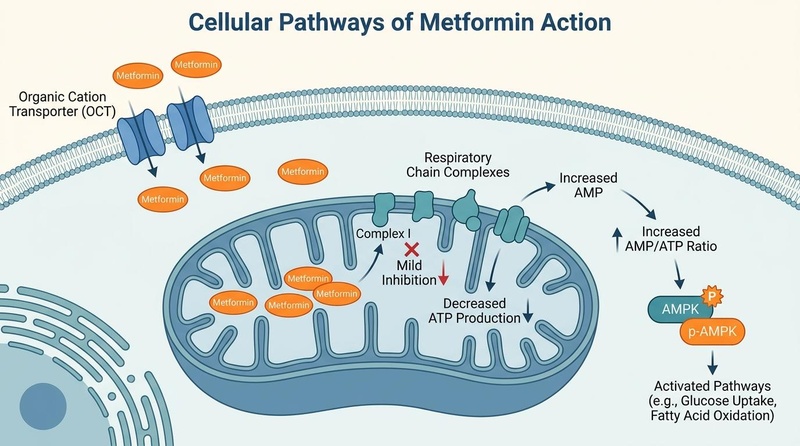
Metformin’s cellular pharmacology is complex, primarily characterized by energetic stress induction and subsequent metabolic reconfiguration.
                  [ Metformin ]
                        │ (Enters via OCT3)
                        ▼
            [ Mitochondrial Complex I ]
                        │ (Mild Inhibition)
                        ▼
               [ ↑ AMP/ATP Ratio ]
                        │
                        ▼
                     [ AMPK ] ────► [ Autophagy & Glucose Uptake ]
                        │
                        ▼ (Inhibition)
                     [ mTOR ]
- Primary targets: Mitochondrial Respiratory Chain Complex I, AMP-activated protein kinase (AMPK), and Organic Cation Transporters (OCT1, OCT2, OCT3).
- Core mechanisms:
- Mitochondrial Complex I Inhibition: Metformin enters cells via organic cation transporters and accumulates within the mitochondria due to its positive electrical charge. It exerts mild, non-competitive inhibition on Complex I of the respiratory chain [13][5:1]. This transiently suppresses ATP synthesis, leading to an increase in intracellular AMP-to-ATP and ADP-to-ATP ratios.
- AMPK Activation: The increased AMP/ATP ratio directly activates AMP-activated protein kinase (AMPK), the body's primary bioenergetics sensor [5:2][6:1]. Activated AMPK phosphorylates downstream targets to suppress hepatic gluconeogenesis, enhance skeletal muscle glucose uptake, promote mitochondrial biogenesis, and initiate autophagy.
- mTOR Inhibition: Through direct AMPK activation and transcription factor regulation, metformin suppresses the mammalian target of rapamycin complex 1 (mTORC1) pathway [5:3][6:2]. This down-regulates protein synthesis and cell growth, mimicking caloric restriction and promoting cellular longevity pathways.
- Systemic Endocrine Modulation: Metformin alters systemic hormones, improving metabolic biomarkers, neutralizing pathological androgen shifts in patients undergoing clinical therapies, and promoting healthy tissue Repair cascades [12:1][14].
- Pharmacokinetics:
- Absorption: Bioavailability is approximately 50% to 60%. Absorption occurs primarily in the upper small intestine and is mediated by plasma membrane monoamine transporters (PMAT) and organic cation transporters.
- Tissue Distribution: Concentrates heavily in the liver, kidneys, and gastrointestinal tract. Notably, OCT3 facilitates significant accumulation and active secretion of metformin within salivary glands [7:1].
- Metabolism & Elimination: Metformin does not undergo hepatic metabolism and is not bound to plasma proteins. It is eliminated entirely unchanged via renal excretion (glomerular filtration and active tubular secretion). The elimination half-life is roughly 4.5 to 6.5 hours in patients with normal renal function.
¶ Effects on different systems
¶ Metabolic health (glucose, insulin, lipids)
Metformin is the gold standard clinical oral hypoglycemic. By suppressing hepatic gluconeogenesis and glycogenolysis, it reduces hepatic glucose output. Simultaneously, it increases insulin receptor tyrosine kinase activity, facilitating GLUT4 translocation and insulin-stimulated glucose uptake in skeletal muscle [3:4][5:4]. In clinical trials comparing metformin monotherapy to sulfonylureas, metformin demonstrates superior long-term glycemic stability, reduced risk of cardiovascular events, and avoids the pancreatic beta-cell exhaustion typical of insulin secretagogues [3:5].
¶ Cardiovascular health (blood pressure, vascular markers)
The vascular benefits of metformin are mediated by both glucose-lowering and direct endothelial mechanisms. It has been shown to improve nitric oxide bioavailability, reduce oxidative stress in endothelial cells, and decrease arterial stiffness [8:3]. Meta-analyses of randomized trials confirm a long-term protective effect against myocardial infarction and stroke, particularly in individuals with pre-existing metabolic disease [4:7].
¶ Body weight and composition
Metformin acts as a modest weight-loss agent. The weight reduction (typically 1.5–3.0 kg over 6–12 months) is primarily characterized by adipose tissue reduction while sparing lean muscle mass. This is achieved via appetite regulation (driven by increases in circulating Growth Differentiation Factor 15 [GDF15] and glucagon-like peptide-1 [GLP-1]) and the restoration of normal hypothalamic leptin sensitivity.
¶ Brain & mental health (cognition, mood, sleep)
Preclinical research highlights metformin's ability to cross the blood-brain barrier and stimulate neurogenesis via AMPK activation. However, human data are complex. Long-term metformin use is strongly associated with progressive vitamin B12 malabsorption [1:3], which can manifest as elevated homocysteine, peripheral neuropathy, and cognitive deficits if left unsupplemented. Adequate B12 status is mandatory to preserve cognitive health in long-term users.
¶ Gut & digestion
The gastrointestinal tract is a major therapeutic target and the primary site of metformin-associated side effects. Metformin concentrations in the intestinal mucosa can reach up to 300 times circulating plasma levels. This leads to altered local glucose metabolism, increased anaerobic glycolysis (producing lactic acid locally), and changes in the gut microbiota—specifically enriching mucin-degrading Akkermansia muciniphila. In the upper GI tract, active secretion via OCT3 transporters drives heavy salivary gland accumulation, resulting in a persistent metallic taste [7:2].
¶ Bone & Regenerative Medicine
Recent clinical translational research indicates metformin plays an active role in skeletal remodeling. By driving AMPK-activated cellular bioenergetics, metformin promotes osteoblast metabolic activation and fracture callus maturation, accelerating structural bone recovery following trauma [12:2].
¶ Cancer & Endocrine Oncology
Metformin has been widely evaluated in oncology. Rigorous target trial emulations show no long-term chemopreventative benefit for certain solid tumors like colorectal cancer in diabetic patients [10:3]. However, in active therapeutic settings, systematic reviews support the use of metformin to improve pathologic and clinical responses to neoadjuvant treatments in non-diabetic breast cancer [9:3]. Additionally, in prostate cancer therapy, metformin effectively modifies and dampens the adverse metabolic and androgenic hormone drift associated with androgen deprivation therapy [14:1].
¶ Dosage and how to take it
¶ Standard dosing in studies
- Type 2 Diabetes: Clinically initiated at 500 mg orally once or twice daily with meals. The dose is titrated upwards in 500 mg increments weekly, up to a standard therapeutic maintenance dose of 1,000–2,000 mg/day (maximum recommended dose is 2,550 mg/day).
- Longevity / Off-Label Geroprotection: Clinical protocols (such as those proposed in the TAME trial) typically utilize 1,000 to 1,500 mg/day of an extended-release (ER) formulation, taken with the evening meal.
¶ Forms and bioavailability
- Immediate-Release (IR): Absorbed rapidly but associated with high peak plasma concentrations and a higher incidence of gastrointestinal side effects. Usually dosed 2–3 times daily with meals.
- Extended-Release (ER/XR): Formulated with dual-hydrophilic polymer matrices that slow drug release, providing a flatter absorption curve and significantly improved gastrointestinal tolerability. Typically dosed once daily.
- Bioavailability Impact of Food: Food decreases the extent of absorption and slightly delays the peak concentration of immediate-release metformin, but taking it with meals is universally recommended to buffer gastrointestinal irritation.
¶ Special populations
- Renal Impairment: Renal function must be assessed prior to initiation and monitored regularly.
- eGFR ≥ 60 mL/min/1.73m²: No dose adjustment required.
- eGFR 45–59 mL/min/1.73m²: Metformin may be continued; monitor renal function closely.
- eGFR 30–44 mL/min/1.73m²: Metformin initiation is not recommended. For those already taking it, consider a 50% dose reduction and assess safety every 3 months.
- eGFR < 30 mL/min/1.73m²: Metformin is strictly contraindicated.
- Hepatic Impairment: Avoid use in patients with clinical liver disease due to the impaired capacity to clear lactate, which significantly escalates the risk of lactic acidosis.
- Pregnancy & Lactation: Metformin crosses the placenta and is excreted in breast milk. While human data show no clear teratogenic risk, insulin remains the preferred first-line therapy during pregnancy.
¶ Safety and side effects
Metformin is generally well-tolerated, but its distinct pharmacological profile carries predictable adverse risks.
¶ Common side effects
- Gastrointestinal Distress: Diarrhea, abdominal bloating, nausea, flatulence, and metallic taste occur in up to 30% of patients initiating immediate-release therapy. These symptoms are usually dose-dependent, self-limiting, and resolve within 2–4 weeks.
- Metallic Taste (Dysgeusia): Driven directly by high active accumulation and secretion of metformin into the saliva via organic cation transporter-3 (OCT3) [7:3].
- Vitamin B12 Deficiency: Long-term metformin therapy interferes with the calcium-dependent absorption of the vitamin B12-intrinsic factor complex in the terminal ileum, leading to clinical B12 deficiency in 10% to 15% of patients after several years.
¶ Less common / serious concerns
- Lactic Acidosis: A rare but life-threatening metabolic emergency (characterized by blood lactate > 5 mmol/L and pH < 7.35). It occurs almost exclusively in patients with severe underlying contraindications (such as profound renal failure, tissue hypoxia, severe sepsis, or acute hepatic shock).
- Exercise Blunting: In healthy older adults, clinical trials demonstrate that metformin can partially suppress the increase in mitochondrial respiration, cardiorespiratory fitness ( max), and whole-body insulin sensitivity normally gained from aerobic exercise training [11:1].
¶ Who should avoid it
- Individuals with severe renal impairment (eGFR < 30 mL/min/1.73m²).
- Individuals with acute or chronic metabolic acidosis.
- Individuals with advanced hepatic cirrhosis or active liver failure.
- Patients undergoing major surgical procedures or imaging studies involving intravascular iodinated contrast agents (metformin must be held at the time of, or prior to, the procedure and withheld for 48 hours post-procedure until renal function is confirmed stable).
¶ LongeviData safety widget
¶ Drug and supplement interactions
Metformin interactions primarily involve competition for renal/organic cation transport clearance pathways or additive pharmacodynamic metabolic effects.
¶ Pharmacokinetic interactions
- OCT/MATE Substrates and Inhibitors: Metformin is actively cleared via renal tubular secretion mediated by Organic Cation Transporter 2 (OCT2) and Multidrug and Toxin Extrusion proteins (MATE1/MATE2-K).
- Inhibitors (e.g., Cimetidine, Dolutegravir, Ranolazine, Vandetanib): Can decrease the renal clearance of metformin, increasing systemic exposure and elevating lactic acidosis risks. Doses may need reduction.
- Competitors: Organic cation transporter-3 (OCT3) mediates metformin's heavy concentration in salivary glands [7:4]; co-administration with other cationic drugs can modify taste disturbances or localized tissue accumulation.
¶ Pharmacodynamic interactions
- SGLT2 Inhibitors and Other Hypoglycemics: Co-administration with SGLT2 inhibitors (e.g., dapagliflozin) or sulfonylureas creates additive glucose-lowering effects [8:4]. While dapagliflozin maintains vascular endothelial health, glycemic parameters must be monitored to prevent hypoglycemia when stacking multiple active agents.
- Carbonic Anhydrase Inhibitors (e.g., Topiramate, Zonisamide, Acetazolamide): Frequently cause a mild systemic metabolic acidosis and can increase the risk of metformin-induced lactic acidosis. Avoid concurrent use.
- Iodinated Contrast Media: Can cause acute kidney injury, resulting in rapid metformin accumulation and lactic acidosis. Metformin must be temporarily discontinued.
¶ Combining Metformin with other supplements (“stacks”)
Due to metformin’s distinct mitochondrial and metabolic properties, biohackers and clinicians utilize structured co-administration strategies to optimize outcomes or mitigate side effects.
- Vitamin B12 (Essential Co-supplementation):
- Rationale: Metformin impairs B12 absorption at the terminal ileum.
- Evidence: Strongly supported by long-term clinical data [1:4]. Daily oral supplementation of 1,000 mcg of methylcobalamin is standard clinical practice to prevent subclinical macrocytic anemia and peripheral neuropathy.
- Aerobic Exercise Timing / Stacking:
- Rationale: Metformin blunts mitochondrial adaptations to aerobic exercise [11:2].
- Evidence: Clinical trial evidence indicates that taking metformin concurrently with aerobic training limits the physiological improvements in max and mitochondrial enzyme activities. Some protocols suggest avoiding metformin dosing on high-intensity training days, or restricting its use to individuals whose primary clinical target is metabolic control rather than athletic conditioning.
- AMPK / Sirtuin Activators (e.g., Resveratrol, Berberine):
- Rationale: Synergistic cellular pathway activation.
- Evidence: Strictly theoretical and preclinical. Stacking metformin with other strong Complex I inhibitors (like berberine) or sirtuin activators is popular in longevity communities but is not supported by human safety data and may theoretically escalate gastrointestinal side effects or metabolic distress.
¶ Practical questions (FAQ)
¶ 1. How long does it take for Metformin to work?
Glycemic improvements typically begin within 48 to 72 hours of starting metformin, with maximum therapeutic reductions in fasting blood glucose and HbA1c achieved after 4 to 6 weeks of consistent daily dosing.
¶ 2. Can I take Metformin long term?
Yes. Metformin has been prescribed continuously for decades in type 2 diabetic cohorts with an exceptional safety profile. The primary long-term monitoring requirements are periodic renal function assessments (eGFR) and annual vitamin B12 serum level checks [1:5].
¶ 3. Why does Metformin cause a metallic taste?
Metformin is a cationic molecule that is actively transported and highly concentrated within the secretory acinar cells of the salivary glands by Organic Cation Transporter-3 (OCT3) [7:5]. The active excretion of the drug into saliva creates a persistent, localized metallic taste.
¶ 4. Is Metformin useful if I am otherwise healthy and non-diabetic?
The evidence for using metformin in healthy, non-diabetic individuals is highly controversial. While preclinical animal models show lifespan extension, human data indicate it may blunt positive exercise adaptations in healthy, active adults [11:3] and fails to improve exceptional longevity outcomes in clinical trial emulations [15].
¶ 5. Does Metformin cause hair loss or muscle wasting?
There is no clinical evidence linking metformin to direct hair loss or muscle wasting. However, chronic metformin use can cause a subclinical vitamin B12 deficiency [1:6], which can indirectly affect cellular health, energy levels, and neurological function if uncorrected.
¶ 6. Can I combine Metformin with Berberine?
While both act as mild mitochondrial Complex I inhibitors and AMPK activators, combining them is not recommended. Human clinical trials on this specific stack are lacking, and the combination is highly likely to cause severe gastrointestinal distress (diarrhea, cramping, nausea) due to overlapping mechanisms.
¶ How we evaluated the evidence
We evaluated the clinical evidence for metformin by prioritizing:
- Systematic Reviews and Meta-Analyses: Gold-standard Cochrane reviews and updated clinical meta-analyses assessing mortality and metabolic control [4:8][3:6].
- Target Trial Emulations (TTE): Robust, modern epidemiological designs specifically constructed to eliminate immortal-time and selection biases inherent to older observational studies [10:4][15:1].
- Randomized Controlled Trials (RCTs): Clinical trials investigating molecular, cellular, and physiological outcomes in humans [8:5][11:4].
- GRADE Framework: Evidence was graded as High, Moderate, Low, or Very Low based on trial design, consistency of outcomes across studies, cohort sizes, and clinical directness.
¶ References
Campbell JM, et al. Metformin as Anti-Aging Therapy: Is It for Everyone? Trends in Endocrinology & Metabolism. 2019;30(10):745-758. https://pmc.ncbi.nlm.nih.gov/articles/PMC6779524/ ↩︎ ↩︎ ↩︎ ↩︎ ↩︎ ↩︎ ↩︎
Mohammed I, et al. A Critical Review of the Evidence That Metformin Is a Putative Anti-Aging Drug That Enhances Healthspan and Extends Lifespan. Frontiers in Endocrinology. 2021;12:718942. https://pubmed.ncbi.nlm.nih.gov/34421827/ ↩︎ ↩︎
Cochrane Meta-Analysis. Sulfonylurea versus metformin monotherapy in patients with type 2 diabetes: a Cochrane systematic review and meta-analysis of randomized clinical trials and trial sequential analysis. Cochrane Database of Systematic Reviews. 2014;10:CD009017. https://pubmed.ncbi.nlm.nih.gov/25295236/ ↩︎ ↩︎ ↩︎ ↩︎ ↩︎ ↩︎ ↩︎
Han Y, et al. Effect of metformin on all-cause mortality and major adverse cardiovascular events: An updated meta-analysis of randomized controlled trials. BMJ Open. 2021;11(2):e043513. https://pubmed.ncbi.nlm.nih.gov/33549430/ ↩︎ ↩︎ ↩︎ ↩︎ ↩︎ ↩︎ ↩︎ ↩︎ ↩︎
Barzilai N, Crandall JP, Kritchevsky SB, Espeland MA. Metformin as a Tool to Target Aging. Cell Metabolism. 2016;23(6):1060-1065. https://pmc.ncbi.nlm.nih.gov/articles/PMC5943638/ ↩︎ ↩︎ ↩︎ ↩︎ ↩︎
Kulkarni AS, et al. Benefits of Metformin in Attenuating the Hallmarks of Aging. Cell Metabolism. 2020;32(1):15-30. https://pmc.ncbi.nlm.nih.gov/articles/PMC7347426/ ↩︎ ↩︎ ↩︎
Lee N, Duan H, Hebert MF, Liang CJ, Rice KM, Wang J. Taste of a pill: organic cation transporter-3 (OCT3) mediates metformin accumulation and secretion in salivary glands. Journal of Biological Chemistry. 2014;289(39):27055-27064. https://pubmed.ncbi.nlm.nih.gov/42399684/ ↩︎ ↩︎ ↩︎ ↩︎ ↩︎ ↩︎
Chee YJ, Acharyya S, Liew H. First-Line Dapagliflozin, Metformin, or Combination Therapy in Type 2 Diabetes: Vascular and Molecular Outcomes of a Randomised Controlled Trial. Diabetes, Obesity & Metabolism. 2026;28(7):dom.15234. https://pubmed.ncbi.nlm.nih.gov/42396722/ ↩︎ ↩︎ ↩︎ ↩︎ ↩︎ ↩︎
Arriaga-Izabal D, Morales-Lazcano F, Angulo-Zamudio UA. Neoadjuvant metformin on clinical and pathological response in non-diabetic patients with non-metastatic breast cancer: an updated systematic review and meta-analysis. Clinical & Translational Oncology. 2026;28(7):102-111. https://pubmed.ncbi.nlm.nih.gov/42399548/ ↩︎ ↩︎ ↩︎ ↩︎
Hiroki S, Fukasawa T, Honda M. Effectiveness of Metformin in Preventing Colorectal Cancer Among Japanese Patients With Type 2 Diabetes: A Target Trial Emulation. Pharmacoepidemiology and Drug Safety. 2026;35(7):pds.70429. https://pubmed.ncbi.nlm.nih.gov/42399205/ ↩︎ ↩︎ ↩︎ ↩︎ ↩︎
Konopka AR, et al. Metformin inhibits mitochondrial adaptations to aerobic exercise training in older adults. Aging Cell. 2019;18(1):e12880. https://pubmed.ncbi.nlm.nih.gov/30548390/ ↩︎ ↩︎ ↩︎ ↩︎ ↩︎
Pastukh V, Zhang J, Alexander PG, Bhargava S, Shams A, Zhao C, Hogan MV, Wang JH. Repurposing Metformin to Promote Fracture Callus Maturation via AMPK-Driven Metabolic Activation. Journal of Orthopaedic Research. 2026;44(7):e70246. https://pubmed.ncbi.nlm.nih.gov/42400344/ ↩︎ ↩︎ ↩︎
Fang J, et al. Metformin in aging and aging-related diseases: clinical applications and relevant mechanisms. Aging Disease. 2022;13(2):456-470. https://pmc.ncbi.nlm.nih.gov/articles/PMC8965502/ ↩︎
Gorman M, Usmani N, Pollak MN. Metformin modifies hormone changes associated with androgen deprivation therapy for prostate cancer. Endocrine Oncology. 2026;3(1):eo-25-0123. https://pubmed.ncbi.nlm.nih.gov/42395839/ ↩︎ ↩︎
Borenstein M, et al. Comparative Effectiveness of Metformin Versus Sulfonylureas on Exceptional Longevity in Women With Type 2 Diabetes: Target Trial Emulation. The Journals of Gerontology: Series A. 2025;80(7):glaf095. https://academic.oup.com/biomedgerontology/article/80/7/glaf095/8137954 ↩︎ ↩︎