¶ Phenylpiracetam
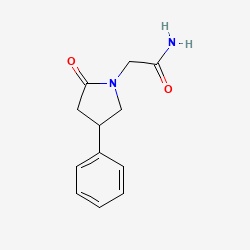
| Type | Synthetic Nootropic (Racetam) |
| Active Isomer | (R)-Phenylpiracetam |
| Source | Synthetic derivative of Piracetam |
| Dose Range | 100–200 mg (per dose) |
| Half-life | 3–5 hours |
| Main Benefit | Cognitive and Physical Performance, Asthenia |
| Absorption | ~100% (High Oral Bioavailability) |
Phenylpiracetam is a highly bioavailable phenylated derivative of piracetam that acts as a central nervous system stimulant and neuroprotective agent. Human clinical evidence primarily supports its use in cognitive rehabilitation following ischemic stroke and cranial trauma, as well as in treating asthenic syndrome, though its potent stimulant properties have led to its ban by athletic regulatory bodies.
¶ At a glance
Aliases
- Also known as: Phenotropil, Fonturacetam, Carphedon, Actitropil
- Chemical / botanical name: N-carbamoylmethyl-4-phenyl-2-pyrrolidone (or (RS)-2-(2-oxo-4-phenylpyrrolidin-1-yl)acetamide)
- Category: Synthetic Nootropic (Racetam / pyrrolidone derivative)
Key points (high-level summary)
- In adults recovering from ischemic stroke or organic brain injuries, phenylpiracetam significantly improves cognitive function, memory consolidation, and activities of daily living[1][2][3][4].
- It exhibits robust psychostimulant and adaptogenic effects, enhancing physical stamina, tolerance to extreme cold, and resistance to fatigue, which led to its classification as a banned performance-enhancer by WADA[5][6].
- Rapid tolerance to its locomotor and stimulatory effects develops within consecutive days of use, necessitating intermittent dosing or cycling protocols[5:1].
- It is generally well-tolerated with low toxicity, but can cause insomnia when taken late in the day, mild psychomotor agitation, or headaches related to acetylcholine depletion[7][1:1][5:2].
What people use it for
- Main goals: Cognitive enhancement, focus, physical stamina, fatigue reduction, stroke recovery, and asthenic syndrome.
- Evidence quality (overall): Moderate
¶ What is Phenylpiracetam?
Phenylpiracetam (N-carbamoylmethyl-4-phenyl-2-pyrrolidone) is a synthetic pyrrolidone-class nootropic compound. It was developed in the early 1980s as a more potent, lipophilic derivative of piracetam.
- Definition: Phenylpiracetam is a phenylated analog of piracetam, where a phenyl group is attached to the 4-position of the 2-pyrrolidone ring.
- Natural sources: Phenylpiracetam is a purely synthetic compound and does not occur naturally in any food or plant sources.
- Traditional / historical use: Developed in Russia in 1983 at the Institute of Biomedical Problems of the Russian Academy of Sciences, it was originally designed to help cosmonauts cope with the physical and psychological stresses of long-duration space flight[1:2].
- Current regulatory status: It is a prescription drug in Russia and some Eastern European countries (under the brand names Phenotropil and Actitropil) for various CNS disorders. In the United States and Western Europe, it is unregulated and sold as an over-the-counter dietary supplement or research chemical, though it is banned in-competition by the World Anti-Doping Agency (WADA)[5:3][6:1].
- Key pharmacological property in one line: A potent lipophilic dopamine transporter inhibitor and cholinergic neuromodulator.
¶ What are Phenylpiracetam’s main benefits?
Phenylpiracetam is primarily valued for its dual-action profile as both a nootropic (cognitive enhancer) and a psychostimulant (performance enhancer). Unlike its parent molecule piracetam, phenylpiracetam provides an immediate and perceptible increase in mental alertness and physical energy.
Cognitive Recovery following Stroke or Trauma
- Outcome: Cognitive function and activities of daily living
- Direction of effect: Increase in cognitive performance (Reduction in neurological deficit)
- Magnitude: Moderate to Large
- Population studied: Patients recovering from ischemic stroke or mild traumatic brain injury
- Evidence quality: Moderate (supported by several large-scale RCTs and controlled trials)
- Summary sentence: Multiple clinical trials demonstrate that daily administration of 100–400 mg of phenylpiracetam significantly accelerates the restoration of speech, memory, attention, and daily life independence after cerebral ischemia or cranial trauma[2:1][3:1].
Mitigation of Asthenia and Chronic Fatigue
- Outcome: Asthenic syndrome and chronic fatigue symptoms
- Direction of effect: Decrease
- Magnitude: Moderate
- Population studied: Patients with vascular encephalopathy, mild TBI, or asthenic syndrome
- Evidence quality: Moderate
- Summary sentence: Clinical trials and meta-analyses show that phenylpiracetam significantly reduces symptoms of asthenia (severe physical and mental fatigue), apathy, and autonomic dysregulation[1:3][8][9].
Seizure Frequency in Epilepsy
- Outcome: Seizure frequency and EEG parameters
- Direction of effect: Decrease
- Magnitude: Moderate
- Population studied: Adult patients with locally-induced or refractory epilepsy
- Evidence quality: Moderate
- Summary sentence: When used as an add-on therapy, 100 mg of phenylpiracetam daily reduces seizure counts and improves background EEG readings without disrupting sleep architecture or causing sedation[10][11].
Metabolic Health and Weight Management
- Outcome: Weight gain and glucose tolerance
- Direction of effect: Decrease in weight gain (adaptation to hyperglycemia)
- Magnitude: Small to Moderate
- Population studied: Predominantly animal models; human evidence is highly preliminary or observational
- Evidence quality: Low to Very Low
- Summary sentence: While preclinical research shows that the (S)-enantiomer of phenylpiracetam selectively inhibits DAT to suppress weight gain and improve hyperglycemia, human clinical data are limited to secondary metabolic findings in vascular encephalopathy patients[7:1][9:1].
¶ Evidence summary table (human outcomes)
| Outcome / Goal | Effect* | Consistency** | Evidence quality | Trials*** | Notes (population, duration, dose) |
|---|---|---|---|---|---|
| Cognitive Recovery (Stroke) | High | Moderate | 2 RCTs | Improved neurological deficit, memory, and motor function; 400 mg/day for 12 months in ischemic stroke[2:2][3:2] | |
| Cognitive Function (Encephalopathy) | High | Moderate | 2 Trials | Significant improvement in memory, attention, and mental performance; 100–200 mg/day for 30 days[2:3][12] | |
| Asthenia & Fatigue | High | Moderate | 1 Meta-Analysis, 3 Trials | Substantial reduction in physical fatigue, general apathy, and weakness; 100–200 mg/day for 30–60 days[9:2][12:1][8:1] | |
| Seizure Frequency (Epilepsy) | High | Moderate | 3 RCTs | Significant reduction in seizure frequency as adjunctive therapy; 100 mg/day for 60 days[10:1][11:1] | |
| Anxiety & Depression (Secondary) | Moderate | Low | 1 Trial | Improved psychomotor drive, reduced anxiety and depressive symptoms in organic brain lesion patients; 200 mg/day for 30 days[2:4] | |
| Physical Performance & Adaptation | Moderate | Low | Obs/Animal | Adaptogenic effect under physical stress and extreme cold; banned by WADA; dose 100–200 mg[1:4][6:2] | |
| Weight Management | Unclear | Very Low | Animal Only | Preclinical evidence showing weight loss and insulin sensitivity; no formal human trials[7:2][5:4] |
- *Effect: Number of arrows (1-3) indicates magnitude. Direction: ↑ (increase), ↓ (decrease), = (no effect), ? (unclear). Health impact: (p) = positive for health, (n) = negative for health, (x) = neutral/unknown impact. Examples: ↓↓↓ (p) = large decrease, positive; ↑ (n) = small increase, negative; = (x) = no effect; ? = unclear.
- **Consistency: Low (results conflict), Moderate (mixed but leaning one way), High (most trials agree)
- ***Trials: Number of RCTs or total trials informing this outcome (shows evidence depth at a glance)
¶ How does Phenylpiracetam work?
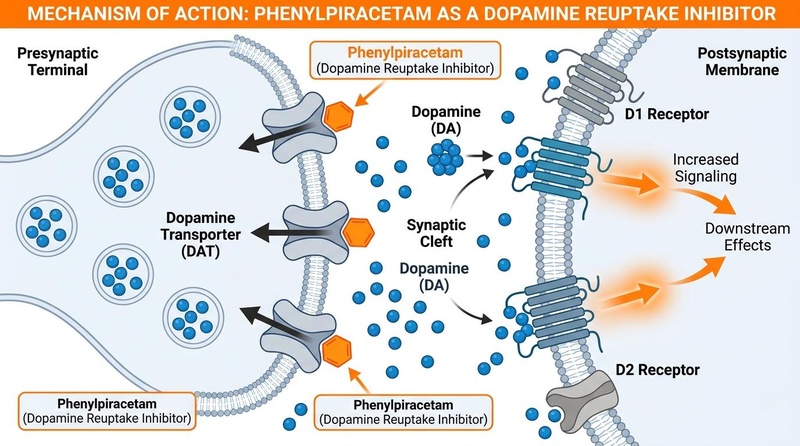
Phenylpiracetam's mechanism of action is distinct from other members of the racetam family due to its robust dopaminergic activity and high lipophilicity.
¶ Primary Target: Dopamine Transporter (DAT) Inhibition
Unlike typical racetams, phenylpiracetam acts as a selective inhibitor of the dopamine transporter (DAT) with stereoselective affinity. The active (R)-enantiomer binds to DAT with a dissociation constant (Ki) of approximately 13–16 µM, which is significantly more potent than the (S)-enantiomer (Ki ≈ 56 µM)[13][14]. By blocking DAT, phenylpiracetam prevents the reuptake of dopamine from the synaptic cleft, thereby elevating extracellular dopamine concentrations in the striatum and improving drive, focus, and motor output[13:1][5:5].
¶ Upregulation of Nicotinic Acetylcholine and NMDA Receptors
Under physical and cognitive stress, phenylpiracetam has been shown to prevent the downregulation of nicotinic acetylcholine receptors (nAChRs) in the cerebral cortex and upregulate NMDA glutamate receptors in the hippocampus[15]. It increases the density of these receptors, which directly enhances long-term potentiation (LTP), synaptic plasticity, and memory consolidation[15:1].
¶ Enhancement of Cerebral Blood Flow and Cellular Energy Metabolism
It increases regional cerebral blood flow and glucose consumption in ischemic brain areas, elevating cellular ATP levels and offering potent neuroprotection under conditions of hypoxia or toxicity[1:5][3:3].
¶ Pharmacokinetics basics
Phenylpiracetam is highly lipophilic due to the phenyl group, allowing it to cross the blood-brain barrier rapidly and completely. It has nearly 100% oral bioavailability, with peak plasma concentrations reached within 1 hour[5:6][16]. It does not undergo extensive hepatic biotransformation or first-pass metabolism, with approximately 40% excreted unchanged in the urine and 60% in bile and feces. Its elimination half-life is approximately 3 to 5 hours[5:7][16:1].
¶ Effects on different systems
¶ Brain & mental health (cognition, mood, sleep)
Phenylpiracetam is widely used for cognitive enhancement and neurological rehabilitation. Clinical trials in patients with ischemic stroke, vascular encephalopathy, and mild traumatic brain injury have consistently shown improvements in memory, attention, and executive function[12:2][8:2][2:5][3:4]. Beyond cognition, it exerts anxiolytic and antidepressant effects (particularly in organic lesions) by improving psychomotor drive and motivation without typical stimulant-induced sedation[1:6][2:6]. It is also being investigated for treating excessive daytime sleepiness and fatigue associated with Parkinson's disease and other sleep disorders[17].
¶ Physical Performance, Fatigue, and Thermoregulation
One of the compound's most unique properties is its adaptogenic effect on physical performance. It increases physical work capacity, reduces perceived exertion, and improves motor coordination[1:7][5:8][6:3]. Additionally, it significantly enhances the body's tolerance to extreme cold stress and pain, likely via its modulation of central dopaminergic and adrenergic systems. These properties have led to its status as a prohibited substance in-competition by WADA[6:4].
¶ Other Domains (Epilepsy, Neuroprotection, and Weight Management)
- Epilepsy: In adult patients with epilepsy, phenylpiracetam (100 mg daily) as an add-on therapy has been shown to reduce seizure frequency and stabilize EEG readings without disrupting sleep architecture or causing CNS depression[10:2][11:2].
- Neuroprotection: It stabilizes neuronal membranes and protects against glutamate-induced excitotoxicity and oxidative stress in models of systemic inflammation[18][4:1].
- Weight Management: Preclinical studies suggest that the (S)-enantiomer selectively inhibits DAT to suppress high-fat diet-induced weight gain and improve glucose tolerance without the locomotor stimulation characteristic of the (R)-isomer[7:3].
¶ Dosage and how to take it
¶ Standard dosing in studies
- Typical daily dose range: 100–200 mg taken 1 to 3 times daily (total 100–600 mg/day). In stroke rehabilitation studies, 400 mg daily (divided into 200 mg twice daily) is commonly utilized[3:5]. For mild cognitive impairment, asthenia, and organic brain lesions, 100–200 mg daily is standard[12:3][2:7].
- Timing: Due to its stimulant properties, it is recommended to take the last dose no later than 4:00 PM to avoid insomnia or disruption of sleep architecture.
- Duration: Study durations typically range from 1 to 12 months in clinical settings.
¶ Forms and bioavailability
- Enantiomers: Phenylpiracetam exists as a racemic mixture of (R) and (S) enantiomers. The (R)-enantiomer is the primary driver of locomotor, stimulant, and cognitive-enhancing effects. The (S)-enantiomer has been explored in preclinical studies for metabolic adaptation and weight loss without inducing psychomotor agitation[13:2][7:4][14:1].
- Administration: It has ~100% oral bioavailability and can be taken with or without food. However, co-administration with a lipid source may enhance absorption consistency and minimize gastrointestinal discomfort.
¶ Special populations
- Kidney Impairment: Approximately 40% of phenylpiracetam is excreted unchanged by the kidneys. Dosage reduction or avoidance is warranted in individuals with renal impairment.
- Liver Impairment: Lack of hepatic metabolism reduces liver interaction risk, but safety in severe hepatic insufficiency is not established.
- Pregnancy and Breastfeeding: Safety and efficacy have not been established. Avoid use in these populations.
¶ Safety and side effects
Phenylpiracetam is generally well-tolerated with a high safety margin. The LD50 in rodents is greater than 800 mg/kg, indicating very low acute toxicity.
¶ Common side effects
- Insomnia and sleep disturbances: Most common if taken late in the day due to its stimulatory nature.
- Psychomotor agitation: Jitters, restlessness, or increased irritability in sensitive individuals.
- Headache: Common with all racetams, often attributed to increased acetylcholine demand.
- Gastrointestinal: Mild nausea or stomach discomfort.
- Cardiovascular: Transient elevations in blood pressure and heart rate.
¶ Less common / serious concerns
- Severe Anxiety: Stimulatory effects may exacerbate pre-existing panic disorder or severe generalized anxiety.
- Dependence & Crash: While it has a low potential for physical dependence, psychological dependence or a "rebound" crash (fatigue, apathy) may occur upon abrupt cessation after prolonged daily use.
¶ Who should be especially cautious or avoid it
- Individuals with pre-existing severe hypertension, cardiac arrhythmias, or coronary artery disease.
- Individuals with panic disorder, severe generalized anxiety, or psychotic disorders (due to increased dopaminergic activity)[14:2].
- Competitive athletes subject to anti-doping testing (prohibited at all times in-competition by WADA)[6:5].
¶ Drug and supplement interactions
¶ Pharmacokinetic interactions
- Renal Clearance: Drugs that impair renal function or alter glomerular filtration can increase plasma levels of phenylpiracetam.
- CYP Enzymes: Phenylpiracetam does not significantly induce or inhibit major cytochrome P450 enzymes, making direct metabolic drug interactions unlikely.
¶ Pharmacodynamic interactions
- Other Stimulants & Dopaminergics: Synergistic and potentially dangerous additive effects with caffeine, amphetamines, methylphenidate, or modafinil, which can lead to excessive sympathetic activation and cardiovascular strain.
- Neuroleptics (Antipsychotics): Can oppose the effects of dopaminergic antagonists. Phenylpiracetam has been shown to modulate neuroleptic activity, potentially diminishing their effectiveness[14:3].
- Sedatives & Alcohol: Phenylpiracetam can mask the depressant and motor-impairing effects of alcohol, leading to a dangerous false sense of sobriety.
- Cholinergics: Combining with acetylcholinesterase inhibitors (e.g., donepezil, huperzine A) or choline donors may lead to synergistic cognitive effects but also increased cholinergic side effects.
¶ Combining Phenylpiracetam with other supplements (“stacks”)
- The Choline Stack: Since phenylpiracetam increases acetylcholine utilization, stacking with a high-quality choline source is standard practice to prevent headaches and support learning.
- Alpha-GPC: 300–600 mg per 100 mg of Phenylpiracetam.
- CDP-Choline (Citicoline): 250–500 mg per 100 mg of Phenylpiracetam.
- The Adaptogenic Stack: Often combined with L-Theanine (100–200 mg) to smooth out stimulant-induced jitters, or with Rhodiola Rosea (200–400 mg) to support sustained mental stamina and mitigate post-use fatigue.
¶ Practical FAQ
How long does it take for Phenylpiracetam to work?
Cognitive and physical stimulation is typically felt within 30 to 60 minutes after oral administration, corresponding to its rapid peak plasma absorption. However, the disease-modifying, neurorehabilitative benefits in stroke or brain injury patients require consistent daily administration for 1 to 12 months.
Can I take Phenylpiracetam long term?
While clinical trials in stroke rehabilitation have successfully administered 400 mg daily for up to a full year without serious adverse events, the psychostimulant and locomotor effects are subject to rapid tolerance within 3 to 5 days of consecutive use. For healthy individuals seeking cognitive enhancement, intermittent use (1 to 3 times per week) or a structured cycle (e.g., 3 weeks on, 1 week off) is recommended to preserve sensitivity.
Can I take Phenylpiracetam with other stimulants or caffeine?
Caution is advised. Because phenylpiracetam inhibits the dopamine transporter (DAT) and acts as a central nervous system stimulant, combining it with other stimulants like caffeine, yohimbine, or prescription ADHD medications can cause a synergistic increase in blood pressure, heart rate, anxiety, and insomnia.
Why is Phenylpiracetam banned by WADA?
Phenylpiracetam (under the name Carphedon) is banned in-competition by the World Anti-Doping Agency (WADA) due to its potent ergogenic and adaptogenic properties. It increases physical work capacity, reduces perceived exertion, improves motor coordination, and significantly enhances resistance to extreme cold stress and pain.
Is Phenylpiracetam useful if I am otherwise healthy?
In healthy populations, anecdotal reports and pilot trials indicate that phenylpiracetam serves as a powerful short-term focus and productivity aid, particularly during sleep deprivation or intensive physical training. However, the vast majority of rigorous, large-scale clinical evidence is in populations suffering from neurological disorders, stroke, or cognitive impairment.
¶ How we evaluated the evidence
- Study types prioritized: Randomized controlled trials, systematic reviews, meta-analyses, and high-impact peer-reviewed pharmacological overviews.
- How we graded evidence quality:
- High: Multiple high-quality, large-scale RCTs or meta-analyses with consistent, direct evidence, low risk of bias, and robust statistical power.
- Moderate: Controlled trials with minor methodological limitations, smaller sample sizes, or mixed results from otherwise high-quality studies.
- Low: Few clinical trials, significant design limitations, high risk of bias, or small cohort sizes.
- Very Low: Only preclinical (animal/in vitro) data, case reports, or speculative mechanistic extrapolation.
- Methodological limits in current literature: Many of the key clinical trials on phenylpiracetam were conducted in Russia or Eastern Europe, and some lack the rigorous clinical registry data, blinding transparency, or pre-registration standards expected by modern Western drug authorities. Therefore, even large-scale trials (e.g., 400 patients) are graded as "Moderate" quality rather than "High" to account for potential translation, registry, and publication bias.
¶ References
Malykh, A. G., & Sadaie, M. R. (2010). Piracetam and piracetam-like drugs: from basic science to novel clinical applications to CNS disorders. Drugs, 70(3), 287-312. https://doi.org/10.2165/11319230-000000000-00000 ↩︎ ↩︎ ↩︎ ↩︎ ↩︎ ↩︎ ↩︎ ↩︎
Savchenko, A. Iu, et al. (2005). (The phenotropil treatment of the consequences of brain organic lesions). Zhurnal Nevrologii i Psikhiatrii imeni S.S. Korsakova, 105(12), 22-26. https://pubmed.ncbi.nlm.nih.gov/16447562/ ↩︎ ↩︎ ↩︎ ↩︎ ↩︎ ↩︎ ↩︎ ↩︎
Koval'chuk, V. V., et al. (2010). (Efficacy of phenotropil in the rehabilitation of stroke patients). Zhurnal Nevrologii i Psikhiatrii imeni S.S. Korsakova, 110(12 Pt 2), 38-40. https://pubmed.ncbi.nlm.nih.gov/21626817/ ↩︎ ↩︎ ↩︎ ↩︎ ↩︎ ↩︎
Voronina, T. A., et al. (2023). Cognitive Impairment and Nootropic Drugs: Mechanism of Action and Spectrum of Effects. Neurochemical Journal, 17(2), 115-125. https://link.springer.com/article/10.1134/S1819712423020198 ↩︎ ↩︎
Carphedon at the Crossroads: A Dangerous Drug or a Promising Psychopharmaceutical? (2019). Global Journal of Pharmacy & Pharmaceutical Sciences, 6(5), 555713. https://doi.org/10.19080/gjpps.2019.06.555713 ↩︎ ↩︎ ↩︎ ↩︎ ↩︎ ↩︎ ↩︎ ↩︎ ↩︎
World Anti-Doping Agency. (2024). Prohibited List. https://www.wada-ama.org/en/prohibited-list ↩︎ ↩︎ ↩︎ ↩︎ ↩︎ ↩︎
Zvejniece, L., et al. (2017). S-phenylpiracetam, a selective DAT inhibitor, reduces body weight gain and improves adaptation to hyperglycemia. Pharmacology Biochemistry and Behavior, 156, 17-25. https://pubmed.ncbi.nlm.nih.gov/28743458/ ↩︎ ↩︎ ↩︎ ↩︎ ↩︎
Kalinsky, P. P., et al. (2007). (Use of phenotropil in the treatment of asthenic syndrome and autonomic disturbances in the acute period of mild cranial brain trauma). Zhurnal Nevrologii i Psikhiatrii imeni S.S. Korsakova, 107(11), 32-35. https://pubmed.ncbi.nlm.nih.gov/18689001/ ↩︎ ↩︎ ↩︎
Gromova, O. A., et al. (2024). (Pharmacological effects of fonturacetam (Actitropil) and prospects for its clinical use). Zhurnal Nevrologii i Psikhiatrii imeni S.S. Korsakova, 124(8), 21-31. https://pubmed.ncbi.nlm.nih.gov/39269293/ ↩︎ ↩︎ ↩︎
Belskaia, G. N., et al. (2014). (The efficacy of add-on treatment with phenotropil in adult patients with locally-induced epilepsy). Zhurnal Nevrologii i Psikhiatrii imeni S.S. Korsakova, 114(11), 27-33. https://pubmed.ncbi.nlm.nih.gov/25591651/ ↩︎ ↩︎ ↩︎
Lybzikova, G. N., et al. (2008). (The efficacy of phenotropil in the complex treatment of epilepsy). Zhurnal Nevrologii i Psikhiatrii imeni S.S. Korsakova, 108(1), 69-71. https://pubmed.ncbi.nlm.nih.gov/18646385/ ↩︎ ↩︎ ↩︎
Gustov, A. V., et al. (2006). (Phenotropil in the treatment of vascular encephalopathy). Zhurnal Nevrologii i Psikhiatrii imeni S.S. Korsakova, 106(3), 52-53. https://pubmed.ncbi.nlm.nih.gov/16608112/ ↩︎ ↩︎ ↩︎ ↩︎
Merz Pharma GmbH. (2015). Use of (R)-phenylpiracetam for the treatment of sleep disorders. European Patent EP2891491A1. https://patents.google.com/patent/EP2891491A1/en ↩︎ ↩︎ ↩︎
(Identification and evaluation of the neuroleptic activity of phenotropil). (2013). Zhurnal Nevrologii i Psikhiatrii imeni S.S. Korsakova, 113(6), 46-51. https://pubmed.ncbi.nlm.nih.gov/23994920/ ↩︎ ↩︎ ↩︎ ↩︎
Firstova, IuIu, et al. (2011). The effects of scopolamine and the nootropic drug phenotropil on rat brain neurotransmitter receptors during testing of the conditioned passive avoidance task. Neurochemical Journal, 5(2), 115-125. https://doi.org/10.1134/s1819712411020048 ↩︎ ↩︎
Poverennova, I. E., et al. (1997). Experimental pharmacokinetics of carphedon. Pharmaceutical Chemistry Journal, 31(1), 1-3. https://doi.org/10.1007/bf02334630 ↩︎ ↩︎
Merz Pharma GmbH. (2015). Use of (R)-phenylpiracetam for the treatment of sleep disorders. European Patent EP2891491A1. https://patents.google.com/patent/EP2891491A1/en ↩︎
Zvejniece, L., et al. (2020). Neuroprotective and anti-inflammatory activity of DAT inhibitor R-phenylpiracetam in experimental models of inflammation in male mice. Inflammopharmacology, 28(5), 1283-1292. https://pubmed.ncbi.nlm.nih.gov/32279140/ ↩︎