
| Label | Value |
|---|---|
| Type | Essential Mineral / Electrolyte |
| Active Cmpd | Potassium ion (K+) |
| Source | Leafy greens, avocados, potatoes, fish, dairy |
| Dose Range | 99 mg (OTC) to 2,600–3,400 mg (Dietary AI) |
| Half-life | Dependent on renal clearance (~hours to days) |
| Main Benefit | Hypertension control, stroke risk reduction |
| Absorption | High (~90% absorbed in proximal small intestine) |
Potassium is an essential mineral and primary intracellular electrolyte crucial for cellular membrane potential, vascular function, and cardiovascular protection. Strong clinical evidence supports its role in reducing blood pressure and stroke risk, though oral supplementation is subject to tight regulatory and physiological constraints.
¶ At a glance
Aliases
- Also known as: Potassio, K+
- Chemical / botanical name: Potassium
- Category: Essential mineral / electrolyte
Key points (high-level summary)
- In hypertensive adults, increased potassium intake significantly lowers systolic and diastolic blood pressure and reduces stroke risk by approximately 24% [1][2][3].
- Bioavailability of standard potassium salts (such as chloride and citrate) is near-complete, making them highly effective when used as healthy sodium chloride substitutes [4][5].
- Solid potassium pills are strictly limited to 99 mg per dose in the US because local dissolution of high concentrations can cause mucosal damage and gastrointestinal lesions [6].
- Clinical safety is primarily dictated by renal function; excess potassium is rapidly excreted by healthy kidneys, but accumulates dangerously in renal impairment [7][8].
What people use it for
- Main goals: Blood pressure regulation, stroke prevention, kidney stone prophylaxis, cardiovascular mortality reduction.
- Evidence quality (overall): High
¶ What is Potassium?
Potassium is the primary intracellular cation in the human body, with approximately 98% of the body's potassium stores located within cells. It is critical for maintaining the resting membrane potential of cells, which is essential for nerve conduction, muscle contraction, and cardiac function.
- Definition: Potassium is an alkali metal and essential dietary mineral.
- Natural sources: Highest concentrations are found in plant-based whole foods, including leafy greens (spinach, Swiss chard), avocados, potatoes (especially the skin), bananas, legumes, and certain fish (salmon).
- Traditional / historical use: Historically recognized as a vital component of plant-rich diets, with modern research emphasizing its role as a counterbalance to high-sodium industrialized diets.
- Current regulatory status: Categorized as a dietary supplement and food ingredient. In the US, the FDA limits over-the-counter solid oral potassium supplements to 99 mg of elemental potassium per dose for safety.
- Key pharmacological property: Primary intracellular osmotic and electrical stabilizer.
¶ What are Potassium’s main benefits?
Potassium’s primary clinical value lies in its profound impact on cardiovascular and renal health, as well as its evolving role in gastroenterology and precision medicine.
-
Outcome: Blood pressure reduction (Hypertensive adults)
-
Direction of effect: Decrease
-
Magnitude: Moderate; typically ~3.5 mmHg systolic and ~2.0 mmHg diastolic [1:1][2:1][9].
-
Population studied: Hypertensive adults, particularly those with high sodium intake.
-
Evidence quality: High
-
Summary sentence: High-quality meta-analyses consistently show that increasing potassium intake effectively lowers blood pressure in hypertensive individuals.
-
Outcome: Stroke risk reduction
-
Direction of effect: Decrease
-
Magnitude: Large; ~24% reduction in incident stroke risk [1:2][3:1][10].
-
Population studied: Mixed adult populations.
-
Evidence quality: High
-
Summary sentence: Higher potassium intake is strongly associated with a significant decrease in the risk of stroke, independent of its effect on blood pressure.
-
Outcome: Cardiovascular mortality risk
-
Direction of effect: Decrease (optimal range)
-
Magnitude: Small-to-moderate; U-shaped association observed [11][12].
-
Population studied: Patients with cardiovascular disease.
-
Evidence quality: High
-
Summary sentence: Both low and high serum potassium levels are linked to increased mortality, with the lowest risk found near 4.2 mmol/L.
-
Outcome: Gastric acid suppression (via P-CABs)
-
Direction of effect: Decrease (acid secretion)
-
Magnitude: Large; superior to traditional proton pump inhibitors (PPIs) [6:1][13][14][15][16].
-
Population studied: Patients with GERD, erosive esophagitis, or H. pylori.
-
Evidence quality: High
-
Summary sentence: Potassium-competitive acid blockers (P-CABs) provide faster and more sustained acid suppression than traditional PPIs by targeting the K+ binding site of the proton pump.
¶ Evidence summary table (human outcomes)
| Outcome / Goal | Effect* | Consistency** | Evidence quality | Trials*** | Notes (population, duration, dose) |
|---|---|---|---|---|---|
| Blood pressure (Hypertensive) | High | High | Many Meta-analyses | Significant reduction (mean ~3.5/2.0 mmHg) [1:3][2:2][6:2]. | |
| Blood pressure (Normotensive) | High | Moderate | Multiple Meta-analyses | Minimal to no significant BP reduction in healthy adults [1:4][6:3]. | |
| Stroke risk reduction | High | High | Meta-analyses | ~24% reduction in incident stroke risk [1:5][3:2][10:1]. | |
| Cardiovascular mortality | High | High | Cohort Meta-analyses | U-shaped risk; optimal serum level near 4.2 mmol/L [11:1][12:1]. | |
| Urinary stone prevention | High | High | Multiple Trials | Potassium citrate alkalizes urine and binds calcium [4:1][5:1]. | |
| GERD healing (P-CABs) | High | High | Multiple Meta-analyses | Superior to PPIs for erosive esophagitis and acid reflux [14:1][15:1][16:1][9:1]. | |
| H. pylori eradication | High | High | Network Meta-analyses | P-CAB-based quadruple therapy achieves higher eradication [14:2][17]. | |
| Hyperkalemia control | High | High | RCTs & Meta-analyses | Novel binders effectively lower K+ and optimize RAAS therapy [18][19][20]. | |
| PCI Myocardial Protection | Moderate | Moderate | Meta-analyses | GIK strategy provides protection during planned PCI [12:2]. |
- *Effect: ↑ (increase), ↓ (decrease), = (no effect), ? (unclear). (p) = positive for health, (n) = negative for health, (x) = neutral impact.
- **Consistency: Low, Moderate, High.
- ***Trials: Number of RCTs or total trials informing this outcome.
¶ How does Potassium work?
Potassium exerts its effects through fundamental electrochemical gradients and specific ion transporters and channels throughout the body.
- Primary targets: Na+/K+ ATPase (Sodium-Potassium Pump), H+/K+ ATPase (Gastric Proton Pump), Kir (Inward-rectifying) channels, and Kv (Voltage-gated) potassium channels [6:4][5:2].
- Core mechanisms:
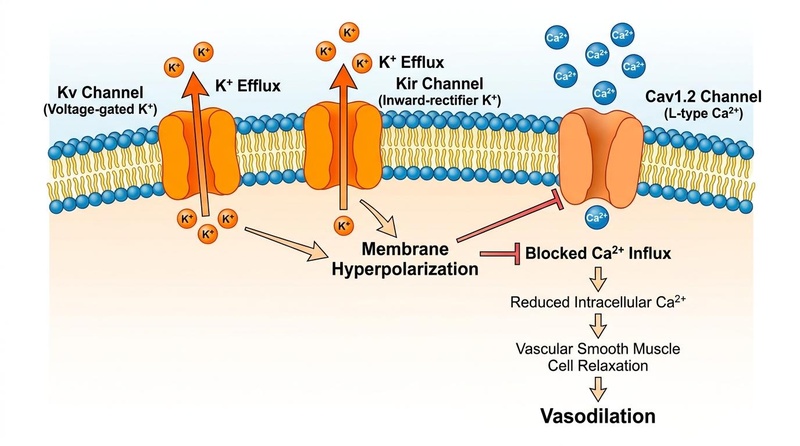
- Vascular Smooth Muscle Relaxation: Potassium efflux through Kir and Kv channels hyperpolarizes the membrane of vascular smooth muscle cells (VSMCs). This hyperpolarization leads to the closure of L-type voltage-gated calcium channels, reducing calcium influx and promoting vasodilation and reduced peripheral resistance [5:3].
- RAAS Blunting and Natriuresis: High potassium levels inhibit the Renin-Angiotensin-Aldosterone System (RAAS) and promote the excretion of sodium (natriuresis) by the kidneys, directly countering sodium-driven hypertension [2:3][6:5].
- Gastric Acid Competition: Potassium-competitive acid blockers (P-CABs) such as vonoprazan compete with ionic K+ for the binding site on the gastric H+/K+ ATPase pump. Unlike PPIs, which require acid activation and bind irreversibly, P-CABs bind reversibly but with high affinity, providing immediate and durable acid suppression [6:6][13:1][15:2].
- Cellular Excitability: In the central nervous system, potassium channels regulate the threshold for neuronal firing. Mutations or dysfunction in these channels (channelopathies) are linked to hyperexcitability states such as epilepsy and schizophrenia [5:4][21][10:2][22].
¶ Effects on different systems
Cardiovascular health (blood pressure, vascular markers)
- High dietary potassium and low-sodium salt substitutes (KCl) consistently lower blood pressure and reduce the risk of stroke and cardiovascular events in mixed and hypertensive populations [1:6][23][6:7].
- Adherence to plant-rich diets (e.g., Mediterranean diet) naturally maximizes potassium-driven cardioprotection [3:3][10:3].
Gastrointestinal health
- P-CABs (e.g., vonoprazan) have revolutionized the treatment of erosive esophagitis, GERD, and H. pylori infection, offering superior healing rates and faster symptom relief compared to traditional PPIs [6:8][14:3][16:2][9:2][24].
- Functional dyspepsia symptoms are significantly improved with P-CAB therapy [25].
- Conversely, high-dose solid potassium pills are localized GI irritants and can cause small-bowel ulceration [6:9].
Renal & Metabolic health
- In chronic kidney disease (CKD) and hemodialysis, potassium management is critical. Novel potassium binders (patiromer, sodium zirconium cyclosilicate) are highly effective and safe for managing chronic hyperkalemia, allowing for the optimization of life-prolonging RAAS inhibitor therapy [18:1][19:1][20:1].
- Potassium supplementation (citrate) is a Tier-1 strategy for preventing recurrent calcium-based kidney stones [4:2][5:5].
Neurological & Muscular health
- Precision medicine approaches targeting potassium channelopathies are emerging as personalized treatment strategies for epilepsy and neuropsychiatric disorders [21:1][10:4][22:1].
¶ Dosage and how to take it
Standard dosing in studies
- Adequate Intake (AI): 3,400 mg/day for adult men and 2,600 mg/day for adult women [1:7][23:1].
- Clinical Potassium Repletion: Higher doses are used under medical supervision to treat hypokalemia.
Forms and bioavailability
- Low-Sodium Salt Substitutes: Effectively replace NaCl with KCl (potassium chloride), showing excellent bioavailability and significant blood pressure-lowering effects in clinical trials [1:8][23:2][5:6].
- Potassium Citrate: Highly bioavailable and preferred for urine alkalinization and kidney stone prevention [4:3][5:7].
- OTC Supplement Limit: 99 mg per solid oral dose (US FDA limit) to prevent localized gastrointestinal mucosal injury [6:10].
Special populations
- Chronic Kidney Disease (CKD): These patients have a high risk of hyperkalemia and often require a low-potassium diet and the use of potassium binders [18:2][7:1].
- Elderly: Generally benefit from higher potassium intake for blood pressure control but are at higher risk for hyperkalemia if renal function is impaired.
¶ Safety and side effects
Common side effects
- Dietary Intake: No upper limit is established for potassium from food sources for healthy individuals, as excess is rapidly excreted [6:11].
- Supplements: Gastrointestinal upset, nausea, and diarrhea are common with oral supplements.
Less common / serious concerns
- Hyperkalemia: Serum levels > 5.5 mmol/L can cause fatal cardiac arrhythmias. This is a severe risk in patients with renal failure or those taking potassium-sparing medications [6:12][8:1].
- Gastrointestinal Ulceration: High concentrations of solid potassium salts can cause small-bowel lesions, hemorrhage, and perforation [6:13].
Who should be especially cautious or avoid it
- Individuals with Chronic Kidney Disease (CKD) or renal failure.
- Patients taking ACE inhibitors, ARBs, or Potassium-sparing diuretics [26].
¶ Drug and supplement interactions
Pharmacodynamic interactions (additive effects)
- ACE Inhibitors & ARBs: (e.g., lisinopril, losartan) These medications reduce potassium excretion, significantly increasing the risk of hyperkalemia when combined with supplements [26:1][27].
- Potassium-Sparing Diuretics: (e.g., spironolactone) Directly retain potassium in the body; concurrent supplementation is typically contraindicated.
- NSAIDs: (e.g., ibuprofen, naproxen) Can reduce renal potassium clearance.
- Thiazide Diuretics: Often cause hypokalemia; they are sometimes combined with potassium-sparing agents or supplements to maintain potassium balance [26:2].
¶ Combining Potassium with other supplements (“stacks”)
- Potassium + Magnesium: These two minerals act synergistically to maintain vascular tone and lower blood pressure. Magnesium is a required cofactor for the Na+/K+ ATPase pump [5:8].
- Potassium-Enriched Salt Substitutes: Combining potassium chloride with standard sodium chloride (typically in a 75/25 or 50/50 ratio) is a clinically validated "stack" for cardiovascular risk reduction [1:9][23:3].
¶ Practical questions (FAQ)
¶ Why are potassium supplements limited to 99 mg?
The 99 mg limit applies only to solid oral forms (tablets/capsules). It exists because concentrated potassium chloride can cause chemical burns and ulcerations on the intestinal lining if it dissolves in one spot. Food sources and heavily diluted powders do not carry this risk.
¶ Can I get enough potassium from food?
Yes. A diet rich in plant foods (avocados, spinach, potatoes) can easily provide the recommended 2,600–3,400 mg per day. Food-based potassium is generally safer and more effective for long-term health than supplemental pills.
¶ What are P-CABs and how do they work?
Potassium-competitive acid blockers (P-CABs) are a new class of acid-reducing drugs. They compete with ionic potassium at the gastric proton pump (H+/K+ ATPase). They are faster-acting and more potent than traditional PPIs.
¶ Are potassium binders safe for long-term use?
Modern potassium binders like patiromer and sodium zirconium cyclosilicate (SZC) have shown excellent long-term safety profiles in clinical trials and are much better tolerated than older polystyrene-based binders.
¶ Is high serum potassium dangerous?
Yes. Both significantly high (hyperkalemia) and low (hypokalemia) serum levels increase the risk of cardiac arrhythmias and mortality. Maintaining a level near 4.2 mmol/L is associated with the lowest risk.
¶ How we evaluated the evidence
Evidence for potassium was graded using the following hierarchy:
- High: Consistent results from multiple systematic reviews and meta-analyses of large-scale RCTs (e.g., blood pressure, stroke risk, P-CAB efficacy).
- Moderate: Findings from smaller RCTs or large-scale observational cohorts with consistent associations (e.g., myocardial protection in PCI, mortality U-curve).
- Low: Evidence primarily from mechanistic studies, case reports, or forensic reviews.
¶ References
West KP, et al. (2026). Efficacy and safety of potassium-containing low-sodium salt substitutes for cardiovascular disease prevention in mixed adult populations: an umbrella review. medRxiv. https://pubmed.ncbi.nlm.nih.gov/42145625/ ↩︎ ↩︎ ↩︎ ↩︎ ↩︎ ↩︎ ↩︎ ↩︎ ↩︎ ↩︎
Torres A, et al. (2026). Sodium, potassium, and blood pressure regulation in Latin American populations: a critical narrative review of multifactorial determinants. Frontiers in Cardiovascular Medicine. https://pubmed.ncbi.nlm.nih.gov/42039362/ ↩︎ ↩︎ ↩︎ ↩︎
D'Elia L, et al. (2026). Adherence to the Mediterranean Diet and Dietary Potassium Intake: A Narrative Review of Epidemiological Evidence. Nutrients. https://pubmed.ncbi.nlm.nih.gov/41754069/ ↩︎ ↩︎ ↩︎ ↩︎
Merschmann R, et al. (2025). Bioavailability of Magnesium and Potassium Salts Used as Potential Substitutes for Sodium Chloride in Human Nutrition - A Review. Molecular Nutrition & Food Research. https://pubmed.ncbi.nlm.nih.gov/40931546/ ↩︎ ↩︎ ↩︎ ↩︎
Condorelli GA, et al. (2026). Microdomain-resolved potassium channel gating as a controllable process: patient-specific excitability landscapes, attractor stability, and closed-loop therapeutic optimization. Expert Opinion on Pharmacotherapy. https://pubmed.ncbi.nlm.nih.gov/42299132/ ↩︎ ↩︎ ↩︎ ↩︎ ↩︎ ↩︎ ↩︎ ↩︎ ↩︎
Tietto A, et al. (2025). Safety of potassium-competitive acid blockers in the treatment of gastroesophageal reflux disease. Expert Opinion on Drug Metabolism & Toxicology. https://pubmed.ncbi.nlm.nih.gov/39189409/ ↩︎ ↩︎ ↩︎ ↩︎ ↩︎ ↩︎ ↩︎ ↩︎ ↩︎ ↩︎ ↩︎ ↩︎ ↩︎ ↩︎
Pina P, et al. (2026). Nutritional Challenges in Hemodialysis: A Perspective from Albania. The Eurasian Journal of Medicine. https://pubmed.ncbi.nlm.nih.gov/42381343/ ↩︎ ↩︎
Wu JR, et al. (2015). Potassium Dehydroandrographolide Succinate Injection for the treatment of child epidemic parotitis: A systematic review and meta-analysis. Chinese Journal of Integrative Medicine. https://pubmed.ncbi.nlm.nih.gov/25491538/ ↩︎ ↩︎
Chang JW, et al. (2026). Potassium-competitive Acid Blockers Versus Proton Pump Inhibitors for Erosive Esophagitis: A Systematic Review and Network Meta-analysis. Journal of Neurogastroenterology and Motility. https://pubmed.ncbi.nlm.nih.gov/41821493/ ↩︎ ↩︎ ↩︎
Zhao T, et al. (2024). Potassium channel-related epilepsy: Pathogenesis and clinical features. Epilepsia Open. https://pubmed.ncbi.nlm.nih.gov/38560778/ ↩︎ ↩︎ ↩︎ ↩︎ ↩︎
Fan Y, et al. (2024). Potassium levels and the risk of all-cause and cardiovascular mortality among patients with cardiovascular diseases: a meta-analysis of cohort studies. Nutrition Journal. https://pubmed.ncbi.nlm.nih.gov/38195532/ ↩︎ ↩︎
Liu H, et al. (2023). Effect of preinitiated glucose-insulin-potassium strategy for patients with undergoing planned percutaneous coronary intervention: a systematic review and meta-analysis. BMJ Open. https://pubmed.ncbi.nlm.nih.gov/38149412/ ↩︎ ↩︎ ↩︎
St Onge E, et al. (2023). Vonoprazan: A New Potassium-Competitive Acid Blocker. Journal of Pharmacy Technology. https://pubmed.ncbi.nlm.nih.gov/37323765/ ↩︎ ↩︎
Kharisma Dewi NNG, et al. (2026). Efficacy and safety of potassium-competitive acid blockers in eradicating Helicobacter pylori and treating gastro-esophageal reflux disease: A systematic review and meta-analysis. Caspian Journal of Internal Medicine. https://pubmed.ncbi.nlm.nih.gov/42052602/ ↩︎ ↩︎ ↩︎ ↩︎
Wang Y, et al. (2024). Network Meta-Analysis of Comparing Different Dosages of Potassium-Competitive Acid Blocker With Proton-Pump Inhibitor in Acid-Related Disorders. Clinical and Translational Gastroenterology. https://pubmed.ncbi.nlm.nih.gov/39412166/ ↩︎ ↩︎ ↩︎
Fang Y, et al. (2024). Efficacy and Safety of Potassium-competitive Acid Blockers Versus Proton Pump Inhibitors in Treating Erosive Esophagitis: A Meta-analysis Based on Randomized Controlled Trials. Journal of Clinical Gastroenterology. https://pubmed.ncbi.nlm.nih.gov/39083496/ ↩︎ ↩︎ ↩︎
Taufiqqurrachman I, et al. (2025). Comparative Efficacy and Safety of Potassium-Competitive Acid Blocker- and Proton Pump Inhibitor-Based Bismuth Quadruple Therapy for Helicobacter pylori Eradication: A Network Meta-Analysis. Gastro Hep Advances. https://pubmed.ncbi.nlm.nih.gov/40761703/ ↩︎
Zirino F, et al. (2025). Differences in Efficacy Among New and Old Potassium Binders in Dialysis Patients: A Systematic Review and Meta-Analysis. Giornale Italiano di Nefrologia. https://pubmed.ncbi.nlm.nih.gov/40923581/ ↩︎ ↩︎ ↩︎
Huang N, et al. (2025). Novel Potassium Binders in Reduction of Hyperkalemia and Optimization of RAAS Inhibitors Treatment in Patients with Chronic Kidney Disease or Heart Failure: A Systematic Review and Meta-analysis. Drugs. https://pubmed.ncbi.nlm.nih.gov/40542996/ ↩︎ ↩︎
Zhou X, et al. (2024). Efficacy and safety of potassium-competitive acid inhibitors in the treatment of gastroesophageal reflux: a systematic review and meta-analysis. Scandinavian Journal of Gastroenterology. https://pubmed.ncbi.nlm.nih.gov/38741565/ ↩︎ ↩︎
Xie C, et al. (2026). Potassium Channelopathies and Precision Medicine Approaches in Epilepsy: A Systematic Review of Personalized Treatment Strategies. Current Neuropharmacology. https://pubmed.ncbi.nlm.nih.gov/42003125/ ↩︎ ↩︎
Musselman M, et al. (2023). Potassium channel modulators and schizophrenia: an overview of investigational drugs. Expert Opinion on Investigational Drugs. https://pubmed.ncbi.nlm.nih.gov/37247333/ ↩︎ ↩︎
Riaz AA, et al. (2026). Safety and efficacy of novel potassium binders for chronic hyperkalemia: a systematic review and meta-analysis of randomized controlled trials. Proceedings (Baylor University. Medical Center). https://pubmed.ncbi.nlm.nih.gov/41487544/ ↩︎ ↩︎ ↩︎ ↩︎
Al Hayek M, et al. (2026). Comparative efficacy and safety of potassium-competitive acid blockers and proton pump inhibitors for erosive esophagitis: a network meta-analysis of randomized controlled trials. EClinicalMedicine. https://pubmed.ncbi.nlm.nih.gov/41768276/ ↩︎
Nguyen HT, et al. (2025). Efficacy of Potassium-Competitive Acid Blockers in Functional Dyspepsia: A Systematic Review and Meta-Analysis. Gastroenterology Research. https://pubmed.ncbi.nlm.nih.gov/41211068/ ↩︎
Martins VM, et al. (2023). Thiazide diuretics alone or combined with potassium-sparing diuretics to treat hypertension: a systematic review and network meta-analysis of randomized controlled trials. Journal of Hypertension. https://pubmed.ncbi.nlm.nih.gov/37016911/ ↩︎ ↩︎ ↩︎
Feng PF, et al. (2022). Meta-analysis of the effectiveness and safety of Shenyankangfu tablets combined with losartan potassium in the treatment of chronic glomerulonephritis. PLoS One. https://pubmed.ncbi.nlm.nih.gov/36215266/ ↩︎