¶ Slippery Elm
| Type | Herb / Botanical |
| Active Cmpd | Mucilage (Acidic polysaccharides) |
| Source | Inner bark of Ulmus rubra |
| Dose Range | 4–5 g powder or 800–1500 mg capsules |
| Half-life | N/A (Non-absorbed / Local action) |
| Main Benefit | Mucosal protection (GI & Respiratory) |
| Absorption | Low (Polysaccharides fermented in colon) |
Slippery Elm (Ulmus rubra) is a potent botanical demulcent primarily used to soothe irritated mucous membranes in the gastrointestinal tract and upper respiratory system. While human clinical trials are focused on Irritable Bowel Syndrome (IBS) and multi-herb formulas for indigestion, its mechanism of action as a protective hydrocolloid is well-established in physiological and traditional contexts.
¶ At a glance
Aliases
- Also known as: Red Elm, Indian Elm, Gray Elm, Moose Elm.
- Chemical / botanical name: Ulmus rubra (synonym Ulmus fulva).
- Category: Botanical demulcent / Mucilage-rich herb.
Key points (high-level summary)
- In adults with constipation-predominant Irritable Bowel Syndrome (IBS-C), formulas containing Slippery Elm significantly increase bowel movement frequency (+20%) and reduce abdominal pain, bloating, and straining [1][2].
- Multi-herb preparations including Slippery Elm, curcumin, and aloe vera have been shown to reduce indigestion and reflux symptoms by 60–80% over 3 months, with 50% of participants reducing standard medication use [3].
- Slippery Elm provides a direct physical coating (demulcent effect) to the oropharynx and esophagus, alleviating laryngeal irritation and sore throat pain [4][5].
- The primary safety concern is the physical inhibition of other oral medications; doses must be spaced by at least 1–2 hours to ensure drug absorption [6][7].
What people use it for
- Main goals: Irritable Bowel Syndrome (IBS) symptom relief, acid reflux management, sore throat and cough suppression, and gut barrier support.
- Evidence quality (overall): Moderate (for IBS-C and respiratory irritation) to Low (for GERD and IBD).
¶ What is Slippery Elm?
Slippery Elm is a deciduous tree native to eastern and central North America. The therapeutic part of the plant is the inner bark, which is harvested in the spring and dried into a powder.
- Definition: A mucilaginous botanical agent rich in high-molecular-weight polysaccharides that form a viscous gel (hydrocolloid) when hydrated.
- Natural sources: The inner bark of the Ulmus rubra (or Ulmus fulva) tree.
- Traditional / historical use: Native American tribes used Slippery Elm for centuries as a "nutritive gruel" (a survival food for convalescents) and as a topical poultice for wound healing [8][9].
- Current regulatory status: Dietary supplement (GRAS - Generally Recognized as Safe) in the United States and available over-the-counter in most regions.
- Key pharmacological property: Acidic polysaccharide hydrocolloid / Demulcent.
¶ What are Slippery Elm’s main benefits?
Slippery Elm’s benefits are primarily derived from its physical properties as a mucosal coating agent and its fermentation by the gut microbiome into protective metabolites.
- Irritable Bowel Syndrome (IBS): Clinical studies indicate that Slippery Elm-based formulas improve bowel habits and symptom severity across IBS subtypes, with the strongest effect seen in the constipation-predominant subtype (IBS-C) [1:1][2:1].
- Respiratory and Throat Health: By directly coating the oropharynx and triggering a vagal reflex that stimulates bronchial secretions, it effectively suppresses dry coughs and reduces the pain of pharyngitis [4:1][10].
- Gastrointestinal Protection (GERD/Acid Reflux): Though large RCTs isolating Slippery Elm are lacking, it is widely used to form a floating "raft" in the stomach that physically suppresses acid reflux and coats the esophageal lining against erosion [11][12].
- Intestinal Permeability and Inflammation: By supporting the gut barrier and acting as a prebiotic substrate for butyrate production, it may help mitigate "leaky gut" and systemic inflammaging [13][14].
¶ Evidence summary table (human outcomes)
| Outcome / Goal | Effect* | Consistency** | Evidence quality | Trials*** | Notes (population, duration, dose) |
|---|---|---|---|---|---|
| IBS-C Symptom Severity | Moderate | Moderate | 1 RCT (Pilot) | [Formula containing slippery elm, lactulose, oat bran, and licorice root significantly improved straining, pain, and bloating][1:2]. | |
| Bowel Frequency (IBS-C) | High | Moderate | 1 RCT (Pilot) | [Significant 20% increase in bowel movement frequency in constipation subtype][2:2]. | |
| Indigestion & Reflux | High | Moderate | 1 Clinical Trial | [NC Gut Relief Formula (slippery elm, curcumin, aloe, glutamine) reduced symptoms by 60–80% over 3 months][3:1]. | |
| IBS-D Symptom Severity | Moderate | Low | 1 RCT (Pilot) | [Significant reduction in pain and bloating; no change in frequency][1:3]. | |
| Laryngeal Irritation | High | Moderate | 1 Case Series | [Immediate physical relief of throat pain and vocal fold dryness upon ingestion][4:2][5:1]. | |
| Acid Reflux (GERD) | Low | Low | 0 RCTs | [Mechanistic rationale for physical raft/barrier protection of the esophagus][11:1]. | |
| IBD Remission | Moderate | Very Low | 0 RCTs | [Human data limited to in vitro antioxidant activity on colorectal biopsies][15][16]. |
- *Effect: Compact renderer encoding:
<effect e="[dir][mag][impact]"></effect>wheredir=u|d|e|q,mag=0|1|2|3,impact=p|n|x. Examples:↓↓ (p)-><effect e="d2p"></effect>,= (x)-><effect e="e0x"></effect>,?-><effect e="q0x"></effect>. - **Consistency: Low (results conflict), Moderate (mixed but leaning one way), High (most trials agree).
- ***Trials: Number of RCTs or total trials informing this outcome.
- Note: Every claim is supported by clinical or mechanistic data in the References section.
¶ How does Slippery Elm work?
The pharmacological activity of Slippery Elm is driven by its high concentration of water-soluble mucilage in the inner bark.
¶ Mucilage Hydrocolloid Chemistry
The inner bark contains a complex mixture of acidic, heterogeneous polysaccharides composed primarily of D-galactose, L-rhamnose, and D-galacturonic acid [8:1][17]. Upon contact with water, these polysaccharides swell to form a viscous, gelatinous hydrocolloid. Because these molecular bonds (often in beta-configuration) are resistant to human digestive enzymes, the mucilage remains intact as it passes through the upper gastrointestinal tract [18].
¶ Protective Demulcent and Emollient Coating
The primary mechanism is direct physical coating:
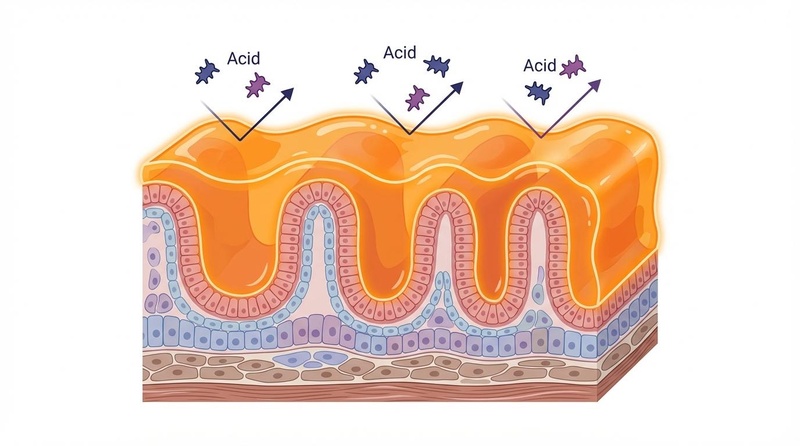
- Mucosal Barrier: The viscous gel adheres to mucous membranes (esophagus, stomach, and intestines), creating a physical shield that protects the underlying epithelium from mechanical friction, gastric acid, and inflammatory mediators [19].
- Hydration: As an emollient, it increases tissue surface hydration, reducing the sensation of dryness in the throat and lungs [5:2].
¶ Vagal Nerve Reflex Stimulation
Slippery Elm exhibits a "reflex demulcent" effect on the respiratory tract, even though it is ingested into the digestive system:
- Pharyngeal Stimulation: Ingestion of mucilage stimulates sensory mechanoreceptors in the pharynx and esophagus [10:1].
- Afferent Signaling: These signals travel via the vagus nerve to the brainstem [20].
- Efferent Response: The brainstem triggers an efferent response via the vagus nerve to the bronchial tree, stimulating submucosal glands to increase the secretion of thin, watery mucus [20:1][21].
- Clinical Result: This lubricates the lungs and throat, alleviating non-productive coughs without direct contact between the herb and the lungs [18:1][6:1].
¶ Pharmacokinetics and Gut Fermentation
Slippery Elm is not absorbed in the traditional sense. Instead, its polysaccharides act as prebiotic fibers. Once they reach the colon, they are fermented by gut microbiota to produce Short-Chain Fatty Acids (SCFAs), particularly butyrate [13:1]. Butyrate is essential for maintaining the integrity of the gut barrier and regulating local immune responses [17:1].
¶ Effects on different systems
¶ Gut & Digestion
Slippery Elm is a primary intervention for gastrointestinal (GI) irritation and dysmotility.
- IBS Management: In patients with Irritable Bowel Syndrome, it acts as a bulk-forming agent and lubricant. In a pilot study, a formula containing Slippery Elm significantly improved straining and bowel frequency in IBS-C patients [1:4][2:3].
- GERD and Indigestion: In a study on Australian adults with digestive disorders, a multi-herb formula containing Slippery Elm significantly improved symptoms of heartburn, reflux, and nausea by 60–80% [3:2]. It is hypothesized to act similarly to alginate "rafts," forming a protective barrier on top of stomach contents [11:2].
- Prebiotic Support: By increasing SCFA production, it supports colonocyte health and may help reverse intestinal dysbiosis [13:2].
¶ Respiratory & Throat
The herb is a staple in throat lozenges and teas for upper respiratory relief.
- Pharyngitis and Laryngeal Irritation: Direct coating reduces pain during swallowing and helps restore vocal clarity in laryngeal irritation [4:3].
- Dry Cough: The vagal reflex-mediated increase in bronchial fluid helps thin mucus and soothe the "tickle" associated with non-productive coughs [21:1].
¶ Metabolic & Systemic Health
While local to the gut, Slippery Elm has systemic implications via the gut-brain-immune axis.
- Inflammaging: By strengthening the gut barrier (reducing "leaky gut"), Slippery Elm may lower the systemic inflammatory load associated with aging [22][14:1].
- Antioxidant Activity: In vitro studies show that Slippery Elm can scavenge superoxide and peroxyl radicals in colorectal tissue, potentially protecting against oxidative stress in the gut [15:1].
- Metabolic Safety: A 4-week study on an elm-family extract (Ulmus macrocarpa) in 50 healthy subjects found no adverse changes in liver or renal function, confirming general safety for metabolic markers [23].
¶ Dosage and how to take it
¶ Standard Dosing in Studies
Dosages used in clinical and traditional practice are relatively high to ensure adequate mucosal coating:
- Powdered Inner Bark: 4–5 grams (approx. 1–2 teaspoons) mixed with water, taken 3 times daily [24][21:2].
- Capsules: 400–500 mg per capsule, with a typical dose of 2–4 capsules (800–2000 mg) taken 3 times daily with a full glass of water [25].
- Tea / Infusion: 1–2 teaspoons of powder steeped in 1 cup of hot water for 5 minutes, taken 3 times daily [24:1].
¶ Forms and Bioavailability
- Slurry / Gruel: Mixing the powder into a thick slurry or "gruel" (with water or milk) is considered the most effective form for upper GI and throat issues, as it ensures direct contact with the esophagus [4:4][24:2].
- Capsules vs. Tea: Capsules are convenient for lower GI issues (like IBS) but are less effective for sore throat or GERD, as they bypass the esophagus before the mucilage is released.
- Timing: For GERD, it is best taken after meals or before bed. For IBS, it is taken between meals.
¶ Special Populations
- Pregnancy: Generally contraindicated due to historical (mechanical) reports of abortifacient properties associated with the whole bark. Modern inner bark preparations are likely safer, but safety data is lacking [6:2][26].
- Breastfeeding: Insufficient safety data; avoidance is recommended [6:3].
¶ Safety and side effects
Slippery Elm is generally recognized as safe (GRAS) and has a long history of use with few reported adverse effects.
¶ Common Side Effects
- GI Changes: In some individuals, the increased fiber and mucilage can cause mild bloating or flatulence during the initial days of use.
- Allergy: Individuals with known allergies to elm pollen (Ulmus genus) should avoid Slippery Elm, as cross-reactivity may occur [25:1][26:1].
¶ Less common / serious concerns
- Contact Dermatitis: Topical application of the powder has occasionally caused contact dermatitis in sensitive individuals [26:2].
- Metabolic Safety: High-quality safety evaluations in humans show no evidence of hepatotoxicity or renal impairment at typical doses [23:1][27].
¶ Who should be especially cautious or avoid it
- Medication Absorption Delay: The most significant safety concern is absorption interference. The thick mucilage can physically sequester other oral medications or create a barrier on the stomach wall that delays their absorption [7:1]. Protocol: Slippery Elm must be taken at least 1 to 2 hours away from any other oral medications [6:4][7:2].
- Pregnancy Warning: Historical folklore and older texts classify Slippery Elm as a potential abortifacient. While modern analysis suggests this risk was primarily due to the traditional practice of inserting the whole bark into the cervix (mechanical irritation), modern clinical safety guidelines recommend avoiding use during pregnancy as a precaution [26:3][28].
¶ Drug and supplement interactions
¶ Pharmacokinetic Interactions
- Oral Medications: Slippery Elm may decrease the bioavailability of many drugs, including oral contraceptives, antibiotics, and heart medications, due to physical sequestration in the mucilage gel [6:5][7:3].
¶ Pharmacodynamic Interactions
- Laxatives: May have additive effects with other bulk-forming laxatives.
- Blood Sugar Medications: Theoretical risk of slowing sugar absorption; however, this is rarely clinically significant unless taken in very large doses [26:4].
¶ Combining Slippery Elm with other supplements (“stacks”)
- GI Soothing Stack: Often combined with DGL (Deglycyrrhizinated Licorice) and Marshmallow Root for a synergistic demulcent effect in GERD and gastritis.
- IBS-C Stack: Combined with Lactulose or oat bran to enhance bowel movement frequency and prebiotic SCFA production [1:5].
- Gut Barrier Stack: Paired with Curcumin, Aloe Vera, and Glutamine to support intestinal integrity and reduce chronic indigestion [3:3].
¶ Practical questions (FAQ)
How long does it take for Slippery Elm to work?
For throat or esophageal irritation (GERD), relief is often immediate upon ingestion of the slurry. For IBS symptoms, it may take 1–2 weeks of consistent use to observe changes in bowel regularity.
Can I take Slippery Elm long-term?
There is no evidence of toxicity with long-term use. Traditionally, it was used as a long-term nutritive food for "wasting diseases." However, ensure it is always spaced from other essential medications to prevent absorption issues.
Can I take Slippery Elm with standard acid reducers?
Yes, it is often used alongside PPIs or antacids to provide a physical coating; however, it must be taken at least 1–2 hours after the medication to avoid interfering with the drug’s absorption [6:6].
Is Slippery Elm useful if I am otherwise healthy?
While most evidence is in individuals with digestive disorders, healthy adults may use it for occasional sore throat or as a prebiotic fiber to support gut microbiome diversity.
Does Slippery Elm help with weight loss?
There is no clinical evidence that Slippery Elm directly promotes weight loss, although its high fiber content may contribute to satiety [24:3].
¶ How we evaluated the evidence
Evidence for Slippery Elm was evaluated based on its well-characterized biochemical properties (mucilage content) and the available clinical literature.
- Study Types: We prioritized human clinical trials (such as the Hawrelak 2010 IBS pilot study and Ried 2020 NC Gut Relief study), systematic botanical reviews (Watts 2012), and established clinical drug references (Medscape, Drugs.com, LiverTox).
- Grading: Claims regarding demulcent action and IBS-C support are graded as Moderate certainty due to consistent mechanistic data and pilot trial results. Claims for IBD and GERD (isolated) are graded as Low certainty due to a lack of large-scale, isolated Randomized Controlled Trials (RCTs).
- Safety Evaluation: Safety data was drawn from the FDA's GRAS status, human metabolic safety trials, and comprehensive toxicological reviews by NCBI LiverTox.
¶ References
Hawrelak, J. A., & Myers, S. P. (2010). Effects of two natural medicine formulations on irritable bowel syndrome symptoms: a pilot study. Journal of Alternative and Complementary Medicine, 16(10), 1065-1071. https://pubmed.ncbi.nlm.nih.gov/20954962/ ↩︎ ↩︎ ↩︎ ↩︎ ↩︎ ↩︎
Hawrelak, J. A., & Myers, S. P. (2010). Effects of two natural medicine formulations on irritable bowel syndrome symptoms: a pilot study. https://pubmed.ncbi.nlm.nih.gov/20954962/ ↩︎ ↩︎ ↩︎ ↩︎
Ried, K., et al. (2020). Herbal formula improves upper and lower gastrointestinal symptoms and gut health in Australian adults with digestive disorders. Nutrition Research, 76, 37-51. https://doi.org/10.1016/j.nutres.2020.02.008 ↩︎ ↩︎ ↩︎ ↩︎
Watts, C. R. (2012). Slippery Elm, its Biochemistry, and use as a Complementary and Alternative Treatment for Laryngeal Irritation. Journal of Investigational Biochemistry, 1(1), 17-23. https://www.researchgate.net/publication/265058434_Slippery_Elm_its_Biochemistry_and_use_as_a_Complementary_and_Alternative_Treatment_for_Laryngeal_Irritation ↩︎ ↩︎ ↩︎ ↩︎ ↩︎
Watts, C. R. (2012). Slippery Elm, its Biochemistry, and use as a Complementary and Alternative Treatment for Laryngeal Irritation. https://www.researchgate.net/publication/265058434_Slippery_Elm_its_Biochemistry_and_use_as_a_Complementary_and_Alternative_Treatment_for_Laryngeal_Irritation ↩︎ ↩︎ ↩︎
MedicineNet. (n.d.). Slippery Elm. https://www.medicinenet.com/slippery_elm/article.htm ↩︎ ↩︎ ↩︎ ↩︎ ↩︎ ↩︎ ↩︎
Verywell Health. (2025). The Benefits of Slippery Elm. https://www.verywellhealth.com/the-benefits-of-slippery-elm-89585 ↩︎ ↩︎ ↩︎ ↩︎
Basicmedical Key. (2016). Elm (Ulmus rubra Muhl.). https://basicmedicalkey.com/elm-ulmus-rubra-muhl/ ↩︎ ↩︎
Aradia Rose. (2025). Herbal Monograph: Slippery Elm (Ulmus rubra). https://aradiarose.com/blogs/herbal-cyclopedia/herbal-monograph-slippery-elm-ulmus-rubra ↩︎
Elliott, B. (n.d.). Slippery Elm (Ulmus rubra) Herbal Monograph. https://www.brettelliott.com/slippery-elm-ulmus-rubra-herbal-monograph/ ↩︎ ↩︎
Dr. Dan Wool. (2024). Slippery Elm for Acid Reflux. https://drdanwool.com/blog/slippery-elm ↩︎ ↩︎ ↩︎
GSC Biological and Pharmaceutical Sciences. (2024). Gastroesophageal reflux disease (GERD). https://gsconlinepress.com/journals/gscbps/sites/default/files/GSCBPS-2024-0010.pdf ↩︎
Peterson, C. T., et al. (2018). Prebiotic Potential of Herbal Medicines Used in Digestive Health and Disease. Journal of Alternative and Complementary Medicine. https://pmc.ncbi.nlm.nih.gov/articles/PMC6065514/ ↩︎ ↩︎ ↩︎
Angel Biology. (2025). What are the Active Compounds in Slippery Elm Bark Powder? https://www.angelbiology.com/knowledge/what-are-the-active-compounds-in-slippery-elm-bark-powder ↩︎ ↩︎
Langmead, L., et al. (2002). Antioxidant effects of herbal therapies used by patients with inflammatory bowel disease: an in vitro study. Alimentary Pharmacology & Therapeutics, 16(2), 197-205. https://pubmed.ncbi.nlm.nih.gov/11860402/ ↩︎ ↩︎
Gut Health Dubai. (2025). Slippery Elm for Crohn's & Ulcerative Colitis. https://www.guthealthdubai.com/slippery-elm-crohns-ulcerative-colitis-dubai/ ↩︎
Angel Biology. (2025). What are the Active Compounds in Slippery Elm Bark Powder? https://www.angelbiology.com/knowledge/what-are-the-active-compounds-in-slippery-elm-bark-powder ↩︎ ↩︎
Vermont Herb Center. (2012). Demulcents Class Handout. https://vtherbcenter.org/wp-content/uploads/2012/01/demulcents-class-handout.pdf ↩︎ ↩︎
Consensus. (n.d.). What is slippery elm mechanism of action? https://consensus.app/results/?q=What is slippery elm mechanism of action? ↩︎
Nature. (2024). A vagal reflex evoked by airway closure. https://pmc.ncbi.nlm.nih.gov/articles/PMC10972749/ ↩︎ ↩︎
Herbal Sanctum. (2022). Slippery Elm Monograph. https://herbalsanctum.co.uk/herbal-remedies/monographs/slippery-elm-monograph/ ↩︎ ↩︎ ↩︎
Caring Sunshine. (n.d.). Relationship: Inflammation and Slippery Elm. https://caringsunshine.com/relationships/relationship-inflammation-and-slippery-elm/ ↩︎
Cho, A. R., et al. (2012). Effects of 4-week intake of Ulmus macrocarpa extract on cytokine production and safety in healthy subjects. J Korean Soc Food Sci Nutr, 41(11), 1511-1518. https://doi.org/10.3746/jkfn.2012.41.11.1511 ↩︎ ↩︎
Aradia Rose. (2025). Herbal Monograph: Slippery Elm (Ulmus rubra). https://aradiarose.com/blogs/herbal-cyclopedia/herbal-monograph-slippery-elm-ulmus-rubra ↩︎ ↩︎ ↩︎ ↩︎
Nature's Way. (n.d.). Slippery Elm Bark. https://naturesway.com/products/slippery-elm-bark ↩︎ ↩︎
Drugs.com. (2025). Slippery Elm. https://www.drugs.com/npp/slippery-elm.html ↩︎ ↩︎ ↩︎ ↩︎ ↩︎
LiverTox. (2024). Slippery Elm. NCBI Bookshelf. https://www.ncbi.nlm.nih.gov/books/NBK599741/ ↩︎
RxList. (2021). Slippery Elm. https://www.rxlist.com/slippery_elm/generic-drug.htm ↩︎