¶ Spermidine
Spermidine is a naturally occurring polyamine found in ribosomes and living tissues. It plays a critical role in cellular function and survival. In longevity science, it has gained prominence as a caloric restriction mimetic due to its ability to induce autophagy, the body's cellular cleanup process. While animal studies consistently show that spermidine supplementation extends lifespan and delays age-related diseases, human clinical trials have produced mixed results, highlighting the importance of dosage and formulation.
¶ Mechanism of Action
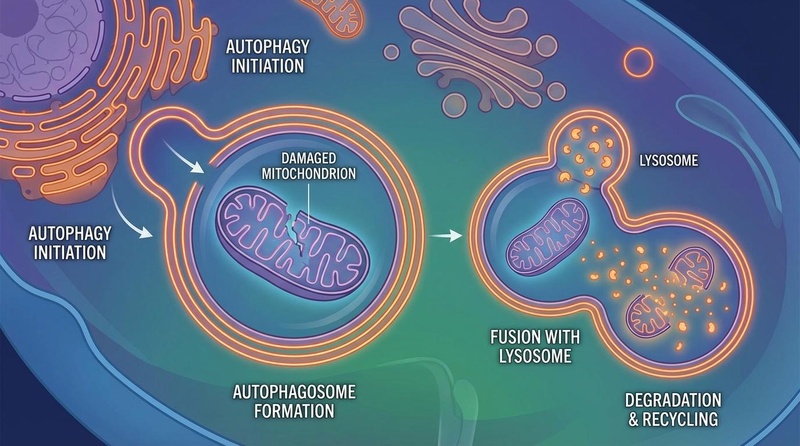
Spermidine functions as a caloric restriction mimetic, inducing autophagy—the cellular "cleanup" process where autophagosomes engulf and recycle damaged organelles like mitochondria.
Spermidine exerts its anti-aging effects primarily through the maintenance of proteostasis and mitochondrial quality control. Its mechanisms are deeply intertwined with the Hallmarks of Aging.
¶ Autophagy Induction
The most well-established mechanism of spermidine is the induction of macroautophagy (often just called autophagy). It achieves this via two main pathways:
- EP300 Inhibition: Spermidine competitively inhibits EP300 (E1A-associated protein p300), an acetyltransferase that normally suppresses autophagy. By inhibiting EP300, spermidine promotes the deacetylation of key autophagy-related proteins (such as Atg5, Atg7, and LC3), thereby activating them[1][2].
- Transcriptional Activation: The inhibition of EP300 also leads to the deacetylation of histone H3, which upregulates the transcription of autophagy-related genes (Atg genes)[3][4].
This process helps reverse Disabled Macroautophagy and clears cellular debris such as lipofuscin and damaged organelles.
¶ The eIF5A-TFEB Axis
Spermidine is the essential substrate for the hypusination of eIF5A (eukaryotic translation initiation factor 5A). Hypusinated eIF5A is critical for the translation of TFEB (Transcription Factor EB), a master regulator of lysosomal biogenesis. By restoring eIF5A hypusination, spermidine enhances lysosomal function and cellular cleanup, which is particularly relevant for immune system aging[5][6].
¶ Other Mechanisms
- Mitochondrial Health: Spermidine promotes mitophagy (the selective degradation of damaged mitochondria), addressing Mitochondrial Dysfunction[7].
- Anti-Inflammatory: Through autophagy and other pathways, it helps reduce systemic inflammation, potentially impacting Inflammaging.
- Epigenetic Regulation: As an inhibitor of histone acetyltransferases (HATs), it directly influences Epigenetic Alterations[4:1].
¶ Clinical Evidence
While preclinical data is robust, human evidence is evolving, with some trials showing promise and others finding no benefit at standard doses.
¶ Cognition and Memory
- Evidence Level: Low to Moderate
- Direction: Mixed/Dose-Dependent
The SmartAge Trial (2022), a rigorous 12-month double-blind RCT with 100 participants, investigated the effects of 0.9 mg/day of spermidine. The study found no significant improvement in the primary endpoint (mnemonic discrimination) compared to placebo. However, exploratory analyses suggested potential modest benefits in verbal memory and reduced inflammation[8][9].