¶ Taurine
| Type | Amino sulfonic acid |
| Active Cmpd | Taurine |
| Source | Meat, seafood, endogenous |
| Dose Range | 1,500–3,000 mg/day |
| Half-life | 1.0–1.5 hours (plasma) |
| Main Benefit | Cardiovascular & Metabolic health |
| Absorption | High (intestinal TAUT) |
Taurine is a non-proteinogenic sulfur-containing amino acid that serves as a critical regulator of cellular homeostasis, particularly in the cardiovascular and central nervous systems. Extensive meta-analytic evidence supports its efficacy in reducing blood pressure and improving glycemic control, while emerging network meta-analyses highlight its cognitive synergy when combined with caffeine [1][2][3].
¶ At a glance
¶ Aliases
- Also known as: 2-aminoethanesulfonic acid, L-taurine.
- Chemical name: 2-aminoethanesulfonic acid.
- Category: Non-proteinogenic amino acid.
¶ Key points
- Cardiovascular Health: Significant reductions in systolic and diastolic blood pressure have been confirmed in multiple meta-analyses of randomized controlled trials [1:1][4].
- Metabolic Support: Effectively lowers fasting blood glucose, HbA1c, and insulin levels, particularly in individuals with metabolic syndrome or type 2 diabetes [5][2:1][6].
- Exercise Performance: Reduces perceived exertion (RPE) and improves physical capacity across aerobic and strength exercises [3:1][7].
- Cognitive Synergy: Co-supplementation with caffeine produces a credible positive effect on cognitive ability that exceeds the effects of either compound alone [3:2].
- Safety Profile: Exceptional tolerability up to 6 grams per day with no major adverse signals in long-term human studies [2:2][8].
¶ What people use it for
- Main goals: Blood pressure management, metabolic health, exercise recovery, and cognitive enhancement.
- Evidence quality (overall): High for cardiovascular and metabolic outcomes; Moderate for exercise and cognitive performance.
¶ What is Taurine?
Taurine is a conditionally essential amino acid derivative found at high concentrations in metabolically active tissues, including the heart, brain, retina, and skeletal muscle.
- Definition: A sulfur-containing amino acid (sulfonic acid) that does not incorporate into proteins but exists as a free intracellular solute.
- Natural sources: Exclusively found in animal products, with the highest concentrations in seafood (shellfish), dark meat poultry, and red meat.
- Endogenous Synthesis: Produced in the liver from cysteine and methionine, though rates may be insufficient during periods of high physiological stress or in specific populations (e.g., vegans) [9][10].
- Current regulatory status: Generally Recognized as Safe (GRAS) in the US and widely available as a dietary supplement globally.
- Key pharmacological property: Multi-functional cytoprotectant, osmoregulator, and antioxidant [11].
¶ What are Taurine's main benefits?
Taurine’s primary clinical value lies in its pleiotropic effects on cardiometabolic health and physical performance.
¶ Cardiovascular Benefits
Meta-analyses consistently demonstrate that taurine supplementation reduces resting blood pressure. The magnitude of effect is clinically significant, with average reductions of approximately 4.0 mmHg in systolic and 1.5 mmHg in diastolic pressure across diverse populations [1:2][5:1]. It also improves left ventricular function and functional class (NYHA) in heart failure patients [1:3][12].
¶ Metabolic Regulation
Taurine enhances insulin sensitivity and glycemic control. Clinical data show significant reductions in fasting blood glucose (average -5.90 mg/dL) and HbA1c (-0.21%), alongside improvements in lipid profiles (decreased triglycerides and total cholesterol) [2:3][6:1].
¶ Physical and Cognitive Performance
In the context of exercise, taurine reduces oxidative damage and muscle soreness while increasing physical capacity [7:1][13]. Notably, latest network meta-analyses identify that the combination of caffeine and taurine uniquely enhances cognitive ability beyond the capacity of individual stimulants [3:3].
¶ Evidence summary table (human outcomes)
| Outcome / Goal | Effect* | Consistency | Evidence quality | Trials | Notes (population, duration, dose) |
|---|---|---|---|---|---|
| Systolic Blood Pressure | High | High | 25+ RCTs | Significant reductions (-4.0 to -4.7 mmHg) across hypertensive and healthy cohorts [1:4][2:4] | |
| Fasting Blood Glucose | Moderate | Moderate | ~27 RCTs | Average reduction of 5.9 mg/dL in metabolic cohorts [2:5][6:2] | |
| HbA1c | Moderate | Moderate | ~27 RCTs | Significant decrease of 0.21% in diabetic and overweight adults [2:6][14] | |
| Triglycerides | Moderate | Moderate | Meta-analysis | Clinically meaningful reductions in overweight/obese populations [5:2][6:3] | |
| Cognitive Function | Moderate | Moderate | Network Meta | Synergistic benefit when combined with caffeine [3:4] | |
| Exercise Capacity | High | Moderate | Systematic Review | Improved endurance and reduced RPE in physical training [3:5][7:2] | |
| Heart Failure Symptoms | Moderate | Moderate | Systematic Review | Improvements in LVEF and NYHA functional classification [1:5][12:1] | |
| Colorectal Cancer Risk | Low | Very Low | Observational | Association noted in observational data; causality unproven [15] |
¶ How does Taurine work?
Taurine functions through several distinct but overlapping biological mechanisms that stabilize cellular environments.
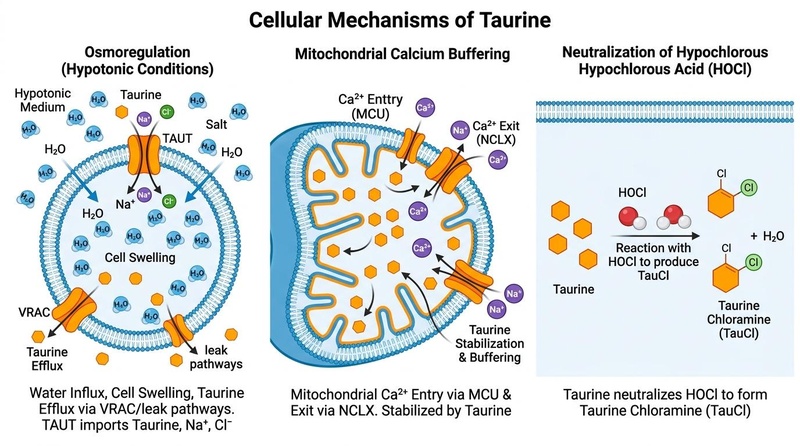
- Osmoregulation: As a major organic osmolyte, taurine maintains cell volume homeostasis. Under hypotonic conditions, cells release taurine via Volume-Regulated Anion Channels (VRAC) or leak pathways to prevent swelling. Conversely, the TAUT (SLC6A6) transporter is a sodium- and chloride-dependent active symporter that imports taurine to maintain high intracellular concentrations [9:1][16].
- Mitochondrial Homeostasis: It stabilizes the mitochondrial membrane and regulates calcium buffering, preventing mitochondrial calcium overload which leads to oxidative stress and apoptosis [11:1].
- Antioxidant Action (Taurine Chloramine): Taurine reacts with hypochlorous acid (a potent oxidant produced during inflammation) to form taurine chloramine (TauCl), which is less toxic and possesses anti-inflammatory signaling properties [11:2].
- GABAergic Modulation: Taurine acts as an agonist for GABAA and glycine receptors in the brain, contributing to its inhibitory/calming effects on the nervous system [9:2].
- Bile Acid Conjugation: It conjugates with bile acids in the liver to form bile salts (e.g., taurocholic acid), improving lipid absorption and cholesterol clearance [5:3][2:7].
¶ Effects on different systems
Cardiovascular Health
Meta-analytic data from over 25 RCTs demonstrate that oral taurine significantly lowers systolic blood pressure (WMD = -3.99 to -4.67 mmHg) and diastolic blood pressure (WMD = -1.43 to -2.90 mmHg) [1:6][17]. In patients with dilated cardiomyopathy or congestive heart failure, taurine supplementation improves cardiac output, left ventricular ejection fraction (LVEF), and NYHA functional class [1:7][12:2].
Metabolic Health
Taurine supplementation significantly improves markers of metabolic syndrome. A 2025 meta-analysis reported reductions in fasting blood glucose (-5.90 mg/dL), fasting insulin, and HbA1c (-0.21%) [2:8]. Long-term supplementation (3,000 mg/day) in overweight or obese adults has been shown to decrease triglycerides and total cholesterol [6:4].
Brain & Mental Health
Taurine acts as a neuroprotective agent. While evidence for standalone cognitive enhancement in healthy humans is mixed, network meta-analysis shows that co-ingestion with caffeine significantly improves cognitive performance [3:6]. Preclinical reviews suggest potential benefits in Alzheimer's disease by ameliorating symptomatic presentation and neurochemical changes [18]. It also shows promise in mitigating symptoms of mood disorders in scoping reviews [17:1].
Physical Performance
Other Domains
- Critically Ill Patients: Taurine-enhanced enteral nutrition may reduce IL-6 levels but has not shown significant impact on overall mortality or ICU length of stay in meta-analyses [19].
- Toxicity Protection: Taurine demonstrates protective effects against heavy metal toxicity (e.g., mercury, lead, cadmium) and drug-induced side effects by mitigating oxidative damage [8:1][20].
- Lupus and Rheumatoid Arthritis: Preclinical studies suggest potential immunomodulatory benefits in systemic lupus erythematosus and rheumatoid arthritis [21][22].
¶ Dosage and how to take it
¶ Standard dosing in studies
- General health & metabolic support: 1,500–3,000 mg per day.
- High-dose range: Up to 6,000 mg per day has been used in specific clinical trials (e.g., for heart failure or portal hypertension) without significant adverse effects [2:9][8:2].
- Dosing schedule: Often divided into 2–3 doses of 500–1,000 mg taken throughout the day.
¶ Forms and bioavailability
- Common forms: Free-form taurine powder or capsules.
- Absorption: Rapidly absorbed via the TAUT transporter in the small intestine. Peak plasma levels are reached within 1–2 hours.
- With or without food: Can be taken with or without food; however, taking it with meals may improve gastrointestinal tolerance at higher doses.
¶ Special populations
- Vegans/Vegetarians: Typically have lower plasma taurine levels and may require higher supplemental doses to reach levels seen in omnivores [9:3].
- Renal Impairment: Clearance is primarily renal; patients with severe kidney disease should use caution as clearance may be impaired.
¶ Safety and side effects
Taurine is characterized by an exceptionally high safety threshold.
¶ Common side effects
- Side effects are rare at doses under 3 grams/day.
- At higher doses (e.g., >5g), mild gastrointestinal symptoms such as nausea, diarrhea, or stomach upset may occur.
¶ Less common / serious concerns
- There are no documented cases of severe toxicity or organ damage from oral taurine supplementation at standard therapeutic doses.
- Observed Association: One meta-analysis noted an observational association between higher circulating taurine levels and colorectal cancer risk, though causality is not established and may reflect dietary patterns (red meat consumption) [15:1].
¶ Who should be especially cautious
- Pregnancy and Breastfeeding: Data are limited; however, taurine is a natural component of breast milk and is added to infant formulas for low birth weight infants without adverse effects [10:1].
- Combined with Stimulants: While synergistic for performance, individuals sensitive to stimulants should monitor heart rate when combining taurine with caffeine.
¶ Drug and supplement interactions
¶ Pharmacokinetic interactions
- Taurine is not a major inhibitor or inducer of CYP450 enzymes, suggesting a low risk for altering drug metabolism.
- It may interact with the TAUT transporter, potentially affecting the absorption of other amino acids if taken in massive quantities.
¶ Pharmacodynamic interactions
- Caffeine: Significant synergy for cognitive performance. Taurine may also mitigate some of the hypertensive effects of caffeine [3:8].
- Antihypertensive Medications: Additive effect; taurine may further lower blood pressure, which may require monitoring in patients on BP-lowering drugs [1:8][2:10].
- Hypoglycemic Agents: May have additive effects with insulin or oral glucose-lowering drugs [2:11].
¶ Combining Taurine with other supplements ("stacks")
- The "Cognitive Edge" Stack: Caffeine (100–200 mg) + Taurine (1,000–2,000 mg). Highly supported by network meta-analysis for mental performance [3:9].
- Metabolic Recovery Stack: Taurine + Carnitine + Alpha-Lipoic Acid. Mechanistically complementary for mitochondrial support and glucose disposal.
- Exercise Recovery Stack: Taurine (2g) + BCAA (5g). Studied for reducing delayed onset muscle soreness (DOMS).
¶ Practical questions (FAQ)
How long does it take for Taurine to work?
Is Taurine in energy drinks bad for you?
Can I take Taurine if I am vegan?
Yes. Vegan diets are essentially devoid of taurine, and vegans often have lower plasma levels. Supplementation is an effective way to normalize taurine status in this population [9:4].
Does Taurine help with sleep?
Taurine has GABAergic properties and may have a calming effect on the nervous system. While some users report better sleep quality, robust clinical trials specifically targeting sleep architecture are limited compared to its metabolic and cardiovascular data.
¶ How we evaluated the evidence
Evidence was evaluated using the GRADE (Grading of Recommendations, Assessment, Development, and Evaluation) framework.
- High Quality: Findings derived from multiple high-quality meta-analyses of RCTs with consistent results (e.g., blood pressure, metabolic markers).
- Moderate Quality: Derived from systematic reviews of RCTs with some heterogeneity or network meta-analyses (e.g., exercise capacity, cognitive synergy).
- Low Quality: Derived from observational studies or limited clinical trials (e.g., colorectal cancer association, Alzheimer's neuroprotection).
¶ References
Tzang CC, et al. Insights into the cardiovascular benefits of taurine: a systematic review and meta-analysis. Nutrition journal. 2024. https://pubmed.ncbi.nlm.nih.gov/39148075/ ↩︎ ↩︎ ↩︎ ↩︎ ↩︎ ↩︎ ↩︎ ↩︎ ↩︎ ↩︎
Nie Z, et al. Effects of Oral Taurine Supplementation on Cardiometabolic Risk Factors: A Meta-analysis and Systematic Review of Randomized Clinical Trials. Nutrition reviews. 2025. https://pubmed.ncbi.nlm.nih.gov/41275513/ ↩︎ ↩︎ ↩︎ ↩︎ ↩︎ ↩︎ ↩︎ ↩︎ ↩︎ ↩︎ ↩︎ ↩︎ ↩︎
Deng H, et al. Caffeine and taurine: a systematic review and network meta-analysis of their individual and combined effects on physical capacity, cognitive function, and physiological markers. Journal of the International Society of Sports Nutrition. 2025. https://pubmed.ncbi.nlm.nih.gov/41032459/ ↩︎ ↩︎ ↩︎ ↩︎ ↩︎ ↩︎ ↩︎ ↩︎ ↩︎ ↩︎
Guan L, Miao P. The effects of taurine supplementation on obesity, blood pressure and lipid profile: A meta-analysis of randomized controlled trials. European journal of pharmacology. 2020. https://pubmed.ncbi.nlm.nih.gov/32871172/ ↩︎
Tzang CC, et al. Taurine reduces the risk for metabolic syndrome: a systematic review and meta-analysis of randomized controlled trials. Nutrition & diabetes. 2024. https://pubmed.ncbi.nlm.nih.gov/38755142/ ↩︎ ↩︎ ↩︎ ↩︎
Sun Q, et al. Effect of Long-Term Taurine Supplementation on the Lipid and Glycaemic Profile in Adults with Overweight or Obesity: A Systematic Review and Meta-Analysis. Nutrients. 2024. https://pubmed.ncbi.nlm.nih.gov/39796489/ ↩︎ ↩︎ ↩︎ ↩︎ ↩︎
Chen Q, et al. The Dose Response of Taurine on Aerobic and Strength Exercises: A Systematic Review. Frontiers in physiology. 2021. https://pubmed.ncbi.nlm.nih.gov/34497536/ ↩︎ ↩︎ ↩︎ ↩︎
Keshavarzi M, et al. A narrative review and new insights into the protective effects of taurine against drug side effects. Naunyn-Schmiedeberg's archives of pharmacology. 2025. https://pubmed.ncbi.nlm.nih.gov/39141023/ ↩︎ ↩︎ ↩︎
Oja SS, Saransaari P. Taurine and the Brain. Advances in experimental medicine and biology. 2022. https://pubmed.ncbi.nlm.nih.gov/35882807/ ↩︎ ↩︎ ↩︎ ↩︎ ↩︎
Cao SL, et al. Effects of Taurine Supplementation on Growth in Low Birth Weight Infants: A Systematic Review and Meta-Analysis. Indian journal of pediatrics. 2018. https://pubmed.ncbi.nlm.nih.gov/29368111/ ↩︎ ↩︎
Faghfouri AH, et al. Profiling inflammatory and oxidative stress biomarkers following taurine supplementation: a systematic review and dose-response meta-analysis of controlled trials. European journal of clinical nutrition. 2022. https://pubmed.ncbi.nlm.nih.gov/34584225/ ↩︎ ↩︎ ↩︎
McGurk KA, et al. Effect of taurine administration on symptoms, severity, or clinical outcome of dilated cardiomyopathy and heart failure in humans: a systematic review. Wellcome open research. 2022. https://pubmed.ncbi.nlm.nih.gov/35855073/ ↩︎ ↩︎ ↩︎
Kurtz JA, et al. Taurine in sports and exercise. Journal of the International Society of Sports Nutrition. 2021. https://pubmed.ncbi.nlm.nih.gov/34039357/ ↩︎ ↩︎
Tao X, et al. The effects of taurine supplementation on diabetes mellitus in humans: A systematic review and meta-analysis. Food chemistry. Molecular sciences. 2022. https://pubmed.ncbi.nlm.nih.gov/35769396/ ↩︎
Sinha A, et al. Systematic Review and Meta-Analysis: Taurine and Its Association With Colorectal Carcinoma. Cancer medicine. 2024. https://pubmed.ncbi.nlm.nih.gov/39632512/ ↩︎ ↩︎
Li XW, et al. The role of taurine in improving neural stem cells proliferation and differentiation. Nutritional neuroscience. 2017. https://pubmed.ncbi.nlm.nih.gov/26906683/ ↩︎
Pedregosa BIC, et al. Therapeutic Potential of Gotu Kola (Centella asiatica), Phosphatidylcholine, and Taurine in Mood Disorders: A Systematic Scoping Review. Complementary medicine research. 2026. https://pubmed.ncbi.nlm.nih.gov/42391143/ ↩︎ ↩︎
Aamer H, et al. Exploring Taurine's Potential in Alzheimer's Treatment: A Comprehensive Review. Cureus. 2024. https://pubmed.ncbi.nlm.nih.gov/38910611/ ↩︎
Zhang C, et al. Efficacy of taurine-enhanced enteral nutrition in improving the outcomes of critically ill patients: A systematic review and meta-analysis. Clinical nutrition ESPEN. 2024. https://pubmed.ncbi.nlm.nih.gov/38777434/ ↩︎
Naraki K, et al. The Protective Effects of Taurine, a Non-essential Amino Acid, Against Metals Toxicities: A Review Article. Biological trace element research. 2025. https://pubmed.ncbi.nlm.nih.gov/38735894/ ↩︎
Malek Mahdavi A, et al. Taurine supplementation and systemic lupus erythematosus in preclinical studies: a systematic review of clinical outcomes and underlying mechanisms. Amino acids. 2026. https://pubmed.ncbi.nlm.nih.gov/41874670/ ↩︎
Malek Mahdavi A, Javadivala Z. A systematic review of preclinical studies on the efficacy of taurine for the treatment of rheumatoid arthritis. Amino acids. 2021. https://pubmed.ncbi.nlm.nih.gov/33929638/ ↩︎