¶ Layer 1: Executive Dashboard
¶ At a Glance
Vitamin A is a fat-soluble vitamin and an essential nutrient that humans must obtain through diet or supplementation. The body uses it to form rhodopsin (the light-absorbing protein in the retina), regulate immune responses, and maintain the integrity of mucosal barriers such as the skin, gut, and respiratory tract.
Will it help me?
Unless you have an established deficiency—which is common in developing nations but rare in developed ones—or a specific medical condition (such as measles or severe acne), supplementing above the Recommended Dietary Allowance (RDA) usually provides no additional benefit and carries significant, potentially severe toxicity risks.
¶ Safety Traffic Light
- 🔴 Stop: Do NOT take high doses of preformed Vitamin A (retinol/retinyl esters) if you are pregnant or planning to become pregnant. Intake exceeding 3,000 mcg RAE (10,000 IU) daily is a known teratogen and can cause severe craniofacial, central nervous system, and cardiovascular birth defects [1].
- 🟡 Caution: Current or former smokers, as well as individuals heavily exposed to asbestos, should strictly avoid high-dose beta-carotene (a Vitamin A precursor) supplements due to a clearly established increased risk of lung cancer and cardiovascular mortality [2].
- 🟡 Caution: High intake of preformed Vitamin A (retinol) over long periods can cause chronic liver damage (hepatotoxicity) and increase the risk of osteoporosis and bone fractures [1:1].
¶ Protocol Card
Note: Always consult the RDA based on your age and sex. The following are general guidelines for adults.
- Forms Available:
- Preformed Vitamin A: Found in animal products and supplements as retinol or retinyl esters (e.g., retinyl palmitate). It is highly bioavailable but carries a high risk of toxicity if overused.
- Provitamin A Carotenoids: Found in plants (e.g., beta-carotene). The body converts these to Vitamin A only as needed, making them significantly safer regarding Vitamin A toxicity.
- Recommended Dietary Allowance (RDA):
- Adult Men: 900 mcg RAE (Retinol Activity Equivalents), equivalent to ~3,000 IU.
- Adult Women: 700 mcg RAE (~2,333 IU).
- Tolerable Upper Intake Level (UL): 3,000 mcg RAE (10,000 IU) per day of preformed Vitamin A for adults. There is no established UL for beta-carotene [1:2].
- Administration: As a fat-soluble vitamin, absorption is optimal when taken with a meal containing dietary fat.
¶ Bottom Line
Vitamin A is indispensable for human survival, particularly for vision and immune function. However, the vast majority of people in developed nations consume adequate amounts through their diet. Routine high-dose supplementation is largely discouraged due to the steep risks of chronic toxicity and teratogenicity.
¶ Layer 2: The Contextual Narrative
¶ The "Why" (Benefits)
Vitamin A's primary, proven benefits revolve around the maintenance of critical physiological systems:
- Vision Preservation: It is a core structural component of rhodopsin. Without adequate Vitamin A, the retina cannot adapt to low light, resulting in night blindness. Severe, prolonged deficiency leads to xerophthalmia (dryness of the conjunctiva and cornea), which can culminate in permanent blindness [1:3].
- Immune System Maintenance: Vitamin A regulates the differentiation of regulatory T-cells and maintains the physical integrity of the skin and mucosal linings (respiratory, gastrointestinal, and urinary tracts). It is heavily utilized during active infections, which is why it is uniquely effective as a targeted therapy for measles [3].
- Cellular and Skin Health: It acts as a powerful regulator of cell turnover and differentiation. While topical retinoids are the clinical gold standard for photoaging and acne, some evidence suggests oral supplementation can act synergistically to improve skin matrix synthesis [4].
¶ Reality Check / Context
- Human Reality vs Marketing Hopes: The supplement industry often markets high-dose Vitamin A or beta-carotene for generic "immune boosting" or "anti-aging" purposes. However, rigorous clinical trials have repeatedly shown that in well-nourished populations, supplementing beyond the RDA does not reduce the incidence of respiratory infections or extend lifespan, and can actively cause harm [1:4].
- Bioavailability and Storage: Unlike Vitamin C or B-complex vitamins, which are water-soluble and easily excreted in urine, Vitamin A is fat-soluble. The body stores excess Vitamin A in the liver's stellate cells. Over time, these stores can reach toxic levels, causing cellular damage and spilling into the bloodstream.
- Dietary Sufficiency: The most efficient and safest way to optimize Vitamin A status is through food. Preformed Vitamin A is abundant in liver, fish oils, dairy, and eggs. Provitamin A (beta-carotene) is easily obtained from carrots, sweet potatoes, spinach, and cantaloupe.
¶ Practical Integration

For the general population, relying on dietary provitamin A (beta-carotene from vegetables) is the smartest strategy. The human body tightly regulates the conversion of beta-carotene to active retinol, meaning you cannot overdose on Vitamin A simply by eating too many carrots (though your skin may temporarily turn orange—a harmless condition called carotenodermia).
If utilizing a multivitamin, check the label to ensure that the majority of its Vitamin A content is derived from beta-carotene rather than preformed retinyl palmitate or retinyl acetate, especially if you regularly consume fortified foods or organ meats.
¶ Layer 3: The Evidence Room
¶ Mechanism of Action
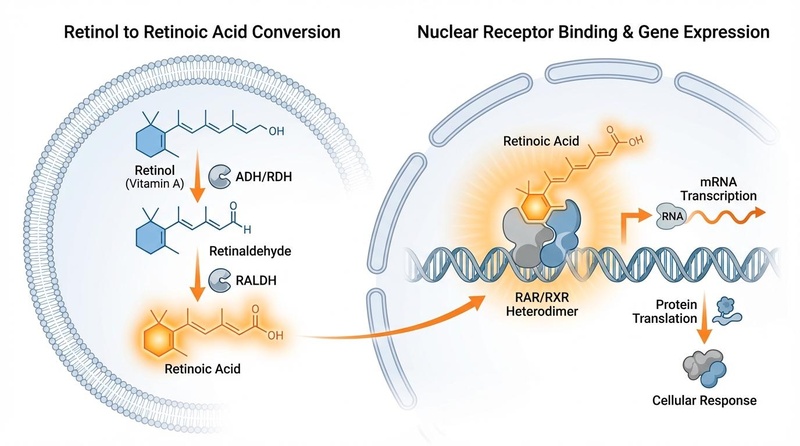
Dietary preformed Vitamin A (retinyl esters) is hydrolyzed in the intestinal lumen, absorbed by enterocytes, and packaged into chylomicrons for transport to the liver. Once in the liver, it is stored as retinyl esters.
When needed, the liver hydrolyzes these stores and releases retinol into the bloodstream bound to Retinol-Binding Protein (RBP). Retinol enters target cells and is oxidized first into retinal (essential for vision) and then into retinoic acid. Retinoic acid is the active hormone form that binds to nuclear Retinoic Acid Receptors (RARs) and Retinoid X Receptors (RXRs). These receptor complexes act as transcription factors, directly binding to DNA to upregulate or downregulate the expression of hundreds of genes involved in cellular differentiation, apoptosis, and immune function.
¶ Evidence summary table (human outcomes)
| Outcome | Population | Intervention | Result | Evidence Quality | Reference |
|---|---|---|---|---|---|
| All-cause mortality | Children (6 mo–5 yr) in developing nations | High-dose Vitamin A supplementation | 12–24% reduction in all-cause mortality, driven primarily by preventing deaths from measles and diarrhea | High | [5] |
| Measles morbidity & mortality | Children hospitalized with severe measles | High-dose Vitamin A (typically 200,000 IU for 2 days) | Significant reduction in overall mortality and severity of complications (e.g., croup, pneumonia) | High | [3:1] |
| Lung cancer incidence | Adult current or former smokers (CARET Trial) | Beta-carotene (30 mg) + Retinyl palmitate (25,000 IU) | 28% increased incidence of lung cancer and 17% increased overall mortality; trial halted early due to harm | High | [2:1] |
| Skin aging (clinical appearance) | Adults with photoaged skin | Oral Vitamin A (retinyl palmitate) + topical retinoic acid | Enhanced clinical improvement of skin aging scores compared to topical retinoic acid alone | Moderate | [4:1] |
| Respiratory infection prevention | Healthy, well-nourished adults | Routine Vitamin A supplementation | No significant reduction in the incidence or severity of common respiratory infections | Moderate | [1:5] |
¶ Comprehensive Safety & Toxicology
Hypervitaminosis A (Toxicity)
Toxicity exclusively applies to preformed Vitamin A (retinol/retinyl esters), not dietary beta-carotene.
- Acute Toxicity: Occurs after a single massive dose (typically >150,000 mcg RAE in adults). Symptoms include severe nausea, vomiting, vertigo, blurry vision, and increased intracranial pressure.
- Chronic Toxicity: Results from chronic daily intakes exceeding the UL of 3,000 mcg RAE (10,000 IU). Symptoms include:
- Hepatotoxicity (liver enlargement and fibrosis)
- Bone and joint pain
- Alopecia (hair loss)
- Dry, scaling skin
- Significant increased risk of osteoporosis and osteoporotic fractures [1:6].
Teratogenicity
Preformed Vitamin A is highly teratogenic. Daily intakes exceeding 3,000 mcg RAE during the first trimester of pregnancy have been conclusively linked to spontaneous abortion and severe congenital malformations involving the central nervous system, face (cleft palate), and heart [1:7].
Drug Interactions
- Orlistat (Alli, Xenical): A weight-loss medication that prevents fat absorption, which can consequently decrease the absorption of fat-soluble vitamins like Vitamin A.
- Prescription Retinoids (Isotretinoin, Acitretin, Bexarotene): These oral medications are Vitamin A derivatives. Concurrently taking Vitamin A supplements exponentially increases the risk of severe hypervitaminosis A.
¶ Comparisons: Beta-Carotene vs. Preformed Vitamin A
While both ultimately serve the body's Vitamin A needs, their safety profiles are vastly different. Beta-carotene is a precursor molecule. The intestinal mucosa and liver contain an enzyme (BCO1) that cleaves beta-carotene into two molecules of retinal only when the body's Vitamin A status is low. As Vitamin A stores become replete, this enzymatic conversion sharply decreases. Therefore, dietary beta-carotene is not associated with Vitamin A toxicity or teratogenicity [1:8]. However, as noted in the CARET trial, high-dose supplemental beta-carotene paradoxically increases cancer risk in smokers, likely due to oxidative breakdown products in the highly oxidative environment of a smoker's lungs [2:2].
¶ References
National Institutes of Health: Office of Dietary Supplements. "Vitamin A and Carotenoids - Health Professional Fact Sheet." https://ods.od.nih.gov/factsheets/VitaminA-HealthProfessional/ ↩︎ ↩︎ ↩︎ ↩︎ ↩︎ ↩︎ ↩︎ ↩︎ ↩︎
Omenn GS, Goodman GE, Thornquist MD, et al. "Effects of a combination of beta carotene and vitamin A on lung cancer and cardiovascular disease." N Engl J Med. 1996;334(18):1150-1155. https://www.nejm.org/doi/full/10.1056/NEJM199605023341802 ↩︎ ↩︎ ↩︎
Huiming Y, Chaomin W, Meng M. "Vitamin A for treating measles in children." Cochrane Database Syst Rev. 2005;(4):CD001479. https://pmc.ncbi.nlm.nih.gov/articles/PMC7076287/ ↩︎ ↩︎
Campione, E.; Gaziano, R.; Dattola, A.; et al. "Skin Anti-Aging Effect of Oral Vitamin A Supplementation in Combination with Topical Retinoic Acid Treatment in Comparison with Topical Treatment Alone: A Randomized, Prospective, Assessor-Blinded, Parallel Trial." Cosmetics 2023, 10, 144. https://www.mdpi.com/2079-9284/10/5/144 ↩︎ ↩︎
Imdad A, Mayo-Wilson E, Herzer K, Bhutta ZA. "Vitamin A supplementation for preventing morbidity and mortality in children from six months to five years of age." Cochrane Database Syst Rev. 2010;(12):CD008524. https://www.bmj.com/content/343/bmj.d5094 ↩︎