¶ Vitamin D3 and K2
| Label | Value |
|---|---|
| Type | Fat-soluble vitamins |
| Active Cmpd | Calcitriol (D3), Menaquinones (K2; MK-7/MK-4) |
| Source | Lanolin/lichen (D3), Natto/fermented foods (K2) |
| Dose Range | 1,000–5,000 IU (D3) / 90–180 mcg (K2-MK7) |
| Half-life | ~15 days (D3), ~72 hours (MK-7), ~1.5 hours (MK-4) |
| Main Benefit | Bone mineral density, vascular calcification prevention |
| Absorption | High (increased with dietary fats) |
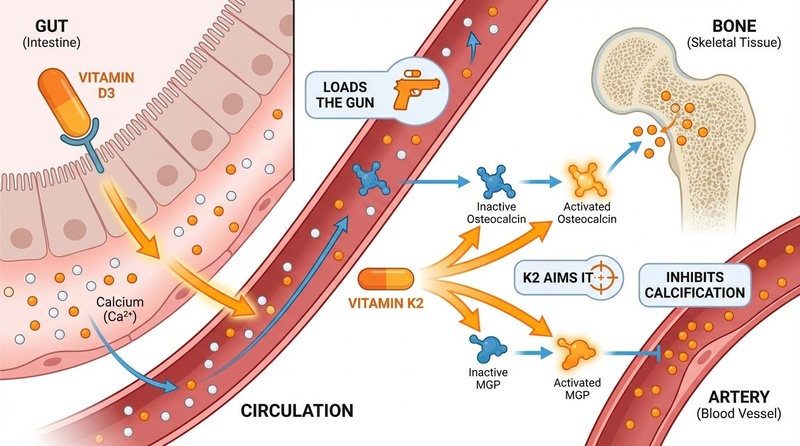
Vitamin D3 and K2 are frequently co-supplemented due to their synergistic roles in calcium homeostasis. While Vitamin D promotes the absorption of calcium from the intestine, Vitamin K2 (specifically menaquinones like MK-4 and MK-7) directs that calcium into bone and keeps it out of soft tissues, potentially resolving the "Calcium Paradox" of supplemental calcium[1].
¶ At a glance
Aliases
- Also known as: D3 + K2 synergy, cholecalciferol and menaquinone-7
- Chemical / botanical name: Cholecalciferol (D3) and Menaquinone (K2)
- Category: Vitamin complex
Key points
- Strongest Benefit: Combined supplementation significantly increases total bone mineral density (BMD) and reduces bone turnover markers in postmenopausal women more effectively than Vitamin D alone[2][3][4].
- Synergy: Vitamin D3 facilitates calcium absorption and the production of calcium-binding proteins, while Vitamin K2 activates these proteins to ensure calcium is deposited in bones rather than arterial walls[2:1][5].
- Longevity Link: Combined deficiency of vitamins D and K is associated with a 46% higher risk of all-cause mortality, a significantly higher risk than the deficiency of either vitamin alone[6].
- Key Interaction: Vitamin K2 directly antagonizes Vitamin K Antagonists (VKA) like Warfarin, requiring strict clinical monitoring of coagulation profiles[7].
What people use it for
- Main goals: Bone mineral density, cardiovascular health, vascular calcification prevention, and all-cause mortality risk reduction.
- Evidence quality (overall): Moderate to High
¶ What is Vitamin D3 and K2?
Vitamin D3 and K2 are fat-soluble vitamins that work in tandem to manage calcium distribution in the body.
- Definition: Vitamin D3 (cholecalciferol) is a secosteroid hormone primarily synthesized in the skin via UV exposure, while Vitamin K2 (menaquinone) is a group of compounds synthesized by bacteria or found in fermented foods.
- Natural sources: Vitamin D3 is found in fatty fish, eggs, and fortified foods. Vitamin K2 is found in fermented foods like natto, hard cheeses, and organ meats[8].
- Traditional / historical use: Vitamin D was historically used to prevent rickets, while Vitamin K was discovered for its essential role in blood coagulation.
- Current regulatory status: Widely available as dietary supplements; high-dose MK-4 is used as a prescription osteoporosis treatment in Japan.
- Key pharmacological property: Synergistic regulators of calcium-dependent protein carboxylation.
¶ What are Vitamin D3 and K2’s main benefits?
The primary benefits of combining Vitamin D3 and K2 focus on optimizing the "Calcium Paradox," where calcium is directed away from the heart and into the skeletal system.
- Bone Health: Combined supplementation increases bone mineral density (BMD) and reduces levels of undercarboxylated (inactive) osteocalcin, which is a marker for bone health[3:1][4:1].
- Cardiovascular Health: Vitamin K2 activates Matrix Gla Protein (MGP), the most potent inhibitor of vascular calcification[9]. Supplementation has been shown to slow the progression of coronary and aortic calcification in high-risk patients[10][11].
- Mortality Reduction: Long-term cohort data indicates that individuals with adequate levels of both vitamins have significantly lower all-cause mortality risks compared to those deficient in both[6:1].
¶ Evidence summary table (human outcomes)
| Outcome / Goal | Effect* | Consistency** | Evidence quality | Trials*** | Notes (population, duration, dose) |
|---|---|---|---|---|---|
| Bone Mineral Density (BMD) | High | High | 12+ RCTs | Significant increase in total BMD in postmenopausal women compared to D3 alone[2:2][3:2][4:2]. | |
| Fracture Risk | Moderate | Moderate | 8+ RCTs | Inverse association between K intake and fracture risk (RR=0.78), with synergy from D[12]. | |
| Vascular Calcification | Moderate | Moderate | 2 RCTs | Slows progression of calcification in patients with high baseline CAC scores (>400)[10:1][11:1]. | |
| Arterial Stiffness (PWV) | High | Moderate | 2 RCTs | Reduces progression of arterial stiffness, notably in subclinical atherosclerosis and SIBO[8:1]. | |
| All-Cause Mortality | High | Moderate | Cohort | Combined deficiency linked to 46% higher mortality risk vs. adequate status[6:2]. | |
| Blood Pressure | High | High | NMA | Vitamin D3 supplementation (alone or with most micronutrients) does not lower SBP[13]. | |
| Dysmenorrhea Relief | Moderate | Moderate | Review | High-dose D3 (50,000 IU/week) inhibits prostaglandins and reduces menstrual pain[14]. | |
| Post-Bariatric Status | High | High | NMA | Long-term prevalence of D (35.8%) and K (9.6%) deficiency is high post-surgery[15]. | |
| IBD Micronutrient Status | High | High | Meta-analysis | Significant depletion of fat-soluble vitamins (A, D, E, K) in Crohn's and UC patients[16]. |
- *Effect: ↑ (increase), ↓ (decrease), = (no effect), ? (unclear). (p) = positive, (n) = negative, (x) = neutral.
- **Consistency: Low (conflicting), Moderate (mixed), High (most agree).
- ***Trials: Number of RCTs, Meta-analyses, or high-quality Cohorts informing the outcome.
¶ How does Vitamin D3 and K2 work?
The "synergy" between D3 and K2 is a two-step process of protein induction and activation.
¶ Primary Targets
- Vitamin D Receptor (VDR): Increases calcium absorption in the gut and stimulates the production of Vitamin K-dependent proteins (VKDPs).
- -Glutamyl Carboxylase: The enzyme that uses Vitamin K2 as a cofactor to activate VKDPs.
¶ Core Mechanisms
- Vitamin D3 (The Loader): Stimulates the synthesis of Osteocalcin (in bone) and Matrix Gla Protein (MGP) (in blood vessels). However, these proteins are initially produced in an inactive, undercarboxylated form[2:3][5:1].
- Vitamin K2 (The Director): Acts as an essential cofactor for the carboxylation (activation) of these proteins.
Pharmacokinetics: Both are fat-soluble and require dietary lipids for optimal absorption. Vitamin D3 has a long half-life (~15 days in circulation), while Vitamin K2 forms vary significantly: MK-4 has a very short half-life (~1.5 hours) requiring multiple daily doses, whereas MK-7 has a long half-life (~72 hours), allowing for stable serum levels with once-daily dosing[2:5][17].
¶ Effects on different systems
¶ Bone & Skeletal Health
The combination is superior to Vitamin D alone for maintaining bone mineral density. Meta-analyses show significant improvements in total BMD and significant reductions in undercarboxylated osteocalcin (ucOC), a marker of bone fragility[3:4][4:3]. This effect is most pronounced in postmenopausal women and those with osteoporosis.
¶ Cardiovascular Health
The synergy protects against vascular calcification and arterial stiffening.
- Inhibition of Calcification: Vitamin K2-activated MGP is the primary inhibitor of soft tissue calcification[9:1]. In the AVADEC trial, high-dose D3+K2 slowed the progression of coronary artery calcification in high-risk patients[10:2][11:2].
- Arterial Stiffness: Low levels of K2 are linked to increased pulse-wave velocity (PWV), a measure of arterial stiffness. Patients with Small Intestinal Bacterial Overgrowth (SIBO) often exhibit K2 deficiency and associated arterial stiffening, which may be mitigated by supplementation[8:3].
¶ Metabolic Health
While Vitamin D is involved in metabolic pathways, a 2024 network meta-analysis found that D3 supplementation does not significantly lower systolic blood pressure (SBP) in adults with essential hypertension, contrasting with the effects of Vitamin E[13:1].
¶ Other Domains
- Primary Dysmenorrhea: High-dose Vitamin D3 (e.g., 50,000 IU/week) has been shown to inhibit prostaglandin synthesis, significantly reducing menstrual pain and inflammation[14:1].
- Bariatric & IBD Recovery: Long-term follow-up of bariatric surgery patients shows high rates of Vitamin D (35.8%) and K (9.6%) deficiency due to malabsorption[15:1]. Similarly, patients with IBD are significantly depleted in all fat-soluble vitamins, necessitating targeted supplementation[16:1].
¶ Dosage and how to take it
Standard dosing in studies
- Vitamin D3: 1,000–5,000 IU/day is standard for maintenance; high-dose boluses (e.g., 50,000 IU/week) are used for deficiency or specific conditions like dysmenorrhea[14:2].
- Vitamin K2 (MK-7): 90–180 mcg/day is most common in clinical trials for BMD and cardiovascular health[2:6][10:3].
- Vitamin K2 (MK-4): 45 mg/day (split into 3 doses) is used in Japanese therapeutic protocols for osteoporosis.
Forms and bioavailability
- MK-7 (Menaquinone-7): Preferred for once-daily dosing due to its ~72-hour half-life and high bioavailability at microgram doses[2:7][17:1].
- MK-4 (Menaquinone-4): Natural form found in animal fats; requires high milligram doses due to rapid clearance (~1.5-hour half-life)[17:2].
- With Food: Always take with a fat-containing meal to maximize absorption of these fat-soluble molecules.
Special populations
- Bariatric Surgery: Requires lifetime monitoring and often higher doses due to high (35.8%) long-term deficiency prevalence[15:2].
- IBD (Crohn's/UC): High risk of fat-soluble malabsorption; dosage should be adjusted based on serum levels[16:2].
- Elderly: Frequent use of medications like statins or calcium channel blockers may influence Vitamin D status; statins generally have a neutral or positive association with D levels, though potential CYP3A4 competition exists[18].
¶ Safety and side effects
CRITICAL WARFARIN / ANTICOAGULANT INTERACTION
Vitamin K2 directly antagonizes vitamin K antagonists (VKA) like Warfarin (Coumadin). MK-7 is extremely potent; doses as low as 10 mcg can destabilize INR levels and increase thrombosis risk. Strictly monitor coagulation profiles under clinical supervision if co-administering.
Common side effects
- Side effects are rare at standard doses. Massive Vitamin D overdose can lead to hypercalcemia (high blood calcium), resulting in nausea, vomiting, and kidney stones. Vitamin K2 does not have a known upper limit or toxicity at studied doses[19].
Who should be especially cautious or avoid it
- Anticoagulant users: Specifically those on Warfarin/VKA.
- Hypercalcemia patients: Individuals with existing high calcium levels or conditions like sarcoidosis or hyperparathyroidism.
¶ Drug and supplement interactions
Pharmacokinetic interactions
- Statins (Atorvastatin/Simvastatin): These drugs and Vitamin D are both processed by the CYP3A4 enzyme. While statin use is often associated with higher Vitamin D levels, high-dose D3 may theoretically compete for the enzyme, potentially altering statin concentrations[18:1].
- Lipase Inhibitors (Orlistat): May significantly reduce the absorption of fat-soluble vitamins D and K.
Pharmacodynamic interactions
- Warfarin (Coumadin): Direct antagonism. Vitamin K is the "antidote" to Warfarin; even low doses in supplements can neutralize the drug's therapeutic effect[7:1].
- Thiazide Diuretics: May increase the risk of hypercalcemia when combined with high-dose Vitamin D3.
¶ Combining with other supplements (“stacks”)
- Bone Density Stack: Vitamin D3 + K2 + Calcium + Magnesium + Boron.
- Vascular Health Stack: Vitamin D3 + K2 + CoQ10 + Omega-3.
¶ Practical questions (FAQ)
¶ How long does it take for D3/K2 to work?
Biomarker changes (such as reduction in ucOC or dp-ucMGP) typically occur within 4–8 weeks. Measurable changes in bone mineral density (BMD) generally require 6–12 months of consistent supplementation.
¶ Can I take D3/K2 long term?
Yes, most clinical trials for bone and vascular health last between 1 and 3 years, showing a consistent safety profile. However, periodic monitoring of 25(OH)D and serum calcium is recommended for long-term high-dose regimens.
¶ Can I take D3/K2 if I am on blood thinners?
If you are on Warfarin (Coumadin), you must avoid Vitamin K2 unless under strict medical supervision, as it directly antagonizes the drug. For "newer" anticoagulants (DOACs like Eliquis or Xarelto), there is no known direct interaction, but monitoring is still advised.
¶ Is D3/K2 useful if I am otherwise healthy?
Yes, many "healthy" individuals in Western populations are subclinically deficient in both vitamins due to limited sun exposure and low intake of fermented foods. Maintaining adequate levels is a primary strategy for long-term skeletal and cardiovascular health preservation.
¶ Do statins interact with Vitamin D?
Statins are generally associated with neutral or even positive effects on Vitamin D levels. However, because both are metabolized by the same liver enzyme (CYP3A4), very high doses of Vitamin D could theoretically interfere with the metabolism of certain statins like atorvastatin.
¶ How we evaluated the evidence
- Study types prioritized: Randomized controlled trials (RCTs), systematic reviews, and meta-analyses.
- Evidence Quality Grading:
- High: Multiple high-quality RCTs or meta-analyses with consistent results (e.g., BMD in postmenopausal women).
- Moderate: RCTs with some limitations or large, high-quality cohort studies (e.g., mortality and vascular calcification).
- Low: Small studies, inconsistent results, or observational data only.
- Very Low: In vitro or animal data only.
¶ References
van Ballegooijen, A. J., et al. (2017). The Synergistic Interplay between Vitamins D and K for Bone and Cardiovascular Health: A Narrative Review. Int J Endocrinol. https://pmc.ncbi.nlm.nih.gov/articles/PMC5613455/ ↩︎
Rusu ME, et al. (2024). Investigating the Effects and Mechanisms of Combined Vitamin D and K Supplementation in Postmenopausal Women: An Up-to-Date Comprehensive Review of Clinical Studies. Nutrients. https://pubmed.ncbi.nlm.nih.gov/39064799/ ↩︎ ↩︎ ↩︎ ↩︎ ↩︎ ↩︎ ↩︎ ↩︎
Kuang X, et al. (2020). The combination effect of vitamin K and vitamin D on human bone quality: a meta-analysis of randomized controlled trials. Food & Function. https://pubmed.ncbi.nlm.nih.gov/32219282/ ↩︎ ↩︎ ↩︎ ↩︎ ↩︎
AlHajri L, et al. (2021). Effect of Vitamin K2 Alone or in Combination on Various Bone Turnover Markers Amongst Postmenopausal Females. Journal of Bone Metabolism. https://pubmed.ncbi.nlm.nih.gov/33730780/ ↩︎ ↩︎ ↩︎ ↩︎
Khalil Z, et al. (2021). The Medical Benefits of Vitamin K(2) on Calcium-Related Disorders. Nutrients. https://pubmed.ncbi.nlm.nih.gov/33670005/ ↩︎ ↩︎ ↩︎
van Ballegooijen AJ, et al. (2020). Combined low vitamin D and K status amplifies mortality risk: a prospective study. European Journal of Nutrition. https://pubmed.ncbi.nlm.nih.gov/32808059/ ↩︎ ↩︎ ↩︎
Theuwissen E, et al. (2013). Low-dose menaquinone-7 supplementation significantly decreases INR in patients on acenocoumarol. Blood. https://pubmed.ncbi.nlm.nih.gov/23530987/ ↩︎ ↩︎
Ponziani FR, et al. (2017). Subclinical atherosclerosis is linked to small intestinal bacterial overgrowth via vitamin K2-dependent mechanisms. World Journal of Gastroenterology. https://pubmed.ncbi.nlm.nih.gov/28275304/ ↩︎ ↩︎ ↩︎ ↩︎
Hariri, E., et al. (2021). Vitamin K2—a neglected player in cardiovascular health: a narrative review. Open Heart. https://openheart.bmj.com/content/8/2/e001715 ↩︎ ↩︎
Diederichsen ACP, et al. (2022). Vitamin K2 and D in Patients With Aortic Valve Calcification: A Randomized Double-Blinded Clinical Trial. Circulation. https://www.ahajournals.org/doi/10.1161/CIRCULATIONAHA.121.057008 ↩︎ ↩︎ ↩︎ ↩︎
Hasific S, et al. (2023). Effects of vitamins K2 and D3 supplementation in patients with severe coronary artery calcification. BMJ Open. https://pmc.ncbi.nlm.nih.gov/articles/PMC10351276/ ↩︎ ↩︎ ↩︎
Haghighat MML, et al. (2025). Dietary Vitamin K Intake and Fracture Risk: A Systematic Review and Dose-Response Meta-Analysis on the Interplay with Vitamin D. Current Rheumatology Reviews. https://pubmed.ncbi.nlm.nih.gov/40947710/ ↩︎
Qi S, et al. (2024). Effect of vitamin B(2), vitamin C, vitamin D, vitamin E and folic acid in adults with essential hypertension: a systematic review and network meta-analysis. BMJ Open. https://pubmed.ncbi.nlm.nih.gov/38296289/ ↩︎ ↩︎
Matsas A, et al. (2023). Vitamin Effects in Primary Dysmenorrhea. Life. https://pubmed.ncbi.nlm.nih.gov/37374091/ ↩︎ ↩︎ ↩︎
Chen L, et al. (2024). Long-term prevalence of vitamin deficiencies after bariatric surgery: a meta-analysis. Langenbeck's Archives of Surgery. https://pubmed.ncbi.nlm.nih.gov/39030449/ ↩︎ ↩︎ ↩︎
Fabisiak N, et al. (2017). Fat-soluble Vitamin Deficiencies and Inflammatory Bowel Disease: Systematic Review and Meta-Analysis. Journal of Clinical Gastroenterology. https://pubmed.ncbi.nlm.nih.gov/28858940/ ↩︎ ↩︎ ↩︎
Sato T, et al. (2012). Comparison of menaquinone-4 and menaquinone-7 bioavailability in healthy women. Nutrition Journal. https://pmc.ncbi.nlm.nih.gov/articles/PMC3502319/ ↩︎ ↩︎ ↩︎
van Orten-Luiten AC, et al. (2014). The association between drugs frequently used by the elderly and vitamin D blood levels: a review of observational and experimental studies. Drugs & Aging. https://pubmed.ncbi.nlm.nih.gov/24385337/ ↩︎ ↩︎
Kodentsova VM, et al. (2022). [Specialized vitamin-mineral supplements for persons in extreme conditions]. Voprosy Pitaniia. https://pubmed.ncbi.nlm.nih.gov/36648178/ ↩︎