¶ Prevención y minimización de cicatrices
La cicatrización es una respuesta fisiológica natural a la lesión tisular, sin embargo, la extensión y visibilidad de una cicatriz son significativamente modificables mediante una intervención oportuna y basada en la evidencia. La transición de una herida abierta a una cicatriz madura implica una compleja cascada de inflamación, proliferación y remodelación. Al dirigirse a vías biológicas específicas (como la modulación de la respuesta inflamatoria, asegurar el depósito organizado de colágeno y la inhibición de la diferenciación de miofibroblastos), es posible reducir significativamente la formación de cicatrices hipertróficas y queloides.
Esta guía detalla un protocolo práctico para el manejo de cicatrices, integrando tratamientos tópicos de primera línea con terapias de péptidos seleccionadas, apoyos sistémicos, procedimientos clínicos e intervenciones conductuales. Para problemas estéticos relacionados, consulte [[pages/blemishes-pigment-marks-and-acne-scars|Manchas, marcas de pigmentación y cicatrices de acné]], [[pages/microneedling|Microneedling]] y el [[pages/biohacking-goals-appearance|Centro de piel, cabello y apariencia]].
¶ TL;DR
- Las heridas recientes cicatrizan menos cuando se mantienen limpias, húmedas, cubiertas, con baja tensión y protegidas de la luz ultravioleta. Los mayores logros tempranos son el control de infecciones, la oclusión húmeda, la reducción de la tensión y evitar el sol.
- El gel de silicona o las láminas de silicona son la herramienta no invasiva de prevención de cicatrices con mayor respaldo una vez que la superficie de la piel está completamente cerrada.
- Los queloides, las cicatrices hipertróficas, las quemaduras, las contracturas y las cicatrices que cruzan las articulaciones necesitan atención clínica más temprana porque retrasar el tratamiento puede dificultar la remodelación.
- Las cicatrices antiguas no se tratan como heridas recientes. Las cicatrices establecidas generalmente necesitan herramientas de remodelación como silicona, masajes, microneedling, láseres, inyecciones de corticosteroides, 5-FU, PRP o revisión quirúrgica, dependiendo del tipo de cicatriz.
- Evite los atajos de alto riesgo. No aplique activos irritantes en heridas abiertas, no use vitamina E como tratamiento predeterminado para cicatrices, no aplique agujas en infecciones activas ni reinicie medicamentos que suprimen la curación de heridas después de una cirugía sin la orientación de un médico.
¶ Respuesta rápida
Para un corte o incisión nueva, límpielo suavemente, manténgalo húmedo y cubierto, reduzca la tensión a lo largo de la herida, evite el sol y comience a usar silicona solo después de que la herida esté completamente cerrada. Para una cicatriz elevada, priorice la silicona, la presión o el vendaje (taping) cuando sea apropiado, y acuda temprano al dermatólogo si está creciendo, es dolorosa, pica o es propensa a formar queloides. Para las cicatrices de acné deprimidas, piense en términos de remodelación: microneedling, láser fraccionado, subcisión, PRP, rellenos o TCA CROSS, dependiendo del patrón de la cicatriz.
¶ Primero: Identifique su tipo de cicatriz
Identificar el tipo específico de cicatriz es crucial para seleccionar el protocolo de tratamiento correcto. Antes de cualquier intervención, una evaluación adecuada garantiza un manejo específico y eficaz.
| Característica | Cicatriz hipertrófica | Cicatriz queloide | Cicatriz atrófica |
|---|---|---|---|
| Apariencia | Elevada, roja, firme. | Elevada, morada/roja, brillante, lisa. | Deprimida, con hoyuelos (en picahielo, furgón o boxcar). |
| Límites | Permanece dentro de los bordes originales de la herida. | Se extiende más allá de los bordes originales de la herida (en forma de "garra"). | Por debajo del nivel de la piel (pérdida de tejido). |
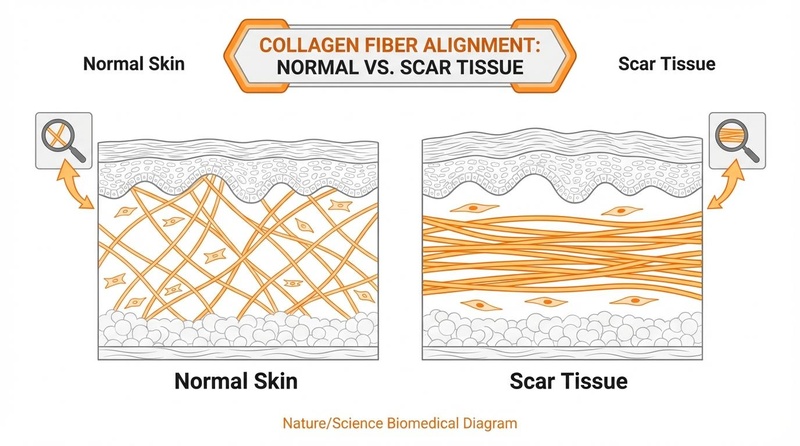
| Colágeno | Haces ondulados paralelos y organizados [1]. | Haces desorganizados, gruesos y "vítreos" [2]. | Pérdida de colágeno/grasa subcutánea. |
| Pronóstico | Puede regresar (aplanarse) con el tiempo. | Rara vez regresa; alta tasa de recurrencia. | Permanente sin intervención. |
| Etiología | Tensión, curación retrasada, quemaduras. | Genética, tipos de piel más oscuros (Fitzpatrick IV-VI). | Acné, varicela. |
¶ Herida vs. Cicatriz antigua: Una guía de triaje
El manejo eficaz de las cicatrices comienza con la comprensión de la etapa de reparación del tejido. Las intervenciones para una herida reciente tienen como objetivo prevenir la cicatrización excesiva, mientras que los tratamientos para una cicatriz establecida se centran en la remodelación y la mejora de la apariencia.
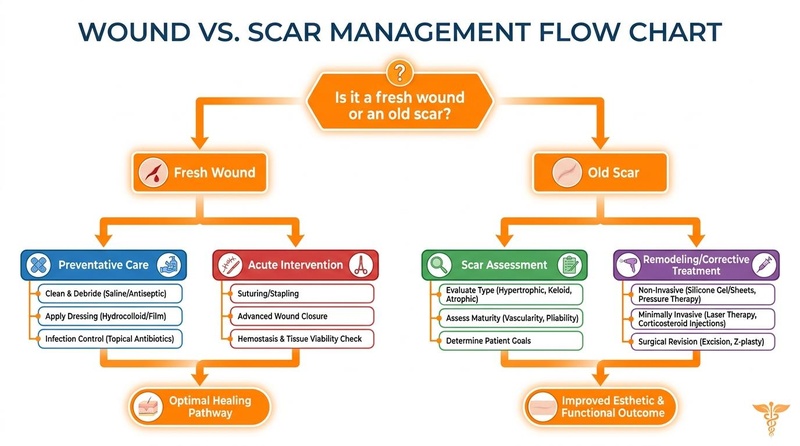
Herida aguda (Herida reciente): Esta fase suele durar hasta 2-4 semanas después de la lesión. El objetivo principal es promover una curación óptima de la herida y prevenir la formación anormal de cicatrices. Las intervenciones incluyen:
- Cuidado preventivo: Limpieza suave, apósitos adecuados y control de infecciones para minimizar la inflamación.
- Intervención aguda: Cierre quirúrgico (suturas, grapas), productos avanzados para el cuidado de heridas y hemostasia para garantizar la viabilidad adecuada del tejido.
Cicatriz establecida (Cicatriz antigua): Cicatrices que han madurado más allá de la fase de curación inicial, generalmente después de varias semanas o meses. El enfoque cambia a la remodelación del tejido cicatricial existente y la mejora de sus resultados estéticos y funcionales. Las intervenciones incluyen:
- Evaluación de la cicatriz: Evaluación detallada del tipo de cicatriz (hipertrófica, queloide, atrófica), madurez y objetivos del paciente.
- Tratamiento de remodelación/correctivo: Opciones no invasivas como geles de silicona o terapia de presión; procedimientos mínimamente invasivos como terapia con láser o inyecciones de corticosteroides; o revisión quirúrgica.
¶ Contexto Biológico de la Cicatrización
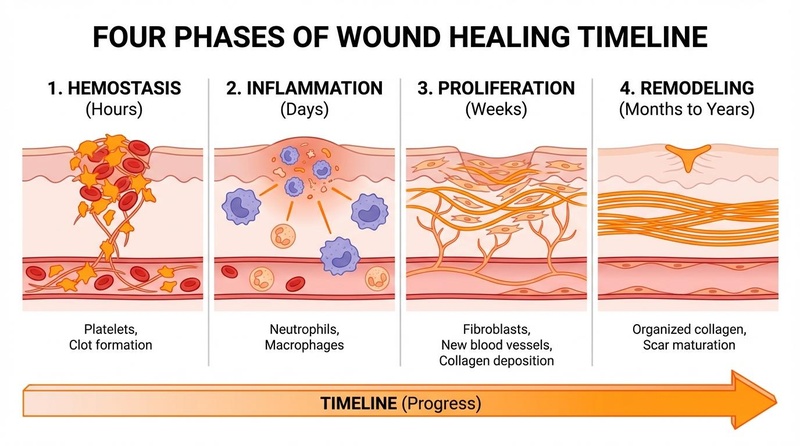
Comprender las fases de la cicatrización de heridas es fundamental para programar las intervenciones correctamente. Las intervenciones que son beneficiosas en una fase pueden ser perjudiciales en otra.
¶ 1. Fases de la Cicatrización de Heridas
- Hemostasia (Inmediato – Día 2): La herida se coagula para detener el sangrado. Las plaquetas liberan factores de crecimiento (PDGF, TGF-β) que inician la reparación [3].
- Inflamación (Día 1 – Día 7): Los neutrófilos y macrófagos eliminan restos y bacterias. Punto Crucial: La inflamación excesiva o prolongada es un impulsor primario de la fibrosis (cicatrización). Las heridas crónicas a menudo se detienen en esta fase [3:1][4].
- Proliferación (Día 4 – Semana 3): Los fibroblastos migran al sitio y depositan colágeno Tipo III (tejido de granulación). Se forman nuevos vasos sanguíneos (angiogénesis) para suministrar nutrientes al tejido [5]. Esta es la ventana crítica para las intervenciones con péptidos y tópicos para asegurar que el colágeno se deposite en un patrón organizado de "tejido de cesta" (basket-weave) en lugar de haces paralelos.
- Remodelación (Semana 3 – 1 Año+): Esta es la fase crítica para la apariencia de la cicatriz. El colágeno Tipo III es reemplazado por colágeno Tipo I, más fuerte y organizado. Los miofibroblastos (células contráctiles) deben someterse a apoptosis (muerte celular). Si persisten, continúan traccionando y depositando colágeno, lo que conduce a cicatrices hipertróficas [6].
¶ Las reglas de oro de la prevención
Antes de aplicar cualquier producto, el cumplimiento de estos pilares de comportamiento es innegociable para minimizar la formación de cicatrices.
¶ 1. Humedad y oclusión (el modelo de curación "húmeda")
Una herida seca cicatriza más lentamente y deja más marca. Las costras actúan como una barrera mecánica para las nuevas células de la piel (queratinocitos) que intentan desplazarse por la herida.
- Protocolo: Mantener las heridas cubiertas y húmedas (p. ej., con petrolatum o silicona) para evitar la formación de costras. Esto permite que las células epiteliales migren rápidamente a través de un lecho húmedo, reduciendo la duración de la inflamación.
¶ 2. Reducción de la tensión
La tensión mecánica es una señal mecánica primaria para que los fibroblastos produzcan un exceso de colágeno (cicatrización hipertrófica).
- Protocolo: Utilizar cinta quirúrgica (p. ej., Micropore) o cinta de silicona para descargar la tensión a lo largo de la línea de incisión durante varias semanas después de la retirada de los puntos. Evitar ejercicios que estiren la zona específica durante la fase de proliferación (semanas 2–6).
¶ 3. Protección UV
La radiación UV es altamente perjudicial para las cicatrices recientes (hasta 12 meses).
- Mecanismo: Los rayos UV degradan el colágeno nuevo mediante la regulación al alza de las MMP y activan los melanocitos, lo que provoca hiperpigmentación postinflamatoria (PIH). Esta decoloración puede ser permanente.
- Protocolo: Es necesario evitar estrictamente el sol, utilizar cobertura física (cinta/ropa) o SPF 50+ durante al menos 6–12 meses después de la lesión.
¶ Intervenciones tópicas
¶ Nivel 1: El estándar de oro
¶ Geles y láminas de silicona
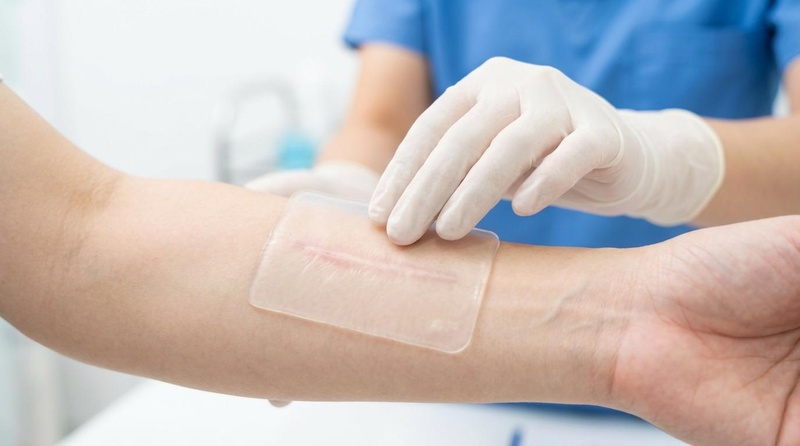
Las láminas de gel de silicona (SGS, por sus siglas en inglés) son el «estándar de oro» no invasivo de primera línea para la prevención y el tratamiento de cicatrices [7].
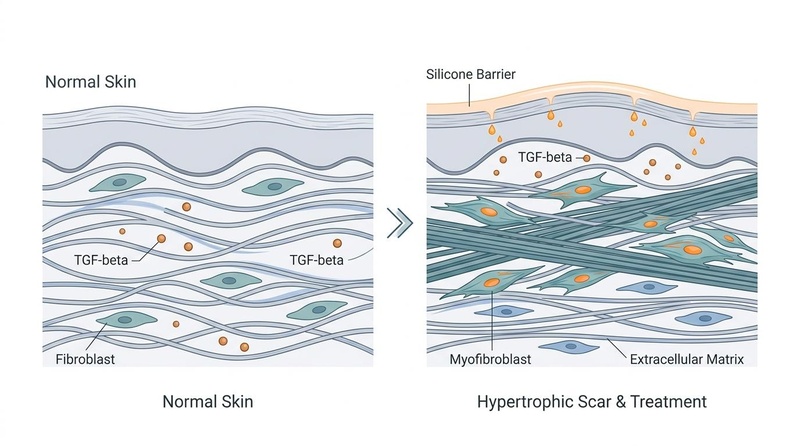
- Mecanismo: El mecanismo principal es la oclusión y la hidratación, no la presión. La silicona reduce la pérdida de agua transepidérmica (TEWL) en casi un 50 %, restaurando la barrera del estrato córneo. Esta hidratación inhibe la cascada de señalización en la que los queratinocitos envían señales a los fibroblastos para que sinteticen colágeno de forma excesiva [8][9].
- Calidad de la evidencia (GRADE: Alta): Múltiples ECA y revisiones Cochrane confirman que las SGS reducen la incidencia de cicatrización hipertrófica en personas de alto riesgo y mejoran el grosor y el color de la cicatriz [10][4:1].
- Uso: Aplicar de 12 a 24 horas al día durante 3 a 6 meses, comenzando tan pronto como la herida esté completamente epitelizada (cerrada).
¶ Nivel 2: Complementos eficaces
¶ GHK-Cu (Tripéptido de cobre-1)
[[peptides/ghk-cu|GHK-Cu]] es un péptido de origen natural con una alta afinidad por el cobre, esencial para la remodelación tisular.
- Mecanismo: El GHK-Cu modula las Metaloproteinasas de matriz (MMP) y sus inhibidores (TIMP). En el tejido fibrótico, aumenta la MMP-2 para degradar los agregados excesivos de colágeno; en el tejido normal, estimula la reparación. Restablece la expresión génica de los fibroblastos a un estado más saludable, promoviendo la síntesis de decorina (un proteoglicano implicado en la organización del colágeno) y reduciendo el exceso de TGF-β1 [11][12].
- Aplicación clínica: Se utiliza tópicamente para aumentar la densidad de la piel y reducir la inflamación. Es particularmente eficaz durante la fase de remodelación para asegurar una deposición organizada de colágeno [13][14].
¶ Miel de grado médico (MGH)
La miel de grado médico (por ejemplo, Manuka) se diferencia de la miel de mesa debido a la esterilización y a la actividad antibacteriana estandarizada (UMF/MGO) [15].
- Mecanismo: La MGH proporciona un ambiente de curación húmedo, estimula el desbridamiento autolítico a través de una alta osmolaridad y reduce el pH de la herida (3.2–4.5), lo que inhibe la actividad de las proteasas que destruyen la matriz extracelular [16][17].
- Eficacia: Evidencia de alta calidad respalda su uso para la curación de quemaduras y heridas infectadas entre 4 y 5 días más rápido que los apósitos convencionales [18].
¶ Centella Asiatica (Gotu Kola)
- Compuestos activos: Madecassoside y Asiaticoside.
- Mecanismo: Inhibe la proliferación de fibroblastos queloides e induce la apoptosis en el tejido cicatricial a través de vías mitocondriales [19][20]. También reduce la expresión de TGF-β1.
- Evidencia: Los ensayos clínicos demuestran una mejora en la pigmentación, flexibilidad y vascularidad de la cicatriz. Eficaz para prevenir la cicatrización hipertrófica en sitios donantes de injertos de piel [21][22].
¶ Nivel 3: Ineficaz o perjudicial (Evitar)
- Vitamina E (Tocoferol): Evitar. Un estudio histórico mostró que el 90% de los pacientes no observaron mejoría o experimentaron un empeoramiento de las cicatrices, y el 33% desarrolló dermatitis de contacto. No se recomienda para el manejo de cicatrices [23][24].
- Extracto de cebolla (Mederma): Evidencia débil. Aunque se comercializa intensamente, los metaanálisis indican que no es superior al placebo o al gel de silicona solo. Funciona eficazmente solo cuando se combina con silicona, lo que sugiere que la silicona es el agente activo [25][26].
- Aloe Vera: Ineficaz para la reducción de cicatrices. Excelente para quemaduras agudas e hidratación, pero la evidencia sugiere que no reduce la formación de cicatrices hipertróficas en comparación con la silicona [27][28].
¶ Terapias con péptidos
Las terapias con péptidos emergentes ofrecen mecanismos dirigidos para reducir la fibrosis a nivel celular.
¶ 1. BPC-157
[[peptides/bpc-157|BPC-157]] (Body Protection Compound-157) ayuda a equilibrar el proceso de curación para prevenir la "sobre-curación" (fibrosis).
- Mecanismo (Eje EGR-1/NAB2): La expresión sostenida del gen Early Growth Response 1 (EGR-1) está vinculada a la fibrosis. El BPC-157 activa rápidamente el EGR-1 pero, simultáneamente, activa su represor, NAB2. Este bucle de retroalimentación negativa evita la señalización del factor de crecimiento descontrolada que conduce a una cicatrización desorganizada [29][30].
- Acción: Acelera la formación de tejido de granulación al tiempo que garantiza que las fibras de colágeno se depositen de manera organizada.
¶ 2. TB-500 (Timosina Beta-4)
[[peptides/tb-500|TB-500]] es un fragmento sintético de la Timosina Beta-4, crucial para la migración celular.
- Mecanismo:
- Secuestro de actina: Se une a los monómeros de actina, manteniendo el citoesqueleto flexible para una rápida migración celular (cierre) [31][32].
- Antifibrótico: Regula a la baja la diferenciación de fibroblastos en miofibroblastos. Al inhibir esta transformación (a menudo impulsada por el TGF-β), reduce la deposición de colágeno rígido similar al de una cicatriz [5:1][33].
¶ Suplementos y Nutrición
El apoyo sistémico asegura que el cuerpo tenga las materias primas y las moléculas de señalización para una reparación óptima.
¶ 1. Curcumina
[[supplements/curcumin-turmeric|Curcumin]] se dirige a los miofibroblastos persistentes que causan cicatrices hipertróficas.
- Mecanismo: Modula la vía de señalización Nrf2 y regula a la baja el TGF-β1. Crucialmente, promueve la apoptosis de los miofibroblastos durante la fase de remodelación. Si estas células no mueren, la cicatrización persiste [34][35].
- Uso: Requiere formulaciones de alta biodisponibilidad (liposomales o fitosomas) debido a su mala absorción.
¶ 2. Vitamina C y Zinc
- Vitamina C: Cofactor esencial para la lisil hidroxilasa y la prolil hidroxilasa, enzimas necesarias para entrecruzar las fibras de colágeno. Sin ella, el nuevo tejido carece de resistencia a la tracción [21:1][36].
- Zinc: Cofactor para las MMPs (enzimas de remodelación) y la ADN polimerasa. La deficiencia retrasa significativamente la epitelización [21:2].
¶ 3. Brahmi y Triphala
- [[supplements/brahmi-bacopa|Brahmi]] (Bacopa monnieri): Contiene bacósidos que mejoran la fuerza de ruptura de la herida y el entrecruzamiento del colágeno en modelos animales [37].
- [[supplements/triphala|Triphala]]: Una mezcla antioxidante potente rica en Vitamina C. Exhibe una actividad antibacteriana de amplio espectro (reduciendo la carga biológica) y modula la expresión de MMP-9 para prevenir la degradación excesiva del tejido [38].
¶ 4. Senolíticos (Fisetina): Un matiz crucial
Las células senescentes (células que han dejado de dividirse) se acumulan en los sitios de la herida.
- La Paradoja: En la fase aguda (días 1-5), las células endoteliales y los fibroblastos senescentes secretan PDGF-AA, que es esencial para el cierre de la herida. Eliminarlos demasiado pronto retrasa la curación [39].
- La Fase Crónica: Sin embargo, las células senescentes persistentes secretan citoquinas inflamatorias (SASP) que impulsan las heridas crónicas y la fibrosis.
- Guía: Evite los senolíticos (como la Fisetina o el Dasatinib) durante la ventana inmediata posterior a la lesión/cirugía (primeras 2-3 semanas). Pueden ser beneficiosos en la fase tardía de remodelación para prevenir la fibrosis crónica o rejuvenecer la piel envejecida, pero el tiempo es crítico.
¶ Procedimientos Clínicos y Cosméticos
Para cicatrices establecidas o prevención de alto riesgo, los procedimientos clínicos ofrecen las intervenciones más potentes.
¶ 1. Corticosteroides Intralesionales (Triamcinolona)
- Veredicto: Terapia de Primera Línea (Alta Eficacia) [38:1].
- Mecanismo: Suprime la inflamación, inhibe la proliferación de fibroblastos y reduce la síntesis de colágeno.
- Protocolo: Inyecciones (10–40 mg/mL) cada 4–6 semanas hasta que la cicatriz se aplane. A menudo se combina con Crioterapia o 5-FU para obtener efectos sinérgicos y reducir los efectos secundarios (atrofia/telangiectasia) [40][41].
¶ 2. PRP con Microneedling
Combinar [[pages/prp-platelet-rich-plasma|Plasma Rico en Plaquetas (PRP)]] con microneedling es superior al microneedling solo para cicatrices atróficas.
- Evidencia: Un metaanálisis encontró que la combinación aumentó las probabilidades de una mejora clínica significativa en casi 3 veces (OR: 2.97) en comparación con el microneedling solo [42][43].
- Sinergia: El microneedling crea canales físicos para la remodelación; el PRP libera factores de crecimiento concentrados (PDGF, VEGF) para acelerar la curación y reducir el tiempo de inactividad [21:3].
¶ 3. Terapias con Láser
- Láser de Colorante Pulsado (PDL): El estándar de oro para el enrojecimiento (eritema). Se dirige a la hemoglobina para destruir la microvasculatura que alimenta la cicatriz, reduciendo el enrojecimiento y el picor [34:1][44].
- Láser de CO2 Fraccionado: El estándar de oro para la textura y remodelación. Crea columnas microscópicas de lesión térmica, obligando a la piel a producir colágeno Tipo I nuevo y organizado. Eficaz tanto para cicatrices atróficas (acné) como hipertróficas [42:1][45].
¶ 4. 5-Fluorouracilo (5-FU)
- Función: Un agente quimioterapéutico antimetabolito utilizado por vía intralesional.
- Uso: Rara vez se usa solo debido al dolor; típicamente se mezcla con Triamcinolona (TAC) para queloides recalcitrantes. La combinación (TAC + 5-FU) es estadísticamente superior a la TAC sola [41:1][46].
¶ 5. Terapia de luz roja (Fotobiomodulación)
- Parámetros: 630–670 nm (Roja) a 4–8 J/cm².
- Mecanismo: La terapia de luz roja estimula la actividad mitocondrial (Citocromo C Oxidasa), reduce la inflamación y modula la actividad de los fibroblastos para prevenir la deposición excesiva de colágeno [16:1][47]. Nota: Una dosis excesiva (>50 J/cm²) puede tener un efecto inhibitorio [48].
¶ 6. Crioterapia
- Técnica: La crioterapia intralesional (congelación desde el interior hacia fuera mediante una aguja) es significativamente más eficaz (reducción de volumen del 51–93%) que la crioterapia con spray de contacto [3:2][5:2].
¶ Intervenciones conductuales
¶ Masaje de cicatrices
- Veredicto: Eficaz para el alivio de los síntomas y la flexibilidad.
- Protocolo: 5–10 minutos, 2–3 veces al día.
- Mecanismo: Disrupción mecánica de las bandas fibrosas, reducción del edema y realineación de las fibras de colágeno. Se ha demostrado que reduce el dolor, el picor y la ansiedad asociados a las cicatrices [49][50].
¶ Presoterapia
- Veredicto: Estándar de cuidado para quemaduras y cicatrices hipertróficas.
- Protocolo: Prendas de compresión que ejercen una presión de 20–25 mmHg, utilizadas durante 23 horas al día durante 6–12 meses [51][52].
- Mecanismo: Induce hipoxia local, lo que reduce la proliferación de fibroblastos y la síntesis de colágeno.
¶ Consideraciones quirúrgicas para usuarios de rapamicina
Los usuarios de [[supplements/rapamycin|Rapamicina (Sirolimus)]] deben adherirse a protocolos estrictos debido a su potente inhibición de la cicatrización de heridas (inhibición de mTOR).
¶ Mecanismo de inhibición
La rapamicina perjudica la cicatrización mediante:
- Detención de la proliferación de fibroblastos: Detiene la división celular necesaria para cerrar la brecha de la herida [53][54].
- Inhibición de la angiogénesis: Reduce el VEGF, previniendo la formación de nuevos vasos sanguíneos [55].
- Reducción de la síntesis de colágeno: Debilita la resistencia a la tracción [56].
¶ Protocolo de pausa
- Pre-cirugía: Suspender 7–14 días antes de la cirugía (aprox. 5 vidas medias) para asegurar la eliminación del fármaco [10:1][57].
- Post-cirugía: No reiniciar hasta que la herida esté completamente cerrada, se hayan retirado los puntos y no haya infección. La recomendación estándar es una pausa de 2–4 semanas después de la cirugía para prevenir la dehiscencia y la formación de linfocele [58][19:1].
¶ Protocolo resumido: El «Scar Stack»
Fase 1: Post-lesión inmediata (Días 0–14)
- Objetivo: Control de infecciones, humedad, cierre.
- Acción: Mantener húmedo (Petrolato/Miel), Cubrir (Oclusión), Péptidos (BPC-157/TB-500 sistémicos), Dieta (Vit C, Zinc, Proteínas). CERO SOL.
Fase 2: Proliferación/Remodelación temprana (Semanas 2–12)
- Objetivo: Prevenir la hipertrofia, deposición organizada.
- Acción:
- Gel/Láminas de silicona (12-24h/día).
- Vendaje (taping) para reducir la tensión.
- GHK-Cu tópico.
- Masaje de la cicatriz (una vez completamente cerrada).
- Terapia de luz roja.
Fase 3: Remodelación tardía (Meses 3–12)
- Objetivo: Aplanar, atenuar, remodelar.
- Acción:
- Continuar con la silicona si está activa.
- Procedimientos: PDL (para el enrojecimiento), CO2 fraccional (para la textura), Microneedling.
- Inyecciones: Esteroides/5-FU si aparece hipertrofia.
- Protección solar sigue siendo fundamental.
¶ Referencias
[Associazione Nazionale Macrodattilia] Cicatrici ipertrofiche o cheloidi. https://www.associazione-nazionale-macrodattilia.org/wp-content/uploads/2021/04/Cicatrici-ipertrofiche-o-cheloidi.pdf ↩︎
[Medscape] Keloid and Hypertrophic Scar Pathophysiology. https://emedicine.medscape.com/article/1057599-overview ↩︎
[Vohra Wound Care] The Four Stages of Wound Healing. https://cert.vohrawoundcare.com/the-four-stages-of-wound-healing-an-updated-overview-for-clinicians/ ↩︎ ↩︎ ↩︎
[PMC: 7949016] Efficacy of silicone gel for scar prevention. https://pmc.ncbi.nlm.nih.gov/articles/PMC7949016/ ↩︎ ↩︎
[NCBI Bookshelf] Acute and Chronic Wound Healing. https://www.ncbi.nlm.nih.gov/books/NBK534261/ ↩︎ ↩︎ ↩︎
[Wound Source] The Four Stages of Wound Healing. https://www.woundsource.com/blog/four-stages-wound-healing ↩︎
[PMC: 6063260] Intralesional triamcinolone hypertrophic scar GRADE. https://pmc.ncbi.nlm.nih.gov/articles/PMC6063260/ ↩︎
[ResearchGate] Evolution of Silicone Therapy and Mechanism. https://www.researchgate.net/publication/5876937_Evolution_of_Silicone_Therapy_and_Mechanism_of_Action_in_Scar_Management ↩︎
[PubMed: 18653391] Mechanism of silicone action: Hydration. https://pubmed.ncbi.nlm.nih.gov/18653391/ ↩︎
[Semantic Scholar] The effectiveness of pressure therapy for hypertrophic burn scars. https://www.semanticscholar.org/paper/The-effectiveness-of-pressure-therapy-(15–25 mmHg)-Ai-Liu/9b6970becfdcbc4e5bf549b7961e26b10cf98c92 ↩︎ ↩︎
[Delta Peptides] GHK-Cu MMP expression profiling. https://deltapeptides.com/ghk-cu ↩︎
[PMC: 4508379] GHK peptide and tissue remodeling. https://pmc.ncbi.nlm.nih.gov/articles/PMC4508379/ ↩︎
[Elements Arms] GHK-Cu: Breakthrough in skin healing. https://www.elementsarms.com/blog/post/ghk-cu-copper-peptides-a-breakthrough-in-skin-healing-and-repair ↩︎
[PMC6073405] GHK peptide as a natural modulator of skin regeneration. https://pmc.ncbi.nlm.nih.gov/articles/PMC6073405/ ↩︎
[Wound Practice and Research] Medical-grade honey evidence summary. https://journals.cambridgemedia.com.au/wpr/volume-25-number-2/evidence-summary-wound-management-medical-grade-honey ↩︎
[Red Light Wellness] Red Light Therapy Dosage Guide. https://www.redlight-wellness.com/news/red-light-therapy-dosage-guide-2025 ↩︎ ↩︎
[UCLA Health] Medical grade honey in wound care. https://www.uclahealth.org/news/article/medical-grade-honey-is-viable-tool-in-wound-care ↩︎
[Cochrane] Honey as a topical treatment for wounds. https://www.cochrane.org/evidence/CD005083_honey-topical-treatment-acute-and-chronic-wounds ↩︎
[MDPI] Centella asiatica scar treatment. https://www.mdpi.com/2076-3417/11/18/8475 ↩︎ ↩︎
[PMC: 11359448] Efficacy and mechanism of Centella asiatica. https://pmc.ncbi.nlm.nih.gov/articles/PMC11359448/ ↩︎
[PMC: 11510310] Centella asiatica mechanism and clinical efficacy. https://pmc.ncbi.nlm.nih.gov/articles/PMC11510310/ ↩︎ ↩︎ ↩︎ ↩︎
[ResearchGate] A Prospective Randomized Controlled Double-Blind Trial of Centella. https://www.researchgate.net/publication/327726446_A_Prospective_Randomized_Controlled_Double-Blind_Trial_of_the_Efficacy_Using_Centella_Cream_for_Scar_Improvement ↩︎
[PubMed: 10417589] The effects of topical vitamin E on the cosmetic appearance of scars. https://pubmed.ncbi.nlm.nih.gov/10417589/ ↩︎
[PubMed: 10417589] Vitamin E scars efficacy dermatitis risk. https://pubmed.ncbi.nlm.nih.gov/10417589/ ↩︎
[PubMed: 33372412] Onion extract gel is not better than other topical treatments in scar management: A meta-analysis. https://pubmed.ncbi.nlm.nih.gov/33372412/ ↩︎
[Semantic Scholar] Onion extract gel is not better than other topical treatments. https://www.semanticscholar.org/paper/Onion-extract-gel-is-not-better-than-other-topical-Yuan-Shen/ff4241f83c8d7acbcca64f6257fd3c61a289c9a0 ↩︎
[PMC: 6330525] Aloe vera scar improvement evidence systematic review. https://pmc.ncbi.nlm.nih.gov/articles/PMC6330525/ ↩︎
[PMC: 1313538] Aloe vera: a systematic review of its clinical effectiveness. https://pmc.ncbi.nlm.nih.gov/articles/PMC1313538/ ↩︎
[PMC: 3135176] Egr-1 in tissue repair and fibrosis. https://pmc.ncbi.nlm.nih.gov/articles/PMC3135176/ ↩︎
[PMC: 8275860] BPC 157 and the EGR-1/NAB2 feedback axis. https://pmc.ncbi.nlm.nih.gov/articles/PMC8275860/ ↩︎
[Peptide Systems] TB-500 mechanisms and research. https://www.peptidesystems.com/post/tb-500-the-research-behind-this-popular-peptide ↩︎
[Swolverine] TB-500 peptide benefits and dosage. https://swolverine.com/blogs/blog/tb-500-peptide-benefits-what-the-science-says-about-healing-recovery-and-muscle-repair ↩︎
[Loti Labs] Thymosin Beta 4 and liver fibrosis. https://lotilabs.com/resources/thymosin-beta-4-tissue-regeneration/ ↩︎
[PubMed: 34351564] Pulsed dye laser PDL scar erythema efficacy meta-analysis. https://pubmed.ncbi.nlm.nih.gov/34351564/ ↩︎ ↩︎
[PMC: 10763766] Curcumin and Nrf2 signaling in wound healing. https://pmc.ncbi.nlm.nih.gov/articles/PMC10763766/ ↩︎
[Wound Management & Prevention] Should we be supplementing Vitamin C and Zinc? https://www.hmpgloballearningnetwork.com/site/wmp/should-we-be-supplementing-vitamin-c-and-zinc ↩︎
[NeuroQuantology] Wound healing potential of Bacopa monnieri. https://www.neuroquantology.com/open-access/WOUND+HEALING+POTENTIAL+OF+BACOPA++MONNIERIIN+ACID+BURN+%26+BOILING+WATER++INDUCED+WOUNDS_7501/?download=true ↩︎
[PMC: 6063260] Intralesional corticosteroids triamcinolone scars efficacy. https://pmc.ncbi.nlm.nih.gov/articles/PMC6063260/ ↩︎ ↩︎
[Dev Cell: 2014] Demaria M, et al. An Essential Role for Senescent Cells in Optimal Wound Healing through Secretion of PDGF-AA. https://pubmed.ncbi.nlm.nih.gov/25499912/ ↩︎
[IJDVL] Standard guidelines of care: Keloids and hypertrophic scars. https://ijdvl.com/standard-guidelines-of-care-keloids-and-hypertrophic-scars/ ↩︎
[ResearchGate] Therapeutic Efficacy of Intralesional Steroid With Carbon Dioxide Laser. https://www.researchgate.net/publication/308767747_Therapeutic_Efficacy_of_Intralesional_Steroid_With_Carbon_Dioxide_Laser_Versus_With_Cryotherapy_in_Treatment_of_Keloids_A_Randomized_Controlled_Trial ↩︎ ↩︎
[Frontiers in Medicine] Combined Effect of Microneedling and PRP for Acne Scars. https://www.frontiersin.org/journals/medicine/articles/10.3389/fmed.2021.788754/full ↩︎ ↩︎
[PubMed: 35237616] Combined treatment with microneedling and PRP. https://pubmed.ncbi.nlm.nih.gov/35237616/ ↩︎
[ResearchGate] Efficacy and safety of pulsed dye laser for surgical scars. https://www.researchgate.net/publication/353730810_Efficacy_and_safety_of_pulsed_dye_laser_for_the_treatment_of_surgical_scars_a_systematic_review_and_meta-analysis ↩︎
[RIPED] Evaluating the efficacy of fractional laser therapy in scar remodeling. https://www.riped-online.com/articles/evaluating-the-efficacy-of-fractional-laser-therapy-in-scar-remodeling-and-reducing-scarrelated-complications-systematic.pdf ↩︎
[ResearchGate] Efficacy of Intralesional 5-Fluorouracil and Triamcinolone. https://www.researchgate.net/publication/24030825_Efficacy_of_Intralesional_5-Fluorouracil_and_Triamcinolone_in_the_Treatment_of_Keloids ↩︎
[PMC: 8919713] CURES: Red-light Efficacy on Scarring. https://pmc.ncbi.nlm.nih.gov/articles/PMC8919713/ ↩︎
[NeoScience] Red Light Therapy Dose. https://neoscience.com/red-light-therapy-dose/ ↩︎
[ResearchGate] Effects of scar massage on burn scars. https://www.researchgate.net/publication/361574904_Effects_of_scar_massage_on_burn_scars_A_systematic_review_and_meta-analysis ↩︎
[PubMed: 37698247] Scar massage efficacy systematic review. https://pubmed.ncbi.nlm.nih.gov/37698247/ ↩︎
[ResearchGate] Pressure therapy for scars: myth or reality? https://www.researchgate.net/publication/369176946_Pressure_therapy_for_scars_myth_or_reality_A_systematic_review ↩︎
[PubMed: 36941176] Systematic review pressure therapy efficacy. https://pubmed.ncbi.nlm.nih.gov/36941176/ ↩︎
[PMC: 8901320] mTOR-I and Mechanism of Impaired Wound Healing. https://pmc.ncbi.nlm.nih.gov/articles/PMC8901320/ ↩︎
[PMC: 3478904] Sirolimus and Wound Healing. https://pmc.ncbi.nlm.nih.gov/articles/PMC3478904/ ↩︎
[Frontiers] Sirolimus Mechanism. https://www.frontierspartnerships.org/articles/10.1111/j.1432-2277.2009.00858.x/pdf ↩︎
[PMC: 8901320] mTOR-I and Wound Healing. https://pmc.ncbi.nlm.nih.gov/articles/PMC8901320/ ↩︎
[Frontiers Partnerships] Sirolimus in Renal Transplantation. https://www.frontierspartnerships.org/articles/10.1111/j.1432-2277.2009.00858.x/pdf ↩︎
[UK Clinical Pharmacy] Sirolimus Perioperative Handbook. https://periop-handbook.ukclinicalpharmacy.org/drug/sirolimus/ ↩︎