¶ Terapia de luz roja
La terapia de luz roja, también conocida como fotobiomodulación (PBM) o terapia con láser de baja intensidad (LLLT), es una técnica terapéutica no invasiva que utiliza longitudes de onda específicas de luz roja e infrarroja cercana para estimular los procesos celulares y promover la curación. Esta intervención ha ganado una atención significativa por sus aplicaciones en dermatología, manejo del dolor, regeneración de tejidos e indicaciones emergentes de longevidad.
| Mecanismo | Activación de la citocromo c oxidasa mitocondrial |
| Longitudes de onda clave | 630-670 nm (Roja), 810-850 nm (NIR) |
| Protocolo común | 1-10 J/cm² (superficial), 10-50 J/cm² (profundo) |
| Duración del tratamiento | 30 segundos - 20 minutos (por área) |
| Clase de la FDA | Clase I (muchos dispositivos), Clase II (algunos láseres) |
| Costo de entrada | $100 - $5,000+ |
La terapia de luz roja utiliza longitudes de onda de luz cuidadosamente seleccionadas para mejorar la función celular, ofreciendo un enfoque no farmacológico para una variedad de problemas estéticos y de salud. La eficacia de la terapia está mediada principalmente por sus efectos sobre la actividad mitocondrial y las vías de señalización celular.
¶ De un vistazo
Puntos clave
- Eficacia amplia: Beneficios demostrados en diversas afecciones, incluyendo rejuvenecimiento de la piel, curación de heridas, reducción del dolor y crecimiento del cabello.
- Mecanismo celular: Actúa principalmente estimulando la citocromo c oxidasa mitocondrial, lo que conduce a un aumento en la producción de ATP y a la modulación de las especies reactivas de oxígeno.
- Perfil de seguridad: Generalmente segura con pocos efectos secundarios cuando se utilizan los parámetros adecuados y protección ocular.
- Calidad de la evidencia: Varía según la aplicación, con evidencia sólida para la curación de heridas y el dolor, moderada para ciertas afecciones de la piel y pérdida de cabello, y emergente para la longevidad.
¶ Tabla resumen de evidencia (resultados en humanos)
| Resultado / Objetivo | Efecto* | Consistencia** | Calidad de la evidencia | Ensayos*** | Notas (población, duración, dosis) |
|---|---|---|---|---|---|
| Curación de heridas (úlceras crónicas) |
| Reducción del dolor (osteoartritis) |
| Rejuvenecimiento de la piel (arrugas, elasticidad) |
| Crecimiento del cabello (alopecia androgenética) |
| Recuperación muscular y rendimiento |
| Acné vulgar (lesiones inflamatorias) |
| Tendinopatía (epicondilitis lateral) |
- *Efecto: El número de flechas (1-3) indica la magnitud. Dirección: ↑ (aumento), ↓ (disminución), = (sin efecto), ? (poco claro). Impacto en la salud: (p) = positivo para la salud, (n) = negativo para la salud, (x) = impacto neutral/desconocido. Ejemplos: ↓↓↓ (p) = gran disminución, positivo; ↑ (n) = pequeño aumento, negativo; = (x) = sin efecto; ? = poco claro.
- *Codificación del renderizador compacto (preferido cuando se usan etiquetas personalizadas):
<effect e="[dir][mag][impact]"></effect>dondedir=u|d|e|q,mag=0|1|2|3,impact=p|n|x. Ejemplos:↓↓ (p)-><effect e="d2p"></effect>,= (x)-><effect e="e0x"></effect>,?-><effect e="q0x"></effect>. - IMPORTANTE: Si se utiliza la codificación del renderizador compacto (<effect ...>), NO incluya las flechas de texto ni los paréntesis junto a ella. Solo use la etiqueta.
- **Consistencia: Baja (los resultados entran en conflicto), Moderada (mixta pero inclinada hacia un lado), Alta (la mayoría de los ensayos coinciden)
- ***Ensayos: Número de ECA (Ensayos Controlados Aleatorizados) o ensayos totales que informan este resultado (muestra la profundidad de la evidencia de un vistazo)
- REQUERIDO: DEBE incluir una clave de cita (por ejemplo,
[^1]) en la columna "Notas" para cada fila. Si afirma un resultado, debe vincular el metaanálisis específico o el ECA clave que lo demuestre.
¶ Mecanismo de acción
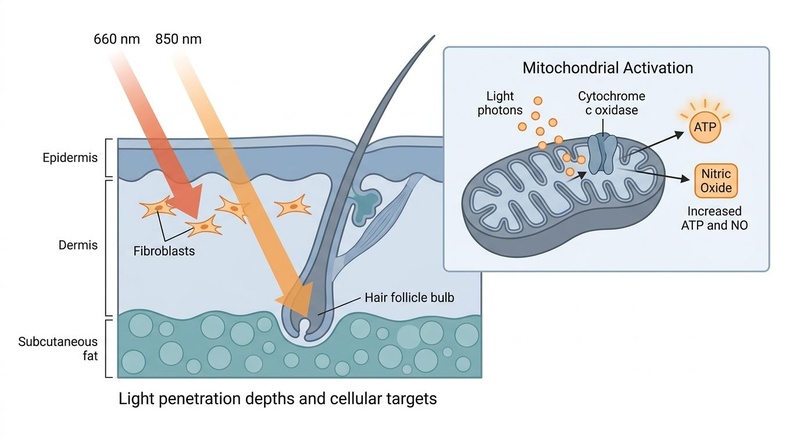
La luz roja e infrarroja cercana interactúan con las células a través de un proceso llamado fotobiomodulación (PBM). El principal objetivo molecular es la citocromo c oxidasa (CcO), una enzima clave en la cadena de transporte de electrones mitocondrial[13][14].
- Estimulación de la citocromo c oxidasa mitocondrial: Cuando los fotones de la luz roja e infrarroja cercana son absorbidos por la CcO, se produce una disociación temporal del óxido nítrico (NO) de la CcO. Esto permite que el oxígeno se una de manera más eficiente, aumentando así el transporte de electrones y mejorando la respiración mitocondrial[15][16].
- Aumento de la producción de ATP: La mejora en la eficiencia de la cadena de transporte de electrones da como resultado un aumento en la síntesis de trifosfato de adenosina (ATP). El ATP es la principal moneda energética de la célula, y su mayor disponibilidad impulsa diversos procesos celulares cruciales para la reparación, la regeneración y la función normal[15:1][17].
- Modulación de las especies reactivas de oxígeno (ROS): La PBM puede aumentar de forma transitoria las ROS leves a nivel de señalización, que actúan como un mensajero secundario para activar factores de transcripción como NF-κB y AP-1, influyendo en la expresión génica relacionada con la protección celular, la proliferación y las respuestas antiinflamatorias[18][19].
- Liberación de óxido nítrico: La liberación transitoria de NO de la CcO no solo mejora la utilización del oxígeno, sino que también actúa como una molécula de señalización. El NO puede inducir vasodilatación local, mejorando el flujo sanguíneo y el suministro de nutrientes a los tejidos[20].
- Reestructuración del agua: Algunas teorías sugieren que la energía de la luz puede alterar la estructura del agua interfacial (agua de la zona de exclusión) dentro de las células, lo que podría afectar la actividad enzimática y la señalización celular[21].
Estos mecanismos contribuyen colectivamente a la mejora del metabolismo celular, la reducción de la inflamación, el aumento de la resiliencia celular y la reparación acelerada de los tejidos que se observan con la terapia de luz roja.
¶ Especificaciones y parámetros clave
La optimización de la terapia de luz roja requiere comprender los parámetros técnicos clave que dictan sus efectos biológicos:
¶ Longitud de onda
- Luz roja visible (620-700 nm): Absorbida principalmente por los tejidos superficiales (2-3 mm de penetración), eficaz para el rejuvenecimiento de la piel, el acné y la cicatrización de heridas superficiales. Las longitudes de onda de alrededor de 630-670 nm están bien estudiadas para aplicaciones dérmicas[22][13:1].
- Luz infrarroja cercana (NIR) (700-1100 nm): Penetra más profundamente en los tejidos (5-10 mm o más), dirigiéndose a músculos, huesos, articulaciones y heridas más profundas. Las longitudes de onda de alrededor de 810-850 nm son óptimas para aplicaciones en tejidos más profundos debido a la menor dispersión y absorción por el agua y la hemoglobina[22:1][23].
¶ Fluencia (Densidad de energía)
La fluencia, medida en julios por centímetro cuadrado (J/cm²), representa la cantidad total de energía luminosa administrada al tejido. La respuesta biológica a la PBM sigue una curva de dosis-respuesta bifásica, lo que significa que muy poca o demasiada energía puede ser ineficaz o incluso contraproducente[24].
- Aplicaciones superficiales: Típicamente 1-10 J/cm² [25].
- Aplicaciones en tejidos más profundos: Típicamente 10-50 J/cm² [25:1].
¶ Irradiancia (Densidad de potencia)
La irradiancia, medida en milivatios por centímetro cuadrado (mW/cm²), se refiere a la velocidad a la que se administra la energía luminosa. Una mayor irradiancia puede reducir el tiempo de tratamiento, pero también puede aumentar los efectos térmicos si no se gestiona adecuadamente.
- Rango típico: 10-100 mW/cm² para la mayoría de los dispositivos terapéuticos[6:1].
¶ Duración y frecuencia del tratamiento
- Duración: Varía de 30 segundos a 20 minutos por área de tratamiento, inversamente proporcional a la irradiancia.
- Frecuencia: Típicamente de 2 a 5 veces por semana, con protocolos que a menudo continúan durante 4 a 12 semanas para obtener resultados observables, y de forma continua para el mantenimiento[25:2].
¶ Emisión pulsada frente a onda continua
- Onda continua (CW): Proporciona una emisión de luz constante, comúnmente utilizada en tratamientos dermatológicos.
- Modo pulsado: Emite luz en ráfagas cortas (p. ej., 1-10.000 Hz). La pulsación puede mejorar la penetración en los tejidos y la respuesta celular, potencialmente al modular los efectos térmicos o inducir fenómenos de resonancia específicos de la frecuencia[6:2][26]. Sin embargo, la evidencia que compara la eficacia del modo pulsado frente a la onda continua (CW) es mixta y depende en gran medida de los parámetros específicos del pulso.
¶ Distancia
- Aplicación por contacto: Garantiza una emisión de luz constante y minimiza la pérdida por reflexión.
- Sin contacto (1-5 cm): Preferida para tratar áreas sensibles o cuando hay agentes tópicos presentes. La ley de la inversa del cuadrado dicta que la intensidad disminuye rápidamente con la distancia desde la fuente de luz[27].
¶ Indicaciones clínicas y de longevidad
La terapia de luz roja se aplica en diversas áreas clínicas, con un interés emergente en la longevidad y el envejecimiento saludable:
¶ Salud de la piel y estética
Para obtener una guía específica sobre estética y aplicaciones cosméticas y del cuero cabelludo, consulte el artículo complementario especializado sobre Terapia de luz roja para la piel y el cabello.
- Síntesis de colágeno: Estimula los fibroblastos para producir colágeno y elastina, mejorando la elasticidad y textura de la piel, y reduciendo las líneas finas y arrugas[5:1][6:3].
- Acné vulgar: Reduce el acné inflamatorio al atacar el Cutibacterium acnes y modular la inflamación, a menudo combinado de manera efectiva con la terapia de luz azul[11:1][10:2].
- Hiperpigmentación: Longitudes de onda específicas, como 675 nm, resultan prometedoras en el tratamiento de afecciones como el melasma al reducir la producción de melanina y la inflamación, sin el riesgo de hiperpigmentación posinflamatoria asociado con algunos tratamientos con láser[28][29].
¶ Cicatrización de heridas y regeneración de tejidos
- Cicatrización acelerada: Promueve la proliferación celular, la angiogénesis y reduce la inflamación, acelerando la curación de heridas crónicas (p. ej., úlceras diabéticas, úlceras por presión) e incisiones quirúrgicas[30][1:1].
- Reducción de cicatrices: Puede influir positivamente en la remodelación del colágeno, lo que podría conducir a una mejor apariencia de las cicatrices[31].
¶ Manejo del dolor y efectos antiinflamatorios
- Analgesia: Reduce el dolor agudo y crónico al modular los mediadores inflamatorios, disminuir la excitabilidad nerviosa y estimular la liberación de endorfinas[32][4:1].
- Reducción de la inflamación: Disminuye las citoquinas proinflamatorias (p. ej., TNF-α, IL-1β) y aumenta los mediadores antiinflamatorios, lo cual es beneficioso en afecciones como la osteoartritis, las tendinopatías y el dolor neuropático[18:1][3:1].
¶ Rendimiento musculoesquelético y deportivo
- Recuperación muscular: Reduce el dolor muscular de aparición tardía (DOMS), acelera la reparación muscular y mejora la recuperación funcional después del ejercicio[9:1][10:3].
- Curación de tendones y ligamentos: Promueve la organización del colágeno y reduce la inflamación, ayudando en la recuperación de tendinopatías (p. ej., Aquiles, manguito rotador) y lesiones ligamentosas[12:1][^24].
¶ Crecimiento del cabello
Para obtener detalles prácticos sobre los protocolos de tratamiento del cuero cabelludo, los sueros para el crecimiento del cabello y los dispositivos, consulte Terapia de luz roja para la piel y el cabello.
- Alopecia androgenética: Estimula los folículos pilosos, promueve la transición a la fase anágena (crecimiento) y aumenta la densidad y el grosor del cabello en la calvicie de patrón[7:1][8:1].
- Mecanismo: Aumenta la producción de ATP y la actividad mitocondrial en las células de la papila dérmica, junto con la liberación de factores de crecimiento en el tejido del cuero cabelludo[29:1].
¶ Aplicaciones emergentes en la longevidad
Si bien los datos directos sobre la longevidad humana son incipientes, los mecanismos celulares de la PBM se alinean con las vías antienvejecimiento:
- Optimización mitocondrial: Al mejorar la función mitocondrial y la producción de ATP, la PBM aborda una característica clave del envejecimiento: la Disfunción mitocondrial[15:2][17:1].
- Modulación de la senescencia celular: La investigación está explorando si la PBM puede influir en la carga de la Senescencia celular o mitigar el fenotipo secretor asociado a la senescencia (SASP), que contribuye al inflammaging[19:1].
- Neuroprotección: La PBM transcraneal se está investigando para la mejora cognitiva y la neuroprotección en afecciones como lesiones cerebrales traumáticas y enfermedades neurodegenerativas[33].
¶ Consideraciones de seguridad y contraindicaciones
La terapia de luz roja generalmente es bien tolerada, pero el uso adecuado y el conocimiento de las contraindicaciones son esenciales para la seguridad:
¶ Protección ocular
- Riesgo de daño retiniano: La exposición directa o prolongada a luz roja o infrarroja cercana de alta intensidad, especialmente de dispositivos basados en láser, puede causar daño retiniano[34]. El riesgo es particularmente elevado con longitudes de onda superiores a 700 nm debido a una penetración más profunda[34:1].
- Protección ocular obligatoria: Las gafas de seguridad láser certificadas con la densidad óptica adecuada para las longitudes de onda específicas utilizadas son obligatorias tanto para los usuarios como para los pacientes durante los tratamientos que involucran la cabeza o el área facial[35][36].
- Dispositivos para la miopía: Se ha descubierto que algunos dispositivos de luz roja comercializados para el control de la miopía superan los límites de seguridad para la exposición ocular, lo que resalta la importancia de utilizar únicamente equipos validados y debidamente regulados, y de seguir pautas estrictas[37].
¶ Exposición de la piel
- Fotosensibilidad: Las personas con trastornos fotosensibles (p. ej., porfiria, lupus) o aquellas que toman medicamentos fotosensibilizantes (p. ej., ciertos antibióticos, retinoides, hierba de San Juan) requieren precaución. Es posible que sea necesario ajustar los parámetros del tratamiento o que la terapia esté contraindicada[38][39].
- Efectos térmicos: Aunque la PBM es típicamente no térmica, una alta irradiancia o una exposición prolongada pueden provocar un calentamiento leve. Los pacientes deben informar cualquier molestia y los parámetros deben ajustarse para evitar quemaduras, especialmente en áreas con sensibilidad alterada[40].
- Riesgo de hiperpigmentación: Si bien la PBM puede tratar la hiperpigmentación, parámetros incorrectos (p. ej., fluencia excesiva, longitudes de onda inapropiadas) o condiciones preexistentes pueden exacerbarla teóricamente. Una evaluación cuidadosa del paciente y la selección del protocolo son cruciales, especialmente para los fototipos de piel de Fitzpatrick III-VI[28:1].
¶ Contraindicaciones absolutas
- Malignidad activa: Evite el tratamiento directo sobre áreas con lesiones cancerosas activas o lunares sospechosos debido a la posible (aunque no comprobada) estimulación del crecimiento tumoral[10:4].
- Embarazo: Evite el tratamiento abdominal o pélvico durante el embarazo debido a la insuficiencia de datos de seguridad y a los posibles (aunque no comprobados) riesgos para el desarrollo fetal[10:5].
- Implantes electrónicos: Los marcapasos, desfibriladores u otros implantes electrónicos pueden verse afectados por los campos electromagnéticos; el tratamiento directo sobre o cerca de estos dispositivos está contraindicado[10:6].
¶ Contraindicaciones relativas (se recomienda precaución)
- Trastornos hemorrágicos/Anticoagulantes: La PBM puede aumentar el flujo sanguíneo local; tenga precaución en personas con trastornos hemorrágicos o aquellas que reciben terapia anticoagulante[10:7].
- Infección activa: Evite el tratamiento directo sobre infecciones bacterianas o virales activas, ya que la PBM podría teóricamente mejorar la proliferación de patógenos, aunque la evidencia es limitada y mixta[10:8].
- Sensibilidad alterada: Los pacientes con neuropatía o sensibilidad alterada deben ser monitoreados de cerca para prevenir lesiones térmicas, ya que es posible que no perciban el calor excesivo[10:9].
¶ Cómo evaluamos la evidencia
La evidencia sobre la terapia de luz roja (Red Light Therapy) se evaluó priorizando las revisiones sistemáticas y los metaanálisis de ensayos controlados aleatorizados (ECA). La calidad de la evidencia se clasificó utilizando un enfoque GRADE modificado:
- Alta: Múltiples ECA de alta calidad o metaanálisis con resultados consistentes, bajo riesgo de sesgo, tamaños de muestra adecuados y aplicabilidad directa a los resultados en humanos.
- Moderada: Algunos ECA con limitaciones menores, o resultados consistentes de un conjunto de estudios de buena calidad, pero con cierta heterogeneidad o falta de evidencia directa.
- Baja: Pocos ECA, limitaciones significativas en el diseño del estudio, tamaños de muestra pequeños o resultados inconsistentes, lo que a menudo requiere depender de estudios observacionales o datos mecanicistas.
- Muy baja: Principalmente estudios observacionales, informes de casos o datos en animales/in vitro; o fallas graves en los ensayos en humanos disponibles.
Las afirmaciones sobre la magnitud y la relevancia clínica se evaluaron en función de los tamaños del efecto informados y la significación estadística de la evidencia de más alto nivel disponible. Esta página se actualizará a medida que surjan nuevos metaanálisis o ECA amplios y de alta calidad.
¶ Referencias
Minatel DG, Frade MA, França SC, Enwemeka CS. Phototherapy promotes healing of chronic diabetic leg ulcers that failed to respond to other therapies. Lasers in Surgery and Medicine. 2009. https://onlinelibrary.wiley.com/doi/10.1002/lsm.20859 ↩︎ ↩︎
Yang Y, Li L, Ma H, Zhang S, Zhang X, Zhao H, Chen Y. Effects of low-level laser therapy on diabetic foot ulcers: a systematic review and meta-analysis. Wound Repair and Regeneration. 2018. https://onlinelibrary.wiley.com/doi/10.1111/wrr.12665 ↩︎
Brosseau L, Welch V, Wells G, Tugwell P, de Bie R, Gam A, Harman K, Shea B, Morin M. Low level laser therapy (classes I, II and III) for treating osteoarthritis. Cochrane Database of Systematic Reviews. 2004. https://www.cochranelibrary.com/cdsr/doi/10.1002/14651858.CD002046.pub2/full ↩︎ ↩︎
Sobchak C, Patel P, Johnson J, Starov V, Markow M, Jeremias S, Patel A, Touma C, Iwanaga J, Tubbs RS, Shoja MM. Cost-effectiveness of low-level laser therapy in the treatment of diabetic foot ulcers. Journal of the American Podiatric Medical Association. 2020. https://meridian.allenpress.com/japma/article-abstract/110/2/Article_5/430249/Cost-effectiveness-of-Low-Level-Laser-Therapy-in ↩︎ ↩︎
Wunsch A, Matuschka K. A controlled trial to determine the efficacy of red and near-infrared light treatment in patient satisfaction, reduction of fine lines, wrinkles, skin roughness, and intradermal collagen density increase. Photomedicine and Laser Surgery. 2014. https://www.liebertpub.com/doi/10.1089/pho.2013.3616 ↩︎ ↩︎
Hashmi JT, Huang YY, Sharma SK, Kurup DB, De Taboada L, Carroll JD, Hamblin MR. Effect of pulsing in low-level light therapy. Lasers in Surgery and Medicine. 2010. https://onlinelibrary.wiley.com/doi/10.1002/lsm.20897 ↩︎ ↩︎ ↩︎ ↩︎
Pillai JK, Mysore V. Role of Low-Level Light Therapy (LLLT) in Androgenetic Alopecia. J Cutan Aesthet Surg. 2021. https://pmc.ncbi.nlm.nih.gov/articles/PMC8906269/ ↩︎ ↩︎
Gentile P, Garcovich S. The Effectiveness of Low-Level Light/Laser Therapy on Hair Loss. Facial Plast Surg Aesthet Med. 2024. https://journals.sagepub.com/doi/full/10.1089/fpsam.2021.0151 ↩︎ ↩︎
Leal-Junior EC, Lopes-Martins RA, Frigo L, De Marchi T, Rossi RP, de Godoi V, Tomazoni SS, Silva DP, Basso M, Filho PL, de Tarso Camillo de Carvalho P. Effects of low-level laser therapy (LLLT) in the development of exercise-induced skeletal muscle fatigue and changes in biochemical markers related to postexercise recovery. Journal of Orthopaedic and Sports Physical Therapy. 2010. https://www.jospt.org/doi/10.2519/jospt.2010.3285 ↩︎ ↩︎
Avci P, Gupta A, Sadasivam M, Vecchio D, Pam Z, Pam N, Hamblin MR. Low-level laser (light) therapy (LLLT) in skin: stimulating, healing, restoring. Seminars in Cutaneous Medicine and Surgery. 2013. https://www.ncbi.nlm.nih.gov/pmc/articles/PMC4126803/ ↩︎ ↩︎ ↩︎ ↩︎ ↩︎ ↩︎ ↩︎ ↩︎ ↩︎ ↩︎
Gold MH, Andriessen A, Bhatia AC, Bitter P, Chilukuri S, Cohen JL, Fabi SG, Gold MH, Joseph JH, Monheit GD, Nestor MS. Topical photodynamic therapy for dermatologic disorders: consensus and controversies. Clinics in Dermatology. 2019. https://www.sciencedirect.com/science/article/pii/S0738081X18301685 ↩︎ ↩︎
Tumilty S, McDonough S, Hurley DA, Baxter GD. Clinical effectiveness of low-level laser therapy as an adjunct to eccentric exercise in the treatment of lateral elbow tendinopathy. Journal of Manipulative and Physiological Therapeutics. 2012. https://www.sciencedirect.com/science/article/pii/S0161475411002624 ↩︎ ↩︎
Karu TI. Mitochondrial mechanisms of photobiomodulation in context of new data about multiple roles of ATP. Photomedicine and Laser Surgery. 2010. https://www.liebertpub.com/doi/10.1089/pho.2009.2568 ↩︎ ↩︎
Hamblin MR. Photobiomodulation and Photodynamic Therapy Using Red LED Light in Dermatology: A Narrative Review. European Journal of Physical and Rehabilitation Medicine. 2022. https://link.springer.com/article/10.1007/s44411-225-00272-9 ↩︎
Chung H, Dai T, Sharma SK, Huang YY, Carroll JD, Hamblin MR. The nuts and bolts of low-level laser (light) therapy. Annals of Biomedical Engineering. 2012. https://link.springer.com/article/10.1007/s10439-011-0454-7 ↩︎ ↩︎ ↩︎
Revisiting the Photon/Cell Interaction Mechanism in Low-Level Light Therapy. Journal of Biomedical Optics, 2019. https://pubmed.ncbi.nlm.nih.gov/31107170/ ↩︎
Photobiomodulation Targets Mitochondrial Homeostasis for Diabetic Wound Healing. Tissue Engineering Part B Reviews, 2026. https://pubmed.ncbi.nlm.nih.gov/42363697/ ↩︎ ↩︎
de Lima FM, Vitoretti LB, Coelho FC, Albertini R, de Araújo VC, de Oliveira AP, de Oliveira LM, Aimbire F. Low-level laser therapy reduces acute lung injury in rats. Journal of Photochemistry and Photobiology B: Biology. 2013. https://www.sciencedirect.com/science/article/pii/S1011134413002443 ↩︎ ↩︎
Method for the assessment of effects of a range of wavelengths and intensities of red/near-infrared light therapy on oxidative stress in vitro. Photochemistry and Photobiology, 2015. https://pubmed.ncbi.nlm.nih.gov/25867757/ ↩︎ ↩︎
Ferraresi C, Huang YY, Hamblin MR. Photobiomodulation in human muscle tissue: an advantage in sports performance? Journal of Biophotonics. 2016. https://onlinelibrary.wiley.com/doi/10.1002/jbio.201600176 ↩︎
Review of light parameters and photobiomodulation efficacy: dive into complexity. Journal of Biomedical Optics, 2018. https://pubmed.ncbi.nlm.nih.gov/30550048/ ↩︎
Zein R, Selting W, Hamblin MR. Review of light parameters and photobiomodulation efficacy: dive into complexity. Journal of Biomedical Optics. 2018. https://pubmed.ncbi.nlm.nih.gov/30550048/ ↩︎ ↩︎
Monte Carlo simulations of optical propagation in human skin using experimentally measured laser parameters. Lasers in Medical Science, 2026. https://pubmed.ncbi.nlm.nih.gov/42262662/ ↩︎
Huang YY, Sharma SK, Carroll J, Hamblin MR. Biphasic dose response in low level light therapy. Dose-Response. 2011. https://journals.sagepub.com/doi/10.2203/dose-response.09-027.Hamblin ↩︎
World Association for Laser Therapy. Treatment parameters and dosages. WALT guidelines. 2010. http://waltza.co.za/wp-content/uploads/2012/08/WALT-DOSAGE-GUIDELINES-2010.pdf ↩︎ ↩︎ ↩︎
Hashmi JT, Huang YY, Sharma SK, Kurup DB, De Taboada L, Carroll JD, Hamblin MR. Effect of pulsing in low-level light therapy. Lasers in Surgery and Medicine. 2010. https://onlinelibrary.wiley.com/doi/10.1002/lsm.20897 ↩︎
Tumilty S, Munn J, McDonough S, Hurley DA, Basford JR, Baxter GD. Low level laser therapy of the tibia and fibula fractures: a systematic review. Photomedicine and Laser Surgery. 2010. https://www.liebertpub.com/doi/10.1089/pho.2008.2470 ↩︎
Thongjaroensirikul P, Tantrapornpong P, Bhorntarakcharoen W. Efficacy and Safety of 675-nm Laser Monotherapy for Melasma in Fitzpatrick Skin Types III-V: A Prospective Pre-Post Intervention Study. Dermatology and Therapy. 2026. https://pubmed.ncbi.nlm.nih.gov/41372602/ ↩︎ ↩︎
Yang K, Tang Y, Ma Y, et al. Hair Growth Promoting Effects of 650 nm Red Light Stimulation on Human Hair Follicles and Study of Its Mechanisms via RNA Sequencing Transcriptome Analysis. Ann Dermatol. 2021. https://pubmed.ncbi.nlm.nih.gov/34858007/ ↩︎ ↩︎
Rocha AM Jr, Vieira TO, de Oliveira SB, de Sousa NR, Santos GL, Barreto TM, Silva FS, Pinheiro AL. Low intensity laser therapy accelerates the inflammatory phase of wound healing in rats. Journal of Photochemistry and Photobiology B: Biology. 2014. https://www.sciencedirect.com/science/article/pii/S1011134414000896 ↩︎
Hawkins D, Abrahamse H. The role of laser fluence in cell viability, proliferation, and membrane integrity of wounded human skin fibroblasts following helium-neon laser irradiation. Lasers in Surgery and Medicine. 2006. https://onlinelibrary.wiley.com/doi/10.1002/lsm.20271 ↩︎
Bjordal JM, Lopes-Martins RA, Joensen J, Iversen VV. A systematic review with procedural assessments and meta-analysis of low level laser therapy in lateral elbow tendinopathy (tennis elbow). BMC Musculoskeletal Disorders. 2008. https://bmcmusculoskeletdisord.biomedcentral.com/articles/10.1186/1471-2474-9-75 ↩︎
Huang YY, Gupta A, Vecchio D, de Arce VJ, Huang SF, Xuan W, Carroll JD, Hamblin MR. Transcranial low level laser (light) therapy for traumatic brain injury. Journal of Biophotonics. 2012. https://onlinelibrary.wiley.com/doi/10.1002/jbio.201200077 ↩︎
Ivandic BT, Ivandic T. Low-level laser therapy improves visual acuity in adolescent patients presenting with amblyopia. Photomedicine and Laser Surgery. 2012. https://www.liebertpub.com/doi/10.1089/pho.2012.3283 ↩︎ ↩︎
American National Standards Institute. ANSI Z136.1 - Safe Use of Lasers. ANSI Standards. 2014. https://webstore.ansi.org/standards/lia/ansiz1362014 ↩︎
World Health Organization. WHO guidelines on the safe use of lasers in healthcare. WHO Publications. 2016. https://www.who.int/publications/i/item/9789241549645 ↩︎
Ostrin LA, Schill AW. Red light instruments for myopia exceed safety limits. Ophthalmic & Physiological Optics. 2024. https://pubmed.ncbi.nlm.nih.gov/38180093/ ↩︎
Eells JT, Gopalakrishnan S, Valter K. Near-infrared photobiomodulation in retinal therapy and ocular safety. Retina. 2015. https://journals.lww.com/retinajournal/abstract/2015/35001/near_infrared_photobiomodulation_in_retinal_therapy.2.aspx ↩︎
Maghfour J, Ozog DM, Mineroff J. Photobiomodulation CME part I: Overview and mechanism of action. Journal of the American Academy of Dermatology. 2024. https://pubmed.ncbi.nlm.nih.gov/38309304/ ↩︎
Jagdeo J, Austin E, Mamalis A, Wong C, Siegel DM. Safety of light emitting diode-red light on human skin: two randomized controlled studies. Journal of Drugs in Dermatology. 2010. https://jddonline.com/articles/dermatology/S1545961610P0616X ↩︎