¶ High-Intensity Interval Training (HIIT): Deep Dive
High-Intensity Interval Training (HIIT) is a highly efficient exercise strategy characterized by alternating brief, repeated bursts of intense, near-maximal physical effort with periods of low-intensity recovery or passive rest [1][2]. In clinical medicine and exercise physiology, HIIT is celebrated for its remarkable capacity to drive rapid, profound adaptations in cardiovascular compliance, skeletal muscle metabolic capacity, and overall longevity [3][4].
| Indication | VO2 Max Expansion, Left Ventricular Compliance, Mitochondrial Power, Insulin Sensitivity |
| Access | Behavioral Intervention |
| Dosing Sched | 1 to 2 sessions per week (highly structured intervals) |
| Safety Profile | Moderate (requires cardiovascular screening for clinical populations) |
| Key Marker | Maximum Heart Rate (90–95% MHR), Peak Power Output, Heart Rate Recovery |
| Est. Cost | $0 (bodyweight sprinting/stair climbing) to variable (stationary trainer) |
¶ TL;DR (5 bullets max)
- Verdict: HIIT is a highly time-efficient training modality that drives massive, rapid improvements in peak cardiorespiratory fitness (VO2 max) and mitochondrial metabolic capacity, comparable or superior to traditional continuous endurance exercise [5][4:1][6].
- Who it's for: Indicated for healthy adults and medically screened clinical populations looking to efficiently elevate their cardiovascular limits, reverse insulin resistance, and support healthy biological aging [7][8].
- Expected Impact: A 10–20% increase in VO2 max and significant reductions in resting blood pressure and arterial stiffness within 6 to 12 weeks of consistent training [9][4:2].
- Key Risk(s): Acute cardiovascular strain, orthopedic overload, and autonomic nervous system overreaching if weekly volume or frequency is excessive [10][8:1].
- What to do next: Incorporate 1 structured HIIT session per week (such as the Norwegian 4x4 protocol) within a balanced, polarized training routine that includes a strong foundation of Zone 2 training [3:1][11].
¶ Quick Answer (Feature Snippet style)
HIIT consists of repeated intervals of vigorous, near-maximal exercise performed at 85% to 95% of maximum heart rate (or an RPE of 8 to 10 out of 10), interspersed with active or passive recovery periods [[1:1][10:1]. This high-intensity stimulus triggers eccentric cardiac remodeling—expanding left ventricular chamber size to increase stroke volume—and activates key signaling pathways (AMPK and PGC-1α) that drive skeletal muscle mitochondrial biogenesis [3:2][12]. To optimize long-term healthspan and cardiorespiratory fitness, clinical guidelines recommend performing 1 to 2 HIIT sessions per week, with each session consisting of 15 to 40 minutes of cumulative training volume (including warm-up and cool-down) [10:2][11:1].
¶ What It Is (Plain-English)
High-Intensity Interval Training (HIIT) is an exercise methodology that uses short, structured periods of intense work to stress the cardiovascular and metabolic systems near their absolute limits [1:2][2:1]. Unlike traditional long, slow distance cardio (where you maintain a steady, moderate pace), HIIT relies on pushing your heart rate and muscular efforts into the anaerobic zone, followed by periods of light recovery that allow your cardiovascular system to partially clear fatigue and prepare for the next effort [13][4:3].
- What counts: Structured intervals of running, cycling, rowing, swimming, or rucking where efforts exceed 85% of your maximum heart rate (or RPE 8/10), such as the Tabata protocol, Norwegian 4x4, or Sprint Interval Training (SIT) [1:3][2:2][4:4].
- What doesn’t count: Casual walking, steady-state Zone 2 training, or circuit training with light weights where heart rate fluctuates but never reaches the near-maximal cardiovascular thresholds required for central cardiac adaptation [10:3][11:2].
¶ Key Physiological Adaptations of HIIT
HIIT drives rapid, profound physiological remodeling across both central cardiovascular and peripheral muscular systems:
¶ Central Cardiovascular Plasticity: Stroke Volume & Peak Cardiac Output
One of the primary drivers of HIIT-mediated improvements in VO2 max is central cardiovascular remodeling [3:3]. Near-maximal high-intensity intervals demand maximal cardiac output, which rapidly increases venous return and myocardial wall stress.
- Stroke Volume Expansion: The elevated volume load during high-intensity intervals induces eccentric cardiac remodeling, leading to ventricular chamber enlargement and increased myocardial contractility [5:1]. This adaptation enhances maximal stroke volume (the volume of blood ejected per contraction) both at rest and during peak exercise.
- Peak Cardiac Output: Because cardiac output is the product of heart rate and stroke volume (), the chronic increase in stroke volume, combined with sustained peak heart rates during maximal efforts, significantly expands peak cardiac output [3:4]. This allows the cardiovascular system to deliver a substantially higher volume of oxygenated blood to contracting skeletal muscles.
¶ Cellular & Peripheral Adaptations: Mitochondrial Biogenesis & PGC-1α Activation
While cardiovascular adaptations improve oxygen delivery, peripheral adaptations dictate the muscle's ability to extract and utilize that oxygen.
- Mitochondrial Biogenesis via PGC-1α Activation: The intense cellular stress associated with HIIT—marked by rapid ATP depletion, transient cellular hypoxia, and marked increases in intracellular calcium () and AMP levels—triggers a robust signaling cascade [12:1]. This activates key energetic sensors, specifically calcium/calmodulin-dependent protein kinase (CaMK) and AMP-activated protein kinase (AMPK) [12:2][13:1]. These upstream kinases converge to activate peroxisome proliferator-activated receptor gamma coactivator 1-alpha (PGC-1α), the master regulator of mitochondrial biogenesis. Chronic PGC-1α activation leads to an increase in both mitochondrial size and density, as well as an upregulation of mitochondrial enzymes involved in the electron transport chain and oxidative phosphorylation [14][12:3].
- Cellular Metabolic Flexibility: HIIT dramatically enhances metabolic flexibility—the cell's capacity to seamlessly transition between lipid and carbohydrate oxidation based on energy demands and nutrient availability [15]. During high-intensity work intervals, the muscle relies heavily on rapid anaerobic glycolysis and carbohydrate oxidation. During recovery intervals and subsequent steady-state activities, the expanded mitochondrial pool and increased expression of fatty acid transporters (such as FAT/CD36) allow the muscle to efficiently utilize lipid oxidation for ATP synthesis [15:1][12:4]. This dual adaptation protects muscle glycogen stores, delays fatigue, and enhances systemic insulin sensitivity.
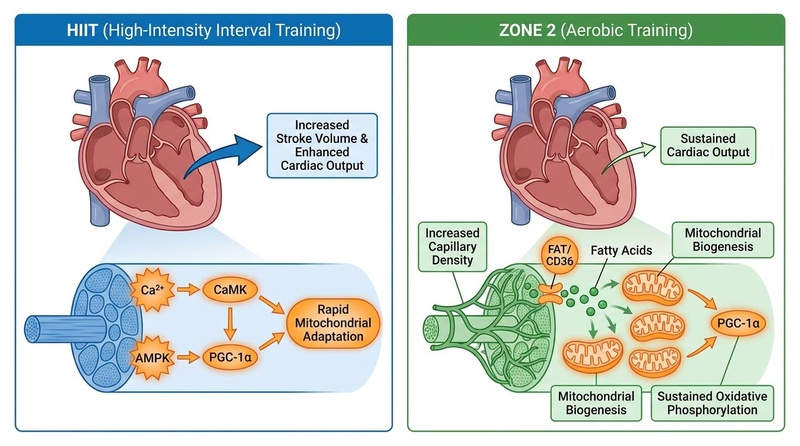
**Figure 1: HIIT vs. Zone 2 adaptations.** HIIT primarily drives central cardiac adaptations, such as left ventricular expansion to increase stroke volume and peak cardiac output. In contrast, Zone 2 training targets peripheral adaptations, such as capillary density and mitochondrial efficiency [^11][^16][^25].
¶ Does It Work? (Evidence Snapshot)
HIIT is highly effective in improving numerous health markers and physiological parameters:
| Outcome / Goal | Population | Effect Size | Confidence | Citations |
|---|---|---|---|---|
| VO2 Max (cardiorespiratory fitness) | General adult, trained/untrained | ↑↑↑ (p) 10–20% increase | High | [1:4][4:5][6:1] |
| Stroke Volume & Cardiac Output | Sedentary, obese, clinical cohorts | ↑↑ (p) Significant increase | High | [5:2][3:5] |
| Mitochondrial Biogenesis & Enzymes | Healthy, active adults | ↑↑ (p) Increased enzyme activity | High | [14:1][12:5] |
| Insulin Sensitivity & Glucose Control | Type 2 Diabetes, metabolic syndrome | ↑↑ (p) Significant improvement | High | [15:2][8:2] |
| Arterial Stiffness & Compliance | Hypertensive adults | ↓↓ (p) Significant reduction | High | [7:1][10:4] |
| Epigenetic Age Deceleration | Middle-aged and older adults | ↓↓ (p) Decelerated DNA methylation age | Moderate | [16][17] |
¶ Who Benefits Most / Least
¶ Who Benefits Most
- Time-Constrained Individuals: Those with limited training time who want to maximize cardiorespiratory and metabolic adaptations with minimal weekly exercise duration [6:2].
- Older Adults: Both older men and women experience significant gains in cardiorespiratory fitness, mitochondrial respiration, and blood pressure regulation through appropriately scaled high-intensity intervals [18][16:1].
- Individuals with Metabolic Syndrome: HIIT rapidly stimulates muscular GLUT4 translocation, leading to long-term improvements in peripheral insulin sensitivity and glycemic control [15:3][8:3].
¶ Who Benefits Least
- Sedentary Beginners (Initial 4 Weeks): Completely detrained individuals should avoid maximal HIIT efforts. Introducing high-intensity intervals too early can cause joint pain, excessive fatigue, and poor adherence. They should focus on developing an aerobic base via Zone 2 training first [10:5][11:3].
- Individuals with Autonomic Burnout: Those presenting with chronic fatigue, poor sleep quality, or high resting cortisol should prioritize low-stress, restorative cardiovascular exercise (Zone 2) over high-sympathetic HIIT sessions [8:4].
¶ Prerequisites & Contexts of Failure
HIIT fails to deliver optimal adaptations when:
- Work Intensities are Blurred: If you fail to push into the true Zone 5/high-intensity zone (> 85% MHR) during work intervals, you will not trigger the cardiac volume overload required for stroke volume expansion [3:6][10:6].
- Recovery Intervals are Executed Too Hard: If you jog or cycle too fast during recovery periods, you will not clear metabolic accumulation, preventing you from reaching maximal workloads in subsequent intervals.
- Frequency is Excessive: Performing more than 3 HIIT sessions per week causes central nervous system fatigue, muscle damage, and joint injury, blunting long-term adaptations.
¶ How to Try It (Actionable Protocols)
Ensure a thorough 10-minute warm-up before any HIIT session and a 5-minute cool-down afterwards to transition your cardiovascular system safely.
¶ Protocol A: The "Norwegian 4x4" Method
This is the gold-standard protocol for maximizing VO2 max and cardiac stroke volume adaptations in clinical and athletic populations [5:3].
- Modality: Running, stationary cycling, rowing, or swimming.
- Warm-up: 10 minutes of low-intensity aerobic exercise (Zone 1–2).
- Work Intervals: Perform 4 intervals of 4 minutes at 85–95% of maximum heart rate (RPE 8-9/10; comfortably hard—you can only speak in short, gasping words).
- Recovery Intervals: 3 minutes of light active recovery (Zone 1, easy spinning or jogging) between work intervals.
- Cool-down: 5–10 minutes of light continuous movement.
- Frequency: 1 to 2 sessions per week.
¶ Protocol B: The "Tabata" Protocol
A highly efficient, ultra-short protocol designed to challenge anaerobic capacity and peak metabolic output [2:3].
- Modality: Stationary cycling, rowing, or bodyweight exercises (e.g., thrusters, kettlebell swings).
- Warm-up: 5–10 minutes of progressive movement.
- Work Intervals: Perform 8 intervals of 20 seconds of all-out, maximal effort (RPE 10/10).
- Recovery Intervals: 10 seconds of complete rest between work intervals.
- Total Duration: 4 minutes (excluding warm-up and cool-down).
- Frequency: 1 session per week.
¶ Protocol C: Sprint Interval Training (SIT)
Involves maximal, supramaximal efforts followed by long, complete recovery periods to challenge fast-twitch muscle fibers and Peak Power Output [6:3].
- Modality: Stationary cycling or sprinting on a flat surface.
- Warm-up: 10 minutes of easy continuous work.
- Work Intervals: Perform 3 to 4 intervals of 30 seconds of all-out, maximal-effort sprinting (RPE 10/10).
- Recovery Intervals: 4 minutes of complete passive rest or very light walking between intervals to allow full replenishment of ATP-PCr stores.
- Frequency: 1 session per week.
¶ Polarized Training Integration
To maximize longevity benefits, integrate HIIT into a polarized routine, commonly known as the 80/20 rule [10:7][11:4]. Dedicate approximately 80% of your weekly training volume to low-intensity Zone 2 training, and 20% to high-intensity training (Zone 5/HIIT). This prevents autonomic fatigue while driving comprehensive cardiorespiratory and metabolic adaptations [3:7]. For annual structuring, refer to the Training Blocks & Periodization guide.