¶ N-of-1 Nutrition Testing: Deep Dive
Personalized nutrition, often guided by N-of-1 (single-subject) testing, moves beyond generalized dietary advice to understand how individual bodies respond to specific foods, supplements, and eating patterns. This approach utilizes real-time data from various monitoring technologies and structured self-experimentation to optimize health outcomes.
¶ TL;DR (5 bullets max)
- Personalized nutrition based on N-of-1 experiments is critical for understanding individual metabolic responses to diet, offering insights beyond population averages [1][2].
- Continuous Glucose Monitors (CGMs) provide real-time feedback on glycemic sensitivity to specific foods, allowing for personalized dietary adjustments [3][4].
- Postprandial lipid testing helps identify individuals with impaired fat clearance, even with normal fasting lipids, a key cardiovascular risk factor [5][6].
- Salt sensitivity testing can reveal individualized blood pressure responses to sodium intake, guiding personalized sodium recommendations.
- Structured food elimination-reintroduction protocols are effective for identifying food sensitivities and their impact on various symptoms.
¶ Quick Answer
N-of-1 nutrition testing involves systematic self-experimentation and data collection to determine individual responses to specific dietary interventions. This can include using Continuous Glucose Monitors (CGMs) to map glycemic sensitivity to foods [3:1], conducting oral fat tolerance tests to assess postprandial lipid clearance [7], evaluating salt-induced blood pressure changes, and employing elimination-reintroduction diets for food sensitivities. The goal is to move from population-level dietary guidelines to precise, individualized nutritional strategies, often leveraging technologies that provide real-time biofeedback [4:1]. Such personalized approaches can lead to significant improvements in metabolic health, energy levels, and symptom management by aligning diet with unique physiological needs [1:1].
¶ What It Is (Plain-English)
N-of-1 (pronounced "N-of-one") nutrition testing is about turning yourself into a miniature science experiment to figure out exactly what your body needs. Instead of following generic health advice, you systematically test how different foods or dietary changes affect your unique physiology. This approach recognizes that while general guidelines are a starting point, individual responses can vary wildly due to genetics, gut microbiome, lifestyle, and other factors [1:2][2:1].
This personalized approach typically involves:
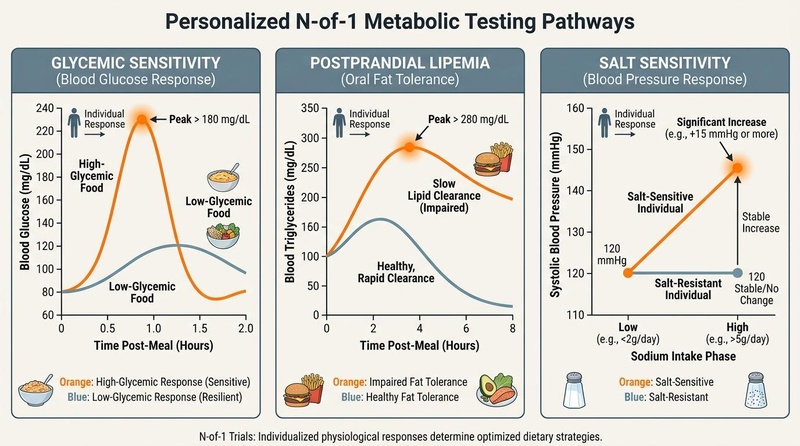
- Continuous Glucose Monitoring (CGM) Testing: Wearing a small sensor that tracks your blood sugar levels in real-time, showing how different meals and activities cause spikes and dips (see Glycemic Control) [3:2].
- Lipid Responsiveness to Dietary Fat Changes: Assessing how your body processes fats after a meal, often through blood tests, to identify if you're efficiently clearing fats from your bloodstream [7:1].
- Salt/Blood Pressure Sensitivity: Determining if your blood pressure is particularly sensitive to sodium intake by tracking changes with varying salt levels.
- Food Elimination-Reintroduction Ladders: Systematically removing suspected problematic foods from your diet and then reintroducing them one by one to pinpoint triggers for symptoms like digestive issues, fatigue, or skin problems.
- Postprandial Lipemia Testing: A specific type of lipid testing that measures triglyceride levels several hours after a high-fat meal to evaluate fat metabolism [6:1].
The core idea is to collect objective data about your body's responses, rather than relying solely on subjective feelings or broad assumptions. This data-driven approach allows for fine-tuning your diet to your personal metabolic blueprint.
¶ Does It Work? (Evidence Snapshot)
N-of-1 nutrition testing methodologies are gaining traction and demonstrating significant clinical utility, particularly in tailoring interventions for metabolic health.
| Outcome | Intervention | Population | Typical Effect Size | Certainty Grade (GRADE) | Study Count & Best Design |
|---|---|---|---|---|---|
| Personalized Glycemic Control | N-of-1 CGM-guided diet | Healthy adults, prediabetics | High within-individual reproducibility of glycemic response to foods (ICC = 0.73-0.88 over 2 years) [3:3] | High | Multi-subject N-of-1 trials (176 participants validated in 30-subject cohort) [3:4] |
| Identification of Impaired Fat Clearance | Oral Fat Tolerance Test (OFTT) | Individuals with normal fasting lipids, metabolic syndrome | Identifies postprandial hypertriglyceridemia (triglycerides > 280 mg/dL post-meal) in those missed by fasting tests [7:2][6:2] | Moderate | Population-based study (212 subjects) & reviews [7:3][6:3] |
| Optimized Dietary Intervention Adherence | Sensor-based eating monitoring | General population | Enhances accuracy of personalized nutrition interventions by capturing real-time eating behaviors [4:2] | Moderate | Scoping Review [4:3] |
| Improved Dietitian Practice | Integration of N-of-1 methods | Dietitians, patients | Warrants further research to provide evidence for personalized medical nutrition therapy [1:3] | Moderate | Systematic Review of Nutrition-Related N-of-1 studies [1:4] |
| Identification of Food-Specific Responses | N-of-1 meal pattern analysis | Adults with obesity | Postprandial glucose response is highly dependent on meal patterns and individual insulin resistance [8] | Moderate | Cohort study [8:1] |
¶ Who Benefits Most / Least
¶ Who Benefits Most
- Individuals with persistent, unexplained symptoms (e.g., digestive issues, fatigue, skin problems) where general dietary changes haven't helped. N-of-1 testing can pinpoint specific triggers [1:5].
- Those seeking to optimize metabolic health beyond standard guidelines, including athletes and biohackers looking for precise fuel timing or specific food sensitivities [3:5].
- Individuals with prediabetes or early metabolic dysfunction who want to fine-tune their diet to stabilize blood sugar and improve insulin sensitivity [3:6][8:2].
- People with normal fasting lipid panels but other cardiovascular risk factors who may have occult postprandial hyperlipemia identified through specific testing [5:1][7:4].
- Anyone motivated by data-driven approaches to health and willing to commit to structured self-experimentation and detailed tracking.
¶ Who Benefits Least (or Require Caution)
- Individuals with a history of disordered eating, orthorexia, or eating disorders: The intense focus on food tracking, restriction, and physiological responses can exacerbate unhealthy behaviors and lead to anxiety [1:6][2:2].
- Those unwilling or unable to commit to consistent data collection and structured protocols: N-of-1 testing requires discipline and careful adherence to yield meaningful insights.
- Individuals relying solely on N-of-1 data for serious medical conditions: While informative, N-of-1 results should always be interpreted within a broader clinical context and under the guidance of a healthcare professional.
- People seeking quick fixes: Personalized nutrition takes time, patience, and iterative adjustments; it's not a one-time test.
¶ How to Try It (Actionable Protocols)
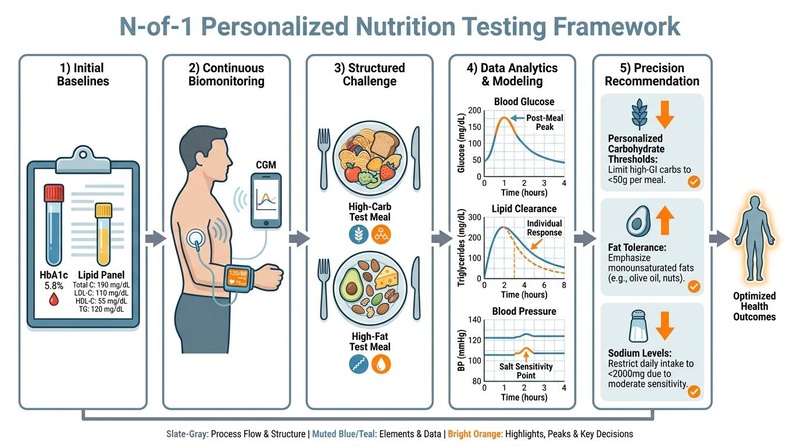
Implementing N-of-1 nutrition testing involves structured protocols tailored to specific metabolic outcomes.
¶ 1. Continuous Glucose Monitoring (CGM) for Glycemic Sensitivity
Goal: Understand how different foods and meals impact your blood sugar.
Starter Protocol (2-4 Weeks):
- Wear a CGM: Obtain a prescription for a CGM (e.g., Dexcom, Freestyle Libre) and wear it for 14-28 days.
- Baseline Week: Eat your usual diet. Log everything you eat and drink, noting quantities and timing. Observe your glycemic patterns (spikes, time-in-range, overnight stability).
- Targeted Food Testing: Select 3-5 specific foods or food combinations you want to test (e.g., white rice vs. brown rice, bread vs. sweet potato, protein shake vs. whole meal).
- Controlled Meals: Over several days, eat only one test food at a consistent time (e.g., breakfast or lunch) with minimal other variables. Monitor your glucose response for 2-4 hours post-meal.
- Analyze & Adjust: Compare the glucose curves for different foods. Identify "hyper-spikers" and adjust your diet to favor foods that elicit a more stable response [3:7].
Pitfall: Over-restricting healthy carbohydrates due to transient spikes; focus on overall glycemic load and consistency.
¶ 2. Postprandial Lipemia Testing (Oral Fat Tolerance Test - OFTT)
Goal: Evaluate your body's ability to clear dietary fats from the bloodstream after a meal, even if fasting lipids are normal.
Starter Protocol:
- Preparation: Fast for 12 hours overnight. Avoid strenuous exercise and alcohol for 24 hours prior.
- Baseline Blood Draw: Obtain a fasting lipid panel (total cholesterol, HDL, LDL, triglycerides).
- High-Fat Meal: Consume a standardized high-fat meal (e.g., ~800-1000 calories with 50-70g fat, such as a high-fat breakfast sandwich or a standardized liquid meal).
- Serial Blood Draws: Have blood drawn at 3, 4, 6, and 8 hours post-meal to measure triglyceride levels [6:4].
- Interpretation: Look for peak triglyceride levels and how quickly they return to baseline. A postprandial triglyceride level of >280 mg/dL at any point post-meal can indicate impaired clearance and increased cardiovascular risk [6:5].
Consideration: This test requires coordination with a lab capable of serial blood draws.
¶ 3. Salt Sensitivity / Blood Pressure Response
Goal: Determine if your blood pressure is disproportionately affected by sodium intake.
Starter Protocol (2 Weeks):
- Establish Baseline: For 1 week, eat your usual diet. Measure your blood pressure twice daily (morning/evening) and average the readings. Track your typical sodium intake.
- Low-Sodium Phase: For 3-5 days, aim for a very low sodium intake (e.g., <1500 mg/day). Track food intake meticulously. Continue daily BP measurements.
- High-Sodium Challenge: For 3-5 days, reintroduce higher sodium intake (e.g., 3000-5000 mg/day). Continue daily BP measurements.
- Analyze: Compare average blood pressure readings across the phases. A significant increase (>5 mmHg systolic) during the high-sodium phase suggests salt sensitivity.
Warning: Individuals with existing hypertension or kidney disease should perform this only under medical supervision.
¶ 4. Food Elimination-Reintroduction Ladder
Goal: Identify specific foods or ingredients that trigger adverse symptoms.
Starter Protocol (4-6 Weeks):
- Elimination Phase (2-3 Weeks): Identify common problematic foods (e.g., gluten, dairy, soy, corn, eggs, nightshades, artificial sweeteners). Eliminate ALL of them completely from your diet. Focus on whole, unprocessed, hypoallergenic foods. Meticulously track all symptoms (digestive, skin, energy, mood) daily.
- Reintroduction Phase (1 Week per Food):
- Choose one eliminated food to reintroduce.
- Consume a small amount of that food for 1-2 days.
- Observe symptoms for 2-3 days without consuming that food again.
- If no symptoms, that food is likely safe. If symptoms appear, it's a potential trigger.
- Proceed to the next food on your list.
Commitment: This protocol requires strict adherence and patience. Maintaining a detailed food and symptom journal is crucial.
¶ Safety, Interactions, Red Flags
Who should avoid/exercise caution:
- Individuals with a history or active diagnosis of eating disorders (e.g., anorexia nervosa, bulimia nervosa, orthorexia): The intense focus on food rules, data, and body responses inherent in N-of-1 testing can be highly detrimental and trigger relapse [1:7][2:3]. These individuals require professional psychological and nutritional support, not self-experimentation.
- Children and adolescents: Their nutritional needs are dynamic and critical for growth; restrictive or highly monitored diets without medical supervision are inappropriate.
- Pregnant or breastfeeding individuals: Nutrient needs are elevated; restrictive or experimental diets can pose risks to maternal and fetal health.
- Individuals with severe chronic diseases (e.g., advanced kidney disease, uncontrolled diabetes on complex medication regimens): Significant dietary changes or testing should only be undertaken under strict medical supervision.
Common Side Effects (and mitigation):
- Anxiety or Obsession: The constant tracking and analysis can lead to anxiety about food choices or an unhealthy preoccupation with data. Mitigation: Take breaks from tracking, focus on overall patterns rather than daily fluctuations, and consult a mental health professional if concerns arise.
- Nutrient Deficiencies (during elimination diets): Restricting food groups can lead to inadequate intake of essential vitamins and minerals. Mitigation: Work with a registered dietitian to ensure nutritional adequacy; consider a broad-spectrum multivitamin/mineral supplement.
- Social Isolation: Strict dietary protocols can make social eating challenging. Mitigation: Communicate your needs to friends/family, choose restaurants with flexible menus, and focus on the health benefits without becoming rigid.
- Hypoglycemia (with aggressive CGM-guided carbohydrate restriction): Especially if also on glucose-lowering medications. Mitigation: Monitor closely, be aware of symptoms of low blood sugar, and consult a clinician for medication adjustments.
Red Flags (Consult a Clinician Immediately):
- Persistent, severe fatigue, dizziness, or weakness not resolving with dietary adjustments.
- Unexplained or rapid weight loss/gain.
- Signs of nutrient deficiencies (e.g., hair loss, brittle nails, unusual bruising).
- Development or exacerbation of disordered eating thoughts or behaviors.
- Recurrent episodes of symptomatic hypoglycemia (<55 mg/dL).
- Orthostatic hypotension (dizziness upon standing) unresponsive to fluid/electrolyte adjustments.
- Significant changes in mood, anxiety, or sleep patterns.
¶ Tracking & What “Good” Looks Looks Like
Effective N-of-1 nutrition testing relies on consistent tracking of both objective biomarkers and subjective well-being.
Biomarkers (with units/frequency):
- Continuous Glucose Monitor (CGM) Data:
- Time-in-Range (TIR): % of readings 70-140 mg/dL (daily/weekly average). Good: >90%.
- Glycemic Variability (Standard Deviation/Coefficient of Variation): (daily/weekly). Good: SD < 20 mg/dL, CV < 36%.
- Area Under the Curve (AUC): Postprandial glucose response (calculated for specific test meals).
- Blood Lipids (Fasting & Postprandial):
- Triglycerides: mg/dL (Fasting: quarterly; Postprandial: 3, 4, 6, 8 hours post-OFTT). Good: Fasting <100 mg/dL; Postprandial <180 mg/dL at 4 hours, returning to baseline by 8 hours.
- Apolipoprotein B (ApoB): mg/dL (annually). Good: <90 mg/dL.
- Blood Pressure: mmHg (daily morning/evening average). Good: <120/80 mmHg.
- HbA1c: % (quarterly). Good: <5.4%.
- Inflammatory Markers (hs-CRP): mg/L (annually). Good: <1.0 mg/L.
- Metabolomics: Untargeted small-molecule profiles (pre/post-intervention, if using advanced testing).
Subjective Metrics (Daily Journaling):
- Energy Levels: (1-10 scale).
- Digestive Symptoms: (bloating, gas, stool consistency/frequency).
- Mood & Cognitive Clarity: (e.g., brain fog, irritability).
- Sleep Quality: (duration, ease of falling asleep, awakenings).
- Cravings: (intensity, type).
- Skin Health: (acne, rashes, redness).
Time-to-Benefit:
- Acute (hours-days): Immediate changes in CGM readings post-meal, subtle shifts in energy or digestive comfort with food changes.
- Intermediate (1-4 weeks): Noticeable improvements in symptom severity, more stable energy, improved CGM metrics.
- Long-term (1-3 months+): Sustained improvements in overall well-being, stable blood pressure, optimized lipid panels, and reduced inflammatory markers.
Simple N-of-1 Template (AB/ABA Design): For a comprehensive breakdown of crossover trials, washouts, and decision rules, see How to Run N-of-1 Experiments.
- Phase A (Baseline/Control): Follow your regular diet for 1-2 weeks. Track all chosen objective and subjective metrics. This establishes your personal "normal."
- Phase B (Intervention): Implement one specific dietary change (e.g., eliminate dairy, increase fiber, test a specific food). Maintain this change for 1-2 weeks. Track all metrics.
- Phase A (Reintroduction/Return to Baseline - optional but recommended): If symptoms improved in Phase B, return to Phase A for 1 week to see if symptoms recur. This strengthens causality.
- Compare: Analyze data from Phase A vs. Phase B to identify effects. Repeat the cycle with other interventions.
¶ Common Mistakes & Myths
- Myth: CGMs are only for diabetics.
- Reality: CGMs offer invaluable biofeedback for healthy individuals to understand personalized glycemic responses, even if they never experience clinical diabetes [3:8]. However, interpreting data for non-diabetics differs from diabetic management.
- Mistake: Confounding variables.
- Reality: In N-of-1 testing, changing too many variables at once makes it impossible to pinpoint cause and effect. Rule of thumb: test one intervention at a time.
- Myth: All high-fat foods are bad for heart health if you have normal fasting lipids.
- Mistake: Ignoring subjective symptoms while focusing only on objective data.
- Reality: How you feel (energy, mood, digestion) is crucial. Objective data explains why you feel that way. Integrate both.
- Myth: Food sensitivities are always severe and immediate.
- Reality: Many food sensitivities cause delayed or subtle symptoms (e.g., chronic fatigue, mild joint pain) that can be difficult to link without structured elimination/reintroduction.
- Mistake: Neglecting professional guidance.
- Reality: While N-of-1 is self-experimentation, consulting with a doctor, dietitian, or nutritionist can help design safe protocols, interpret complex data, and ensure nutritional adequacy.
¶ Decision Tree (Text-Based)
[Start: Assess Interest in Personalized Nutrition]
       │
       ▼
Do you have a history of disordered eating or orthorexia?
       ├─► YES: DO NOT proceed with unsupervised N-of-1 testing. Seek professional psychological and nutritional support.
       │
       └─► NO:
                │
                ▼
            What is your primary goal?
                ├─► METABOLIC OPTIMIZATION (Blood Sugar, Energy, Weight)
                │      │
                │      ▼
                │  Consider CGM-Guided Protocol (Section 1).
                │  Action: Wear CGM for 2-4 weeks, test specific foods, analyze responses.
                │
                ├─► CARDIOVASCULAR RISK ASSESSMENT (beyond fasting lipids)
                │      │
                │      ▼
                │  Consider Postprandial Lipemia Testing (Section 2).
                │  Action: Consult clinician for OFTT, monitor post-meal triglycerides.
                │
                ├─► IDENTIFYING SYMPTOM TRIGGERS (Digestive, Skin, Fatigue, Mood)
                │      │
                │      ▼
                │  Consider Food Elimination-Reintroduction Ladder (Section 4).
                │  Action: Eliminate common triggers for 2-3 weeks, reintroduce one by one.
                │
                └─► BLOOD PRESSURE MANAGEMENT (individualized sodium response)
                       │
                       ▼
                   Consider Salt Sensitivity Testing (Section 3).
                   Action: Track BP with varied sodium intake (under supervision if hypertensive).
¶ FAQs (People Also Ask targets)
¶ What is a "glucotype"?
A "glucotype" refers to an individual's unique pattern of blood glucose responses to different foods and meals, as measured by a CGM. Research shows that people have distinct glucotypes, meaning a food that spikes one person's blood sugar might have little effect on another's. N-of-1 testing helps uncover your specific glucotype [3:9].
¶ Can N-of-1 testing help with weight loss?
Yes, by providing personalized insights into how specific foods affect your blood sugar, satiety, and energy levels, N-of-1 testing can help you make more effective dietary choices for weight management. For example, identifying foods that cause rapid glucose spikes and subsequent crashes can help you avoid cravings and overeating.
¶ How accurate are wearable sensors for nutrition testing?
Modern wearable sensors, particularly CGMs, are highly accurate for tracking interstitial glucose trends and variability. While they measure interstitial fluid glucose (which lags slightly behind blood glucose), they provide reliable real-time patterns essential for N-of-1 experimentation. Other sensors for eating behavior are emerging and improving [4:4].
¶ Is N-of-1 testing expensive?
The cost varies. Basic N-of-1 food journaling and symptom tracking are free. CGMs can be expensive without insurance coverage, but short-term trials (e.g., 14 days) may be accessible. Specialized tests like OFTT require lab work. Consider prioritizing tests based on your specific health goals and budget.
¶ What is metabolomics, and how does it relate to personalized nutrition?
Metabolomics is the large-scale study of small molecules (metabolites) within cells, tissues, or organisms. In personalized nutrition, untargeted metabolomics can provide a snapshot of an individual's metabolic state, revealing unique biochemical responses to diet that can be tracked in N-of-1 studies to fine-tune interventions [9].
¶ Glossary
- N-of-1 Trial: A scientific study where a single individual is the entire study population, systematically testing an intervention's effect on themselves over time.
- Continuous Glucose Monitor (CGM): A device worn on the body that measures interstitial glucose levels continuously, providing real-time data on blood sugar trends.
- Glycemic Sensitivity: An individual's unique physiological response (specifically, the magnitude and duration of blood sugar changes) to carbohydrate-containing foods.
- Postprandial Lipemia: The transient increase in triglyceride levels in the blood after consuming a meal, particularly one high in fat.
- Oral Fat Tolerance Test (OFTT): A diagnostic test that measures triglyceride levels at multiple time points after a standardized high-fat meal to assess fat clearance.
- Salt Sensitivity: A physiological trait where an individual's blood pressure significantly increases in response to higher sodium intake.
- Orthorexia Nervosa: An eating disorder characterized by an unhealthy obsession with eating "pure" or "healthy" foods, often leading to restrictive and compulsive behaviors.
- Metabolomics: The scientific study of chemical processes involving metabolites, providing a snapshot of an individual's metabolic state.
¶ Methods (Transparency)
This deep-dive article was developed by synthesizing evidence from:
- PubMed/PMC: For systematic reviews, meta-analyses, and randomized controlled trials on N-of-1 study designs, glycemic control, and lipid metabolism.
- Clinical Nutrition Journals: Including The American Journal of Clinical Nutrition, Nutrients, and Clinical Nutrition, for studies on personalized dietary responses and physiological testing.
- Methodological Reviews: Addressing the application and validity of N-of-1 methods in nutrition research.
Search Strategy: Keywords included "N-of-1 nutrition testing", "personalized glycemic sensitivity CGM", "postprandial lipemia oral fat tolerance test", "salt sensitivity blood pressure sodium", "food elimination reintroduction diet", "metabolomics personalized nutrition", "N-of-1 trials ethics eating disorders".
Inclusion/Exclusion Rules: Primary focus on human clinical trials (N-of-1 designs, RCTs, cohort studies, systematic reviews) directly relevant to individualized nutrition testing and its physiological outcomes. Methodological papers and clinical perspectives were also included to inform best practices and safety considerations. Studies focusing solely on pharmacological interventions without a nutritional component were excluded.
Evidence Grading Rubric:
- High: Multiple well-conducted N-of-1 trials or multi-subject studies with robust methodology (e.g., validated biomarkers, crossover designs) and consistent effects.
- Moderate: Well-designed cohort studies, single high-quality N-of-1 studies, or systematic reviews synthesizing evidence with some inherent limitations (e.g., self-reported data).
- Low: Small pilot studies, mechanistic data, or expert opinions without strong empirical support.
¶ References
¶ Update Log
- 2026-07-07: Initial creation based on
templates/deep_dive.mdand vetted source manifest. Incorporated content on CGM, postprandial lipids, salt sensitivity, and food elimination, including safety guidelines and cross-links. Added biomedical illustration. - 2026-07-07: Revised schematic diagrams to ensure high physiological accuracy (removed aldosterone-sodium curve error, added labeled axes, and integrated a structured 5-step testing framework workflow diagram).
Allman-Farinelli M, Boljevac B, Vuong T. Nutrition-Related N-of-1 Studies Warrant Further Research to Provide Evidence for Dietitians to Practice Personalized (Precision) Medical Nutrition Therapy: A Systematic Review. Nutrients. 2023 Apr 4;15(7):1756. https://pubmed.ncbi.nlm.nih.gov/37049595/ ↩︎ ↩︎ ↩︎ ↩︎ ↩︎ ↩︎ ↩︎ ↩︎
Potter T, Vieira R, de Roos B. Perspective: Application of N-of-1 Methods in Personalized Nutrition Research. Advances in nutrition (Bethesda, Md.). 2021 Jun 1;12(3):653-61. https://pubmed.ncbi.nlm.nih.gov/33460438/ ↩︎ ↩︎ ↩︎ ↩︎
Zhang K, Fu Y, Gou W, et al. Quantification of personalized glycemic sensitivity to food and its potential for precision nutrition in a series of n-of-1 trials. The American journal of clinical nutrition. 2025 Aug;122(2):331-41. https://pubmed.ncbi.nlm.nih.gov/40754388/ ↩︎ ↩︎ ↩︎ ↩︎ ↩︎ ↩︎ ↩︎ ↩︎ ↩︎ ↩︎
Wang L, Allman-Farinelli M, Hekler E. A Scoping Review of Sensor-Based Capture of Eating and Drinking Occasions That Could Be Used for Enhancing Personalized Nutrition Interventions in Real Time. Advances in nutrition (Bethesda, Md.). 2026 Feb;17(1):108-27. https://pubmed.ncbi.nlm.nih.gov/41429290/ ↩︎ ↩︎ ↩︎ ↩︎ ↩︎
Sciarrillo CM, Koemel NA, Keirns BH. Who would benefit most from postprandial lipid screening? Clinical nutrition (Edinburgh, Scotland). 2021 Jul;40(7):4691-8. https://pubmed.ncbi.nlm.nih.gov/34242916/ ↩︎ ↩︎ ↩︎
Muñoz-Hernández L, Méndez-Guerrero O, Posadas-Romero C. Identification of a threshold to discriminate fasting hypertriglyceridemia with postprandial values. Lipids in health and disease. 2018 Jul 18;17(1):156. https://pubmed.ncbi.nlm.nih.gov/30021651/ ↩︎ ↩︎ ↩︎ ↩︎ ↩︎ ↩︎
Hou X, Song A, Guan Y. Identification of the Chinese Population That Can Benefit Most From Postprandial Lipid Testing: Validation of the Use of Oral Fat Tolerance Testing in Clinical Practice. Frontiers in endocrinology. 2022;13:831435. https://pubmed.ncbi.nlm.nih.gov/35250883/ ↩︎ ↩︎ ↩︎ ↩︎ ↩︎ ↩︎
Martin-Olmedo JJ, Clavero-Jimeno A, Camacho-Cardenosa A. Meal pattern matters: Associations of meal-specific dietary patterns with postprandial glucose response in free-living adults with obesity. Clinical nutrition (Edinburgh, Scotland). 2026 Jun;45:106671. https://pubmed.ncbi.nlm.nih.gov/42105608/ ↩︎ ↩︎ ↩︎
Kennedy AD, Wittmann BM, Evans AM. Metabolomics in the clinic: A review of the shared and unique features of untargeted metabolomics for clinical research and clinical testing. Journal of mass spectrometry : JMS. 2018 Nov;53(11):1093-102. https://pubmed.ncbi.nlm.nih.gov/30242936/ ↩︎