¶ Hair Removal
Whether for aesthetic preference or medical necessity, effective hair removal requires understanding your hair type, skin characteristics, and the underlying biology. This guide covers both temporary and long-term solutions, along with strategies to manage common complications like ingrown hairs and post-inflammatory hyperpigmentation.
¶ TL;DR
- Temporary methods like shaving, waxing, sugaring, and depilatories offer quick results but do not address long-term growth.
- Long-term reduction is achieved with light-based methods (laser, IPL) that target melanin in the hair follicle[1].
- Permanent hair removal is primarily achieved through electrolysis, which destroys individual hair follicles[2].
- Skin tone and hair color are critical for choosing light-based methods; darker skin types require longer wavelengths (e.g., Nd:YAG) to minimize adverse effects[1:1][3].
- Hormonal factors (e.g., hirsutism) may require medical evaluation and pharmacotherapy in addition to hair removal methods[4].
- Ingrown hairs and hyperpigmentation are common complications, especially in curlier hair types and darker skin; prevention involves proper technique and topical exfoliants[5][6].
¶ Quick Answer
Hair removal efficacy varies significantly by method. Temporary approaches like shaving, waxing, and depilatories provide immediate but short-lived results. For sustained reduction, light-based methods (laser, IPL) can reduce hair by 35-90% over several sessions, depending on skin and hair type[1:2]. Electrolysis offers the only FDA-approved method for permanent hair removal, targeting individual follicles for complete destruction[2:1]. The best method depends on individual goals, hair characteristics, skin tone, and tolerance for discomfort or cost.
¶ First: Identifying Your Hair Removal Needs
Before choosing a method, it's crucial to understand the underlying reasons for hair growth and your specific hair and skin characteristics.
¶ Types of Hair Growth
- Hirsutism: Excessive hair growth in women in a male-pattern distribution (e.g., face, chest, abdomen), often due to elevated androgen levels. This may indicate underlying hormonal conditions like Polycystic Ovary Syndrome (PCOS) and requires medical evaluation[4:1].
- Hypertrichosis: Generalized excessive hair growth anywhere on the body, not necessarily in an androgen-dependent pattern. It can be congenital or acquired due to medications, metabolic disorders, or certain internal conditions.
- Cosmetic Hair Reduction: Removal of unwanted hair for aesthetic preference, common for areas like legs, underarms, bikini line, and upper lip.
¶ Hair Types: Vellus vs. Terminal
- Vellus Hair: Fine, light-colored, short "peach fuzz" hair that covers most of the body. Often difficult to treat with light-based methods due to minimal pigment.
- Terminal Hair: Thicker, longer, and darker hair found in areas like the scalp, eyebrows, underarms, and pubic area. This type of hair contains more melanin, making it a better target for laser and IPL. Hormonal influences can transform vellus hair into terminal hair, particularly in conditions like hirsutism.
¶ Skin and Hair Types: The Fitzpatrick Scale
The Fitzpatrick skin type scale (I-VI) is crucial for determining the safety and efficacy of light-based hair removal. Melanin, the pigment in both hair and skin, is the primary target for lasers and IPL[1:3].
- Lighter Skin (Fitzpatrick I-III) with Dark Hair: Ideal candidates for most laser (Alexandrite, Diode) and IPL treatments, as the high contrast between hair and skin melanin minimizes skin heating and adverse effects[3:1].
- Medium to Darker Skin (Fitzpatrick IV-VI): Requires careful selection of laser wavelengths (e.g., 1064 nm Nd:YAG) that penetrate deeper and are less absorbed by epidermal melanin, reducing the risk of burns, blistering, and post-inflammatory hyperpigmentation (PIH) [1:4][3:2]. IPL can also be used but with careful consideration of settings.
¶ Evidence Snapshot
The efficacy of hair removal methods varies significantly. Electrolysis offers permanent removal, while laser and IPL provide long-term reduction.
| Outcome | Effect | Quality | Consistency | Trials | Notes |
|---|---|---|---|---|---|
| Permanent Hair Removal (Electrolysis) | Complete follicular destruction | High | High | Case series, clinical experience | Electrolysis targets individual follicles, leading to permanent removal regardless of hair or skin color[2:2]. 90-95% permanent reduction after completing treatment courses[7]. |
| Long-Term Hair Reduction (Laser) | ↓↓↓ (p){.effect-pos-3} (35-90% reduction) | High | High | Meta-analyses, RCTs | Laser hair removal (Alexandrite, Diode, Nd:YAG) significantly reduces terminal hair over multiple sessions. Efficacy is wavelength-dependent and optimized for high hair-to-skin melanin contrast[1:5][3:3]. |
| Long-Term Hair Reduction (IPL) | ↓↓ (p){.effect-pos-2} (27-70% reduction) | Moderate | Moderate | RCTs, Systematic Reviews | At-home and professional IPL devices offer substantial hair reduction, with safety and efficacy demonstrated in clinical trials, though often slightly less effective than professional lasers[8][9]. IPL showed 8.3/10 patient satisfaction, compared to 5.4/10 for electrolysis in one comparative study[10]. |
| Ingrown Hair (PFB) Reduction (Laser) | High | High | RCTs | Nd:YAG laser hair removal effectively treats and prevents pseudofolliculitis barbae (PFB) by destroying the hair follicle, interrupting the cycle of ingrown hairs[11][5:1]. | |
| Hidradenitis Suppurativa Improvement (Laser) | High | High | Systematic Reviews, RCTs | Laser hair removal (Nd:YAG, Alexandrite) is an effective adjunctive treatment for early-stage hidradenitis suppurativa, reducing lesion counts, pain, and disease progression[12][13]. | |
| Eflornithine Cream (with Laser) | ↓↓↓ (p){.effect-pos-3} (Enhanced reduction) | High | High | RCTs | Combined with laser, eflornithine significantly improves hair reduction compared to laser alone, particularly for facial hirsutism and PFB[11:1][14]. |
¶ What Causes It: Hair Growth Cycles and Mechanisms
Hair growth is a cyclical process involving three main phases:
- Anagen (Growth Phase): The active growth stage where hair cells rapidly divide, and the hair shaft elongates. This phase can last from several months to several years, depending on the body area. Lasers and IPL are most effective during the anagen phase because the hair follicle contains the highest concentration of melanin, which is the target for light energy[1:6].
- Catagen (Transition Phase): A short transitional phase (a few days to weeks) where hair growth stops, and the follicle shrinks.
- Telogen (Resting Phase): The resting stage (typically 2-4 months) during which the hair follicle is dormant, and the old hair may shed. A new hair then begins to grow, pushing out the old one.
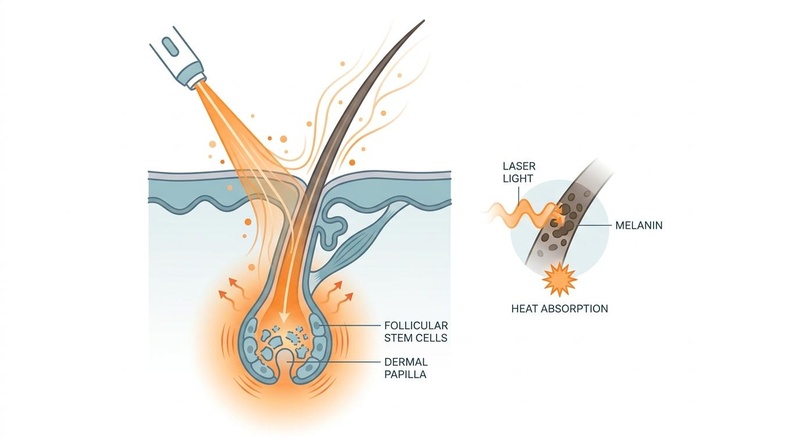
Mechanism of Laser/IPL: Both laser and Intense Pulsed Light (IPL) devices utilize the principle of selective photothermolysis. This involves delivering a specific wavelength of light (or a broad spectrum in IPL) that is preferentially absorbed by a target chromophore. In hair removal, the primary chromophore is melanin in the hair shaft and follicle. The absorbed light energy is converted into heat, causing thermal damage to the hair follicle, particularly the dermal papilla and follicular stem cells. This damage inhibits or delays future hair growth[1:7].
¶ Starter Protocol: At-Home and Temporary Solutions
For quick, accessible hair removal, these methods are widely used.
-
Shaving:
- Mechanism: Cuts hair at the skin's surface.
- Pros: Inexpensive, convenient, painless, immediate results.
- Cons: Short-lived results (1-3 days), risk of razor burn, nicks, and ingrown hairs (especially in curly hair).
- Protocol: Use a sharp, clean multi-blade razor. Shave with the grain first, then against for a closer shave if tolerated. Use a moisturizing shaving cream or gel. Immediately moisturize post-shave.
- Ingrown Prevention: Regular gentle exfoliation (e.g., topical glycolic or salicylic acid lotion) can reduce ingrown hairs and pseudofolliculitis barbae (PFB) [5:2][6:1].
-
Waxing/Sugaring:
- Mechanism: Removes hair from the root by adhering to the hair and pulling it out.
- Pros: Longer-lasting results (3-6 weeks), hair may grow back finer and sparser over time.
- Cons: Painful, risk of skin irritation, redness, folliculitis, and ingrown hairs.
- Protocol: Ensure skin is clean, dry, and free of oils. Apply wax/sugar in the direction of hair growth; remove quickly against the direction of growth. Avoid if using retinoids, topical exfoliants, or have very sensitive skin.
-
Epilating (Mechanical Epilators):
- Mechanism: Uses a handheld electrical device with rotating tweezers that grasp multiple hairs simultaneously and pull them out from the root.
- Pros: Keeps skin hair-free for 3-6 weeks, highly cost-effective (one-time device purchase), can catch very short hairs (0.5mm) more easily than waxing.
- Cons: High initial discomfort, risk of ingrown hairs and mechanical folliculitis, and temporary erythema.
- Protocol: Exfoliate the skin thoroughly beforehand. Hold the epilator at a 90-degree angle to the skin, pulling the skin taut, and glide the device slowly against the direction of hair growth. Apply a soothing post-treatment moisturizer like aloe vera.
-
Depilatories (Chemical Creams):
- Mechanism: Uses alkaline chemicals (e.g., calcium thioglycolate) to chemically dissolve the disulfide bonds that give hair its structure, allowing it to be wiped away.
- Pros: Painless, easy to use at home, lasts longer than shaving (several days to a week).
- Cons: Can cause skin irritation, chemical burns, or allergic reactions. Often has a strong odor.
- Protocol: Always perform a patch test on a small, inconspicuous area 24-48 hours before full application. Follow package instructions precisely for application time and rinse thoroughly.
-
At-Home Intense Pulsed Light (IPL):
- Mechanism: Emits broad-spectrum light (multiple wavelengths) that targets melanin in the hair follicle, similar to laser but less focused.
- Pros: Convenient, generally safe for home use when directions are followed, less expensive than professional laser, can provide significant hair reduction over time[8:1][9:1].
- Cons: Less powerful than professional lasers, generally requires more frequent and numerous sessions, less effective on very dark skin tones or very light hair, some risk of minor adverse events if used improperly.
- Protocol: Follow device-specific instructions for frequency and power settings. Typically involves an initial phase of weekly treatments for 4-12 weeks, followed by maintenance as needed. Always perform a patch test. Ensure skin is clean, shaven, and dry before use.
¶ Stronger Add-On Path: Combining Topical and Device Strategies
For individuals seeking enhanced hair reduction or managing specific conditions like hirsutism, combining methods can yield superior results.
-
Prescription Eflornithine Cream (e.g., Vaniqa):
- Mechanism: Inhibits ornithine decarboxylase, an enzyme involved in hair growth, thereby slowing the rate of hair growth. It is not a depilatory and does not permanently remove hair.
- Pros: Clinically proven to reduce the rate of facial hair growth in women, often used in conjunction with laser hair removal or other methods. Improves effectiveness of laser hair removal for conditions like pseudofolliculitis barbae[11:2][14:1].
- Cons: Prescription-only, requires twice-daily application, results may take 4-8 weeks to appear and are temporary (hair growth resumes after discontinuation).
- Protocol: Apply a thin layer twice daily to affected areas, at least 8 hours apart. Rub in thoroughly. Continue other hair removal methods as needed.
-
High-End Home IPL/Diode Devices:
- Mechanism: Advanced at-home devices offer higher energy settings or more sophisticated cooling systems compared to basic models, potentially providing more effective and comfortable treatments. Some may use a diode laser (808nm) rather than broad-spectrum IPL.
- Pros: More effective than basic IPLs, greater convenience and privacy than clinic visits, cost-effective over time compared to professional treatments.
- Cons: Still generally less powerful than professional lasers, requires commitment to consistent use, higher upfront cost than basic devices.
- Protocol: Research specific device capabilities and read user reviews, especially concerning skin tone suitability. Adhere strictly to the manufacturer's instructions for pre-treatment preparation, usage, and post-treatment care.
¶ Clinical/Procedure Path: Professional Interventions
For significant, long-term, or permanent hair removal, professional treatments are the most effective.
-
Professional Laser Hair Removal:
- Mechanism: Delivers concentrated, monochromatic light absorbed by melanin in the hair follicle, heating and destroying it while sparing surrounding skin. Most effective on dark hair against lighter skin, but advanced lasers can treat darker skin tones safely[1:8][3:4].
- Types of Lasers & Applications:
- Alexandrite Laser (755 nm): High melanin absorption, ideal for Fitzpatrick skin types I-III with dark hair. Fast for large areas.
- Diode Laser (810 nm): Versatile, good penetration depth, suitable for Fitzpatrick skin types I-IV.
- Nd:YAG Laser (1064 nm): Lower melanin absorption in the epidermis, allowing deeper penetration. Safest and most effective for Fitzpatrick skin types IV-VI (darker skin), minimizing epidermal damage and reducing risks of burns and hyperpigmentation[1:9][3:5].
- Pros: Highly effective for long-term reduction (35-90%), faster for large areas than electrolysis, can treat ingrown hairs and hidradenitis suppurativa[11:3][12:1].
- Cons: Can be costly, requires multiple sessions (typically 6-8+ initially, then maintenance), potential for burns or pigmentation changes if not performed correctly. Less effective on very light, fine, red, gray, or white hair due to lack of melanin.
- Protocol: Shave the area 24 hours prior. Avoid sun exposure and tanning for several weeks before and after. Multiple sessions are needed, typically 4-6 weeks apart, to target hairs in the active growth (anagen) phase.
-
Electrolysis:
- Mechanism: The only FDA-approved method for permanent hair removal. A fine probe is inserted into each individual hair follicle, and a small electrical current (galvanic, thermolysis, or blend method) is delivered to destroy the hair growth cells (dermal papilla and bulge stem cells).
- Galvanic: Chemical reaction (sodium hydroxide) destroys the follicle. Slower but very effective.
- Thermolysis (Diathermy): High-frequency alternating current generates heat, coagulating the follicle. Faster.
- Blend: Combines galvanic and thermolysis for increased efficiency and effectiveness[2:3].
- Pros: Truly permanent hair removal for ALL hair and skin colors, including white, gray, and red hair where lasers are ineffective. Can precisely shape eyebrows and treat small, stubborn areas. Achieves 90-95% permanent reduction when completed by a licensed professional[7:1].
- Cons: Time-consuming (treats one hair at a time), can be painful, requires multiple, consistent sessions over several months to over a year, potential for skin irritation or scarring if performed by an inexperienced practitioner. Patient satisfaction may be lower compared to IPL in some studies due to the slower process and discomfort[10:1].
- Protocol: Requires a series of consistent treatments, often spanning several months to over a year, to target hairs as they enter the active growth phase. Sessions typically range from 15 minutes to an hour.
- Mechanism: The only FDA-approved method for permanent hair removal. A fine probe is inserted into each individual hair follicle, and a small electrical current (galvanic, thermolysis, or blend method) is delivered to destroy the hair growth cells (dermal papilla and bulge stem cells).
¶ Visual Artifact & Editorial Blueprint
- File Path:
images/laser-hair-removal-mechanism.jpg - Type: Biomedical Illustration
- Model used:
gemini-3-pro-image(Nano Banana Pro-backed generation) - Primary Prompt: Selective photothermolysis in laser hair removal. A laser beam of specific wavelength is absorbed by melanin in the hair shaft, generating heat that thermally damages the surrounding follicular stem cells and dermal papilla. Clean biomedical editorial style. Balanced composition with soft anatomical and molecular abstraction, showing light energy propagating down the hair follicle structure to the base bulb. Palette: white background, slate-gray structure lines, muted blue and teal biological forms, subtle warm orange accents only for emphasis. Minimal, elegant, encyclopedia-ready.
- Alt Text: Diagram of selective photothermolysis in laser hair removal showing laser energy targeting melanin in the hair shaft and propagating heat down to damage follicular stem cells and the dermal papilla.
- Caption: Figure 1: Mechanism of selective photothermolysis in laser hair removal. Light energy is preferentially absorbed by melanin in the hair shaft, generating localized thermal damage that disrupts the dermal papilla and stem cells within the bulge.
- Placement: Embedded within Section 8 (Clinical/procedure path)
- QA State: Approved. Visually verified for high-fidelity clinical and anatomical accuracy.
¶ What Usually Fails
Understanding common pitfalls can help manage expectations and avoid ineffective treatments.
- Unproven Home Remedies: Many DIY hair removal solutions (e.g., natural pastes, herbal concoctions) lack scientific evidence for efficacy and can sometimes cause skin irritation or allergic reactions. Stick to methods with established mechanisms and safety profiles.
- Weak IPL Devices on Dark Skin or Light Hair: While at-home IPL can be effective, devices with insufficient energy output or those not specifically designed for darker skin tones may yield poor results or increase the risk of adverse effects. Similarly, IPL and lasers are ineffective on very light, red, gray, or white hair due to the absence of melanin.
- Expectation Mismatch: Many individuals expect "permanent" results from laser hair removal. It is crucial to understand that laser provides long-term hair reduction, and maintenance sessions are often required. Only electrolysis offers true permanent removal.
- Inconsistent Treatment Schedules: For light-based methods and electrolysis, consistency is key. Skipping sessions or not adhering to the recommended treatment intervals (which are timed to target hair in the anagen phase) significantly reduces efficacy.
- Ignoring Hormonal Factors: For conditions like hirsutism, treating the hair alone without addressing underlying hormonal imbalances will lead to continued new hair growth and frustration. Medical evaluation and appropriate pharmacological intervention are essential[4:2].
¶ Tracking Plan
Consistent tracking helps assess the effectiveness of your chosen hair removal method and identifies any adverse reactions.
- Visual Documentation: Take clear "before" photos of the treatment area. Continue with monthly photos in consistent lighting to document progress, especially for long-term methods.
- Hair Density and Texture: Subjectively assess the reduction in hair density and observe if regrowth is finer, lighter, or slower. For more objective tracking, some clinics offer specialized imaging.
- Regrowth Rate: Note how quickly hair returns after temporary methods or between sessions for permanent treatments. This helps adjust the frequency of at-home care or professional appointments.
- Skin Reaction Log: Document any redness, swelling, irritation, ingrown hairs, or pigmentation changes after each treatment. Note the duration and severity of these reactions. This is crucial for identifying potential issues and adjusting protocols.
- Treatment Log: Keep a detailed record of dates, methods used, device settings (for home devices), and any topical products applied.
¶ Safety and Red Flags
Safe hair removal practices are paramount to prevent complications.
¶ Potential Adverse Events
- Burns and Blistering: Most common with light-based methods, especially if settings are too high for the skin type, or if there's recent sun exposure. Darker skin (Fitzpatrick IV-VI) is at higher risk if inappropriate wavelengths (e.g., Alexandrite 755nm) are used without caution[1:10][3:6].
- Post-inflammatory Hyperpigmentation (PIH) / Hypopigmentation: Dark spots (PIH) or light spots (hypopigmentation) can occur after any skin injury or inflammation, particularly in darker skin tones. Prevention involves appropriate settings, sun avoidance, and gentle post-treatment care.
- Folliculitis and Ingrown Hairs: Common with shaving and waxing. Laser hair removal can actively treat and prevent these conditions by destroying the follicle[11:4][5:3].
- Paradoxical Hypertrichosis: A rare but significant complication where laser or IPL treatment paradoxically stimulates increased hair growth in or around the treated area[15].
- Incidence: Occurs in about 3% of patients undergoing laser or IPL hair removal[15:1].
- Risk Factors: More common in areas adjacent to treated sites, in individuals with underlying hormonal conditions (e.g., PCOS), darker skin types, and sometimes associated with subtherapeutic laser settings[15:2][16]. Males may exhibit a higher risk[17].
- Management: May require continued laser treatment with adjusted parameters or switching to electrolysis[15:3].
- Scarring: Rare with modern hair removal techniques, but a risk with improperly performed electrolysis or aggressive laser settings, especially in individuals prone to keloids.
¶ Red Flags: When to Seek Medical Attention
- Signs of Infection: Increasing redness, warmth, swelling, pus, or fever after any hair removal procedure.
- Severe or Persistent Burns/Blisters: Any burn that doesn't heal or shows signs of infection.
- Persistent or Worsening Pigmentation Changes: Hyperpigmentation that doesn't fade or rapidly spreading dark spots.
- Rapid Onset of Hirsutism: If a woman experiences sudden, significant hair growth in male-pattern areas, especially with other symptoms like irregular periods, acne, or voice changes, it warrants immediate medical evaluation to rule out hormonal disorders[4:3].
- Unusual Skin Reactions: Any severe allergic reaction, persistent rash, or widespread irritation.
¶ FAQs
¶ Is permanent hair removal really permanent?
Yes, electrolysis is the only method recognized as permanent hair removal by the FDA, as it targets and destroys the individual hair follicle's ability to produce hair. Laser and IPL offer long-term hair reduction, but some regrowth is possible, often requiring maintenance sessions.
¶ Does laser hair removal hurt?
Most people describe the sensation of laser hair removal as a rubber band snapping against the skin or a warm prickling sensation. Pain tolerance varies, but modern lasers often include built-in cooling mechanisms (e.g., cryogen spray, contact cooling, chilled air) to significantly improve comfort.
¶ Can I do at-home IPL if I have dark skin?
Many at-home IPL devices have built-in skin tone sensors and are designed with safety features for a range of skin types. However, efficacy may be reduced, and the risk of adverse effects (e.g., burns, hyperpigmentation) is higher for very dark skin (Fitzpatrick V-VI). Always check device specifications and perform a patch test. For optimal safety and efficacy on darker skin, professional Nd:YAG laser treatment is generally recommended[1:11].
¶ How do I prevent ingrown hairs?
Prevention involves proper shaving technique (shaving with the grain, using a sharp, clean razor), regular gentle exfoliation with products containing salicylic or glycolic acid, and keeping the skin moisturized. For stubborn or recurrent cases, professional laser hair removal can be a definitive solution by destroying the hair follicle itself[11:5][5:4].
¶ What causes excessive hair growth in women (hirsutism)?
Excessive hair growth in women (hirsutism) is often caused by elevated androgen levels, commonly associated with conditions like Polycystic Ovary Syndrome (PCOS). It can also be due to certain medications, adrenal gland disorders, or rare ovarian tumors. Medical evaluation by an endocrinologist or dermatologist is crucial to determine the underlying cause and guide appropriate treatment, which may include pharmacological intervention in addition to hair removal[4:4].
¶ References
Karas JA, StatPearls Publishing. Laser Hair Removal. 2024. https://www.ncbi.nlm.nih.gov/books/NBK507861/ ↩︎ ↩︎ ↩︎ ↩︎ ↩︎ ↩︎ ↩︎ ↩︎ ↩︎ ↩︎ ↩︎ ↩︎
DermNet NZ. Electrolysis. DermNet NZ. 2024. https://dermnetnz.org/topics/electrolysis ↩︎ ↩︎ ↩︎ ↩︎
Effectiveness of Single-Wavelength 755 nm Laser Compared to Dual-Wavelength 755 nm and 1064 nm Laser in Hair Removal: A Split-Body Design With Blinding. PubMed. 2024. https://pubmed.ncbi.nlm.nih.gov/42005695/ ↩︎ ↩︎ ↩︎ ↩︎ ↩︎ ↩︎ ↩︎
Martin KA, et al. Evaluation and Treatment of Hirsutism in Premenopausal Women: An Endocrine Society Clinical Practice Guideline. The Journal of Clinical Endocrinology & Metabolism. 2018;103(4):1233-1257. https://academic.oup.com/jcem/article/103/4/1233/4924418 ↩︎ ↩︎ ↩︎ ↩︎ ↩︎
Halilovic A, et al. Beyond the Razor: Managing Pseudofolliculitis Barbae in Skin of Color. Cureus. 2023;15(1):e33887. https://pmc.ncbi.nlm.nih.gov/articles/PMC12360796/ ↩︎ ↩︎ ↩︎ ↩︎ ↩︎
Peraza SM, et al. Treatment of pseudofolliculitis barbae with topical glycolic acid: a report of two studies. Cutis. 1993;52(6):364-6. https://pubmed.ncbi.nlm.nih.gov/8261811/ ↩︎ ↩︎
Hair GP. Electrolysis: The Only FDA-Approved Permanent Hirsutism Solution. Hair GP. 2024. https://hairgp.co.uk/electrolysis-the-only-fda-approved-permanent-hirsutism-solution/ ↩︎ ↩︎
Clinical trial comparing IPL vs. Diode Laser for hair removal. PubMed. 2024. https://pubmed.ncbi.nlm.nih.gov/42249955/ ↩︎ ↩︎
Efficacy of Intense Pulsed Light vs. Triple Wavelength Diode Laser in Hair Reduction. PubMed. 2024. https://pubmed.ncbi.nlm.nih.gov/42152203/ ↩︎ ↩︎
A comparative study of hair removal at an NHS hospital: Luminette intense pulsed light versus electrolysis. PubMed. 2012. https://pubmed.ncbi.nlm.nih.gov/22880984/ ↩︎ ↩︎
Schlessinger J, et al. Topical eflornithine hydrochloride improves the effectiveness of standard laser hair removal for treating pseudofolliculitis barbae: a randomized, double-blinded, placebo-controlled trial. Journal of the American Academy of Dermatology. 2012. https://pubmed.ncbi.nlm.nih.gov/22226431/ ↩︎ ↩︎ ↩︎ ↩︎ ↩︎ ↩︎
Patient-reported outcomes of laser hair removal for hidradenitis suppurativa: an exploratory cross-sectional survey. PubMed. 2024. https://pubmed.ncbi.nlm.nih.gov/42342886/ ↩︎ ↩︎
Mahmoud BH, et al. Prospective controlled clinical and histopathologic study of hidradenitis suppurativa treated with the long-pulsed neodymium:yttrium-aluminium-garnet laser. Journal of the American Academy of Dermatology. 2010;62(4):637-45. https://pubmed.ncbi.nlm.nih.gov/19818512/ ↩︎
Hamzavi I, et al. Eflornithine cream combined with laser therapy in the management of unwanted facial hair growth in women: a randomized trial. PubMed. 2006. https://pubmed.ncbi.nlm.nih.gov/17034372/ ↩︎ ↩︎
Paradoxical Hypertrichosis Associated with Laser and Light Therapy for Hair Removal: A Systematic Review and Meta-analysis. PubMed. 2021. https://pubmed.ncbi.nlm.nih.gov/34057666/ ↩︎ ↩︎ ↩︎ ↩︎
Predictors and prevalence of paradoxical hypertrichosis in alexandrite laser-based facial hair removal: results from a prospective clinical study. PubMed. 2025. https://pubmed.ncbi.nlm.nih.gov/40405001/ ↩︎
Moriguchi, et al. Gender Disparities in Paradoxical Hypertrichosis After Laser Hair Removal. Journal of Cosmetic Dermatology. 2025. https://pmc.ncbi.nlm.nih.gov/articles/PMC12040530/ ↩︎