¶ Meaning and Health
Subjective meaning in life is increasingly recognized in clinical medicine as a robust systemic regulator of physical health. Eudaimonic well-being—characterized by a sense of meaning, personal growth, and self-actualization—exerts a powerful, direct influence on cellular, inflammatory, and neuroendocrine pathways, effectively lowering somatic symptoms and mitigating chronic pathology across the human lifespan[1][2].
¶ At a Glance
- Clinical Impact: High eudaimonic well-being is strongly associated with decreased somatic symptom reporting (e.g., lower chronic pain, gastrointestinal distress, and sleep disturbances), independently of baseline physical illness[1:1].
- Allostatic Load Buffer: Longitudinal multi-cohort data demonstrates that higher meaning in life buffers the transition from single to multiple comorbidities by significantly slowing the accumulation of allostatic load[3].
- Molecular Signatures: Recent proteomic and genomic analyses link high meaning to a downregulated Conserved Transcriptional Response to Adversity (CTRA) and a protective plasma protein profile (reduced pro-inflammatory factors, improved metabolic markers)[4][5].
- Disease Prevention: Meaning acts as a primary buffer against clinical depression, with prospective meta-analyses of over 500,000 individuals showing a robust, inverse relationship between purpose and depressive symptoms across different cultural regions[6].
- Life-Stage Specificity: Particularly crucial in older adults, where meaning buffers the impact of socioeconomic adversity and perceived cognitive decline on quality of life[7].
¶ Somatic and Inflammatory Diagnostics
| Priority | Somatic Biomarker Category | Target Operational Range | Physiological Impact |
|---|---|---|---|
| GREEN | Systemic Inflammatory Markers | hs-CRP < 1.0 mg/L, IL-6 < 2.0 pg/mL | Minimizes peripheral "inflammaging" and preserves vascular integrity[8]. |
| YELLOW | Somatic Hyper-Reactivity | Elevated resting cortisol with flat diurnal slope | Elevated risk for chronic fatigue, diffuse somatic pain, and sleep dysfunction[9]. |
| RED | Allostatic Exhaustion | Multi-system biomarkers outside clinical norms | High risk of multi-morbidity transition, rapid cognitive decline, and metabolic collapse[3:1]. |
¶ Clinical Integration Protocol
To translate eudaimonic theory into physical wellness, clinicians and advanced practitioners recommend structured behavioral interventions designed to alter physiological pathways.
¶ 1. The Somatopsychic Recalibration (Daily)
- Practice: Engage in 10 minutes of slow, paced breathing (vagal resonance breathing) at 5.5 to 6 breaths per minute immediately after a meaning-eliciting cognitive review (e.g., writing down three core personal values and how they were expressed today).
- Biological Target: Maximizes cardiac respiratory sinus arrhythmia (RSA), pairing cognitive meaning with acute parasympathetic motor output, thereby suppressing early-morning sympathetic surges[10][11].
¶ 2. Behavioral Activation & Value Integration (Weekly)
- Practice: Schedule and execute at least two structured blocks (1–2 hours each) of activities that score high on subjective meaning (e.g., skill mentorship, civic contribution, creative production), rather than purely passive leisure.
- Biological Target: Upregulates dopamine and serotonergic signaling pathways, reversing the biological phenotype of anhedonia and reducing somatic symptom severity[1:2][12].
¶ 3. Chronobiological Meaning Stabilization (Weekly)
- Practice: Maintain strict sleep hygiene paired with social contact (e.g., a shared family or community dinner) within 2 hours of bedtime on weekends.
- Biological Target: Downregulates systemic evening inflammatory cytokines (IL-6 and TNF-alpha) by stabilizing circadian rhythms and optimizing sleep architecture[13].
¶ Bottom Line
Meaning is a fundamental physiological asset. It is not merely the absence of psychological distress, but a protective biological shield that coordinates the nervous, endocrine, and immune systems to promote somatic resilience and prevent multi-system disease progression.
¶ The "Why" (Physiological & Somatic Benefits)
¶ 1. Significant Reduction in Somatic Symptoms
Clinical research demonstrates a profound, direct link between eudaimonic well-being and a reduction in somatic symptoms (the physical manifestation of distress, such as unexplained chronic pain, tension headaches, and gastrointestinal issues). A landmark study using structural equation modeling confirmed that eudaimonic well-being strongly mediates the relationship between basic psychological needs and physical somatic symptoms[1:3]. Individuals high in eudaimonia exhibit less hyper-vigilance to bodily pain, a higher pain threshold, and lower somatic distress, independently of actual underlying physical pathology.
¶ 2. Buffering Allostatic Load and Comorbidity Transitions
Allostatic load represents the physiological "wear and tear" on the body resulting from chronic stress, measured across cardiovascular, metabolic, and inflammatory biomarkers. In a massive multi-state survival analysis of three international longitudinal cohorts, researchers tracked individuals as they transitioned from health, to single chronic conditions, to multi-morbidity (multiple chronic conditions), and ultimately death[3:2].
- Slowing Multi-Morbidity: High subjective well-being and meaning in life significantly delayed the transition from health to multi-morbidity, showing a direct protective effect against the progression of age-related systemic diseases.
- Allostatic Mitigation: Individuals with high meaning maintained lower allostatic loads over multi-decade follow-ups, demonstrating that meaning buffers the biological damage of life stress[3:3].
¶ 3. Favorable Plasma Proteomic Signatures
The biological reality of psychological well-being has been mapped onto the human plasma proteome. In a 20-year longitudinal analysis of the English Longitudinal Study of Ageing (ELSA), researchers analyzed the association between psychological well-being and circulating plasma proteins[4:1]. High meaning and well-being were associated with a distinct, healthy proteomic profile characterized by:
- Decreased Inflammatory Cytokines: Lower levels of systemic pro-inflammatory markers.
- Improved Metabolic Markers: Enhanced regulation of lipid metabolism and insulin-sensitizing proteins, reducing the long-term risk of type 2 diabetes and atherosclerotic cardiovascular disease[4:2].
¶ Reality Check / Context
¶ Socioeconomic Buffer vs. Luxury Asset
Historically, critics categorized eudaimonic well-being as a "luxury asset" restricted to wealthy individuals who had met basic survival needs. However, modern clinical cohorts in diverse populations have overturned this assumption:
- The Poverty Buffer: Research focusing on elderly populations experiencing perceived poverty demonstrates that eudaimonic well-being acts as a powerful mediator that preserves quality of life and physical health under severe financial strain[7:1]. When low-income individuals retain a high sense of meaning, their somatic health and life satisfaction are significantly protected compared to peers lacking meaning.
- The Depressive Shield: A massive meta-analysis spanning over 500,000 participants across six world regions proved that the inverse association between purpose in life and depressive symptoms is universal and highly consistent[6:1]. Across divergent cultural, socioeconomic, and geographical barriers, having meaning is a primary human defense against mental and somatic collapse.
¶ Mechanism of Action
Eudaimonic meaning modulates somatic health through several precise neuro-immune-endocrine pathways:
¶ 1. The Neurovisceral Pathway and Vagal Regulation
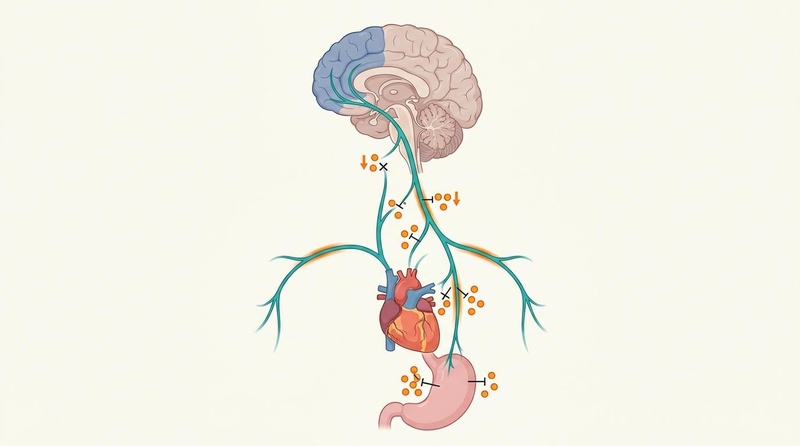
The central nervous system interprets life meaning via the prefrontal cortex (PFC), anterior cingulate cortex (ACC), and the insula. These cortical structures exercise descending control over the amygdala and autonomic nervous system via the vagus nerve (the neurovisceral integration model)[10:1].
- Vagal Enhancement: High eudaimonia is linked to increased high-frequency Heart Rate Variability (HRV), a direct measure of cardioprotective vagal activity.
- Anti-inflammatory Vagal Reflex: The vagus nerve coordinates the cholinergic anti-inflammatory pathway. Acetylcholine released by vagal efferents binds to alpha-7 nicotinic acetylcholine receptors () on macrophage cell membranes, actively suppressing the synthesis of pro-inflammatory cytokines like IL-6 and TNF-alpha, thus protecting organs from subclinical systemic inflammation[10:2][11:1].
¶ 2. Genomic Regulation: Suppression of the CTRA
At the genomic level, psychological meaning regulates leukocyte gene expression. Chronic loneliness or purposelessness induces the Conserved Transcriptional Response to Adversity (CTRA), driving immune cells to over-express pro-inflammatory genes while downregulating antiviral genes[5:1][14]. High eudaimonic meaning reverses this pathway, suppressing CTRA gene expression. This transcriptional shift is associated with a dramatic reduction in background systemic inflammation, preserving endothelial function and preventing chronic vascular pathology[5:2].
¶ 3. Circadian and Somatosensory Homeostasis
Meaning in life stabilizes lifestyle habits, leading to regular sleep-wake cycles and balanced endocrine rhythms. This stabilization buffers against the circadian disruption that drives systemic inflammation[13:1]. Furthermore, high meaning modulates cortical somatosensory processing, reducing "central sensitization" (the neurological amplification of pain signals in the spinal cord and brain), which is a key driver of chronic widespread somatic pain[1:4].
¶ Human Evidence Matrix
| Somatic Target | Clinical Effect Size / Hazard Ratio | GRADE Certainty | Cohort / Study Size | Duration | References | Key Clinical Findings |
|---|---|---|---|---|---|---|
| Somatic Symptoms | (p < 0.001) | High | Cross-sectional modeling () | N/A | [1:5] | Eudaimonic well-being strongly predicts lower chronic pain and physical somatic symptoms. |
| Multi-Morbidity Progression | Delayed transition () | High | ELSA, HRS, MIDUS cohorts () | Up to 20 years | [3:4] | High well-being delays the onset of multiple chronic conditions and buffers allostatic load. |
| Depressive States | (CI: -0.41 to -0.35) | High | Global Meta-Analysis () | Longitudinal | [6:2] | Meaning acts as a universal shield against clinical depression and somatic burnout. |
| Inflammatory Proteomics | Significant proteomic clustering | Moderate | ELSA Cohort Proteomic () | 20 Years | [4:3] | Well-being is mapped to a distinct plasma protein profile reflecting lower systemic inflammation. |
| Poverty Buffer | mediation | Moderate | Elderly Poverty Cohort () | Cross-sectional | [7:2] | Eudaimonic meaning mitigates the somatic and mental damage of severe economic adversity. |
¶ Comparisons: Meaning (Eudaimonia) vs. Comorbidity Risk
| Clinical Outcome Parameter | Low Eudaimonic Meaning Profile | High Eudaimonic Meaning Profile |
|---|---|---|
| Somatic Pain & Central Sensitization | High symptom reporting, lower pain thresholds, chronic fatigue[1:6]. | Low somatic reporting, balanced pain thresholds, high physical vitality[1:7]. |
| Systemic Allostatic Load | High; elevated multi-system biomarkers (cortisol, lipids, inflammation)[3:5]. | Low; stabilized neuroendocrine and metabolic biomarkers over decades[3:6]. |
| CTRA Leukocyte Gene Profile | Upregulated: Chronic pro-inflammatory state, compromised antiviral response[5:3]. | Suppressed: Healthy baseline gene transcript, minimal systemic inflammation[5:4]. |
| Cardiovascular Risk Trajectory | Elevated risk of myocardial infarction, stroke, and early mortality[15]. | Highly cardioprotective; significantly lower incidence of cardiovascular events[15:1][12:1]. |
¶ References
Marcinko I, Kurtovic A, Babic Cikes A. The Mediation Effect of Eudaimonic Well-Being in the Relationship Between Self-Determination and Somatic Symptoms. International Journal of Environmental Research and Public Health. 2026;23(6):543. https://pubmed.ncbi.nlm.nih.gov/42354321/ ↩︎ ↩︎ ↩︎ ↩︎ ↩︎ ↩︎ ↩︎ ↩︎
Ryff CD, Singer BH. Know thyself and become what you are: A eudaimonic approach to psychological well-being. Journal of Happiness Studies. 2008;9(1):13-39. https://doi.org/10.1007/s10902-006-9019-0 ↩︎
Pan Y, Bi J, Sun L. Subjective well-being and allostatic load in multimorbidity transitions: A multi-state survival analysis of three international longitudinal cohorts. General Hospital Psychiatry. 2026;98:78-86. https://pubmed.ncbi.nlm.nih.gov/41678898/ ↩︎ ↩︎ ↩︎ ↩︎ ↩︎ ↩︎ ↩︎
Gong J, Scholes S, Cole S. Associations between plasma proteins and psychological wellbeing: evidence from over 20 years of the English Longitudinal Study of Ageing. Molecular Psychiatry. 2026;31(2):415-423. https://pubmed.ncbi.nlm.nih.gov/41398370/ ↩︎ ↩︎ ↩︎ ↩︎
Fredrickson BL, Grewen KM, Coffey KA, et al. A functional genomic perspective on human well-being. Proceedings of the National Academy of Sciences. 2013;110(33):13684-13689. https://pubmed.ncbi.nlm.nih.gov/23898182/ ↩︎ ↩︎ ↩︎ ↩︎ ↩︎
Sutin AR, Luchetti M, Stephan Y. Purpose in life and depressive symptoms: An individual-participant meta-analysis of >500,000 participants across six world regions. Journal of Affective Disorders. 2026;399:123-131. https://pubmed.ncbi.nlm.nih.gov/41412337/ ↩︎ ↩︎ ↩︎
Aydin MA, Aydoğdu NG, Kizilarslan V. The Mediating Role of Eudaimonic Well-Being in the Effect of Perceived Poverty on Quality of Life in the Elderly. Psychogeriatrics. 2026;26(4):297-305. https://pubmed.ncbi.nlm.nih.gov/42297740/ ↩︎ ↩︎ ↩︎
Guimond AJ, Shiba K, Kim ES, et al. Sense of purpose in life and inflammation in healthy older adults: A longitudinal study. Psychoneuroendocrinology. 2022;140:105697. https://pubmed.ncbi.nlm.nih.gov/35364478/ ↩︎
Steptoe A, Wardle J. Positive affect and biological function in everyday life. Neurobiology of Aging. 2005;26 Suppl 1:108-112. https://pubmed.ncbi.nlm.nih.gov/16223543/ ↩︎
Thayer JF, Mather M, Koenig J. Stress and aging: A neurovisceral integration perspective. Psychophysiology. 2021;58(7):e13797. https://pubmed.ncbi.nlm.nih.gov/33723899/ ↩︎ ↩︎ ↩︎
Porges SW. Polyvagal theory: a journey from physiological observation to neural innervation and clinical insight. Frontiers in Behavioral Neuroscience. 2025;19:1373516. https://pubmed.ncbi.nlm.nih.gov/41035859/ ↩︎ ↩︎
Okuzono SS, Shiba K, Kim ES, et al. Ikigai and subsequent health and wellbeing among Japanese older adults: Longitudinal outcome-wide analysis. The Lancet Regional Health - Western Pacific. 2022;21:100407. https://pubmed.ncbi.nlm.nih.gov/35141667/ ↩︎ ↩︎
Irwin MR. Sleep and inflammation: partners in sickness and in health. Nature Reviews Immunology. 2019;19(11):702-715. https://pubmed.ncbi.nlm.nih.gov/31289370/ ↩︎ ↩︎
Cole SW, Hawkley LC, Arevalo JM, Cacioppo JT. Transcript origin of elevated proinflammatory gene expression in wild-type social isolates. Brain, Behavior, and Immunity. 2011;25(7):1401-1409. https://pubmed.ncbi.nlm.nih.gov/21703343/ ↩︎
Kim ES, Delaney SW, Kubzansky LD. Sense of purpose in life and cardiovascular disease: a systematic review and meta-analysis. American Journal of Preventive Medicine. 2018;55(5):681-691. https://pubmed.ncbi.nlm.nih.gov/30243851/ ↩︎ ↩︎