¶ Purpose and Longevity
A robust sense of purpose in life is one of the most powerful and consistent predictors of human longevity. Epidemiological, neurobiological, and clinical cohorts show that having a strong direction in life significantly reduces all-cause mortality, shields the cardiovascular system, and directly protects against cellular and epigenetic aging.
¶ At a Glance
- Longevity Verdict: Prospective cohort studies comprising hundreds of thousands of adults demonstrate that individuals with a high sense of purpose have a 20% to 40% reduction in all-cause mortality over 8- to 10-year follow-up periods compared to those with low purpose[1][2][3].
- Physiological Core: Modulates autonomic nervous system (ANS) and endocrine balance, resulting in lower systemic inflammation (reduced IL-6, CRP), decreased cortisol reactivity, and enhanced vagal tone[4][5].
- Cellular Protection: High purpose is associated with significantly slower epigenetic age acceleration (measured via GrimAge and PhenoAge clocks) and preserved leukocyte telomere length, signaling slowed biological aging at the molecular level[6][7].
- Cardiovascular Safety: Strongly linked to reduced incidence of myocardial infarction, stroke, and cardiovascular-related mortality across diverse demographics[8][9].
- Highly Actionable: Purpose is not a static trait; structured, iterative cognitive and behavioral practices can measurably strengthen purpose and its downstream biological benefits over time.
¶ Autonomic & Behavioral Alignment
| Priority | Risk Category | Operational Parameter | Action / Avoidance |
|---|---|---|---|
| GREEN | Optimized Vagal Activity | Daily resting Heart Rate Variability (HRV) showing high parasympathetic tone. | Engaging in daily prosocial activities and values-aligned behavior. |
| YELLOW | Systemic Strain | Elevating inflammatory markers (hs-CRP > 1.0 mg/L) or high cortisol reactivity. | Mitigate high-conflict relationships and excessive, unaligned vocational load. |
| RED | Existential Void & Isolation | Chronic perceived loneliness or severe lack of daily direction/meaning. | Immediate behavioral activation, social integration, and targeted life-stage transition plans. |
¶ Purpose Activation Protocol
Strengthening eudaimonic purpose requires behavioral frameworks that bridge psychology with daily physical activity. The following multi-tiered protocol is designed to maximize neuroendocrine benefit.
¶ 1. Daily Autonomic Integration (Micro-Dosing Prosocial Behavior)
- The "Prosocial Prompt": Every morning, identify one simple task of micro-contribution (e.g., sending an appreciative message, mentoring a peer, or performing a small favor for a family member).
- Biological Target: Elevates salivary oxytocin and improves resting cardiac vagal tone, lowering early-morning HPA axis reactivity[2:1][3:1].
¶ 2. Weekly Values-Aligned Action (The Ikigai Alignment)
- Structured Activity: Commit to at least 2 hours per week of structured, non-vocational community engagement or skill-sharing (e.g., volunteering, teaching, community gardening).
- Evidence Basis: Cohort data shows that regular volunteerism is associated with a 24% lower risk of all-cause mortality and a significant reduction in pro-inflammatory leukocyte gene expression[10].
¶ 3. Monthly Purpose Elicitation (The "Best Possible Self" Exercise)
- Visualization: Devote 20 minutes on the first Sunday of each month to write a detailed vision of your future self (5–10 years ahead), assuming all your efforts have succeeded and you are living your highest-impact, values-aligned life.
- Action Plan: Extract 2 concrete intermediate goals from this vision and integrate them into your immediate calendar.
¶ Bottom Line
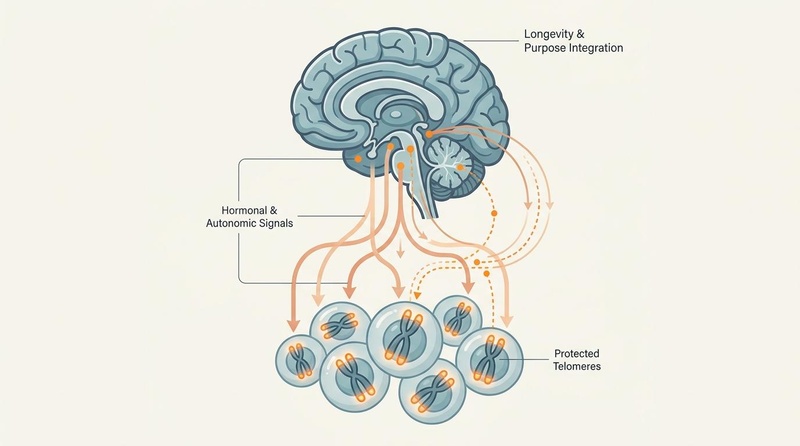
A clear sense of purpose acts as a central physiological organizing force. It coordinates neurovisceral circuits to buffer environmental stressors, preserve cellular longevity (telomeres and epigenetics), and dramatically lower the risk of age-related systemic decline.
¶ The "Why" (Biopsychosocial Benefits)
¶ 1. Life Extension and Mortality Risk Reduction
Large prospective cohort studies have consistently confirmed that the psychological asset of purpose is independently protective against mortality. In a landmark analysis of the U.S. Health and Retirement Study (HRS) involving older adults, individuals in the highest category of purpose in life had a significantly lower hazard ratio for all-cause mortality () compared to those in the lowest category over an 8-year period[1:1]. This protective effect persisted even after rigorously controlling for age, sex, race, education, baseline health status, and health behaviors. A comprehensive meta-analysis of over 136,000 individuals confirmed that higher purpose is associated with a 17% lower risk of all-cause mortality[3:2].
¶ 2. Slowed Molecular Aging (Epigenetics & Telomeres)
The biological mechanism of purpose-driven longevity reaches deep into our genomic regulatory systems:
- Epigenetic De-acceleration: Individuals with a strong sense of purpose exhibit a younger biological age than their chronological counterparts. Specifically, longitudinal cohort data reveals that high purpose is linked to slower biological aging on second-generation epigenetic clocks, such as GrimAge and PhenoAge, which are highly predictive of mortality and clinical morbidity[6:1].
- Telomere Protection: Telomeres are protective caps at the ends of chromosomes that shorten with cell division and psychological stress. Meta-analyses demonstrate that high psychological well-being—specifically eudaimonic purpose—is robustly associated with longer leukocyte telomeres, indicating a deceleration of cellular senescence pathways[7:1][11].
¶ 3. Cardiovascular and Neurovascular Preservation
A high sense of purpose is highly cardioprotective. It is associated with a 20% to 35% reduced risk of cardiovascular events, including myocardial infarction and stroke[9:1]. Epidemiological data from cohorts like the English Longitudinal Study of Ageing (ELSA) and the Japanese Ikigai longitudinal cohorts demonstrate that individuals with high meaning are significantly less likely to develop coronary heart disease or succumb to cardiovascular-related death[8:1][12].
¶ Reality Check / Context
¶ Epigenetic Confounders and Socioeconomic Realities
While the epidemiological associations are clear, translating psychological purpose into clinical outcomes requires navigating several real-world confounders:
- Socioeconomic Confounding: Critics historically argued that a "sense of purpose" is merely a luxury of high socioeconomic status (SES). However, modern multi-cohort prospective analyses (including the Midlife in the United States [MIDUS] and ELSA cohorts) have controlled for income, wealth, and education, confirming that purpose remains a statistically significant, independent predictor of longevity across all socioeconomic strata[1:2][13].
- Eudaimonia vs. Hedonia: It is vital to separate eudaimonic well-being (purpose, self-actualization, contribution) from hedonic well-being (pleasure, comfort). While both correlate with subjective happiness, they possess starkly different biological profiles. Genomic transcriptomics show that eudaimonic well-being is associated with highly favorable gene expression (low inflammation, high antiviral defense), while hedonic well-being in the absence of eudaimonia is linked to a pro-inflammatory gene profile, similar to that seen under chronic stress[10:1].
- The Non-Responder Reality: Some individuals struggle to cultivate purpose due to biological barriers (such as major depressive disorder or neurochemical deficits) or systemic socioeconomic constraints. In these cases, cognitive-behavioral therapies, mindfulness, and occupational transitions are necessary precursors to unlock the physiological benefits of purpose.
¶ Mechanism of Action
The translation of a psychological construct (purpose) into physical health (longevity) occurs through three primary physiological axes: