Peptide therapy in regenerative medicine is defined not only by the selection of specific ligands but by the precision of their administration and the synergy of their combinations. This guide provides an evidence-based framework for medical professionals and researchers on the practical application of regenerative peptides, focusing on bioavailability, tissue-specific targeting, and the "Holy Trinity" of musculoskeletal repair: BPC-157, TB-500, and GHK-Cu.
¶ Administration Route Deep Dive
The therapeutic efficacy of peptides is strictly dependent on bypassing enzymatic degradation and achieving target tissue saturation.
¶ Injection Techniques and Site Management
Injection remains the "gold standard" for systemic peptide delivery, ensuring precise dosing and bypassing first-pass metabolism.

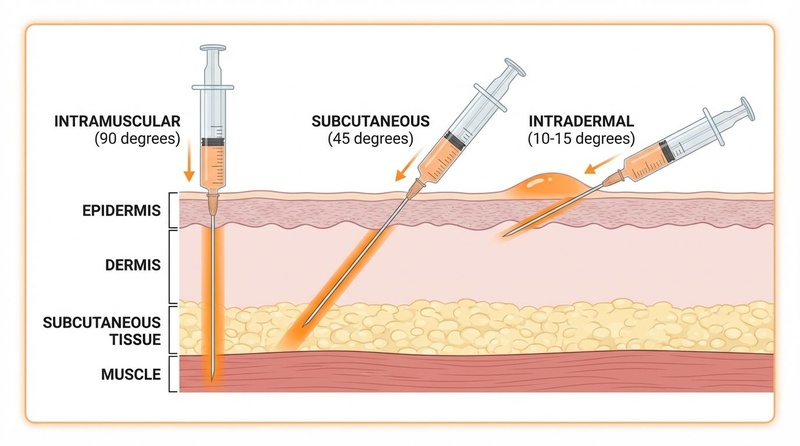
- Subcutaneous (SubQ): The primary route for most regenerative peptides (e.g., BPC-157, TB-500, Growth Hormone Secretagogues).
-
Intramuscular (IM): Utilized for rapid absorption or larger volumes.
-
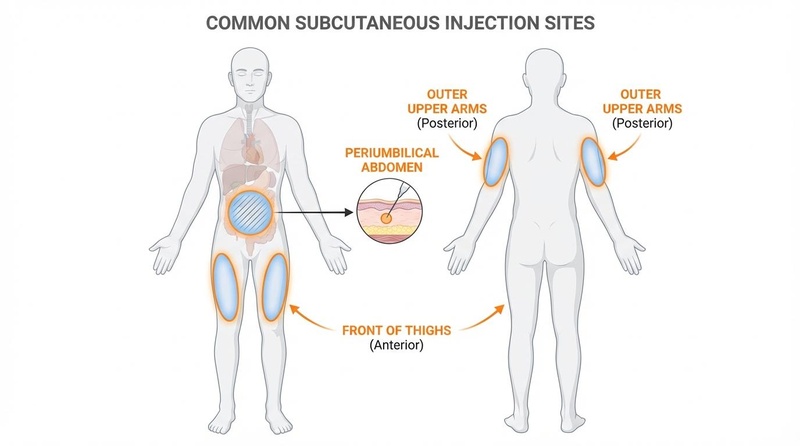
Rotation: Essential to prevent lipohypertrophy. Common sites include the periumbilical region (2 inches from navel), outer thighs, and gluteal fat pad.
- Reconstitution & Sterile Technique:
¶ Oral vs. Injectable Absorption
The transition of peptides to oral delivery is limited by gastric acidity and protease degradation.
| Form | Gastric Stability | Use Case | GRADE |
|---|---|---|---|
| BPC-157 Arginate | High (>24h at pH 3.0) | GI repair, systemic repair (high dose) | Moderate [6] |
| BPC-157 Acetate | Very Low ( % at 3h) % at 3h) |
Injectable only | Low (Oral) [7] |
| GHK-Cu | Low | Injectable or Topical only | N/A |
Clinical Takeaway: For systemic musculoskeletal repair (tendons/ligaments), injectable routes are preferred to ensure peak plasma concentrations bypass the "gastric barrier."
¶ Novel Delivery Methods
- Nasal Sprays: Effective for neuroregenerative peptides (e.g., Semax, Selank). Bypasses the blood-brain barrier (BBB) via the olfactory and trigeminal nerve pathways, achieving CNS saturation within minutes [8].
- Transdermal: Primarily used for GHK-Cu. While the stratum corneum is a barrier, liposomal bases or microneedling can increase penetration for localized skin remodeling [9].
- Liposomal & Microspheres: PLGA microspheres are emerging for "depot" injections, allowing sustained release of peptides like TB-500 over weeks, reducing injection frequency [10].
¶ Tissue-Specific Targeting
While peptides circulate systemically, certain protocols maximize local tissue interaction.
¶ Tendon and Ligament Repair
- Protocol: BPC-157 systemic administration (SubQ or Oral Arginate) is highly effective in animal models [11].
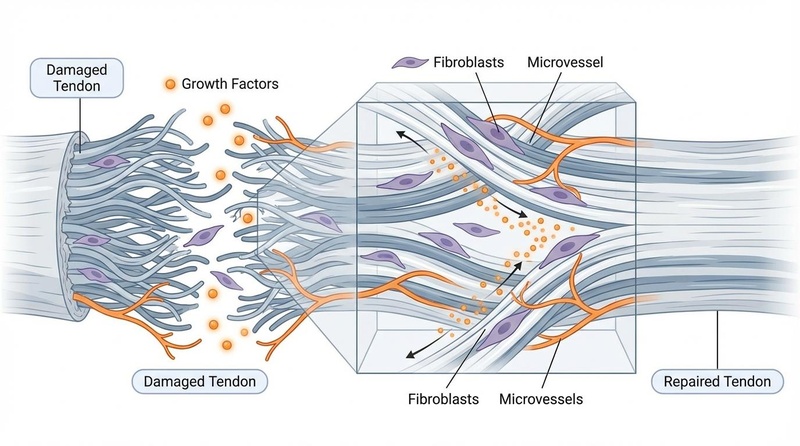
- Local vs. Systemic: Preclinical data suggests that systemic delivery (intraperitoneal/oral) is as effective as local injection for Achilles tendon and MCL repair, as the peptide upregulates growth factor receptors (VEGFR2) systemically [11:1][12].
- Evidence: High (Preclinical); Low (Human) due to lack of large-scale RCTs [13].
¶ Muscle Tissue
- Strategy: SubQ is standard for steady absorption. For acute tears, some protocols utilize deep IM injection near the lesion, though systemic circulation remains the primary driver of regeneration via egr-1 gene activation [14].
¶ Joint Repair (Intra-Articular)
- BPC-157 Protocol: A retrospective study utilized 2 cc of BPC-157 (2000 mcg/ml) injected via a 25G needle into the knee joint, reporting significant pain relief for >6 months [15].
- Pentosan Polysulfate (PPS): Although a semi-synthetic macromolecule, PPS is often used alongside peptides. Standard protocol is 2 mg/kg SubQ twice weekly for 6 weeks, which improves subchondral blood flow [16].
¶ Neural Tissue and BBB
- Agents: Cerebrolysin (IV/IM), Semax (Nasal), Selank (Nasal).
- Timing: For acute injury (stroke/TBI), Cerebrolysin should be initiated within 24–72 hours for maximal neuroprotection [17].
¶ Synergistic Combination Protocols ("Stacks")
The most effective regenerative protocols utilize combinations that target different stages of the healing cascade.
¶ The 'Holy Trinity' Stack: BPC-157 + TB-500 + GHK-Cu
This combination targets the three pillars of tissue repair: Blood Supply, Cell Migration, and Structural Architecture.
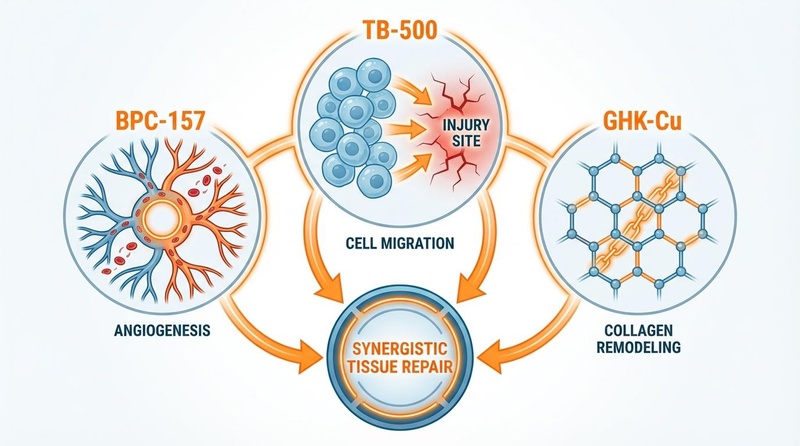
- BPC-157 ("The Supply Line"): Drives angiogenesis (VEGF) and modulates inflammation [18].
- TB-500 ("The Transport"): Sequesters actin to allow stem cells and fibroblasts to migrate to the injury site [19].
- GHK-Cu ("The Architect"): Modulates MMPs to break down scar tissue and stimulate organized collagen synthesis [9:1].
Standard "Trinity" Protocol:
- BPC-157: 500 mcg daily (SubQ).
- TB-500: 5–7.5 mg per week (split into 2-3 doses) for 4–6 weeks [20].
- GHK-Cu: 1–2 mg daily (SubQ). Note: Dilute with BPC-157 or extra diluent to mitigate injection site pain.
¶ Sport-Specific Protocols
- Post-Injury (Accelerated): BPC-157 (1000 mcg daily split) + TB-500 (10 mg front-load week 1) [20:1].
- Overuse (Maintenance): BPC-157 (250 mcg daily) + TB-500 (2 mg weekly).
- Surgical Prep: Cease all peptides 7 days prior (theoretical bleeding risk from angiogenesis); restart 3 days post-op to accelerate wound closure [18:1].
¶ Injury-Specific Phasing
- Phase 1: Acute (0-7 days): Focus on BPC-157 and TB-500 to clear debris and initiate vascularization.
- Phase 2: Repair (1-6 weeks): Introduce GHK-Cu for collagen organization; maintain BPC/TB-500.
- Phase 3: Chronic (6+ weeks): Focus on GHK-Cu for scar tissue remodeling and PPS for joint lubrication [20:2].
¶ Dosing Mathematics
¶ Weight-Based Calculations
While fixed dosing is common, weight-based titration is superior for secretagogues and specific repair targets.
- BPC-157: 2.5 to 3.75 mcg/kg (e.g., 200–300 mcg for an 80kg individual; often rounded to 500 mcg in clinical practice) [11:2].
- GHRPs (Ipamorelin): Saturation dose is 1 mcg/kg. Exceeding this offers diminishing returns and increases side effects (cortisol/prolactin) [21].
- Obesity Adjustment: For BMI > 30, use Lean Body Mass (LBM) for hydrophilic peptides to avoid overdosing fat tissue [21:1].
¶ Treatment Duration Protocols
- Acute Phase: 1–14 days.
- Repair Phase: 4–8 weeks.
- Maintenance Phase: 2–6 months (often requiring a 1-month "washout" every 3 months to prevent receptor desensitization) [22].
¶ Safety and Monitoring
¶ Contraindications Matrix
- Active Malignancy: Strictly contraindicated. Angiogenic peptides (BPC-157, TB-500) could theoretically vascularize and accelerate existing tumors [23].
- WADA Status: BPC-157 and TB-500 are S0 Prohibited Substances (banned at all times) [24].
- Pharmaceutical Interactions: BPC-157 antagonizes NSAID toxicity and counteracts corticosteroid-induced healing impairment [25].
¶ Labs and Monitoring
- Inflammatory Markers: Track CRP (acute) and ESR (chronic) to assess resolution of tissue inflammation [22:1].
- IGF-1 Z-Score: For Growth Hormone Secretagogue use, maintain IGF-1 within 0 to +2 SDS of age-adjusted norms to mitigate cancer risk [21:2].
- TGF-beta 1: Monitoring for aberrant fibrosis in chronic remodeling phases [22:2].
¶ Real-World Context and Patient Profiles
| Profile | Adjustment |
|---|---|
| Elite Athlete | Front-load TB-500; split-dose BPC-157 to maintain constant VEGF signaling. |
| Weekend Warrior | Pulse dosing (Fr-Sun) to manage inflammation from heavy weekend activity. |
| Seniors | Lower dose secretagogues to avoid insulin resistance; focus on GHK-Cu for skin/tissue integrity. |
| Pediatric | Avoid. Growth factor signaling in developing systems is not clinically established. |
¶ References
Peptide Biologix. TB-500 Clinical Studies and Pharmacokinetics. 2024. https://peptidebiologix.com/tb-500 ↩︎ ↩︎
Henry Schein. Injection Techniques Guide for Healthcare Professionals. 2024. https://www.henryschein.nl/images/ads/BD SAF.pdf ↩︎
Nurse.com. Clinical Guide: The Z-Track Injection Method. 2024. https://www.nurse.com/nursing-resources/definitions/what-is-z-track-method/ ↩︎
DailyMed. Bacteriostatic Water for Injection, USP. 2024. https://dailymed.nlm.nih.gov/dailymed/fda/fdaDrugXsl.cfm?setid=ccadcf46-6a6f-436b-9bbc-17e2983a335f ↩︎
Preferred Regen. Tips for Mixing and Storing Peptides. 2025. https://preferredregen.com/blog/tips-for-mixing-peptides ↩︎
Diagen. Stability of BPC-157 Arginate vs Acetate Salts in Gastric Juice. International Journal of Pharmaceutics. 2020. https://doi.org/10.1016/j.ijpharm.2020.119273 ↩︎
Campbell, J. BPC-157 Oral vs Injection: Stability and Bioavailability Review. 2025. https://jaycampbell.com/biohacking/bpc-157-oral-vs-injection/ ↩︎
PMC. Intranasal Delivery to the Central Nervous System: Olfactory and Trigeminal Pathways. 2022. https://pmc.ncbi.nlm.nih.gov/articles/PMC9502087/ ↩︎
Pickart, L., et al. Regenerative and Protective Actions of the GHK-Cu Peptide in the Light of the New Gene Data. International Journal of Molecular Sciences. 2018. https://pmc.ncbi.nlm.nih.gov/articles/PMC6073405/ ↩︎ ↩︎
MDPI. PLGA Microspheres for Sustained Peptide Delivery. 2025. https://www.mdpi.com/1424-8247/18/1/127 ↩︎
De la Vega, M., et al. Local and Systemic Peptide Therapies for Soft Tissue Regeneration: A Narrative Review. Yale Journal of Biology and Medicine. 2024. https://pmc.ncbi.nlm.nih.gov/articles/PMC11426299/ ↩︎ ↩︎ ↩︎
Sikiric, P., et al. Stable Gastric Pentadecapeptide BPC 157 and Tendon Healing. 2020. https://pmc.ncbi.nlm.nih.gov/articles/PMC8504390/ ↩︎
AAOS. Emerging Use of BPC-157 in Orthopaedic Sports Medicine: A Systematic Review. 2025. https://index.mirasmart.com/AAOS2025/PDFfiles/AAOS2025-009087.PDF ↩︎
ResearchGate. BPC-157 and Muscle Tissue Healing: A Narrative Review 2019-2024. 2024. https://www.researchgate.net/publication/390200938_BPC-157_and_MuscleTissue_Healing_A_Narrative_Review_2019-2024 ↩︎
Lee, E. Intra-Articular Injection of BPC-157 for Multiple Types of Knee Pain. Alternative Therapies in Health and Medicine. 2021. https://pubmed.ncbi.nlm.nih.gov/34324435/ ↩︎
Kumagai, K., et al. Pentosan polysulfate sodium in patients with knee osteoarthritis. 2010. https://pmc.ncbi.nlm.nih.gov/articles/PMC2873929/ ↩︎
EVER Pharma. Cerebrolysin Treatment Handbook: Stroke and TBI Guidelines. 2023. https://www.cerebrolysin.com/wp-content/uploads/2023/11/Cerebrolysin_TreatmentHandbook_2023_SCREEN_nocomments.pdf ↩︎
Vasireddi, N., et al. Emerging use of BPC-157 in orthopaedic sports medicine: A systematic review. HSS Journal. 2024. https://pmc.ncbi.nlm.nih.gov/articles/PMC12313605/ ↩︎ ↩︎
Peptide Sciences. Thymosin Beta-4 vs TB-500: Understanding the Actin-Binding Domain. 2024. https://www.peptidesciences.com/peptide-research/thymosin-beta-4-vs-tb-500 ↩︎
Drip Hydration. Wolverine Stack: Benefits, Dosage, & Protocols for Recovery. 2025. https://driphydration.com/blog/wolverine-stack/ ↩︎ ↩︎ ↩︎
Frontiers in Endocrinology. Clinical Pharmacology of Peptide Drug Products: Dosing and Monitoring. 2025. https://www.frontiersin.org/journals/endocrinology/articles/10.3389/fendo.2024.1514935/full ↩︎ ↩︎ ↩︎
Vita Bella. Lab Testing: The Foundation of Personalized Peptide Protocols. 2025. https://vitabella.com/blog/lab-testing-foundation-peptide-protocols ↩︎ ↩︎ ↩︎
Prisk Orthopaedics. BPC-157: Miracle Healing Peptide or Hidden Danger? 2025. https://www.orthoandwellness.com/blog/bpc-157-update-and-deep-dive-miracle-healing-peptide-or-hidden-danger ↩︎
USADA. BPC-157 Peptide Prohibited Status. 2024. https://www.usada.org/spirit-of-sport/bpc-157-peptide-prohibited/ ↩︎
PubMed. BPC 157 counteracts corticosteroid-impairment in muscle healing. 2010. https://pubmed.ncbi.nlm.nih.gov/20190676/ ↩︎