¶ Khavinson Bioregulators
Khavinson Bioregulators are a class of peptide compounds discovered and developed by Professor Vladimir Khavinson and his team at the St. Petersburg Institute of Bioregulation and Gerontology. Unlike typical pharmaceutical drugs that often target specific receptors or enzymes, these peptides are designed to function as epigenetic modulators. They interact directly with DNA to regulate gene expression, restore protein synthesis, and normalize organ function, a concept known as "peptide bioregulation."
Research into these compounds began in the 1970s within the Soviet military medical establishment, aiming to enhance the resilience of troops exposed to extreme conditions (radiation, high stress, etc.). Today, they represent a significant category in longevity medicine, with claims of extending lifespan and restoring tissue function in aging organisms.
¶ Mechanism of Action
The primary mechanism of Khavinson bioregulators is epigenetic regulation. Short-chain peptides (typically 2-4 amino acids long) are capable of penetrating the cell membrane and entering the nucleus. Once inside, they bind to specific DNA sequences (often in the promoter regions of genes) and histone proteins.
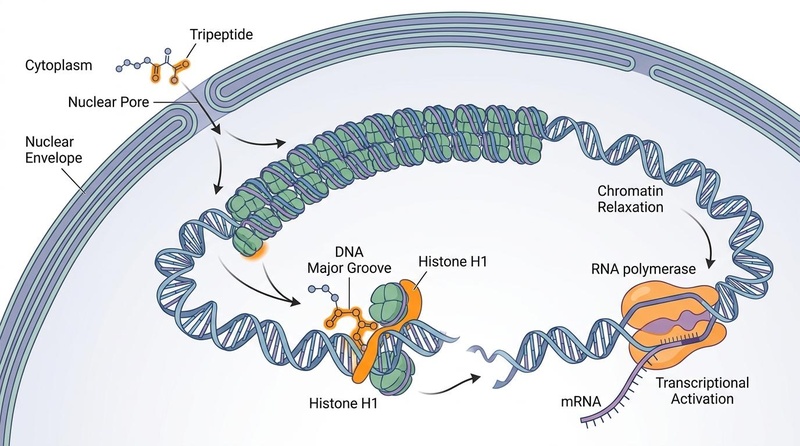
Scientific Disclaimer: Speculative Epigenetic Mechanism
- Hypothesis vs. Consensus Pathway: The epigenetic mechanism depicted above is a specialized hypothesis proposed by Vladimir Khavinson and his research group. It is not a standard or widely accepted model of gene regulation in mainstream molecular biology, where chromatin relaxation (unfolding) is established as a highly complex process requiring multi-protein remodeling complexes (such as SWI/SNF) and specific enzymatic modifications (e.g., histone acetylation, DNA methylation), rather than direct structural disruption or relaxation by short peptides.
- Peptide Specificity ("Tripeptide"): The term "Tripeptide" in the diagram refers specifically to the proposed bioactive peptide bioregulators under investigation (such as Pinealon, Crystagen, or Vesugen) and does not apply to generic tripeptides, which do not possess these alleged epigenetic properties.
- Chromatin Unfolding: These peptides interact with Histone H1, leading to the "unfolding" or relaxation of chromatin. This makes specific genes accessible to transcription factors, thereby reactivating the synthesis of tissue-specific proteins that typically declines with age [1].
- Gene Activation: By exposing specific gene regions, the peptides can upregulate or downregulate gene expression. For example, the KED and EDR peptides have been shown to bind to promoter regions of genes like CASP3, NES, GAP43, APOE, SOD2, PPARA, PPARG, and GDX1, which are involved in Alzheimer's disease pathogenesis [2]. The KE peptide also regulates genes such as SIRT1, PARP1, and PARP2 in human mesenchymal stem cells during aging, influencing protein synthesis [3].
- Tissue Specificity: Each bioregulator is highly tissue-specific. For example, a peptide isolated from the pineal gland triggers gene expression specifically in pineal cells, while one from the thymus targets immune cells [4].
¶ Transport Mechanism
Ultrashort peptides, including those in Khavinson bioregulators, can be transported across cell membranes via various mechanisms. Research indicates the feasibility of transport for 26 biologically active ultrashort peptides through specific carrier proteins, particularly the POT (proton-coupled oligopeptide transporter) and LAT (L-type amino acid transporter) family transporters [5], [6]. This transport efficiency is crucial for their epigenetic regulatory functions within target cells.
¶ Classification: Cytomaxes vs. Cytogens
Khavinson bioregulators are generally divided into two main categories based on their origin and composition:
¶ 1. Cytomaxes (Natural Extracts)
These are complex polypeptide fractions extracted from animal tissues (typically calves or pigs). They contain a mixture of natural peptides and are considered to have a broader, more "holistic" effect. They act more slowly but are believed to have a longer-lasting impact.
- Examples: Epithalamin (Pineal), Thymalin (Thymus), Cortexin (Brain), Retinalamin (Eye).
¶ 2. Cytogens (Synthesized Peptides)
These are short, synthetic peptide chains (di-, tri-, or tetrapeptides) identified as the active "short-chain" components of the natural extracts. They are faster-acting than Cytomaxes but may have a shorter duration of effect. They are typically used for the initial "attack" phase of therapy.
- Examples: Epitalon (Synthetic Epithalamin), Vilon (Synthetic Thymalin), Pinealon (Synthetic Cortexin component).
¶ Key Bioregulators & Their Targets
While Epitalon (Pineal) and Cortagen (Brain/Adrenal) have their own dedicated pages, numerous other bioregulators target specific organ systems.
¶ Immune System
- Vilon (Lys-Glu): A synthetic dipeptide that stimulates the thymus gland. It enhances T-cell differentiation and has been used to treat immunodeficiency and accelerate wound healing. It is the synthetic analogue of Thymalin [7].
- Crystagen (Pro-Glu-Asp): A synthetic tripeptide acting on the immune system. It is often used to restore immune function after radiation, chemotherapy, or severe infections.
- Thymalin: The natural extract from the thymus gland. One of the oldest and most studied bioregulators for immunosenescence. The dipeptides KE and EW, components of the Thymalin drug, have been shown to influence gene expression and protein synthesis involved in COVID-19 pathogenesis [7:1].
¶ Nervous System
- Pinealon (Glu-Arg-Glu): A synthetic tripeptide targeting the brain. Research suggests it can improve cognitive function, memory, and focus by regulating the activity of brain cells and reducing excitotoxicity. It is often linked to the natural extract Cortexin.
- Cerluten: A natural extract targeting the brain, often used for atherosclerosis, memory impairment, and post-stroke recovery.
¶ Cardiovascular & Respiratory
- Vesugen (Lys-Glu-Asp): A synthetic tripeptide regulating vascular health. It targets the endothelial cells of blood vessels, potentially improving circulation and reducing the progression of atherosclerosis.
- Ventfort: The natural peptide extract from blood vessels, often used to treat atherosclerosis and improve circulation.
- Bronchogen (Ala-Glu-Asp-Leu): A synthetic tetrapeptide targeting the lungs and bronchi. It is used to support respiratory health in conditions like chronic bronchitis and asthma.
- Cardiogen: A synthetic peptide for the heart, aiming to improve myocardial function and recovery after heart attacks. Khavinson's work also extends to assessing quality of medical care for patients with chronic heart failure [8].
¶ Musculoskeletal
- Cartalax (Ala-Glu-Asp): A synthetic tripeptide targeting cartilage and connective tissue. It is used to support joint health, reduce inflammation in osteoarthritis, and accelerate collagen synthesis. Peptide regulation of chondrogenic stem cell differentiation is an area of active research [9].
- Sigumir: The natural peptide extract for cartilage and joints.
¶ Digestive & Liver
- Svetinorm: A natural peptide complex extracted from the liver. It promotes hepatocyte regeneration and is used for chronic hepatitis and liver toxicity.
- Ovagen (Glu-Asp-Leu): A synthetic tripeptide targeting the liver and GI tract. It stimulates liver cell proliferation and normalizes metabolic function.
- Pancragen: Synthetic peptide for the pancreas (insulin regulation).
- Livagen (Lys-Glu-Asp-Ala): A peptide that affects the liver and immune system.
¶ Other Systems
- Testoluten: Natural extract for the testes, used to support testosterone levels and libido.
- Glandokort: Natural extract for the adrenal glands, used to restore cortisol balance and improve stress resilience.
- Endoluten: Natural pineal gland extract (the natural source of Epithalamin). Considered the "gold standard" natural bioregulator for longevity and circadian rhythm.
- Gonadotropin-Releasing Hormone: While not a Khavinson peptide, related research highlights the broader field of peptide influence on endocrine systems [10].
¶ Evidence Quality, Clinical Trials, and Regulatory Landscape
The scientific literature on Khavinson bioregulators largely originates from Russia and Eastern Europe. While extensive, this body of research often presents challenges when evaluated against global clinical trial standards.
¶ Research Status
The majority of research on these compounds comes from Russia and Eastern Europe, with over 40 years of clinical observations and animal studies.
- Lifespan Studies: Studies on mice and rats (particularly with Epitalon and Vilon) have shown significant lifespan extension (10-25%) and reduced tumor incidence [4:1].
- Human Data: Long-term observations in elderly populations (e.g., the 12-year Gazprom study) reported reduced mortality and morbidity in groups treated with thymic and pineal peptides [5:1].
¶ Evidence Summary Table (Human Outcomes)
| Intervention | Human Outcome | GRADE (Certainty of Evidence) | Key Findings | References |
|---|---|---|---|---|
| Thymalin (natural) | Reduced mortality & morbidity in elderly | Low | Long-term observational studies reported improved health markers and reduced death rates in aged populations. However, these are not randomized controlled trials (RCTs). | [5:2] |
| Vilon (synthetic Thymalin) | Immunomodulation | Very Low | Animal studies show enhanced T-cell differentiation and immune function; human data is limited to small observational studies. | [7:2] |
| Pinealon (synthetic brain peptide) | Cognitive improvement | Very Low | Primarily animal studies showing neuroprotective effects and improved cognitive function in models of aging and neurodegeneration. Human evidence is largely anecdotal or from small, non-randomized trials. | [2:1], [1:1] |
| KED and EDR peptides | Neuroprotection in Alzheimer's models | Very Low (animal data) | Prevent dendritic spine loss in 5xFAD mice; epigenetically regulate genes involved in AD pathogenesis (e.g., CASP3, APOE). Human studies are lacking. | [2:2], [1:2] |
| KE peptide | Gene expression regulation in stem cells | Very Low (in vitro) | Regulates SIRT1, PARP1, PARP2 gene expression and protein synthesis in human mesenchymal stem cells during aging in in vitro settings. Clinical relevance in humans is not yet established. | [3:1] |
| Cartalax (synthetic cartilage peptide) | Joint health, reduced inflammation | Very Low | Animal studies suggest benefits for cartilage and connective tissue. Human studies are scarce and often lack robust methodology. | [9:1] |
| Vesugen (synthetic vascular peptide) | Vascular health, atherosclerosis | Very Low | Animal models indicate potential for improving endothelial function and reducing atherosclerosis. Human data consists mainly of small studies without blinding or control groups. | - |
| Epitalon (synthetic pineal peptide) | Lifespan extension, tumor incidence reduction | Very Low (animal data) | Significant lifespan extension and reduced tumor incidence in rodents. Human data primarily from observational studies. | [4:2] |
¶ Safety Profile
Khavinson bioregulators are generally considered to have an excellent safety profile. Because they consist of naturally occurring amino acids and function via physiological mechanisms (epigenetic regulation), toxic side effects are extremely rare. No drug-drug interactions have been reported in the available literature, although standard caution is advised [4:3].
¶ Product and Regulatory Caveats
¶ Russian Clinical Trials vs. Global Standards
Many "clinical trials" cited for Khavinson peptides are conducted in Russia and may not adhere to the rigorous, double-blind, placebo-controlled methodology required for FDA or EMA approval. While these studies provide valuable long-term observational data and insights, their results should be interpreted with caution when generalizing to broader Western populations or seeking definitive efficacy claims. The absence of comprehensive Phase 2/3 trials by global standards limits their acceptance in mainstream medicine outside of Russia.
¶ Availability and Purity
These peptides are often available as dietary supplements or research chemicals outside of clinical settings. The purity, dosage accuracy, and presence of contaminants in such products can vary widely. Consumers should exercise extreme caution and seek products from reputable manufacturers that provide third-party testing for purity and potency. Regulatory oversight for these compounds as supplements can be ambiguous in many countries.
¶ Practical Interpretation for Longevity and Healthspan
Khavinson bioregulators represent a fascinating, albeit often overlooked, area in longevity science. Their proposed mechanism of epigenetic regulation offers a unique approach to addressing age-related decline at a fundamental cellular level.
- Epigenetic Focus: The idea that short peptides can selectively reactivate genes associated with youth and tissue function is highly compelling. This contrasts with broader interventions that might have systemic effects.
- Tissue-Specific Renewal: The specificity of each peptide for a particular organ or system suggests a targeted approach to rejuvenation, allowing for focused intervention on specific areas of age-related weakness.
- Integrative Approach: While direct, high-GRADE evidence for human longevity extension remains limited by global research standards, the safety profile and the biological plausibility of their mechanisms make them candidates for an integrative longevity strategy, especially when conventional options are limited or undesired.
Individuals considering Khavinson bioregulators should consult with healthcare professionals knowledgeable in integrative or longevity medicine. Further, a critical evaluation of source quality and purity is paramount given the current regulatory landscape.
¶ See Also
- Khavinson Bioregulators Source Manifest: Structured database of peer-reviewed clinical, in vivo, and in vitro evidence supporting Khavinson peptide therapeutic applications.
- Epitalon: The most famous Khavinson bioregulator.
- Cortagen: Brain/Adrenal regulator.
- Thymosin Alpha-1: Another major immune peptide (distinct from Vilon but functionally related).
¶ References
Correction: Khavinson et al. Neuroprotective Effects of Tripeptides-Epigenetic Regulators in Mouse Model of Alzheimer's Disease. Pharmaceuticals (Basel). 2025;18(1):111. doi:10.3390/ph18010111. https://pubmed.ncbi.nlm.nih.gov/39861198/ ↩︎ ↩︎ ↩︎
Khavinson V, Ilina A, Kraskovskaya N, et al. Neuroprotective Effects of Tripeptides-Epigenetic Regulators in Mouse Model of Alzheimer's Disease. Pharmaceuticals (Basel). 2021;14(6):515. doi:10.3390/ph14060515. https://pubmed.ncbi.nlm.nih.gov/34071923/ ↩︎ ↩︎ ↩︎
Khavinson VK, Linkova NS, Ashapkin VV, Shilovsky GA, Borushko NV, Petukhov MG, Vanuyshin BF. [KE peptide regulates SIRT1, PARP1, PARP2 gene expression and protein synthesis in human mesenchymal stem cells aging.]. Advances in Gerontology = Uspekhi Gerontologii. 2023;36(5):782-788. https://pubmed.ncbi.nlm.nih.gov/37782636/ ↩︎ ↩︎
Khavinson VK, Popovich IG, Linkova NS. Peptide Regulation of Gene Expression: A Systematic Review. Molecules (Basel, Switzerland). 2021;26(22):6995. doi:10.3390/molecules26226995. https://pubmed.ncbi.nlm.nih.gov/34834147/ ↩︎ ↩︎ ↩︎ ↩︎
Khavinson VK, Linkova NS, Rudskoy AI, Petukhov MG. Feasibility of Transport of 26 Biologically Active Ultrashort Peptides via LAT and PEPT Family Transporters. Biomolecules. 2023;13(3):552. doi:10.3390/biom13030552. https://pubmed.ncbi.nlm.nih.gov/36979488/ ↩︎ ↩︎ ↩︎
Khavinson V, Linkova N, Kozhevnikova E, Dyatlova A, Petukhov M. Transport of Biologically Active Ultrashort Peptides Using POT and LAT Carriers. International Journal of Molecular Sciences. 2022;23(14):7733. doi:10.3390/ijms23147733. https://pubmed.ncbi.nlm.nih.gov/35887081/ ↩︎
Linkova N, Khavinson V, Diatlova A, Petukhov M, Vladimirova E, Sukhareva M, Ilina A. The Influence of KE and EW Dipeptides in the Composition of the Thymalin Drug on Gene Expression and Protein Synthesis Involved in the Pathogenesis of COVID-19. International Journal of Molecular Sciences. 2023;24(17):13377. doi:10.3390/ijms241713377. https://pubmed.ncbi.nlm.nih.gov/37686182/ ↩︎ ↩︎ ↩︎
Yakovlev AA, Khavinson VK. [Features of assessing the quality of medical care for patients with chronic heart failure of older age groups (review).]. Advances in Gerontology = Uspekhi Gerontologii. 2022;35(2):162-167. https://pubmed.ncbi.nlm.nih.gov/35522116/ ↩︎
Linkova N, Khavinson V, Diatlova A, Myakisheva S, Ryzhak G. Peptide Regulation of Chondrogenic Stem Cell Differentiation. International Journal of Molecular Sciences. 2023;24(9):8415. doi:10.3390/ijms24098415. https://pubmed.ncbi.nlm.nih.gov/37176122/ ↩︎ ↩︎
Sun W, Jarry H, Wuttke W. Gonadotropin releasing hormone modulates gamma-aminobutyric acid-evoked intracellular calcium increase in immortalized hypothalamic gonadotropin releasing hormone neurons. Brain Research. 1997;746(1-2):191-196. doi:10.1016/s0006-8993(96)01140-6. https://pubmed.ncbi.nlm.nih.gov/9042529/ ↩︎