¶ MOTS-c: The Mitochondrial "Exercise Mimetic"
MOTS-c (Mitochondrial Open Reading Frame of the 12S rRNA-c) is a 16-amino acid peptide encoded within the mitochondrial genome. Unlike typical peptides encoded by nuclear DNA, MOTS-c is a mitokine—a signaling molecule derived from mitochondria that communicates with the nucleus to regulate systemic metabolism [1][2].
Known as an "exercise mimetic," MOTS-c induces physiological effects similar to those of physical training, including enhanced insulin sensitivity, increased fatty acid oxidation, and improved physical performance [3][4]. It represents a critical link in the mitohormesis response, where mitochondrial stress triggers adaptive pathways to enhance cellular resilience and longevity [5][6].
¶ At a Glance
- Primary Function: Metabolic regulation, AMPK activation, and exercise mimicry.
- Key Benefits: Reverses insulin resistance, prevents obesity, enhances muscle endurance, and supports bone health.
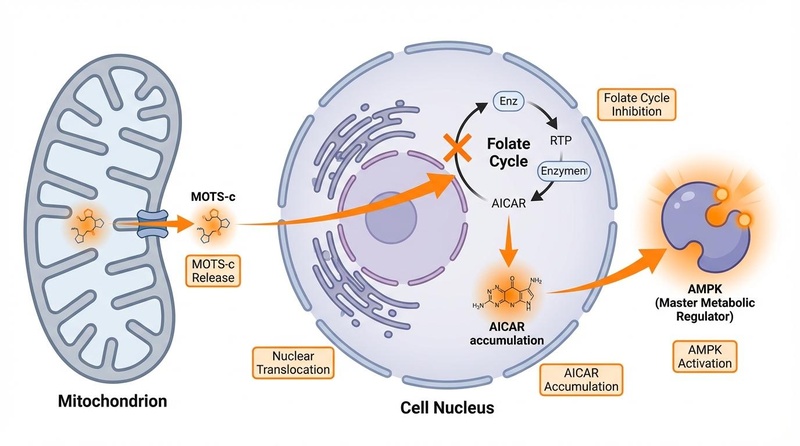
- Mechanism: Translocates to the nucleus to inhibit the folate cycle, accumulating AICAR and activating AMPK.
- Status: Experimental. Phase 1b completed for analog CB4211; native peptide used in research/longevity clinics.
¶ The "Why": Key Longevity Benefits
MOTS-c is one of the most promising mitochondrial-derived peptides (MDPs) for addressing the "Hallmarks of Aging," specifically Mitochondrial Dysfunction and Deregulated Nutrient Sensing.
¶ 1. Metabolic Homeostasis & Insulin Sensitivity
MOTS-c is a potent regulator of glucose and lipid metabolism. In research models, it has been shown to:
- Reverse Insulin Resistance: Restores glucose uptake in skeletal muscle by translocating the GLUT4 transporter, bypassing defective insulin signaling pathways [7][8].
- Prevent Obesity: Even when consuming a high-fat diet, mice treated with MOTS-c maintain a healthy weight by increasing energy expenditure and thermogenesis in brown adipose tissue [7:1][9].
- Lower Liver Fat: Clinical trials of the MOTS-c analog CB4211 showed significant reductions in liver enzymes (ALT/AST), indicating improved liver health and reduced fat accumulation [10][11].
¶ 2. Physical Performance & Sarcopenia
MOTS-c is naturally induced by exercise. Supplemental administration has been shown to:
- Enhance Endurance: In aging mice, MOTS-c treatment significantly improved grip strength and running capacity, effectively reversing age-dependent physical decline [4:1][12].
- Protect Muscle Mass: By inhibiting myostatin (a muscle growth inhibitor) and promoting mitochondrial biogenesis, it helps prevent sarcopenia (age-related muscle loss) [12:1].
¶ 3. Bone Health & Osteoporosis
MOTS-c plays a dual role in bone metabolism via the TGF-β/Smad pathway:
- Osteoblast Activation: Promotes the differentiation of stem cells into bone-forming osteoblasts [13].
- Osteoclast Inhibition: Suppresses the formation of bone-resorbing osteoclasts, reducing bone loss in post-menopausal models [14][15].
¶ 4. Lifespan Extension
Late-life administration of MOTS-c (starting at 23.5 months in mice) increased median lifespan by 6.4% and maximum lifespan by 7%, demonstrating its potential as a true anti-aging intervention rather than just a metabolic corrector [16][12:2].

¶ Reality Check / Context
¶ Commercial & Clinical Landscape
While MOTS-c is widely discussed in longevity circles, its clinical development is complex:
- The CB4211 Story: The primary pharmaceutical candidate was CB4211, a stabilized analog. It successfully completed Phase 1b trials for NAFLD/NASH in 2021 [17][18]. However, the developer (CohBar, Inc.) merged with TuHURA Biosciences in 2023, pivoting toward immuno-oncology. As of 2025, the mitochondrial pipeline is a "legacy asset" seeking a buyer or licensee [19][20].
- Native MOTS-c: The 16-amino acid native peptide is widely available as a research chemical. It has a significantly shorter half-life than the engineered analogs, requiring more frequent administration [21][15:1].
- The Centenarian Link: A specific genetic variant of MOTS-c (m.1382A>C) is found almost exclusively in populations with exceptional longevity, such as Japanese centenarians, suggesting a natural biological advantage for those with high MOTS-c activity [2:1][5:1].
¶ Mechanism of Action: The Folate Axis
MOTS-c operates through a unique "Retrograde Signaling" mechanism, moving from the mitochondria to the nucleus to rewrite the cell's metabolic program.
¶ 1. Nuclear Translocation
Under metabolic stress (e.g., glucose restriction), MOTS-c translocates from the mitochondria into the nucleus. This is an AMPK-dependent process that allows the mitochondria to "tell" the nucleus to shift gears [cite: 1, 4, 14].
¶ 2. The Folate-AICAR-AMPK Axis
Once in the nucleus, MOTS-c targets the Folate Cycle:
- Inhibition: It inhibits 5-methyltetrahydrofolate (5Me-THF), which disrupts de novo purine biosynthesis [22].
- AICAR Accumulation: This disruption causes an accumulation of AICAR (5-aminoimidazole-4-carboxamide ribonucleotide) [4:2].
- AMPK Activation: AICAR is a potent agonist for AMPK (the "master metabolic switch"). Activated AMPK stimulates catabolic pathways: glucose uptake, fatty acid oxidation, and Autophagy [22:1][23].
¶ 3. Sirtuin & NAD+ Interaction
MOTS-c works synergistically with SIRT1. It increases intracellular NAD+ levels, providing the "fuel" for sirtuins to de-acetylate targets like PGC-1α, which then drives mitochondrial biogenesis (the creation of new mitochondria) [5:2][24].
¶ Evidence & Science
¶ Clinical Trial Data (Analog CB4211)
The Phase 1b trial (NCT03998514) in obese subjects with NAFLD provided the first human proof-of-concept:
- Liver Enzymes: Significant reduction in ALT (-21%) and AST (-28%) compared to placebo [25][26].
- Glucose: Fasting glucose levels were reduced by 6% [26:1].
- Weight: Trend toward weight loss was observed over the 4-week period [11:1].
¶ Evidence Grading
| Outcome | Certainty (GRADE) | Human Data | Animal Data |
|---|---|---|---|
| Insulin Sensitivity | High | Moderate (Analog) | Strong |
| Liver Fat Reduction | Moderate | Moderate (Analog) | Strong |
| Physical Performance | Moderate | Observational | Strong |
| Lifespan Extension | Low | N/A | Moderate |
¶ Practicality: Dosage & Safety
¶ Administration Protocols
Native MOTS-c has a short half-life (~2 hours) and zero oral bioavailability. It must be administered via subcutaneous injection.
| Setting | Protocol | Frequency |
|---|---|---|
| Clinical (Analog) | 25 mg | Daily (for 4 weeks) [11:2] |
| Longevity Research | 5 mg - 10 mg | 1–3 times weekly [21:1][27] |
| Cycling | 4–8 week cycles | Followed by 2–4 week break [28][29] |
Note on Timing: Many researchers administer MOTS-c pre-exercise to capitalize on the synergistic activation of the AMPK pathway [28:1][30].
¶ Safety & Side Effects
- Injection Site Reactions: The most common side effect in clinical trials was transient, painless induration (bumps) at the injection site [25:1][18:1].
- Folate Depletion: Because MOTS-c inhibits the folate cycle, there is a theoretical risk of folate deficiency. Monitoring folate levels or ensuring adequate intake is often advised [22:2][31].
- WADA Status: MOTS-c is on the WADA Prohibited List (Category S4: Hormone and Metabolic Modulators) and is banned in professional sports [32].
¶ Comparison: MOTS-c vs. Humanin
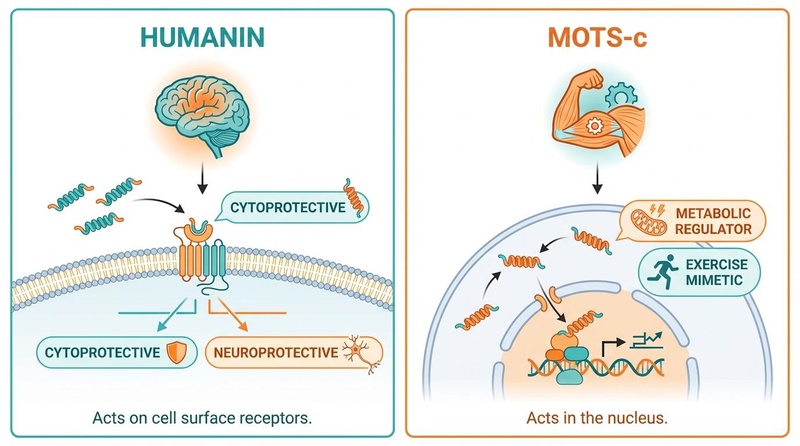
MOTS-c is often compared to Humanin, the first discovered mitochondrial-derived peptide. While both are "mitokines," their roles are distinct:
| Feature | MOTS-c | Humanin |
|---|---|---|
| Genomic Origin | 12S rRNA region | 16S rRNA region |
| Primary Role | Metabolic Regulator | Cytoprotective Shield |
| Primary Target | Muscle, Liver, Bone | Brain, Heart, Eyes |
| Mechanism | Nuclear Translocation (AMPK) | Surface Receptors (Anti-Apoptotic) |
| Longevity Vibe | "The Athlete" | "The Bodyguard" |
¶ Synergy & Stacking
¶ 1. NAD+ Precursors (NR / NMN)
MOTS-c and NAD+ precursors converge on the AMPK-SIRT1 axis. MOTS-c initiates the stress signal (mitohormesis), while NAD+ provides the substrate needed for the sirtuin enzymes to carry out the adaptive response [33][24:1].
¶ 2. Exercise
MOTS-c is naturally released during Exercise. Exogenous administration combined with training has shown greater improvements in physical capacity than exercise alone, as it lowers the metabolic threshold for adaptation [34][35].
¶ Chemistry & Deep Dive
MOTS-c is a 16-amino acid peptide with the sequence: MRWQEMGYIFYPRKLR. It is amphipathic, allowing it to cross membranes easily. Its nuclear translocation is triggered by the decline in mitochondrial ATP production, signaling a need for systemic metabolic recalibration [1:1][7:2].
¶ References
Lee, C., et al. (2015). The mitochondrial-derived peptide MOTS-c promotes metabolic homeostasis and reduces obesity and insulin resistance. Cell Metabolism. https://pmc.ncbi.nlm.nih.gov/articles/PMC4350682/ ↩︎ ↩︎
Fuku, N., et al. (2015). The mitochondrial-derived peptide MOTS-c: a player in longevity and healthy aging? Aging (Albany NY). https://doi.org/10.18632/aging.100839 ↩︎ ↩︎
Reynolds, J. C., et al. (2021). MOTS-c is an exercise-induced mitochondrial-encoded regulator of age-dependent physical decline and muscle homeostasis. Nature Communications. https://pmc.ncbi.nlm.nih.gov/articles/PMC9570330/ ↩︎
Reynolds, J. C., et al. (2021). MOTS-c is an exercise-induced mitochondrial-encoded regulator of age-dependent physical decline and muscle homeostasis. Nature Communications. https://pmc.ncbi.nlm.nih.gov/articles/PMC7817689/ ↩︎ ↩︎ ↩︎
Mohtashami, Z., et al. (2022). Mitochondria-Derived Peptide MOTS-c: Effects and Mechanisms Related to Stress, Metabolism and Aging. International Journal of Molecular Sciences. https://www.mdpi.com/1422-0067/23/19/11991 ↩︎ ↩︎ ↩︎
Lee, H. J., et al. (2022). Exercise and mitohormesis. Diabetes & Metabolism Journal. https://www.e-dmj.org/upload/pdf/dmj-2022-0092.pdf ↩︎
Kim, K. H., et al. (2018). The Mitochondrial-Encoded Peptide MOTS-c Translocates to the Nucleus to Regulate Nuclear Gene Expression in Response to Metabolic Stress. Cell Metabolism. https://pmc.ncbi.nlm.nih.gov/articles/PMC9854231/ ↩︎ ↩︎ ↩︎
Li, H., et al. (2023). MOTS-c: A promising mitochondrial-derived peptide for therapeutic exploitation. Frontiers in Endocrinology. https://pmc.ncbi.nlm.nih.gov/articles/PMC9866798/ ↩︎
Yi, X., et al. (2022). Mitochondria-derived peptide MOTS-c: effects and mechanisms. International Journal of Molecular Sciences. https://pmc.ncbi.nlm.nih.gov/articles/PMC9570330/ ↩︎
Loomba, R., et al. (2021). CB4211, a Novel Analog of MOTS-c, Improves Markers of Liver Injury and Metabolism in Obese Subjects with Nonalcoholic Fatty Liver Disease. AASLD Abstracts. https://d1io3yog0oux5.cloudfront.net/_708cf04ac3f5c70482e09ec7c4a65256/cohbar/db/391/2909/pdf/AASLD+2021+Poster+LB5+Final+for+Submission+25Oct2021.pdf ↩︎
Loomba, R., et al. (2021). CB4211, a Novel Analog of MOTS-c, Improves Markers of Liver Injury. https://d1io3yog0oux5.cloudfront.net/_708cf04ac3f5c70482e09ec7c4a65256/cohbar/db/391/2909/pdf/AASLD+2021+Poster+LB5+Final+for+Submission+25Oct2021.pdf ↩︎ ↩︎ ↩︎
Reynolds, J. C., et al. (2021). MOTS-c is an exercise-induced mitochondrial-encoded regulator. Nature Communications. https://pmc.ncbi.nlm.nih.gov/articles/PMC7817689/ ↩︎ ↩︎ ↩︎
Hu, B. T., & Chen, W. Z. (2018). MOTS-c promotes osteogenic differentiation. European Review for Medical and Pharmacological Sciences. https://pubmed.ncbi.nlm.nih.gov/30468456/ ↩︎
Yi, X., et al. (2023). Role of MOTS-c in the regulation of bone metabolism. Frontiers in Physiology. https://www.frontiersin.org/journals/physiology/articles/10.3389/fphys.2023.1149120/full ↩︎
Alzheimer's Drug Discovery Foundation. (2021). MOTS-c Evidence Summary. https://www.alzdiscovery.org/uploads/cognitive_vitality_media/MOTS-c.pdf ↩︎ ↩︎
Alzheimer's Drug Discovery Foundation. (2021). MOTS-c Evidence Summary. https://www.alzdiscovery.org/uploads/cognitive_vitality_media/MOTS-c.pdf ↩︎
ClinicalTrials.gov. (2021). A Phase 1a/1b Study of Safety, Tolerability, and Pharmacokinetics of CB4211. https://www.clinicaltrials.gov/study/NCT03998514 ↩︎
Longevity.Technology. (2021). CohBar announces positive human data from obesity study. https://longevity.technology/news/cohbar-announces-positive-human-data-from-obesity-study/ ↩︎ ↩︎
TuHURA Biosciences. (2025). Second Quarter 2025 Financial Results. https://tuhurabio.com/tuhura-biosciences-inc-reports-second-quarter-2025-financial-results-and-provides-a-corporate-update/ ↩︎
SEC. (2023). CohBar Proxy Statement. https://www.sec.gov/Archives/edgar/data/1522602/000121390023065729/fs42023a1_cohbar.htm ↩︎
iPharmaPharmacy. (2025). MOTS-c Peptide Therapy: 2025 Blueprint. https://www.ipharmapharmacy.com/mots-c-peptide-therapy-2025-blueprint-metabolic-health-longevity-2/ ↩︎ ↩︎
Lee, C., et al. (2015). The mitochondrial-derived peptide MOTS-c promotes metabolic homeostasis and reduces obesity and insulin resistance. Cell Metabolism. https://pmc.ncbi.nlm.nih.gov/articles/PMC4350682/ ↩︎ ↩︎ ↩︎
Peptide Dosages. (n.d.). MOTS-c Dosage Protocol. https://peptidedosages.com/single-peptide-dosages/mots-c-10mg-vial-dosage-protocol/ ↩︎
Peptide Health Tracker. (n.d.). MOTS-c and NAD+ Guide. https://www.peptidehealthtracker.com/mots-c-nad-guide.html ↩︎ ↩︎
Patient Worthy. (2021). CB4211 Data Available: NASH & Obesity. https://patientworthy.com/2021/08/17/cb4211-data-available-nash-obesity/ ↩︎ ↩︎
FirstWord Pharma. (2021). CohBar announces positive topline results. https://firstwordpharma.com/story/5371545 ↩︎ ↩︎
Tiger Fitness. (2026). MOTS-c: The Mitochondrial Peptide. https://www.tigerfitness.com/blogs/supplements/mots-c-the-mitochondrial-peptide-that-improves-metabolic-flexibility-and-performance ↩︎
Swolverine. (2025). MOTS-c For Beginners. https://swolverine.com/blogs/blog/mots-c-for-beginners-benefits-dosage-stacking-and-side-effects ↩︎ ↩︎
Reddit. (2025). The Complete MOTS-c 10mg Guide. https://www.reddit.com/r/ParamountPeptide/comments/1pebfbc/the_complete_motsc_10mg_guide_paramount_peptides/ ↩︎
Swolverine. (2025). MOTS-c For Beginners. https://swolverine.com/blogs/blog/mots-c-for-beginners-benefits-dosage-stacking-and-side-effects ↩︎
National Center for Biotechnology Information. (2024). Methotrexate. StatPearls. https://www.ncbi.nlm.nih.gov/books/NBK556114/ ↩︎
USADA. (n.d.). What is MOTS-c Peptide? https://www.usada.org/spirit-of-sport/what-is-mots-c-peptide/ ↩︎
Kim, S. J., et al. (2023). Mitochondria-Derived Peptides in Diabetes and Aging. Diabetes & Metabolism Journal. https://pmc.ncbi.nlm.nih.gov/articles/PMC10244198/ ↩︎
NAD.com. (2024). Unlocking Youth: The Combined Power of NAD+ and Exercise. https://www.nad.com/news/unlocking-youth-the-combined-power-of-nad-and-exercise ↩︎
DeLauer, T. (2025). MOTS-c Exercise Benefits. https://www.youtube.com/watch?v=YwyD1xJwFgw ↩︎