¶ Melatonin, Sleep, and Circadian/Light Contraindications
This monograph details the clinical safety, side effects, drug/supplement interactions, and contraindications for melatonin, various sleep aids, and light therapy interventions, in alignment with optimizing sleep and circadian health. Understanding these factors is crucial for safe and effective use.
| Type | Hormone, Light Therapy, Supplements |
| Primary Function | Sleep-wake regulation, circadian entrainment |
| Main Benefit | Improved sleep, circadian alignment |
| Key Risk | Drug interactions, mood disturbance, retinal damage |
Interventions aimed at optimizing sleep, circadian rhythms, and light exposure are powerful tools for health, but they require careful consideration of individual health status, potential side effects, and interactions. This page provides a comprehensive overview of contraindications and safety guidelines for exogenous melatonin, bright light therapy, and common sleep-supporting supplements.
¶ At a glance
Aliases
- Also known as: Circadian Rhythm Interventions, Sleep Health Modalities, Chronobiotics
- Chemical / botanical name: Melatonin, Valeriana officinalis, L-Tryptophan, Magnesium, Passiflora incarnata, Matricaria chamomilla, L-Theanine
- Category: Hormone, Botanical extract, Mineral, Amino acid, Phototherapy
Key points (high-level summary)
- Melatonin is contraindicated in autoimmune diseases, pregnancy/lactation, and requires caution with CYP1A2 inhibitors (e.g., fluvoxamine), anticoagulants, and immunosuppressants [1][2][3].
- Bright Light Therapy (BLT) is contraindicated in acute manic episodes, recent hypomania, certain retinal diseases (e.g., macular degeneration), porphyria, and with photosensitizing medications [4][5][6].
- Valerian root carries risks of hepatotoxicity and additive CNS depression with alcohol or other sedatives [7][8].
- L-Tryptophan can induce serotonin syndrome when combined with SSRIs, SNRIs, or MAOIs [9].
- Passionflower and Chamomile are contraindicated during pregnancy due to uterine-stimulant effects [10][11][12].
- High-dose Magnesium requires caution in patients with chronic kidney disease due to impaired renal excretion and hypermagnesemia risk [13].
- Daytime use of blue-blocking glasses can lead to circadian phase delay and afternoon fatigue, disrupting healthy light exposure [14].
What people use it for
- Main goals: Improving sleep onset and quality, adjusting circadian rhythms (e.g., jet lag, shift work), treating seasonal affective disorder, reducing anxiety.
- Evidence quality (overall): High to Moderate for well-defined applications; caution for long-term use in specific populations or novel combinations.
¶ What is it?
These interventions encompass a range of approaches to modulate the body's internal clock and promote restful sleep.
- Definition:
- Melatonin: A hormone produced by the pineal gland, involved in regulating sleep-wake cycles and circadian rhythms. Exogenous melatonin is used as a chronobiotic.
- Bright Light Therapy (BLT): Exposure to specific intensities and wavelengths of light to influence circadian timing and mood.
- Sleep Aids & Starter-Kit Supplements: A group of natural compounds (e.g., Valerian root, L-Tryptophan, Magnesium, L-Theanine, Chamomile, Passionflower) used to promote relaxation and sleep.
- Natural sources: Melatonin is endogenous. Many sleep aids are botanical (Valerian, Chamomile, Passionflower) or mineral (Magnesium) in origin.
- Traditional / historical use: Many botanicals have traditional uses for sleep and anxiety. Light exposure has always governed natural rhythms.
- Current regulatory status: Melatonin is a dietary supplement in the US and a prescription drug in some other regions (e.g., Europe). Light therapy devices are often regulated as medical devices. Botanicals and minerals are generally dietary supplements.
- Key pharmacological property in one line: Modulating neural and hormonal pathways that control sleep, wakefulness, and circadian timing.
¶ Main benefits
These interventions primarily aim to improve various aspects of sleep and circadian alignment.
-
Outcome: Improved Sleep Onset Latency (Melatonin)
-
Direction of effect:
Small Improvement Decrease -
Magnitude: Small to Moderate
-
Population studied: Individuals with insomnia, jet lag, or circadian rhythm sleep disorders.
-
Evidence quality: High (for short-term use in specific populations)
-
Summary sentence: Exogenous melatonin can reduce the time it takes to fall asleep, especially in individuals with primary insomnia or circadian misalignment [15].
-
Outcome: Circadian Phase Shifting (Melatonin, Bright Light Therapy)
-
Direction of effect:
Large Improvement Increase -
Magnitude: Large
-
Population studied: Shift workers, individuals with jet lag, blind individuals.
-
Evidence quality: High
-
Summary sentence: Both appropriately timed melatonin and bright light therapy are potent chronobiotics, capable of significantly shifting the body's circadian clock [16][4:1].
-
Outcome: Reduced Anxiety / Relaxation (L-Theanine, Valerian, Chamomile, Passionflower)
-
Direction of effect:
Small Improvement Decrease -
Magnitude: Small to Moderate
-
Population studied: Individuals with mild anxiety, stress-related sleep disturbances.
-
Evidence quality: Moderate
-
Summary sentence: Several natural sleep aids promote relaxation and reduce anxiety, which can indirectly improve sleep quality [17][18].
-
Outcome: Reduced Insomnia Severity (Magnesium)
-
Direction of effect:
Medium Improvement Decrease -
Magnitude: Moderate
-
Population studied: Older adults with primary insomnia.
-
Evidence quality: High
-
Summary sentence: Magnesium supplementation has been shown to significantly improve subjective measures of insomnia severity in older adults [19].
¶ Evidence summary table (human outcomes)
| Outcome / Goal | Effect* | Consistency** | Evidence quality | Trials*** | Notes (population, duration, dose) |
|---|---|---|---|---|---|
| Melatonin | |||||
| Sleep Onset Latency | High | High | MA | Reduction in sleep onset latency (various doses) [15:1] | |
| Circadian Phase Shift | High | High | RCTs | Potent chronobiotic effect, particularly in blind individuals (0.5mg) [16:1] | |
| Bright Light Therapy | |||||
| Mood Improvement (SAD) | High | High | MA | Significant reduction in SAD symptoms [4:2] | |
| Manic/Hypomanic Switch (Bipolar) | Moderate | Moderate | RCTs | Risk of mood elevation/switching in susceptible individuals [4:3] | |
| Valerian Root | |||||
| Subjective Sleep Quality | Moderate | Low | RCTs | Modest improvements in subjective sleep perception [7:1] | |
| L-Tryptophan | |||||
| Serotonin Syndrome Risk | High | High | Case Reports | High risk when combined with SSRIs/MAOIs [9:1] | |
| Magnesium | |||||
| Insomnia Severity | High | High | 2 RCTs, 1 MA | 250-500mg elemental Mg/day for 4-8 weeks in adults with poor sleep [20][19:1] | |
| L-Theanine | |||||
| Subjective Sleep Quality | High | Moderate | SR, RCT | 200-400mg/day for 2-4 weeks in healthy adults with stress [21][17:1] | |
| Chamomile | |||||
| Subjective Sleep Quality | High | Moderate | SR/MA | Chamomile extract improves subjective sleep quality [18:1] | |
| Passionflower | |||||
| Uterine Contractions (Pregnancy) | High | High | Pre-clinical, Case Reports | Absolute contraindication in pregnancy due to uterine stimulant effects [10:1][11:1] | |
| Blue-Blocking Glasses (Daytime Use) | |||||
| Circadian Phase Delay | High | Moderate | RCTs | Daytime use can shift circadian rhythm later, causing fatigue [14:1] |
LongeviData outcomes widget (required)
¶ Mechanisms
These interventions influence sleep and circadian rhythms through various physiological mechanisms.
Melatonin:
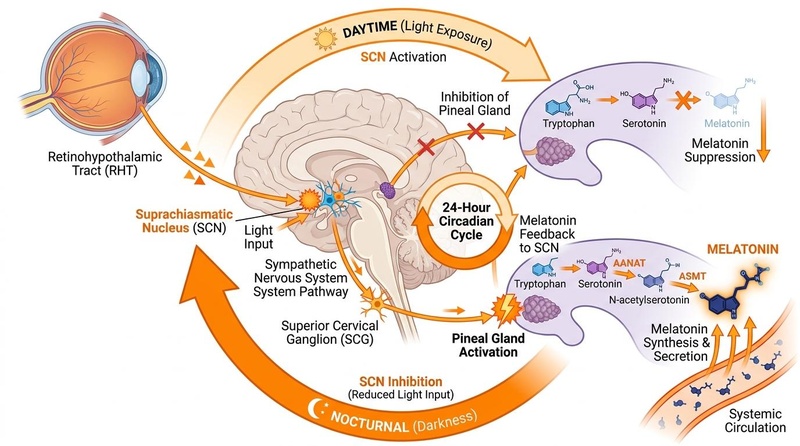
- Primarily acts on MT1 and MT2 receptors in the suprachiasmatic nucleus (SCN), the brain's master clock, to synchronize circadian rhythms. MT1 receptor activation promotes sleep onset, while MT2 receptor activation mediates phase shifting.
- Synthesis is inhibited by light exposure and stimulated by darkness, making it a key signal for the biological night.
- Metabolized primarily by the CYP1A2 enzyme in the liver [22].
Bright Light Therapy & Sunlight:
- Light exposure to the retina, particularly blue-enriched light, activates melanopsin-containing retinal ganglion cells. These cells project to the SCN, signaling "day" and suppressing melatonin production.
- Appropriately timed bright light (e.g., morning exposure) can advance circadian rhythms, while evening light can delay them.
- The intensity and spectrum of light are critical for its chronobiotic effects [4:4].
Sleep Aids & Starter-Kit Supplements:
- Valerian root: Contains valerenic acid and other compounds that are thought to modulate GABA-A receptors, increasing inhibitory neurotransmission and promoting sedation [7:2].
- L-Tryptophan: An essential amino acid and precursor to serotonin, which is then converted to melatonin. Increased serotonin levels can contribute to sleep, but also carry risks of serotonin syndrome [9:2].
- Magnesium: Functions as a natural NMDA receptor antagonist, reducing neuronal excitability. It also modulates GABAergic tone and plays a role in melatonin synthesis [23].
- L-Theanine: Promotes alpha brain wave activity, inducing a state of relaxed alertness. It enhances GABAergic neurotransmission and attenuates excitatory glutamate binding [17:2].
- Chamomile (Apigenin): Apigenin, a flavonoid in chamomile, acts as a ligand for central benzodiazepine receptors, enhancing GABA-A receptor function and promoting anxiolytic and sedative effects [18:2].
- Passionflower: Contains alkaloids (e.g., harmala alkaloids) and flavonoids (e.g., chrysin) that are thought to interact with GABA receptors and may have mild MAOI activity, contributing to anxiolytic and sedative effects. Some compounds can also stimulate the uterus [10:2].
¶ Effects on different systems
Endocrine & Circadian System
- Melatonin: Exogenous melatonin directly influences the SCN, regulating sleep-wake cycles and seasonal rhythms. However, high doses or inappropriate timing can disrupt natural melatonin secretion and feedback loops [24].
- Light Therapy: Timed light exposure is a primary entrainment cue for the circadian system. Misaligned light exposure (e.g., bright light at night) can desynchronize internal rhythms, impacting hormone secretion (cortisol, melatonin) and metabolic function [25].
Neurological & Psychiatric System
- Melatonin: Can cause daytime drowsiness, dizziness, and headache. In individuals with epilepsy, melatonin may increase seizure activity. Caution is advised in patients with mood disorders, as it can potentially exacerbate symptoms [22:1].
- Bright Light Therapy: In bipolar disorder, BLT carries a significant risk of inducing hypomania, mania, or rapid cycling, especially with morning light exposure. Careful monitoring and clinician supervision are essential [4:5].
- CNS Depressants (Valerian, L-Theanine, Chamomile, Passionflower): These supplements can cause additive CNS depression when combined with alcohol, benzodiazepines, barbiturates, or prescription sleep aids, leading to excessive drowsiness and impaired cognitive/motor function [8:1].
- L-Tryptophan: When combined with SSRIs, SNRIs, or MAOIs, L-Tryptophan poses a high risk of serotonin syndrome, a potentially life-threatening condition characterized by altered mental status, autonomic hyperactivity, and neuromuscular abnormalities [9:3].
Ocular System
- Bright Light Therapy: Contraindicated in patients with pre-existing retinal diseases such as macular degeneration, retinitis pigmentosa, or aphakia, due to potential for exacerbating retinal damage [5:1][26]. Cataract surgery and other ocular conditions also warrant caution.
- Photosensitizing Medications: Individuals taking photosensitizing drugs (e.g., tetracyclines, amiodarone, thiazide diuretics, chlorpromazine) are at increased risk of ocular or dermatological damage from bright light exposure [6:1].
Gastrointestinal System
- Magnesium: High doses, especially of less bioavailable forms, can cause gastrointestinal upset, osmotic diarrhea, and abdominal cramping [23:1].
- Valerian Root: Has been linked to rare cases of clinically apparent liver injury, including hepatocellular or mixed damage. Caution is advised in patients with pre-existing liver disease [7:3].
Renal System
- Magnesium: In patients with moderate-to-severe chronic kidney disease, high-dose magnesium supplementation can lead to hypermagnesemia due to impaired renal excretion, with symptoms ranging from nausea to cardiac arrest [13:1].
Hematological System
- Melatonin: Can inhibit platelet aggregation; caution is advised when co-administered with anticoagulants (e.g., warfarin, heparin) or antiplatelet drugs (e.g., aspirin, clopidogrel) due to increased bleeding risk [1:1].
- Chamomile: Contains coumarins that may inhibit platelet aggregation, theoretically increasing bleeding risk with anticoagulants [12:1].
Reproductive & Hormonal System
- Melatonin: Limited safety data for pregnancy and lactation; generally not recommended due to potential endocrine disruption [1:2].
- Passionflower & Chamomile: Both are contraindicated during pregnancy due to uterine-stimulant effects, which can induce contractions and potentially lead to premature labor or miscarriage [10:3][11:2][12:2].
Cardiovascular & Metabolic System (Shift Work Protocols)
- Circadian Misalignment (Shift Work): Chronic misalignment between endogenous circadian rhythms and behavioral cycles (sleep/wake, eating) in shift workers significantly increases the risk of metabolic syndrome, insulin resistance, type 2 diabetes, and cardiovascular diseases (hypertension, ischemic heart disease) [25:1][27][28]. Precise light and melatonin timing are critical to mitigate these risks.
¶ Dosage and how to take it
Dosage and administration vary significantly by intervention and individual needs. Clinical supervision is crucial for therapeutic light use and specific supplement combinations.
Melatonin:
- Typical doses: 0.3-1 mg for circadian rhythm entrainment; 3-5 mg for sleep onset, taken 30-60 minutes before bedtime.
- Timing: Crucial for chronobiotic effects; typically taken in the early evening to advance sleep phase or specific to shift work protocols.
- Forms: Immediate-release (mimics natural secretion) or extended-release (sustained effect).
Bright Light Therapy:
- Intensity: Typically 2,500-10,000 lux light box.
- Duration: 15-60 minutes daily.
- Timing: Morning exposure (e.g., 6-9 AM) to advance circadian phase (e.g., for delayed sleep phase disorder, seasonal affective disorder); evening exposure (less common, usually for advanced sleep phase disorder) [4:6].
Sleep Aids & Starter-Kit Supplements:
- Valerian Root: Extracts standardized to valerenic acid. Doses vary, typically 300-600 mg of extract, 30-60 minutes before bedtime.
- L-Tryptophan: 500-2000 mg, usually taken 30-60 minutes before bedtime on an empty stomach to enhance brain uptake.
- Magnesium: 140-250 mg elemental magnesium (e.g., bisglycinate), 30-60 minutes before bedtime [20:1].
- L-Theanine: 200-400 mg, 30-60 minutes before bedtime [17:3].
- Chamomile: Often consumed as tea; standardized extracts (e.g., 1.2% apigenin) in capsules or tinctures.
- Passionflower: Extracts or teas; doses vary depending on concentration of active constituents.
¶ Safety and side effects
The safety profiles of these interventions range from mild, transient side effects to severe, life-threatening events, particularly with improper use or in vulnerable populations.
Common side effects
- Melatonin: Daytime drowsiness, dizziness, headache, nausea, mild gastrointestinal upset, especially with higher doses [29].
- Bright Light Therapy: Eyestrain, headache, nausea, agitation, irritability, particularly at treatment initiation or with excessive intensity/duration [4:7].
- Valerian Root: Drowsiness, dizziness, headache, gastrointestinal upset, "hangover" effect [7:4].
- L-Theanine, Chamomile, Passionflower: Generally well-tolerated; mild drowsiness or GI upset can occur.
- Magnesium: Diarrhea, abdominal cramping, nausea, particularly with higher doses or less absorbable forms [23:2].
Less common / serious concerns
- Melatonin: Receptor desensitization with chronic high-dose use, inconsistent product labeling with variable melatonin and serotonin content [30]. Potential exacerbation of autoimmune diseases.
- Bright Light Therapy: Induction of hypomania/mania or rapid cycling in bipolar patients, retinal damage in susceptible individuals with ocular conditions, photosensitivity reactions with certain medications [4:8][5:2].
- Valerian Root: Rare but documented cases of hepatotoxicity (liver injury), particularly with long-term use or in individuals with pre-existing liver conditions [7:5].
- L-Tryptophan: High risk of serotonin syndrome when combined with other serotonergic agents, a medical emergency [9:4].
- Magnesium: Hypermagnesemia in individuals with chronic kidney disease, leading to muscle weakness, hypotension, cardiac arrhythmias, and potentially cardiac arrest in severe cases [13:2].
- Passionflower & Chamomile: Uterine stimulation and potential induction of premature labor or miscarriage in pregnant individuals [10:4][11:3][12:3].
Who should be especially cautious or avoid it
- Pregnant or breastfeeding individuals: Absolute contraindication for Passionflower and Chamomile due to uterine stimulant effects [10:5][11:4][12:4]. Melatonin use is not recommended due to limited safety data [1:3].
- Individuals with autoimmune diseases: Absolute contraindication for Melatonin due to potential immunomodulatory effects that may exacerbate disease activity [1:4][2:1].
- Individuals with bipolar disorder: Absolute contraindication for Bright Light Therapy (especially morning light) in acute mania, recent hypomania, mixed states, or rapid cycling, due to risk of mood elevation or switch [4:9].
- Individuals with retinal diseases: Absolute contraindication for Bright Light Therapy in macular degeneration, retinitis pigmentosa, aphakia, or severe diabetic retinopathy [5:3][26:1].
- Individuals on photosensitizing medications: Avoid Bright Light Therapy if taking drugs like tetracyclines, amiodarone, thiazides, or chlorpromazine due to increased risk of phototoxic reactions [6:2].
- Individuals with liver disease/impairment: Caution with Valerian root due to potential hepatotoxicity [7:6].
- Individuals with chronic kidney disease: Caution with high-dose Magnesium due to risk of hypermagnesemia [13:3].
- Individuals with a history of porphyria, lupus, actinic dermatitis, or solar urticaria: Caution with Bright Light Therapy due to photosensitivity [31].
- Patients with impaired airway reflexes or aspiration risk: (Not directly covered by these interventions, but a general contraindication for anything that increases sedation and aspiration risk).
LongeviData safety widget (required)
¶ Drug and supplement interactions
Interactions are a significant concern, especially due to additive CNS depression and impacts on drug metabolism or platelet function.
Pharmacokinetic interactions (how drugs are processed)
- Melatonin and CYP1A2 Inhibitors: Melatonin is primarily metabolized by CYP1A2. Potent CYP1A2 inhibitors like fluvoxamine (an antidepressant) can dramatically increase melatonin plasma concentrations (12-to-17-fold), leading to exaggerated effects and side effects. Other CYP1A2 inhibitors (e.g., cimetidine, ciprofloxacin, oral contraceptives, caffeine) also require caution [3:1][32][33].
- Melatonin and CYP1A2 Inducers: CYP1A2 inducers (e.g., rifampicin, carbamazepine) can reduce melatonin plasma concentrations, potentially diminishing its efficacy [33:1].
- Valerian Root and Liver Enzymes: Valerian may inhibit certain liver enzymes (e.g., CYP3A4), potentially altering the metabolism and increasing the levels of drugs cleared by these pathways [8:2].
Pharmacodynamic interactions (additive / opposing effects)