¶ Sleep Starter Kit
Focus: The Supplement Stack
This page focuses on the core supplement stack for optimizing sleep. For a comprehensive lifestyle-based guide to sleep regularity and quality, please refer to the Sleep Starter Kit (1 week) and the Deep Dive on Sleep.
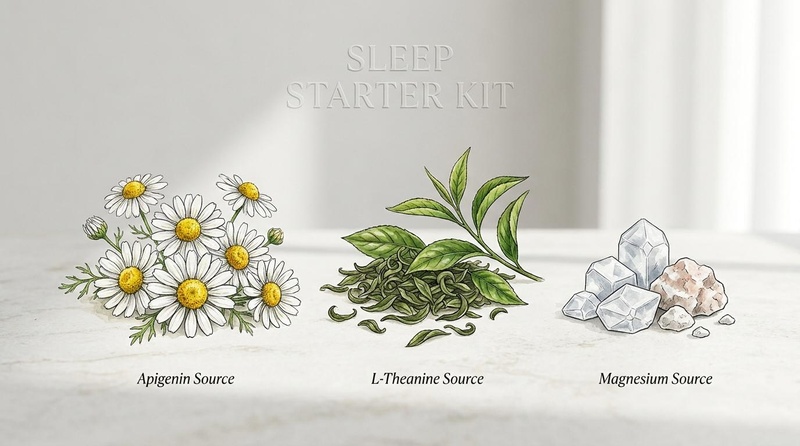
| Type | Multi-Ingredient Supplement Stack |
| Key Compounds | Magnesium, L-Theanine, Apigenin, Melatonin |
| Primary Function | GABAergic modulation, NMDA antagonism, chronobiotic signaling |
| Dose Range (Elemental) | Mg: 140-250mg, L-Theanine: 200-400mg, Apigenin: 50mg, Melatonin: 0.3-1mg |
| Half-life | Varies by ingredient |
| Main Benefit | Improved sleep quality, reduced sleep latency, enhanced relaxation |
| Absorption | Good for most forms |
The Sleep Starter Kit refers to a synergistic combination of supplements designed to optimize various aspects of sleep, including initiating sleep, improving sleep quality, and promoting overall relaxation. This stack typically includes Magnesium, L-Theanine, Apigenin, and sometimes low-dose Melatonin, Glycine, and Myo-Inositol. Each component addresses different physiological pathways involved in sleep regulation, working together to support a more restorative sleep cycle.
¶ At a glance
Aliases
- Also known as: Sleep Stack, Sleep Optimization Protocol Supplements
- Category: Multi-ingredient sleep aid, Nootropic adjunct
Key points (high-level summary)
- Magnesium (e.g., bisglycinate) significantly improves subjective sleep quality and reduces insomnia severity, particularly in individuals with low baseline magnesium levels [1].
- L-Theanine, an amino acid found in green tea, enhances objective sleep efficiency, reduces wakefulness, and promotes relaxation by increasing alpha brain waves and modulating neurotransmitters [2][3].
- Apigenin, a flavonoid from chamomile, contributes to relaxation and sleep by acting as a positive allosteric modulator of GABA-A receptors, similar to benzodiazepines, though direct isolated human RCTs for sleep are limited [4][5].
- Low-dose Melatonin (0.3-1 mg) can effectively entrain circadian rhythms and reduce sleep onset latency without the side effects associated with higher doses [6][7].
What people use it for
- Main goals: Improving sleep quality, reducing sleep onset latency, enhancing relaxation, mitigating stress-induced sleep disturbances.
- Evidence quality (overall): Moderate-High, with strong evidence for individual components, but limited direct combination trials for the entire stack.
What is the Sleep Starter Kit?
The Sleep Starter Kit is a curated selection of natural compounds intended to support healthy sleep patterns. These supplements work in concert to promote physiological states conducive to sleep. The primary components, Magnesium, L-Theanine, and Apigenin, target key neurotransmitter systems (GABA, glutamate) and neuromodulatory pathways, while low-dose Melatonin acts as a chronobiotic to regulate circadian rhythms. Adjunctive components like Glycine and Myo-Inositol can further enhance sleep quality and reduce sleep disturbances through thermoregulatory and neurotransmitter balance mechanisms.
What are the Sleep Starter Kit’s main benefits?
This stack aims to address various facets of sleep health, offering benefits that include:
- Improved Sleep Quality: Magnesium, L-Theanine, and Apigenin contribute to deeper, more restorative sleep by promoting relaxation and reducing nighttime awakenings [1:1][2:1][5:1].
- Reduced Sleep Latency: L-Theanine and low-dose Melatonin can help individuals fall asleep faster by promoting a calmer state and signaling the body for sleep [3:1][6:1].
- Enhanced Relaxation and Stress Reduction: L-Theanine's ability to increase alpha brain waves and Apigenin's GABAergic modulation help alleviate stress and anxiety, which are common barriers to sleep [3:2][5:2].
- Circadian Rhythm Regulation: Low-dose Melatonin, when timed correctly, can help normalize disrupted sleep-wake cycles, especially in cases of jet lag or shift work [8].
- Daytime Alertness: By improving nighttime sleep quality, the stack can lead to reduced daytime fatigue and enhanced cognitive function [9].
Evidence summary table (human outcomes)
| Outcome / Goal | Effect* | Consistency** | Evidence quality | Trials*** | Notes (population, duration, dose) |
|---|---|---|---|---|---|
| Magnesium | |||||
| Insomnia Severity (ISI Score) | High | High | 2 RCTs, 1 MA | 250-500 mg elemental Mg/day for 4-8 weeks in adults with poor sleep or insomnia [1:2][10] | |
| Sleep Onset Latency | Moderate | Moderate | 1 MA | Decreased by ~17.36 min; older adults with insomnia [11] | |
| Total Sleep Time | Moderate | Moderate | 1 MA | Increased by ~16.06 min; older adults with insomnia [11:1] | |
| Sleep Efficiency | High | High | 2 RCTs | Improved in elderly with primary insomnia [10:1] | |
| L-Theanine | |||||
| Subjective Sleep Quality | High | Moderate | 1 SR, 1 RCT | 200-400 mg/day for 2-4 weeks in healthy adults with stress or sleep disturbances [2:2][3:3] | |
| Objective Sleep Efficiency | High | Moderate | 1 RCT | 400 mg/day in boys with ADHD [12] | |
| Wake After Sleep Onset (WASO) | High | Moderate | 2 RCTs | Reduced WASO, especially with caffeine challenge or sleep restriction [13][14] | |
| Apigenin (from Chamomile) | |||||
| Subjective Sleep Quality | High | Moderate | 1 SR/MA | Chamomile extract (containing apigenin) significantly improves subjective sleep quality metrics [5:3] | |
| Sleep Latency | Low | Low | 1 Pilot RCT | Modest benefits in chronic primary insomnia (from chamomile extract) [4:1] | |
| Melatonin (low-dose) | |||||
| Sleep Onset Latency | High | High | 1 MA | Significant reduction in sleep onset latency (all doses) [15] | |
| Total Sleep Time | High | High | 1 MA | Significant increase in total sleep time (all doses) [15:1] | |
| Circadian Phase Shifting | High | High | 1 RCT | Potent chronobiotic effects with 0.5 mg in blind individuals [8:1] | |
| Glycine | |||||
| Subjective Sleep Quality | High | Moderate | 2 RCTs | 3 g before bedtime in individuals with sleep restriction or dissatisfaction [16][9:1] | |
| Daytime Fatigue/Alertness | High | Moderate | 2 RCTs | Reduced daytime fatigue, improved morning sharpness [16:1][9:2] | |
| Myo-Inositol | |||||
| Global Sleep Quality (PSQI) | High | Moderate | 1 RCT | 2,000 mg nightly in pregnant women [17] | |
| Sleep Duration | High | Moderate | 1 RCT | Improved sleep duration in pregnant women [17:1] |
LongeviData outcomes widget (required)
How does the Sleep Starter Kit work?
The individual components of the Sleep Starter Kit operate through distinct yet complementary mechanisms to promote sleep:
- Magnesium: This essential mineral acts as a natural N-Methyl-D-aspartate (NMDA) receptor antagonist, reducing neuronal excitability and preventing calcium influx, which is crucial for brain relaxation. It also modulates Gamma-aminobutyric acid (GABA) receptors, increasing GABAergic tone, and influences melatonin synthesis and secretion [18].
- L-Theanine: An amino acid structurally similar to glutamate, L-Theanine readily crosses the blood-brain barrier. It promotes relaxation without sedation by increasing alpha brain wave activity, which is associated with a relaxed, alert state. Mechanistically, L-Theanine enhances GABAergic neurotransmission and attenuates the binding of excitatory glutamate to its receptors, thereby reducing neuronal overactivity [3:4].
- Apigenin: This flavonoid found in chamomile acts as a ligand for central benzodiazepine receptors, positive allosterically modulating GABA-A receptor function. This enhances the inhibitory effects of GABA, leading to anxiolytic and sedative effects [5:4].
- Melatonin: Primarily known as a chronobiotic, melatonin is a hormone synthesized by the pineal gland that regulates the sleep-wake cycle. Exogenous low-dose melatonin, typically 0.3-1 mg, signals "night" to the brain, facilitating sleep onset and reinforcing the circadian rhythm without causing excessive daytime grogginess or receptor desensitization commonly associated with higher doses [6:2].
- Glycine: This amino acid lowers core body temperature via vasodilation in the extremities, a physiological signal for sleep onset. Glycine also acts as a mild inhibitory neurotransmitter in the central nervous system, particularly in the brainstem and spinal cord, and can act as a co-agonist at NMDA receptors in the suprachiasmatic nucleus to accelerate sleep [19].
- Myo-Inositol: A cyclic polyol that functions as a secondary messenger in various cellular signaling pathways. In the brain, myo-inositol influences neurotransmitter systems, particularly serotonin and GABA pathways. Supplementation may help reduce anxiety and improve sleep quality by normalizing these signaling cascades [17:2].
Effects on different systems
Brain & mental health (cognition, mood, sleep)
The combined effects of the Sleep Starter Kit components lead to significant improvements in brain and mental health outcomes related to sleep. Magnesium's NMDA antagonism and GABA potentiation reduce neuronal excitability, leading to a calmer brain state conducive to sleep [10:2]. L-Theanine directly promotes alpha brain wave activity, fostering a state of relaxed alertness and reducing stress and anxiety, which are common barriers to sleep initiation and maintenance [3:5]. Apigenin further contributes to this by enhancing GABAergic inhibition, mimicking the anxiolytic effects of benzodiazepines [5:5]. Melatonin directly regulates the circadian rhythm, ensuring that the body's internal clock is aligned with the desired sleep schedule, which is crucial for restorative sleep and optimal daytime cognitive function [8:2]. Glycine and myo-inositol can further reduce sleep latency and improve sleep architecture by lowering core body temperature and modulating neurotransmitter sensitivity [19:1][17:3].
Metabolic health
While not a primary focus, optimized sleep achieved through this stack can indirectly benefit metabolic health. Chronic sleep deprivation and circadian misalignment are known to negatively impact glucose metabolism, insulin sensitivity, and contribute to weight gain. By improving sleep quality and regularity, the Sleep Starter Kit can support healthier metabolic function, though direct evidence for the stack's impact on specific metabolic markers is still emerging.
Dosage and how to take it
Standard dosing in studies
- Magnesium: Typically 140-250 mg elemental magnesium, often from magnesium bisglycinate, taken 30-60 minutes before bedtime [1:3].
- L-Theanine: 200-400 mg, taken 30-60 minutes before bedtime [3:6].
- Apigenin: 50 mg of isolated apigenin extract, taken 30-60 minutes before bedtime [5:6].
- Melatonin: 0.3-1 mg (low-dose) taken 30-60 minutes before bedtime to align with natural melatonin secretion and avoid receptor desensitization [6:3]. Higher doses (e.g., 3-5 mg) are common but can lead to receptor downregulation and daytime grogginess [7:1].
- Glycine: 3 g taken 30-60 minutes before bedtime [16:2].
- Myo-Inositol: 2,000 mg taken nightly [17:4].
Forms and bioavailability
- Magnesium: Magnesium bisglycinate is preferred due to its high bioavailability and reduced gastrointestinal side effects compared to other forms like magnesium oxide or citrate.
- L-Theanine: L-Theanine supplements are typically well-absorbed.
- Apigenin: Isolated apigenin extracts are used in supplements, as the concentration in chamomile tea is relatively low.
- Melatonin: Immediate-release forms are often favored for mimicking natural secretion patterns, especially at low doses. Extended-release formulations are also available.
Special populations
- Pregnancy and breastfeeding: Myo-inositol has shown promise in pregnant women for sleep quality [17:5]. However, comprehensive safety data for the entire stack during pregnancy and breastfeeding is limited. Consultation with a healthcare professional is recommended.
- Older adults: Older adults may particularly benefit from magnesium and melatonin due to age-related declines in endogenous production and absorption [10:3].
Safety and side effects
The individual components of the Sleep Starter Kit are generally well-tolerated at recommended doses.
Common side effects
- Magnesium: Gastrointestinal upset, diarrhea (especially with higher doses or less bioavailable forms like magnesium oxide) [18:1].
- L-Theanine: Generally well-tolerated with no significant side effects reported in clinical trials.
- Apigenin: Few side effects reported. Large doses might theoretically cause sedation.
- Melatonin: Daytime drowsiness, dizziness, headache, nausea, particularly with higher doses [7:2].
Less common / serious concerns
- Melatonin: Long-term use of high-dose melatonin may lead to receptor desensitization and potential disruption of natural melatonin production. Commercial melatonin products can have inconsistent labeling, with actual content varying significantly [20].
Who should be especially cautious or avoid it
- Individuals on medications: The components might interact with certain medications, especially sedatives, anticoagulants, or blood pressure medications.
- Kidney impairment: Individuals with severe kidney dysfunction should consult a physician before taking magnesium supplements [18:2].
- Autoimmune conditions or hormone-sensitive cancers: Discuss melatonin use with a doctor.
LongeviData safety widget (required)
Drug and supplement interactions
- Sedatives/Hypnotics: Magnesium, L-Theanine, Apigenin, and Melatonin can all have sedative effects. Combining them with prescription sedatives (benzodiazepines, Z-drugs) or alcohol could lead to additive drowsiness and impaired motor function.
- Anticoagulants/Antiplatelets: Theoretically, high doses of certain flavonoids (like apigenin) could interact with blood thinners, though clinical data for this specific stack is limited.
- Blood Pressure Medications: Magnesium can have hypotensive effects; combining with antihypertensive drugs might lead to additive reductions in blood pressure [18:3].
- Immunosuppressants: Melatonin can affect immune function; caution is advised with immunosuppressants.
Combining Sleep Starter Kit with other supplements (“stacks”)
The components of the Sleep Starter Kit are often used together due to their complementary mechanisms. Glycine and Myo-Inositol are frequently added to enhance the stack's effects. Glycine can improve sleep quality and reduce daytime fatigue, and Myo-Inositol can further regulate neurotransmitter activity and sleep architecture [16:3][17:6]. These additions are based on mechanistic rationale and some supporting human evidence for their individual contributions to sleep.
Practical questions (FAQ)
-
How long does it take for the Sleep Starter Kit to work?
Many individuals report subjective improvements in relaxation and sleep onset within 30-60 minutes of taking the stack. Consistent use over several days to weeks is often needed for more pronounced and sustained improvements in overall sleep quality and circadian rhythm entrainment, especially for magnesium and melatonin. -
Can I take the Sleep Starter Kit long term?
Magnesium, L-Theanine, and Apigenin are generally considered safe for long-term use at recommended doses. Melatonin, particularly at low doses (0.3-1 mg), can be used long-term as a chronobiotic, but some clinicians recommend cycling higher doses to prevent potential receptor desensitization. It's advisable to periodically assess the need for continued supplementation. -
Can I take the Sleep Starter Kit with common medications (e.g., antidepressants, blood pressure meds)?
Caution is advised. Consult a healthcare professional if you are taking any prescription medications, especially sedatives, anticoagulants, or blood pressure drugs, as additive effects or interactions are possible. -
Is the Sleep Starter Kit useful if I am otherwise healthy?
Yes, even healthy individuals can experience benefits in sleep optimization, stress reduction, and overall well-being. The stack can help fine-tune sleep architecture, promote relaxation, and enhance recovery, even without a diagnosed sleep disorder. -
Does it cause dependence or withdrawal?
The components of this stack, particularly L-Theanine and Apigenin, are generally considered non-habit forming and do not cause dependence or withdrawal symptoms like some prescription sleep medications. Melatonin, especially at low doses, also has a favorable safety profile regarding dependence.
How we evaluated the evidence
The evidence supporting the Sleep Starter Kit components was evaluated based on a hierarchical approach, prioritizing:
- High-quality systematic reviews and meta-analyses of randomized controlled trials (Tier 1 evidence) for comprehensive insights into efficacy and safety.
- Individual randomized controlled trials (RCTs) (Tier 2 evidence) examining specific compounds and their effects on objective (polysomnography, actigraphy) and subjective sleep parameters.
- Controlled clinical trials with human participants.
- Pharmacokinetic studies to understand absorption, metabolism, and bioavailability.
Evidence quality was graded as follows:
- High: Multiple high-quality RCTs or meta-analyses with consistent results, low risk of bias, and adequate sample sizes.
- Moderate: Some RCTs with minor limitations, or inconsistent results from otherwise high-quality studies.
- Low: Few RCTs, significant limitations in study design, small sample sizes, or inconsistent results, often relying on observational studies or indirect evidence.
- Very low: Primarily observational studies, case reports, or animal/in vitro data; or serious flaws in available trials.
Magnitude and clinical relevance were assessed by considering effect sizes reported in meta-analyses and the potential for real-world impact on sleep health. This page will be updated as new high-quality research emerges.
¶ References
Schuster J, Cycelskij I, Lopresti A, Hahn A. Magnesium Bisglycinate Supplementation in Healthy Adults Reporting Poor Sleep: A Randomized, Placebo-Controlled Trial. Nature and Science of Sleep. 2025;17:2027-2040. https://pmc.ncbi.nlm.nih.gov/articles/PMC12412596/ ↩︎ ↩︎ ↩︎ ↩︎
Cotter J, et al. Examining the effect of L-theanine on sleep: a systematic review of dietary supplementation trials. Nutritional Neuroscience. 2025. DOI: 10.1080/1028415X.2025.2556925. https://www.tandfonline.com/doi/full/10.1080/1028415X.2025.2556925 ↩︎ ↩︎ ↩︎
Hidese S, Ogawa S, Ota M, Ishida H, Yasukawa Z, Ozeki M, Kunugi H. Effects of L-Theanine Administration on Stress-Related Symptoms and Cognitive Functions in Healthy Adults: A Randomized Controlled Trial. Nutrients. 2019;11(10):2362. https://pmc.ncbi.nlm.nih.gov/articles/PMC6836118/ ↩︎ ↩︎ ↩︎ ↩︎ ↩︎ ↩︎ ↩︎
Zick SM, Wright BD, Sen A, Arnedt JT. Preliminary examination of the efficacy and safety of a standardized chamomile extract for chronic primary insomnia: A randomized placebo-controlled pilot study. BMC Complementary and Alternative Medicine. 2011;11:78. https://pmc.ncbi.nlm.nih.gov/articles/PMC3198755/ ↩︎ ↩︎
Tran HH, et al. Therapeutic efficacy and safety of chamomile for state anxiety, generalized anxiety disorder, insomnia, and sleep quality: A systematic review and meta-analysis of randomized trials and quasi-randomized trials. Phytotherapy Research. 2019;33(6):1604-1615. https://onlinelibrary.wiley.com/doi/10.1002/ptr.6349 ↩︎ ↩︎ ↩︎ ↩︎ ↩︎ ↩︎ ↩︎
Dollins AB, et al. A Randomized, Double-Blind, Crossover Study to Investigate the Pharmacokinetics of Extended-Release Melatonin Compared to Immediate-Release Melatonin in Healthy Adults. Journal of Dietary Supplements. 2023;20(5):671-684. https://www.tandfonline.com/doi/full/10.1080/19390211.2023.2206475 ↩︎ ↩︎ ↩︎ ↩︎
Shin WY, et al. Melatonin Use as a Dietary Supplement: A Narrative Review of Efficacy and Risks. Food Science and Biotechnology. 2025;5:e1. https://e-fsbh.org/DOIx.php?id=10.52361%2Ffsbh.2025.5.e1 ↩︎ ↩︎ ↩︎
Sack RL, et al. Melatonin administration to blind people: phase advancement and clinical benefits. New England Journal of Medicine. 1997;337(13):958-965. https://www.nejm.org/doi/full/10.1056/NEJM199710023371402 ↩︎ ↩︎ ↩︎
Inagawa K, et al. Subjective effects of glycine ingestion before bedtime on sleep quality. Sleep and Biological Rhythms. 2006;4(1):75-77. https://doi.org/10.1111/j.1479-8425.2006.00193.x ↩︎ ↩︎ ↩︎
Abbasi B, Kimiagar M, Sadeghniiat K, Shirazi MM, Hedayati M, Rashidkhani B. The effect of magnesium supplementation on primary insomnia in elderly: A double-blind placebo-controlled clinical trial. Journal of Research in Medical Sciences. 2012;17(12):1161–1169. https://pmc.ncbi.nlm.nih.gov/articles/PMC3703169/ ↩︎ ↩︎ ↩︎ ↩︎
Mah J, Pitre T. Oral magnesium supplementation for insomnia in older adults: a Systematic Review & Meta-Analysis. BMC Complementary Medicine and Therapies. 2021;21:125. (Correction/Update 2024). https://pubmed.ncbi.nlm.nih.gov/33865376/ ↩︎ ↩︎
Lyon MR, Kapoor MP, Juneja LR. The effects of L-theanine (Suntheanine®) on objective sleep quality in boys with attention deficit hyperactivity disorder (ADHD): a randomized, double-blind, placebo-controlled clinical trial. Alternative Medicine Review. 2011;16(4):341-348. https://pubmed.ncbi.nlm.nih.gov/22214254/ ↩︎
Kim HJ, et al. Dietary supplementation with Lactium and L-theanine alleviates sleep disturbance in adults: a double-blind, randomized, placebo-controlled clinical study. Frontiers in Nutrition. 2024;11:1419978. https://www.frontiersin.org/journals/nutrition/articles/10.3389/fnut.2024.1419978/full ↩︎
Unno K, et al. Theanine maintains sleep quality in healthy young women by suppressing the increase in caffeine-induced wakefulness after sleep onset. Food & Function. 2023;14:10390. https://pubs.rsc.org/en/content/articlehtml/2023/fo/d3fo01247f ↩︎
Brzezinski A, et al. Effects of exogenous melatonin on sleep: a meta-analysis. Sleep Medicine Reviews. 2005;9(1):41-50. https://pubmed.ncbi.nlm.nih.gov/15649737/ ↩︎ ↩︎
Yamadera W, et al. Glycine ingestion improves subjective sleep quality in human volunteers, correlating with polysomnographic changes. Sleep and Biological Rhythms. 2007;5(2):126–131. https://doi.org/10.1111/j.1479-8425.2007.00262.x ↩︎ ↩︎ ↩︎ ↩︎
Mashayekh-Amiri S, et al. The impact of myo-inositol supplementation on sleep quality in pregnant women: a randomized, double-blind, placebo-controlled study. The Journal of Maternal-Fetal & Neonatal Medicine. 2021;34(16):2603-2609. https://doi.org/10.1080/14767058.2020.1751036 ↩︎ ↩︎ ↩︎ ↩︎ ↩︎ ↩︎ ↩︎
Guerrera MP, Volpe SL, Mao JJ. Therapeutic uses of magnesium. American Family Physician. 2009;80(2):157-162. https://www.aafp.org/pubs/afp/issues/2009/0715/p157.html ↩︎ ↩︎ ↩︎ ↩︎
Kawai N, et al. The Sleep-Promoting and Hypothermic Effects of Glycine are Mediated by NMDA Receptors in the Suprachiasmatic Nucleus. Neuropsychopharmacology. 2015;40(6):1405–1416. https://pmc.ncbi.nlm.nih.gov/articles/PMC4397399/ ↩︎ ↩︎
Cohen PA, et al. Quantity of Melatonin and Presence of Serotonin in Melatonin Gummies Sold in the US. JAMA. 2023;329(16):1401-1402. https://jamanetwork.com/journals/jama/fullarticle/2804077 ↩︎