¶ Semax
Semax 是一种合成的七肽药物(Met-Glu-His-Phe-Pro-Gly-Pro),源自促肾上腺皮质激素(ACTH)的一个片段。它在俄罗斯被开发出来,广泛应用于东欧的临床实践中,用于治疗缺血性中风、短暂性脑缺血发作(TIA)、视神经疾病和认知障碍。在临床环境之外,它在促智药(nootropic)社区中很受欢迎,据报道它能够增强记忆力、注意力和改善情绪。
与精神兴奋剂不同,Semax 作为一种黑素皮质素(melanocortin)模拟物和神经营养因子诱导剂,能够调节脑源性神经营养因子(BDNF)和神经生长因子(NGF)的表达,且没有明显的心血管副作用。
¶ 化学结构与分类
Semax 由 ACTH 的 N 端片段(氨基酸 4–7:Met-Glu-His-Phe)与 C 端三肽(Pro-Gly-Pro)结合而成。
- 序列:Met-Glu-His-Phe-Pro-Gly-Pro (MEHFPGP)
- ACTH 来源:Met-Glu-His-Phe 片段是 ACTH(4-10) 的神经活性核心,已知能影响学习和记忆,但缺乏完整激素的激素(促皮质激素)活性。
- 稳定性:在 C 端添加 Pro-Gly-Pro (PGP) 基团可保护该肽免受快速的酶促降解,与天然 ACTH 片段相比,显著延长了其生物半衰期和作用持续时间[1][2]。
¶ 结构变体
- N-Acetyl Semax:N 端乙酰化以提高稳定性。
- N-Acetyl Semax Amidate:具有 N 端乙酰化和 C 端酰胺化特征,据称可增加亲脂性和血脑屏障通透性,尽管与母体肽相比,关于该变体的临床数据有限。
¶ 作用机制
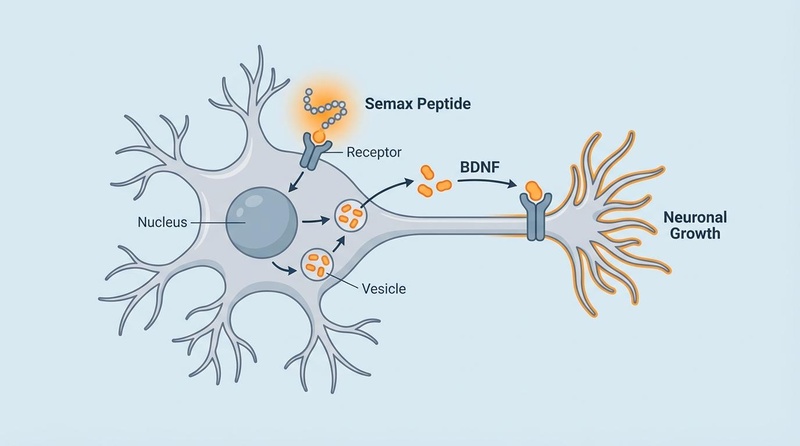
Semax 通过几种不同的机制展现出多效的神经保护和促智作用。
¶ 神经营养因子上调
一个主要机制是神经营养因子的快速和持续上调。
- BDNF 和 NGF:给予 Semax 会导致海马体、额叶皮层和视网膜中脑源性神经营养因子 (BDNF) 和神经生长因子 (NGF) 水平的快速增加[3][4]。
- TrkB 激活:它增加 TrkB 受体(BDNF 的主要受体)的表达和磷酸化,促进突触可塑性和神经元存活[5]。
¶ 神经递质调节
Semax 调节参与认知和情绪的单胺类物质的代谢。
¶ 基因表达与神经保护
转录组分析表明,Semax 影响与免疫反应和血管系统相关的基因表达。
¶ 临床适应症
在俄罗斯和乌克兰,Semax 是一种注册药物,并被列入重要和基本药物目录(List of Vital & Essential Drugs)。
¶ 缺血性卒中与 TIA
Semax 适用于缺血性卒中的急性期治疗和康复。临床试验表明,大剂量鼻腔给药(1% 溶液)可以:
- 减少缺血性损伤的体积。
- 加速局灶性神经功能的恢复。
- 与安慰剂相比,改善功能结局(例如,Barthel Index 评分)[9]。
¶ 视神经疾病
该肽在眼科中用于治疗视神经萎缩和青光眼性视神经病变。研究表明,它能改善视力并扩大视野,这可能是通过保护视网膜神经节细胞免受退化来实现的[10]。
¶ 认知障碍
Semax 被处方用于治疗循环障碍性脑病以及与血管功能不全或创伤性脑损伤 (TBI) 相关的认知能力下降。它有助于恢复器质性脑病变患者的记忆力和注意力[2:1]。
¶ ADHD
虽然不如其在卒中适应症方面确切,但 Semax 已被研究用于治疗注意力缺陷多动障碍 (ADHD)。一项针对儿童的研究表明,其在改善注意力和运动控制方面的疗效与吡拉西坦 (piracetam) 相当,且可能具有更好的安全性[11]。
¶ 促智与超适应症使用
在生物黑客和促智药社区中,Semax 被健康人群用于提升认知能力。
- 记忆力:用户报告称其改善了新信息的获取和保留。
- 注意力:它被描述为能提供“干净”的刺激和头脑清晰感,有别于苯丙胺类药物那种“令人紧张抖动”的能量。
- 情绪:一些用户报告了抗焦虑和抗抑郁的效果,这可能是通过脑啡肽和单胺调节介导的。
¶ 药代动力学
- 给药途径:鼻腔给药是标准途径,允许药物通过嗅觉和三叉神经通路直接转运至中枢神经系统 (CNS),在一定程度上绕过血脑屏障[12]。
- 吸收:鼻腔给药的生物利用度约为 60-70%。
- 半衰期与持续时间:由于酶的降解,血浆半衰期很短(数分钟),但治疗效果可持续 12–24 小时。这种分离现象是因为该肽触发了持久的基因表达和蛋白质合成级联反应[3:1]。
¶ 剂量与给药方法
Semax 通常有两种浓度可供选择:0.1% (1 mg/mL) 和 1.0% (10 mg/mL)。
¶ 临床方案(俄罗斯)
- 缺血性中风:1% 溶液。每个鼻孔 3–4 滴,每天 3–4 次(12–18 mg/天),持续 10 天[9:1]。
- 视神经/认知:0.1% 溶液。每个鼻孔 2–3 滴,每天 2–3 次(600–900 mcg/天),持续 7–10 天。
¶ 促智方案
- 标准剂量:0.1% 溶液,每个鼻孔 2–3 滴,每天一次或两次。
- 每日总剂量:400 mcg 至 1,000 mcg (1 mg)。
- 循环周期:通常以 10–14 天为一个周期使用,随后停药休息,以保持疗效并防止产生耐受性。
¶ 安全性与副作用
Semax 通常被认为具有良好的安全性。
- 副作用:最常见的副作用是鼻黏膜的轻度刺激。它通常不会引起与传统兴奋剂相关的心血管应激(心率加快、血压升高)。
- 禁忌症:妊娠期、哺乳期以及有急性精神病或惊厥病史者。
- 药物相互作用:可能增强其他多巴胺能兴奋剂的作用。应避免使用鼻腔血管收缩剂,因为它们会阻碍吸收。
¶ 证据质量
- 已验证(俄罗斯):在俄罗斯,数十年的临床使用和试验支持其对中风和视神经萎缩的疗效。
- 西方现状:Semax 未获 FDA 批准。西方的研究主要局限于证实其神经营养机制的动物研究。缺乏针对健康成年人认知增强的高质量、大规模西方随机对照试验(RCTs)。
¶ 相关肽类
- Selank:一种密切相关的肽(Tuftsin 类似物),具有更显著的抗焦虑作用。
- Cerebrolysin:一种具有广泛神经营养活性的猪脑提取物,通常用于更严重的神经损伤。
- Dihexa:一种实验性的 HGF 模拟物,能够产生深度的突触生成,通常用于结构修复,而 Semax 则用于功能增强。
¶ 参考文献
Manchenko, D. M., et al. (2010). The Nootropic and Analgesic Effects of Semax Given via Different Routes. Neuroscience and Behavioral Physiology, 40(6), 637-641. ↩︎ ↩︎
Koroleva, S. V., & Myasoedov, N. F. (2018). Semax as a Universal Drug for Therapy and Research. Biology Bulletin, 45, 589–600. ↩︎ ↩︎
Dolotov, O. V., et al. (2006). The Heptapeptide SEMAX stimulates BDNF Expression in Different Areas of the Rat Brain in vivo. Brain Research, 1117(1), 54-60. ↩︎ ↩︎
Agapova, T. Y., et al. (2008). Effect of Semax on the expression of nerve growth factor and its receptors in the rat brain. Neuroscience and Behavioral Physiology, 38, 923–927. ↩︎
Firstova, Y. Y., et al. (2009). The effects of semax on the expression of the BDNF gene and the gene for its receptor trkB in the rat brain. Neurochemical Journal, 3, 226–231. ↩︎
Eremin, K. O., et al. (2005). Semax, an ACTH(4-10) analogue with neuroprotective properties: effects on dopamine and serotonin metabolism in the rat striatum. Neurochemical Research. ↩︎
Filippenkov, I. B., et al. (2020). Brain Protein Expression Profile Confirms the Protective Effect of the ACTH(4–7)PGP Peptide (Semax) in a Rat Model of Cerebral Ischemia–Reperfusion. International Journal of Molecular Sciences, 21(15), 5444. ↩︎
Panickar, K. S., & Polunin, G. S. (2000). Neuroprotective effects of Semax. Journal of Neurochemistry. ↩︎
Gusev, E. I., et al. (2001). Efficiency of Semax in Acute Ischemic Stroke. Zhurnal Nevrologii i Psikhiatrii imeni S.S. Korsakova, 101(11), 35-40. ↩︎ ↩︎
Polunin, G. S., et al. (2000). Efficiency of Semax in Optic Nerve Disease. Vestnik Oftalmologii, 116(1), 15-18. ↩︎
Tsai, S. J. (2007). Semax, an analogue of adrenocorticotropin (4-10), is a potential agent for the treatment of attention-deficit hyperactivity disorder and Rett syndrome. Medical Hypotheses, 68(5), 1144-1146. ↩︎
Balysheva, T. S., et al. (2001). Intranasal delivery of Semax to the brain. Pharmaceutical Chemistry Journal, 35, 263–265. ↩︎