¶ title: Endocrine Disruptors: Deep Dive
description: Comprehensive analysis of endocrine-disrupting chemicals (EDCs) – classes, exposure, mechanisms, and evidence-based avoidance strategies.
published: 1
date: 2026-07-06T18:22:23.324Z
tags: deep-dive, environmental-health, hormones, toxicology, endocrine-disruptors, avoidance
editor: markdown
dateCreated: 2026-07-06T18:22:23.324Z
¶ Endocrine Disruptors: Deep Dive
¶ TL;DR
- Verdict: Endocrine-disrupting chemicals (EDCs) are widespread, interfering with hormone systems and increasing risks for various health issues including reproductive, neurological, and metabolic disorders.
- Who it’s for: Individuals seeking to understand and mitigate environmental chemical exposures for improved health outcomes.
- Expected impact: Reducing EDC exposure can support hormone balance, reproductive health, and overall well-being.
- Key risk(s): Chronic, low-level exposure to EDCs can have cumulative and synergistic effects that are difficult to assess.
- What to do next: Implement practical avoidance strategies in diet, personal care, and household products.
¶ Quick Answer
Endocrine-disrupting chemicals (EDCs) are exogenous substances, both natural and synthetic, that interfere with the normal function of the endocrine (hormone) system. They can mimic, block, or otherwise disrupt the body's natural hormones, leading to adverse health effects across various physiological systems. Exposure to EDCs is linked to reproductive disorders, metabolic dysfunction, neurological issues, and certain cancers.
¶ What It Is
Endocrine-disrupting chemicals (EDCs) are defined as exogenous chemicals that interfere with hormone action, thereby increasing the risk of adverse health outcomes, including cancer, reproductive impairment, cognitive deficits, and obesity [1]. These chemicals are found ubiquitously in the environment, from industrial products to consumer goods, and exposure can occur through air (see Air Quality), diet, skin, and water [2].
¶ Primary Classes of EDCs
Several classes of chemicals are recognized as significant endocrine disruptors:
- Phthalates: Often found in plastics, personal care products, and some medical devices.
- Bisphenols: Including Bisphenol A (BPA), Bisphenol S (BPS), and Bisphenol F (BPF), commonly used in plastics, food can linings, and thermal paper.
- Parabens: Used as preservatives in cosmetics, pharmaceuticals, and foods.
- Triclosan: An antimicrobial agent found in some soaps, toothpastes, and cosmetics.
- Flame Retardants: Such as polybrominated diphenyl ethers (PBDEs) and organophosphate flame retardants, used in furniture, electronics, and building materials.
¶ Clinical Mechanisms
EDCs exert their effects by various mechanisms that interfere with the endocrine system [3]:
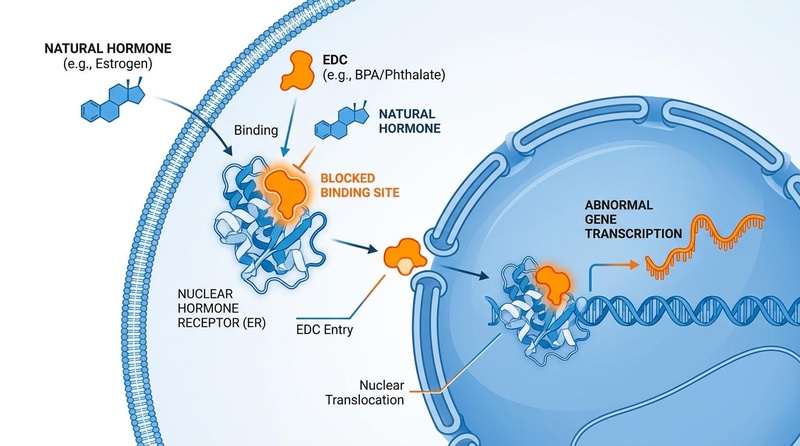
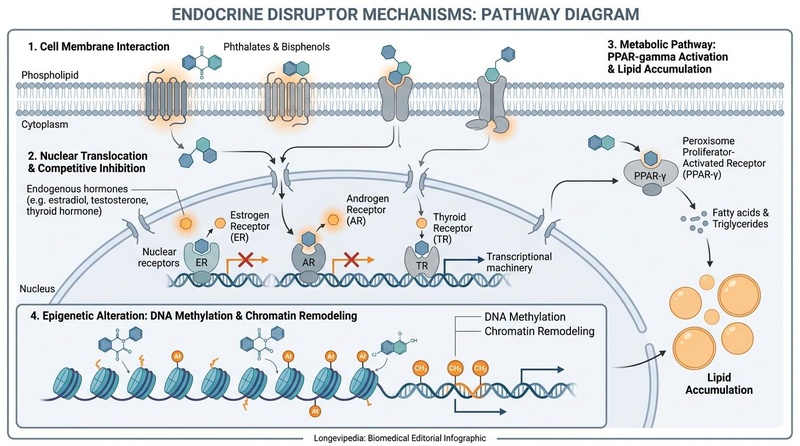
- Hormone Receptor Interaction: EDCs can mimic natural hormones and bind to their receptors (e.g., estrogen or androgen receptors), activating or blocking normal hormone signaling.
- Hormone Synthesis and Metabolism Alteration: They can inhibit or enhance the production of hormones, or alter their breakdown and clearance from the body.
- Hormone Transport Interference: EDCs can interfere with the transport of hormones in the blood, reducing their availability to target tissues.
- Signal Transduction Pathway Disruption: They can interfere with the cellular pathways that relay hormone signals.
- Epigenetic Modifications: Some EDCs can alter gene expression without changing the underlying DNA sequence, leading to long-term changes in cell function (see Epigenetic Alterations).
¶ Thyroid Signaling Disruption
Thyroid hormones (thyroxine, ; and triiodothyronine, ) are crucial regulators of metabolic rate, cellular respiration, and child neurodevelopment. EDCs interfere with the Hypothalamus-Pituitary-Thyroid (HPT) axis through several specific pathological pathways [4][5]:
- Inhibition of Iodide Uptake: Compounds such as perchlorate, thiocyanate, and nitrate competitively inhibit the sodium-iodide symporter (NIS), a transmembrane protein on the basolateral membrane of thyroid follicular cells, thereby restricting iodide transport into the thyroid gland and impairing hormone synthesis [4:1].
- Thyroid Peroxidase (TPO) Inhibition: Environmental contaminants such as isoflavones (including high-dose phytoestrogens) and certain organophosphates can directly inhibit TPO, the key enzyme responsible for the oxidation of iodide and iodination of tyrosine residues on thyroglobulin [4:2][6].
- Transport Protein Interference: EDCs like polychlorinated biphenyls (PCBs) and polybrominated diphenyl ethers (PBDEs) share structural similarities with thyroid hormones, allowing them to bind with high affinity to carrier proteins such as transthyretin (TTR), thyroid-binding globulin (TBG), and albumin, displacing endogenous and and accelerating their peripheral clearance [5:1].
- Peripheral Deiodinase and Receptor Dysregulation: EDCs can impair peripheral deiodination (conversion of to active by deiodinases D1, D2, and D3) and directly bind to nuclear thyroid hormone receptors (TR and TR), acting as antagonists that prevent normal genomic transcription required for developmental and metabolic homeostasis [4:3][5:2].
¶ Metabolic Dysfunction & Obesogenic Signaling
Metabolic EDCs, often termed obesogens, alter the systemic regulation of energy homeostasis, adipogenesis, and glucose metabolism through direct receptor interaction and tissue reprogramming [3:1]:
- Adipocyte Differentiation (PPAR Activation): Organotins (such as tributyltin), phthalate metabolites, and bisphenols activate Peroxisome Proliferator-Activated Receptor gamma (PPAR) and Retinoid X Receptors (RXR). This activation programmatically commits multipotent mesenchymal stem cells (MSCs) to the adipocyte lineage, increasing the number (hyperplasia) and size (hypertrophy) of fat cells and favoring ectopic lipid accumulation [3:2].
- Pancreatic -Cell Pathophysiology: Chronic low-dose exposure to bisphenols (BPA, BPS) can overstimulate pancreatic -cells via membrane-bound estrogen receptors (mER), leading to hyperinsulinemia. Over time, this overstimulation exhausts -cells, causing decreased insulin secretion, impaired glucose tolerance, and the development of insulin resistance [7].
- Hepatic and Adipose Insulin Resistance: EDCs disrupt insulin receptor substrate (IRS) signaling pathways. By inducing chronic low-grade tissue inflammation and altering the secretion of key adipokines (such as adiponectin and leptin), EDCs impair glucose transporter-4 (GLUT4) translocation to the cell membrane, promoting systemic insulin resistance and metabolic syndrome [8].
¶ Cellular Longevity & Biological Aging Impacts
Beyond systemic endocrine signaling, EDCs penetrate cellular boundaries to disrupt foundational pathways of biological aging, cellular maintenance, and longevity [9]:
- Mitochondrial Dysfunction and ROS Generation: EDCs accumulate in lipophilic cellular structures like the inner mitochondrial membrane, directly inhibiting complexes of the Electron Transport Chain (ETC). This disruption diminishes ATP synthesis, contributes to Mitochondrial Dysfunction, and induces a massive influx of reactive oxygen species (ROS), which damages mitochondrial DNA (mtDNA) and initiates lipid peroxidation [9:1][8:1].
- Mitophagy and Autophagy Imbalance: Under healthy conditions, damaged mitochondria are selectively degraded via mitophagy. EDCs (such as cadmium, bisphenols, and certain phthalates) suppress mitophagy-regulating pathways (such as PINK1/Parkin) and inhibit lysosomal fusion. This leads to the accumulation of senescent, dysfunctional mitochondria that constantly leak pro-apoptotic signals and inflammatory cellular debris (see Disabled Macroautophagy) [9:2].
- Cellular Senescence and the SASP: Chronic mitochondrial damage and epigenetic alterations induced by EDCs drive cells into an irreversible state of cellular arrest known as Cellular Senescence [9:3]. These senescent cells secrete a potent mix of pro-inflammatory cytokines, chemokines, and extracellular matrix-degrading proteases collectively referred to as the Senescence-Associated Secretory Phenotype (SASP). The local and systemic accumulation of SASP factors accelerates biological aging and impairs tissue regeneration across the cardiovascular, reproductive, and metabolic systems [9:4].
¶ Does It Work? (Evidence Snapshot)
The evidence linking EDC exposure to adverse health outcomes is extensive, drawing from human epidemiological studies, animal models, and in vitro research.
| Outcome | Population / Model | Effect Size / Observation | Certainty |
|---|---|---|---|
| Decreased Sperm Quality | Human males (epidemiological) | Phthalate exposure associated with decreased sperm count and motility; mixtures of naphthalene and DEHP linked to altered semen quality [10][11]. | Moderate |
| Reproductive Toxicity | Female humans (scoping reviews) | Bisphenol S (BPS) linked to female reproductive toxicity [12]. | Low |
| Neurological Health | Human & Animal | Bisphenol S (BPS) associated with neurotoxicity and neurological health issues [9:5]. | Low |
| Thyroid Hormone Disruption | Human & Animal (systematic reviews) | Flame retardants (PBDEs, organophosphates) linked to alterations in thyroid hormone homeostasis; triclosan can interfere with thyroid function [4:4][5:3][13]. | Moderate |
| Male Reproductive Dysfunction | Male rats (experimental) | Low-dose mixture of genistein (phytoestrogen) and vinclozolin (antiandrogen) altered sperm counts, motility, and fertility [6:1]. | Moderate |
| Estrogenic/Androgenic Disruption | Human cells, animal models (in vitro/vivo) | Triclosan can interfere with estrogenic (ER) and androgenic (AR) receptors; parabens linked to male infertility and breast cancer due to estrogenic properties [7:1]. | Moderate |
| Metabolic Disruption | Fish (experimental) | Metformin (a pharmaceutical emerging as an environmental contaminant) caused upregulation of vitellogenin in male fish, indicating endocrine disruption, and is hypothesized as a human reproductive toxicant [8:2][14]. | Low |
Certainty grade rubric: High: Multiple RCTs or meta-analysis with consistent effects. Moderate: 1–2 good RCTs or strong cohorts with minor limits. Low: Small, uncontrolled, animal, or mechanistic only.
¶ Who Benefits Most / Least
¶ Benefits Most
- Pregnant individuals and young children: These populations are particularly vulnerable to EDC effects due to critical windows of development when hormonal systems are rapidly maturing [2:1].
- Individuals with pre-existing hormone-sensitive conditions: Such as endometriosis, PCOS, or certain cancers, who may experience exacerbated symptoms from EDC exposure [7:2].
- Those with occupational exposures: Workers in industries involving plastics, pesticides, or chemical manufacturing face higher exposure risks.
¶ Least Benefits
- Individuals with minimal environmental exposure: While complete avoidance is impossible, those already practicing low-exposure lifestyles may see less marginal benefit.
¶ How to Try It (Actionable Protocols)
Reducing EDC exposure primarily involves informed choices in consumer products and lifestyle habits.
¶ Starter Protocol: Everyday Avoidance
- Food & Drink:
- Wash hands before eating to minimize ingestion of EDCs from surfaces [15].
- Switch to glass and stainless steel containers/bottles (rather than plastic or just basic glass or ceramic) for storing and consuming food and beverages, and avoid microwaving food in plastic containers [15:1].
- Reduce consumption of canned foods or choose those labeled "BPA-free" [2:2].
- Trim fat from meat and skin from poultry, as some EDCs accumulate in fatty tissues [2:3].
- Filter drinking water to reduce exposure to waterborne EDCs like PFAS and metformin [2:4].
- Personal Care & Cosmetics:
- Limit use of personal care products containing parabens, phthalates, and triclosan; check ingredient lists [15:2]. Look for "phthalate-free" or "paraben-free" labels.
- Household & Everyday Items:
- Avoid handling thermal paper receipts (or wash hands immediately after contact if handling is unavoidable), as thermal receipts contain high concentrations of free BPA or BPS that are readily absorbed transdermally [16].
- Choose natural cleaning products to avoid flame retardants and other chemicals in conventional cleaners [2:5].
- Minimize dust accumulation and implement HEPA air/dust filtration to capture airborne and dust-bound EDCs (like flame retardants and phthalates) that easily settle in household environments [5:4].
¶ Alternatives
If complete avoidance is challenging, focus on reducing exposure where feasible and prioritizing avoidance during critical life stages like pregnancy and early childhood.
¶ Safety, Interactions, Red Flags
- Cumulative Exposure: The primary safety concern with EDCs is chronic, low-level exposure to multiple chemicals, which can have cumulative and synergistic effects that are difficult to predict or assess individually [3:3].
- Non-Monotonic Dose Responses: EDCs can exhibit non-linear or non-monotonic dose responses, meaning that low doses may sometimes have more significant effects than higher doses, challenging traditional toxicology assumptions [3:4].
- Interactions: EDCs can interact with various physiological systems, not just the endocrine system, making their full impact complex.
¶ Tracking & What “Good” Looks Like
Tracking EDC exposure directly is challenging for individuals without specialized testing. However, indirect indicators related to hormonal health can be monitored.
- Biomarkers: While not direct measures of EDC levels, tracking hormone levels (e.g., thyroid hormones, reproductive hormones) can provide insight into potential endocrine system function.
- Subjective Metrics: Consistent improvements in reproductive health, metabolic markers, or neurological function may indirectly suggest reduced EDC impact.
- Time-to-Benefit: Reducing exposure is a long-term strategy, and significant benefits may accrue over months to years.
¶ Common Mistakes & Myths
- Myth: "Small exposures don't matter." Reality: EDCs often exhibit effects at very low doses, and cumulative exposure to mixtures of EDCs can be significant [3:5].
- Myth: "Only synthetic chemicals are EDCs." Reality: While many EDCs are synthetic, some natural compounds (e.g., phytoestrogens like genistein) can also act as endocrine disruptors [6:2].
- Myth: "BPA-free products are completely safe." Reality: Many BPA-free plastics substitute BPA with other bisphenols like BPS or BPF, which may have similar endocrine-disrupting properties [9:6][16:1].
¶ Decision Tree (Text-Based)
IF you are pregnant or planning pregnancy:
    THEN prioritize all avoidance strategies.
ELSE IF you have hormone-sensitive health conditions:
    THEN focus on consistent avoidance in key areas (diet, personal care).
ELSE (for general health):
    THEN implement practical and sustainable avoidance strategies.
¶ FAQs
Q: Are EDCs only a concern for women's health?
A: No, EDCs affect both male and female reproductive health, as well as neurological, metabolic, and immune systems in all individuals [11:1][12:1][9:7].
Q: Can EDCs be completely avoided?
A: Complete avoidance is challenging due to their ubiquity. The goal is to make informed choices to significantly reduce exposure and mitigate risk [2:6].
Q: How quickly do EDCs leave the body?
A: This varies widely depending on the specific chemical. Some EDCs are non-persistent and are metabolized and excreted relatively quickly, while others can accumulate in the body over time [10:1].
Q: What are the most important EDCs to avoid?
A: Phthalates, bisphenols (BPA, BPS), parabens, triclosan, and Microplastics [2:7] are among the most commonly cited EDCs with widespread exposure and documented health effects [2:8].
¶ Glossary
- Endocrine System: The system of glands and hormones that regulates metabolism, growth, development, tissue function, reproduction, sleep, and mood.
- Exogenous: Originating from outside the body.
- Hormone Receptor: A protein molecule that binds to a specific hormone, initiating a cellular response.
- Non-monotonic Dose Response: A dose-response curve where the effect does not consistently increase or decrease with increasing dose, often showing effects at low doses that are absent at higher doses.
- Phytoestrogens: Plant-derived compounds that can bind to estrogen receptors and exert estrogen-like effects.
¶ Methods (Transparency)
This deep-dive guide was developed using a comprehensive literature search focusing on systematic reviews, meta-analyses, and scientific statements from reputable sources such as PubMed, PMC, and Endocrine Society guidelines. Key search terms included "endocrine disrupting chemicals health effects systematic review," "phthalates exposure semen quality," "flame retardants endocrine disruption," "parabens triclosan endocrine disruption mechanisms," and "endocrine disruptors avoidance strategies."
¶ References
¶ Update Log
- 2024-06-12: Initial creation of the deep-dive guide on Endocrine Disruptors.
Gore, A. C., et al. (2015). Endocrine-Disrupting Chemicals: An Endocrine Society Scientific Statement. Endocrine Reviews, 36(6), E1–E15. https://pmc.ncbi.nlm.nih.gov/articles/PMC2726844/ ↩︎
National Institute of Environmental Health Sciences. (n.d.). Endocrine Disruptors. https://www.niehs.nih.gov/health/topics/agents/endocrine ↩︎ ↩︎ ↩︎ ↩︎ ↩︎ ↩︎ ↩︎ ↩︎ ↩︎
Diamanti-Kandarakis, E., et al. (2009). Endocrine-Disrupting Chemicals: An Endocrine Society Scientific Statement. Endocrine Reviews, 30(4), 293–342. https://pmc.ncbi.nlm.nih.gov/articles/PMC2726844/ ↩︎ ↩︎ ↩︎ ↩︎ ↩︎ ↩︎
Ding, N., et al. (2021). Endocrine disrupting potential of replacement flame retardants – Review of current knowledge for nuclear receptors associated with reproductive outcomes. Environment International, 151, 106461. https://pubmed.ncbi.nlm.nih.gov/33848905/ ↩︎ ↩︎ ↩︎ ↩︎ ↩︎
Hao, S., et al. (2024). A Review of the Association between Exposure to Flame Retardants and Thyroid Function. International Journal of Environmental Research and Public Health, 19(9), 5634. https://pmc.ncbi.nlm.nih.gov/articles/PMC11201907/ ↩︎ ↩︎ ↩︎ ↩︎ ↩︎
Auger, J., et al. (2009). Chronic Dietary Exposure to a Low-Dose Mixture of Genistein and Vinclozolin Modifies the Reproductive Axis, Testis Transcriptome, and Fertility. Environmental Health Perspectives, 117(8), 1272–1279. https://pubmed.ncbi.nlm.nih.gov/19672408/ ↩︎ ↩︎ ↩︎
Srnovršnik, T., et al. (2023). Polycystic Ovary Syndrome and Endocrine Disruptors (Bisphenols, Parabens, and Triclosan)—A Systematic Review. Life, 13(1), 138. https://pmc.ncbi.nlm.nih.gov/articles/PMC9864804/ ↩︎ ↩︎ ↩︎
Niemuth, N. J., et al. (2014). Metformin Exposure at Environmentally Relevant Concentrations Causes Potential Endocrine Disruption in Adult Male Fish. Environmental Toxicology and Chemistry, 34(2), 291–296. https://pubmed.ncbi.nlm.nih.gov/25358780/ ↩︎ ↩︎ ↩︎
Zhang, X., et al. (2026). Bisphenol S and Neurological Health: An Integrated Overview of Neurotoxicity and Underlying Mechanisms. Molecular Neurobiology. https://pubmed.ncbi.nlm.nih.gov/41790409/ ↩︎ ↩︎ ↩︎ ↩︎ ↩︎ ↩︎ ↩︎ ↩︎
Dhar, S., et al. (2026). Phthalates as the silent saboteurs of male fertility via changes in semen quality: a systematic review. Reproductive Biology and Endocrinology, 24(1), 44. https://pubmed.ncbi.nlm.nih.gov/41803857/ ↩︎ ↩︎
Deng, Q., et al. (2023). Do phthalates and their metabolites cause poor semen quality? A systematic review and meta-analysis of epidemiological studies on risk of decline in sperm quality. Ecotoxicology and Environmental Safety, 250, 114486. https://pubmed.ncbi.nlm.nih.gov/36504299/ ↩︎ ↩︎
Andrews, F. V., et al. (2026). Bisphenol S and female reproductive toxicity: a scoping review of human studies. Journal of Exposure Science & Environmental Epidemiology. https://pubmed.ncbi.nlm.nih.gov/41963602/ ↩︎ ↩︎
Vandenberg, L. N., et al. (2014). Should oral gavage be abandoned in toxicity testing of endocrine disruptors? Environmental Health, 13(1), 46. https://pubmed.ncbi.nlm.nih.gov/24961440/ ↩︎
Tavlo, M., et al. (2022). Hypothesis: Metformin is a potential reproductive toxicant. Frontiers in Endocrinology, 13, 1000872. https://pubmed.ncbi.nlm.nih.gov/36339411/ ↩︎
Endocrine Society. (n.d.). Endocrine-Disrupting Chemicals (EDCs): Precautionary Steps. https://www.endocrine.org/patient-engagement/endocrine-library/edcs ↩︎ ↩︎ ↩︎
Molina-Molina, J. M., et al. (2019). Determination of bisphenol A and bisphenol S concentrations and assessment of estrogen- and anti-androgen-like activities in thermal paper receipts from Brazil, France, and Spain. Environmental Research, 170, 406–415. https://pubmed.ncbi.nlm.nih.gov/30623888/ ↩︎ ↩︎