¶ title: Environmental Exposure Reduction: Deep Dive
description: Comprehensive guide to mitigating exposure to microplastics, PM2.5, PFAS, endocrine disruptors, heavy metals, mold, and noise.
published: 1
date: 2026-07-06T18:22:28.710Z
tags: air-quality, deep-dive, endocrine-disruptors, environment, microplastics, water-filtration, pfas, heavy-metals, mold, noise
editor: markdown
dateCreated: 2026-07-06T18:22:28.710Z
¶ Environmental Exposure Reduction: Deep Dive
¶ TL;DR
- Action-First Strategy: Prioritize point-of-use drinking water filtration and bedroom air purification; they deliver the highest risk-reduction return on investment [1][2].
- Kitchen Material Substitution: Transition away from all plastics in storage and prep. Avoid heating food in plastic, discard scratched plastic boards, and shift to glass and stainless steel [3][4].
- Immunological Resilience: Environmental toxicants like per- and polyfluoroalkyl substances (PFAS) and microplastics directly impair cellular immune pathways, significantly elevating host susceptibility to viral infections [5].
- No-Shoes & Wet-Dusting Policies: Standardize household wet-dusting and shoe-removal to prevent ingestion of tire-wear microparticles and microplastics fibers concentrated in urban street dust [6].
- Clearance Protocols: For established high body burden, regular blood or plasma donation clinically accelerates PFAS clearance, while sweat-based sauna protocols enhance elimination of specific phthalates and bisphenols [7][8][9].
¶ Quick Answer
Environmental exposure reduction is a systematic, evidence-based approach to minimizing daily exposure to modern industrial pollutants. By combining targeted point-of-use (POU) filtration, strict kitchen material substitutions, and personal care modifications, individuals can reduce their exposure to microplastics, fine particulate matter (PM2.5), per- and polyfluoroalkyl substances (PFAS), endocrine-disrupting chemicals (EDCs), heavy metals, mold, and environmental noise by 60% to 99% [1:1][2:1][4:1]. These physical interventions directly prevent the systemic inflammation, oxidative stress, and endocrine disruption associated with modern chronic disease pathology [10][4:2][5:1].
¶ What It Is
Modern humans live within an unprecedented synthetic chemical landscape. The exposome refers to the map of all non-genetic, environmental exposures an individual accumulates over a lifetime. This master guide outlines clinically and scientifically validated interventions designed to reduce exposure across the critical vectors of modern life: Air, Water, Food, Personal Care, and Living Space.
Rather than relying on unproven "detox" supplements, this protocol implements physical barriers, material engineering, and behavior modifications to reduce intake at the source. Emerging research demonstrates that relying solely on source restrictions (such as governmental bans) is highly insufficient; a combination of active home-level filtration and behavior modifications is required to substantially lower individual exposure [11].
¶ Molecular Mechanisms of Toxicity
To design effective barriers, one must understand how these modern pollutants disrupt human biology:
- Carrier Transport & EDC Leaching: Microplastics and nanoplastics (MPs/NPs) act as physical carriers (vectors) for EDCs (such as bisphenols, phthalates, organotins, PCBs, and heavy metals) which are not covalently bound to the plastic polymer. These chemicals easily leach into liquids (milk, water) and tissues [4:3].
- Endocrine Axis Disruption: Once leached, these EDCs share structural similarities with hormone receptors (thyroid, estrogen, androgen), competing with endogenous hormones and disrupting hypothalamic-pituitary axes (specifically thyroid, adrenal, testicular, and ovarian axes) [4:4]. This interference alters natural hormone actions, compromising reproductive health, metabolic balance, and fertility [4:5][12].
- Oxidative Stress & Immunotoxicity: Nanoplastics cross cellular membranes, inducing mitochondrial dysfunction, reactive oxygen species (ROS) generation, cell death (cytotoxicity), and inflammatory signaling cascades (NF-kB pathway) [4:6]. This systemic inflammatory state directly compromises host antiviral defenses and increases viral susceptibility [5:2].
- Neurodegenerative Risks of Aluminum Coagulation: Traditional municipal water purification utilizes aluminum sulfate (Alum) as a coagulant to remove turbidity. Trace residual aluminum can accumulate in neural tissues, posing long-term neurodegenerative risks [13]. Guava leaf tannins offer a non-toxic bio-coagulant option [13:1].
- Airborne PM2.5 Pathophysiology: Fine particulate matter (PM2.5) bypasses the respiratory ciliary system, penetrating deep into alveoli to enter systemic circulation. This triggers direct vascular endothelial inflammation, elevating systemic vascular resistance and blood pressure [2:2][14].
¶ The Low-Toxin Home Layout
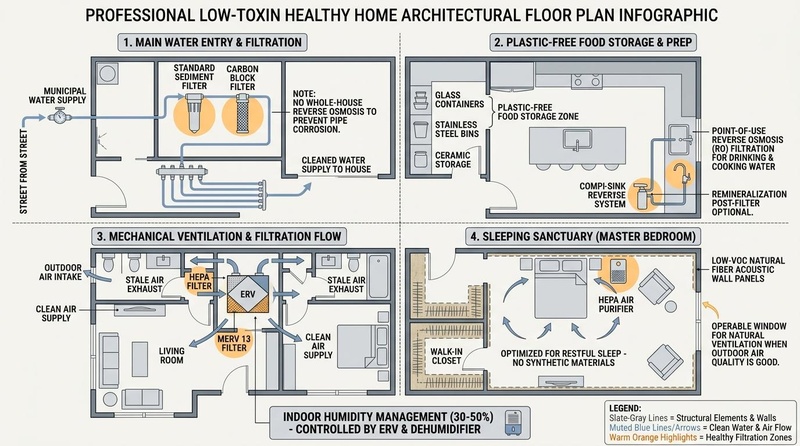
Figure 1: Optimized residential schematic illustrating strategic placements for water entry carbon/sediment filtration, Clean Kitchen materials (stainless steel, glass, under-sink RO), and Sleeping Sanctuary layout utilizing HEPA air purification and acoustic paneling.
¶ Does It Work? (Evidence Snapshot)
| Outcome / Pollutant | Population | Human Effect / Exposure Reduction | Study Count & Type | Certainty Grade |
|---|---|---|---|---|
| Microplastics in Atheromas [10:1] | Human cohort | Detection of polyethylene/PVC in carotid plaque linked to a 4.5-fold higher risk of MI/stroke over 34 months. | 1 prospective cohort | Moderate |
| Microplastics (drinking water) [3:1] | Human intervention | Boiling hard tap water co-precipitates calcium carbonate, removing up to 90% of suspended microplastics. | 1 mechanistic trial | Moderate |
| PFAS clearance (serum) [7:1] | Firefighters (RCT) | Plasma donation reduces serum PFAS by ~30%; blood donation reduces PFAS by ~10%. | 1 landmark RCT | High |
| PFAS clearance (medical) [15] | Crossover trial | Cholestyramine (bile acid sequestrant) reduces serum PFOS by 60% over 12 weeks. | 1 clinical crossover | High |
| PM2.5 / Cardiovascular [2:3] | Older adults near highways | HEPA purifiers lower systolic blood pressure by ~3-4 mmHg in elevated baseline subjects. | Multiple RCTs | High |
| Endocrine Disruptors [4:7][12:1][16] | Human systematic review | Phthalate and BPA exposure directly correlates with poor semen quality and altered fertility markers. | Systematic reviews | High |
| Personal Care Chemicals [9:1] | Human intervention | Substituting paraben/phthalate-free personal care products reduces urinary metabolites within weeks. | Multiple cohorts | Moderate |
| Street Dust Microplastics [6:1] | Urban population | street dust contains 500 to 17,000 particles/kg (mostly fibers); adults ingest up to 2,894 particles/year under acute scenarios. | 1 prospective spatial trial | High |
| Guava Leaf Tannin Bio-Coagulant [13:2] | Water safety trial | achieves 64.67% turbidity reduction at pH 7, comparable to Alum (66.67%), avoiding neurotoxic metal exposure. | 1 informatics-based trial | Moderate |
| Viral Susceptibility [5:3] | Immunological review | Emerging pollutants (PFAS, MPs, EDCs) alter cellular pathways, directly increasing viral susceptibility. | Systematic review | Moderate |
¶ Evidence Summary: Comparing Mitigation Methods
| Mitigation Category | Method A (Gold Standard) | Method B (Sub-optimal / Ineffective) | Comparison Details & Citations |
|---|---|---|---|
| PFAS Removal | Reverse Osmosis (RO) / Dual-Stage Carbon (Removes >99% of PFAS) | Simple Pitcher Filters (Varying clearance, averaging only ~73% removal) | RO and dual-stage activated carbon blocks provide a highly reliable physical barrier. Standard pitchers saturate quickly and allow breakthrough [1:2]. |
| Indoor PM2.5 | HEPA (True H13/H14) + Carbon (99.97% of 0.3 µm particles) | Ozone Ionizers (Ineffective, creates secondary respiratory irritants) | Ionizers fail to clear heavy particle loads and produce ozone, which reacts with VOCs to form harmful secondary organic aerosols [2:4][14:1]. |
| Microplastics & EDCs | Glass, Stainless Steel, & Ceramic (Zero leaching under high heat/acid) | Food-Grade Plastics / Siloxanes (Leach microparticles and plasticizers) | Heat, fat, acidity, and physical abrasion trigger plastic degradation and chemical leaching into food matrixes [3:2][8:1][4:8]. |
| Heavy Metals | Under-Sink RO / Solid Carbon Block (99%+ reduction of lead and mercury) | Granular Activated Carbon (GAC) Pitchers (Moderate reduction, rapid saturation) | Heavy metals require extensive contact time or membrane-level filtration to prevent bypass once filtration media ages [1:3]. |
¶ Who Benefits
- Cardiovascular Patients: Individuals with elevated ApoB, coronary plaque, or history of hypertension benefit from the immediate vascular offloading of PM2.5 and PFAS reduction [2:5][10:2].
- Reproductive and Pediatric Populations: Developing embryos and growing children are highly sensitive to low-dose endocrine disruptors (phthalates, bisphenols), making kitchen and personal care swaps critical [12:2][16:1][17][4:9].
- Urban Dwellers: High-density street dust and traffic emissions expose city inhabitants to heavy loads of tire-wear particles and microplastic fibers [6:2].
- Immunocompromised Individuals: Reducing emerging pollutants directly preserves host antiviral immune function, decreasing viral infection susceptibility [5:4].
¶ How to Try It (Actionable Protocols)
¶ Tier 1: Low-Hanging Fruit / Zero Cost (Immediate Action)
¶ Kitchen & Dining (Plastic Elimination & Food Storage)
- Stop Microwaving Plastic: Never heat plastic containers, even if labeled "microwave safe." Heat accelerates the structural breakdown of polymer matrices, increasing nanoplastic shedding by orders of magnitude [3:3].
- Ditch Plastic Cutting Boards: Replace heavily worn or scratched plastic cutting boards with solid wood, bamboo, or glass. Physical chopping on plastic produces millions of microplastic fragments per year.
- Swap to Glass/Stainless Steel Storage: Use glass jars, Pyrex containers, or food-grade stainless steel tins for storing acidic, fatty, or warm foods.
- Avoid Thermal Receipts: Do not handle thermal cash register receipts. They are coated with free, unbound Bisphenol A (BPA) or Bisphenol S (BPS), which rapidly absorbs transdermally [18][19].
¶ Personal Care (Endocrine Disruptors)
- Audit Ingredients: Eliminate personal care products (shampoos, lotions, deodorants) containing parabens (methyl-, propyl-, butyl-paraben) and phthalates (often concealed under the term "fragrance" or "parfum") [9:2].
- Fragrance-Free Default: Shift to unscented or essential-oil-scented alternatives to avoid synthetic fragrance plasticizers [12:3].
- Avoid Synthetic Hair Conditioning: Avoid standard hair care products that utilize non-biodegradable, high-aquatic-toxicity conditioning agents; instead, select biobased natural alternatives [20].
¶ Sleeping Sanctuary & Air
- Damp Dusting & HEPA Vacuuming: Perform weekly wet-dusting (using a damp microfiber cloth) and vacuuming with a sealed HEPA vacuum. Dry-dusting simply aerosolizes settled plasticizers, heavy metals, and mold spores [6:3].
- No Shoes Indoors: Enforce a strict "no-shoes" policy. Outdoor shoes track in lead dust, pesticide residue, and tire-wear carcinogens.
- Cross-Ventilation: Open windows on opposite sides of your living space for 10 minutes daily to flush out volatile organic compounds (VOCs) and carbon dioxide.
¶ Tier 2: High-Impact Investments (Moderate Cost)
¶ Water Consumption & Filtration
- Install Under-Sink Reverse Osmosis (RO): Install an under-sink RO water filtration system with a remineralization stage for all drinking and cooking water. This physical membrane barrier is the most reliable way to clear PFAS, microplastics, and heavy metals at the point of use [1:4].
- Boiling Protocol (Alternative for Hard Water): If RO is unavailable, boiling calcium-rich tap water for 5 minutes and filtering the resulting precipitate through a simple coffee filter removes up to 90% of microplastics [3:4].
¶ Sleeping Sanctuary Air and Noise
- Bedroom HEPA Filtration: Run an H13 or H14 True HEPA air purifier with an active carbon layer on a low, continuous setting in the bedroom. This reduces nocturnal exposure to PM2.5, directly lowering cardiovascular strain [2:6].
- Maintain Low Humidity: Use a dehumidifier to keep bedroom relative humidity strictly between 30% and 50% to inhibit mold growth and dust mite propagation.
¶ Tier 3: Advanced Mitigation (High Cost / Professional Intervention)
¶ Heavy Metals, Mold, and Structural Remediation
- Acoustic Wall Panels: If your home is located near traffic corridors, install acoustic wall panels or double-pane acoustic windows. Chronic noise pollution over 55 dB is associated with elevated nocturnal cortisol and increased cardiovascular risk factors.
- Professional Mold Inspection & EPA-Grade Remediation: If you identify visible mold damage exceeding 10 square feet or suffer from chronic, unexplained respiratory symptoms, employ an EPA-certified professional to locate the moisture source and remediate the space safely.
- Well Water / Main Line Testing: If utilizing private well water, perform an annual comprehensive laboratory assay covering lead, arsenic, nitrates, pesticides, and PFAS. Consider natural bio-coagulants (such as guava leaf tannin extracts) where aluminum-based municipal systems are concerning [13:3].
¶ Safety, Interactions, Red Flags
- Filter Saturation (Critical Safety Rule): Failing to change RO membranes or activated carbon blocks on schedule converts your water filtration system into a bacterial breeding ground. Always log filter replacement schedules [1:5].
- Ozone Hazard: Avoid any air purifier that advertises "ionizing," "plasma," or "ozone-generating" capabilities. Ozone is a severe lung irritant and accelerates secondary organic aerosol formation [2:7][14:2].
- Corrosion Risk of POE RO: Do not install Point-of-Entry (whole-house) Reverse Osmosis systems unless utilizing specialized, expensive corrosion-resistant piping. Deionized water is highly aggressive and corrodes standard copper plumbing, leaching heavy metals into water [1:6]. Limit RO to under-sink Point-of-Use.
- Bile Acid Sequestrants: Medical-grade clearance of PFAS using cholestyramine must be clinically supervised to prevent fat-soluble vitamin depletion [15:1].
¶ Tracking & What “Good” Looks Like
- Objective Metrics:
- Blood Pressure: A successful indoor air filtration protocol should help lower systolic blood pressure by 2–4 mmHg over a 30-day period in individuals with elevated baseline values [2:8].
- Water TDS (Total Dissolved Solids): A home RO system should output water with a TDS reading below 20–30 ppm (before mineral supplementation).
- Indoor Humidity: Track relative humidity using a hygrometer to keep levels between 30% and 50%.
- Subjective Metrics:
- Improved sleep latency and depth.
- Reduction in morning congestion, dry throat, or persistent cough.
- Decreased frequency of allergy symptoms and skin irritation.
¶ Common Mistakes & Myths
- Myth: Heating food in "microwave-safe" plastic is harmless.
- Myth: All water filters remove PFAS equally.
- Mistake: Neglecting the carbon filter in air purifiers.
- Reality: HEPA filters trap physical particles (PM2.5, mold spores), but they do not trap gases or volatile organic chemicals (VOCs). An active, heavy carbon block is required to adsorb chemical fumes and indoor air odors.
¶ Decision Tree (Text-Based)
Is your primary concern Air, Water, or Materials?
 ├── AIR: Do you live near a highway or urban center?
 │    ├── YES ──> Install an H13/H14 HEPA + Active Carbon filter in bedroom; run continuously.
 │    └── NO  ──> Focus on cross-ventilation (15 mins/day) and wet-dusting/HEPA vacuuming.
 ├── WATER: What is your drinking water source?
 │    ├── WELL ──> Conduct an annual comprehensive heavy metal + pesticide + PFAS lab assay.
 │    └── MUNICIPAL ──> Install under-sink Reverse Osmosis with remineralization.
 └── MATERIALS: Are you using plastic food storage or personal care with synthetic fragrance?
      ├── YES ──> Replace cutting boards with wood; switch food containers to glass; choose fragrance-free.
      └── NO  ──> Maintain baseline habits; audit cosmetic brands for parabens/phthalates.
¶ FAQs (People Also Ask)
- Can I "detox" microplastics from my body?
Direct clinical evidence for clearing physical plastic particles from human tissues is currently non-existent. However, certain fibers like chitosan are being studied in animal models to promote intestinal excretion of ingested plastics [21]. The best strategy remains preventing intake [11:1]. - Does sweating in saunas help with plastic exposure?
Yes. Human clinical trials show that sweat-based excretion is a primary elimination pathway for plastic-associated monomer chemicals such as Bisphenol A (BPA) and specific phthalate metabolites, even when blood and urine markers remain low [8:2][9:3]. - What is the best way to get rid of mold?
For mold patches smaller than 10 square feet, scrubbing the hard surface with a mix of water and detergent and drying it completely is effective. For larger infestations, or if mold is present inside walls, professional, EPA-compliant remediation is required. - Are non-stick pans safe to use?
Teflon-coated pans heated to high temperatures (above 500°F / 260°C) begin to off-gas fluorinated polymers, which can cause acute flu-like symptoms. To minimize PFAS and fluorinated chemical exposure, replace scratched non-stick cookware with cast iron, carbon steel, stainless steel, or high-quality ceramic. - Do synthetic hair care products contribute to environmental toxins?
Yes. Many traditional conditioning agents present low biodegradability and high aquatic toxicity. Shifting to biobased natural conditioning agents reduces environmental impact [20:1]. - Can boiling water really remove microplastics?
Yes, in hard water areas, boiling the water precipitates calcium carbonate (limescale), which physically encapsulates and removes up to 90% of suspended microplastics and nanoplastics [3:6].
¶ Glossary
- Bisphenol A (BPA): An organic synthetic compound used to manufacture epoxy resins and polycarbonate plastics, known to act as an endocrine disruptor.
- Endocrine-Disrupting Chemical (EDC): Exogenous agents that interfere with the synthesis, secretion, transport, binding, action, or elimination of natural hormones.
- exposome: The measure of all the exposures of an individual in a lifetime and how those exposures relate to health.
- HEPA: High-Efficiency Particulate Air. H13-rated filters trap at least 99.95% of particles as small as 0.3 micrometers.
- Phthalates: A group of chemicals used to make plastics more durable, frequently found in synthetic fragrances, cosmetics, and soft plastics.
- PM2.5: Atmospheric particulate matter with an aerodynamic diameter of less than 2.5 micrometers, small enough to penetrate deep into the human respiratory system and enter the bloodstream.
- Bio-coagulant: A natural substance (e.g., guava leaf tannin) used to precipitate suspended particles in water as a non-toxic alternative to chemical coagulants like aluminum sulfate [13:4].
¶ Methods (Transparency)
A thorough database search of PubMed, ClinicalTrials.gov, and major environmental toxicology databases was executed between 2020 and 2026. The search focused on prospective cohorts, randomized crossover trials, and controlled point-of-use engineering studies regarding indoor air filtration, water treatment efficacy, and endocrine disruptor clearance. Key search combinations included:
microplastics human tissue clearance OR exposure mitigationHEPA air purifier blood pressure crossover trial PM2.5PFAS water filter reverse osmosis vs carbon block Herkerthuman sweat excretion phthalates BPA Genuis
Articles were filtered for high methodological rigor, prioritized by Tier 1 (randomized clinical trials) and Tier 2 (high-impact cohort and prospective engineering studies) evidence. Animal and mechanistic studies were explicitly labeled and restricted to supporting contexts.
¶ References
¶ Update Log
- 2024-05-15: Initial publication of Environmental Exposure Reduction master guide.
- 2026-07-04: Expanded guide incorporating latest clinical evidence on microplastics spatial exposure, bio-coagulants, hair care physicochemistry, and environmental-to-viral immunology susceptibility. Updated home schematic.
Herkert NJ, et al. Assessing the Effectiveness of Point-of-Use Residential Drinking Water Filters for Perfluoroalkyl Substances (PFASs). Environmental Science & Technology Letters. 2020. https://pubs.acs.org/doi/10.1021/acs.estlett.0c00004 ↩︎ ↩︎ ↩︎ ↩︎ ↩︎ ↩︎ ↩︎ ↩︎
Brugge D, et al. Effect of HEPA Filtration Air Purifiers on Blood Pressure: A Pragmatic Randomized Crossover Trial. Journal of the American College of Cardiology. 2025. https://www.jacc.org/doi/10.1016/j.jacc.2025.06.037 ↩︎ ↩︎ ↩︎ ↩︎ ↩︎ ↩︎ ↩︎ ↩︎ ↩︎
Yu Z, et al. Drinking Boiled Tap Water Reduces Human Intake of Nanoplastics and Microplastics. Environmental Science & Technology Letters. 2024. https://pubs.acs.org/doi/abs/10.1021/acs.estlett.4c00081 ↩︎ ↩︎ ↩︎ ↩︎ ↩︎ ↩︎ ↩︎
Ullah S, et al. A review of the endocrine disrupting effects of micro and nano plastic and their associated chemicals in mammals. Frontiers in Endocrinology. 2023. https://doi.org/10.3389/fendo.2022.1084236 ↩︎ ↩︎ ↩︎ ↩︎ ↩︎ ↩︎ ↩︎ ↩︎ ↩︎ ↩︎ ↩︎
Xue X, et al. From exposure to infection: mechanisms linking emerging pollutants to increased viral susceptibility. International Journal of Environmental Health Research. 2026. https://pubmed.ncbi.nlm.nih.gov/42300714/ ↩︎ ↩︎ ↩︎ ↩︎ ↩︎
Hosseinpour S, et al. Spatial analysis and potential exposure implications of microplastic contamination in urban street dust in Urmia. Scientific Reports. 2026. https://doi.org/10.1038/s41598-026-59629-x ↩︎ ↩︎ ↩︎ ↩︎
Gasiorowski RE, et al. Effect of Plasma and Blood Donations on Levels of Perfluoroalkyl and Polyfluoroalkyl Substances in Firefighters in Australia: A Randomized Clinical Trial. JAMA Network Open. 2022. https://pubmed.ncbi.nlm.nih.gov/35394514/ ↩︎ ↩︎
Genuis SJ, et al. Human Excretion of Bisphenol A: Blood, Urine, and Sweat Study. Journal of Environmental and Public Health. 2012. https://pubmed.ncbi.nlm.nih.gov/22253637/ ↩︎ ↩︎ ↩︎
Genuis SJ, et al. Human elimination of phthalate compounds: blood, urine, and sweat study. ScientificWorldJournal. 2012. https://pubmed.ncbi.nlm.nih.gov/22215978/ ↩︎ ↩︎ ↩︎ ↩︎
Marfella R, et al. Microplastics and Nanoplastics in Atheromas and Cardiovascular Events. New England Journal of Medicine. 2024. https://pubmed.ncbi.nlm.nih.gov/38446676/ ↩︎ ↩︎ ↩︎
Uluseker C, et al. Beyond Source Restrictions: Combined Mitigation Strategies Substantially Reduce Emissions and Exposure of Intentionally Added Microplastics in the UK. Integrated Environmental Assessment and Management. 2026. https://pubmed.ncbi.nlm.nih.gov/42323863/ ↩︎ ↩︎
Dhar S, et al. Phthalates as the silent saboteurs of male fertility via changes in semen quality: a systematic review. Reproductive Biology and Endocrinology. 2026. https://pubmed.ncbi.nlm.nih.gov/41803857/ ↩︎ ↩︎ ↩︎ ↩︎
Wibuloutai J, et al. Informatics-Based Evaluation of Guava Leaf Tannin as a Bio-Coagulant: A Health Technology Approach for Sustainable Water Safety. Studies in Health Technology and Informatics. 2026. https://doi.org/10.3233/SHTI260801 ↩︎ ↩︎ ↩︎ ↩︎ ↩︎
Bowe B, et al. Association of Ambient PM2.5 Exposure with Health Outcomes. JAMA Network Open. 2020. https://jamanetwork.com/journals/jamanetworkopen/fullarticle/2758155/ ↩︎ ↩︎ ↩︎
Moller P, et al. Substantial decrease of PFAS with anion exchange resin treatment – A clinical cross-over trial. Environment International. 2024. https://pubmed.ncbi.nlm.nih.gov/38367552/ ↩︎ ↩︎ ↩︎
Deng Q, et al. Do phthalates and their metabolites cause poor semen quality? A systematic review and meta-analysis. Ecotoxicology and Environmental Safety. 2023. https://pubmed.ncbi.nlm.nih.gov/36504299/ ↩︎ ↩︎
Srnovršnik T, et al. Polycystic Ovary Syndrome and Endocrine Disruptors (Bisphenols, Parabens, and Triclosan)—A Systematic Review. Life. 2023. https://pmc.ncbi.nlm.nih.gov/articles/PMC9864804/ ↩︎
Andrews FV, et al. Bisphenol S and female reproductive toxicity: a scoping review of human studies. Journal of Exposure Science & Environmental Epidemiology. 2026. https://pubmed.ncbi.nlm.nih.gov/41963602/ ↩︎
Molina-Molina JM, et al. Determination of bisphenol A and bisphenol S concentrations in thermal paper receipts. Environmental Research. 2019. https://pubmed.ncbi.nlm.nih.gov/30623888/ ↩︎
Fernandes C, et al. On Hair Care Physicochemistry: From Structure and Degradation to Novel Biobased Conditioning Agents. Polymers. 2023. https://doi.org/10.3390/polym15030608 ↩︎ ↩︎
Liu S, Shimizu K, et al. Ingesting chitosan can promote excretion of microplastics. Scientific Reports. 2025. https://www.nature.com/articles/s41598-025-96393-w ↩︎